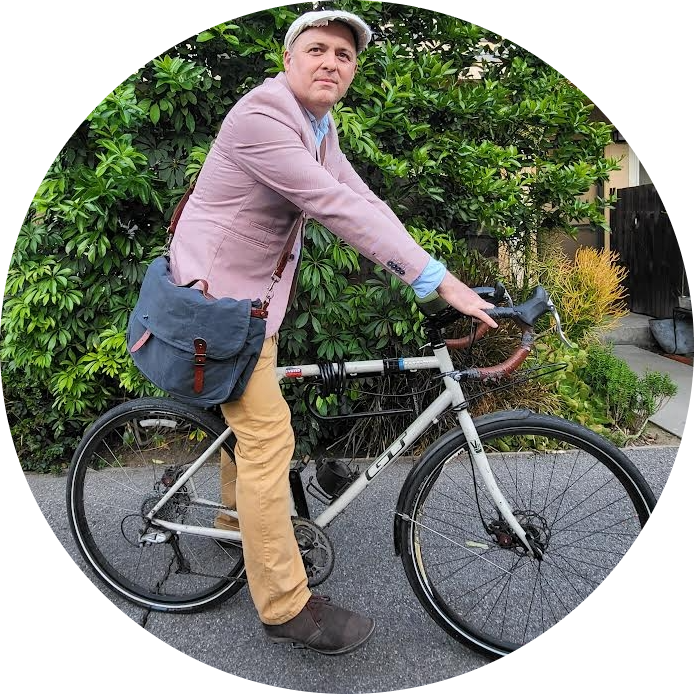
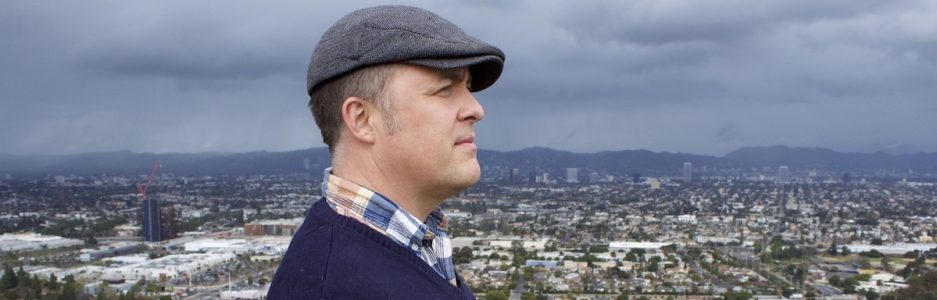
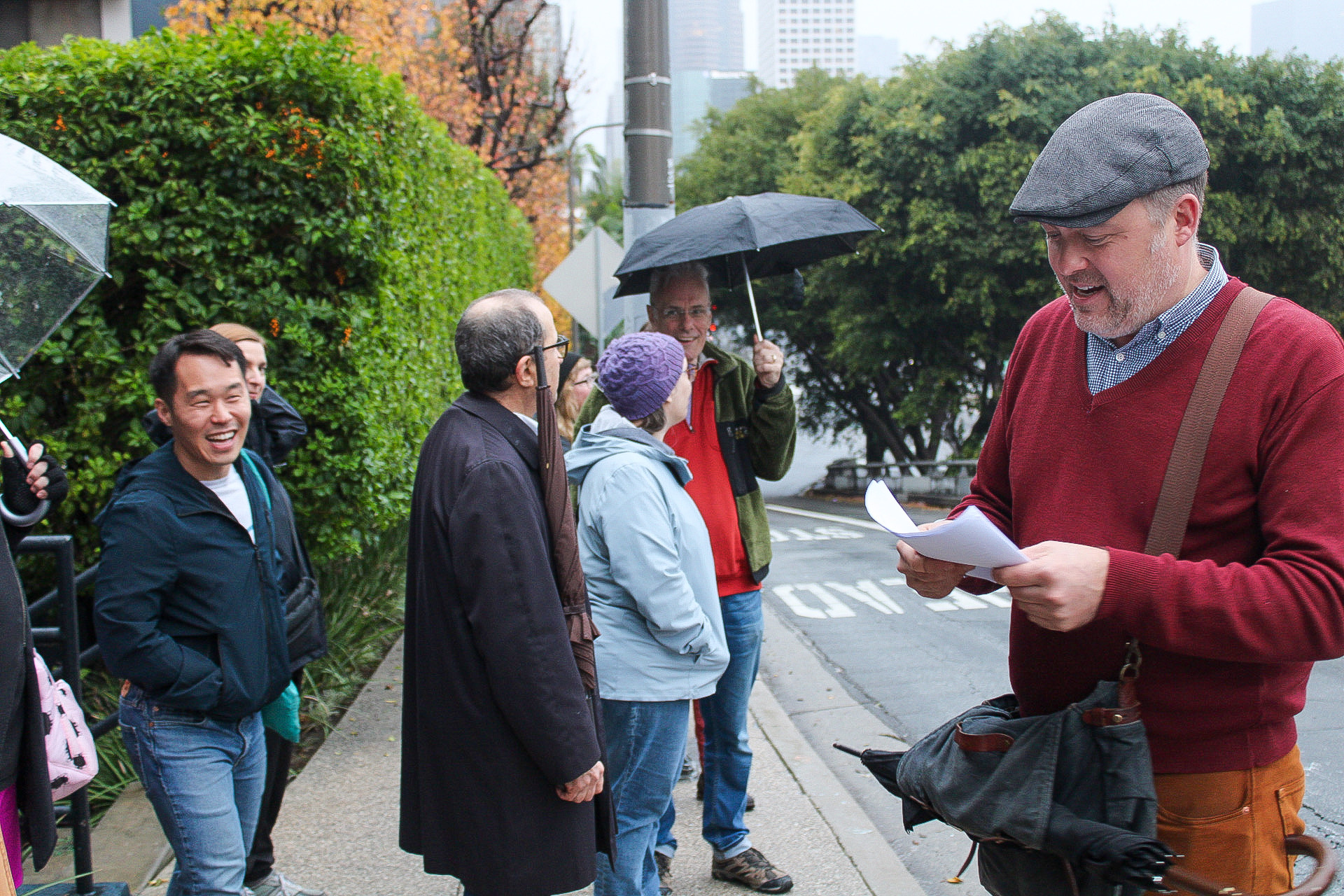
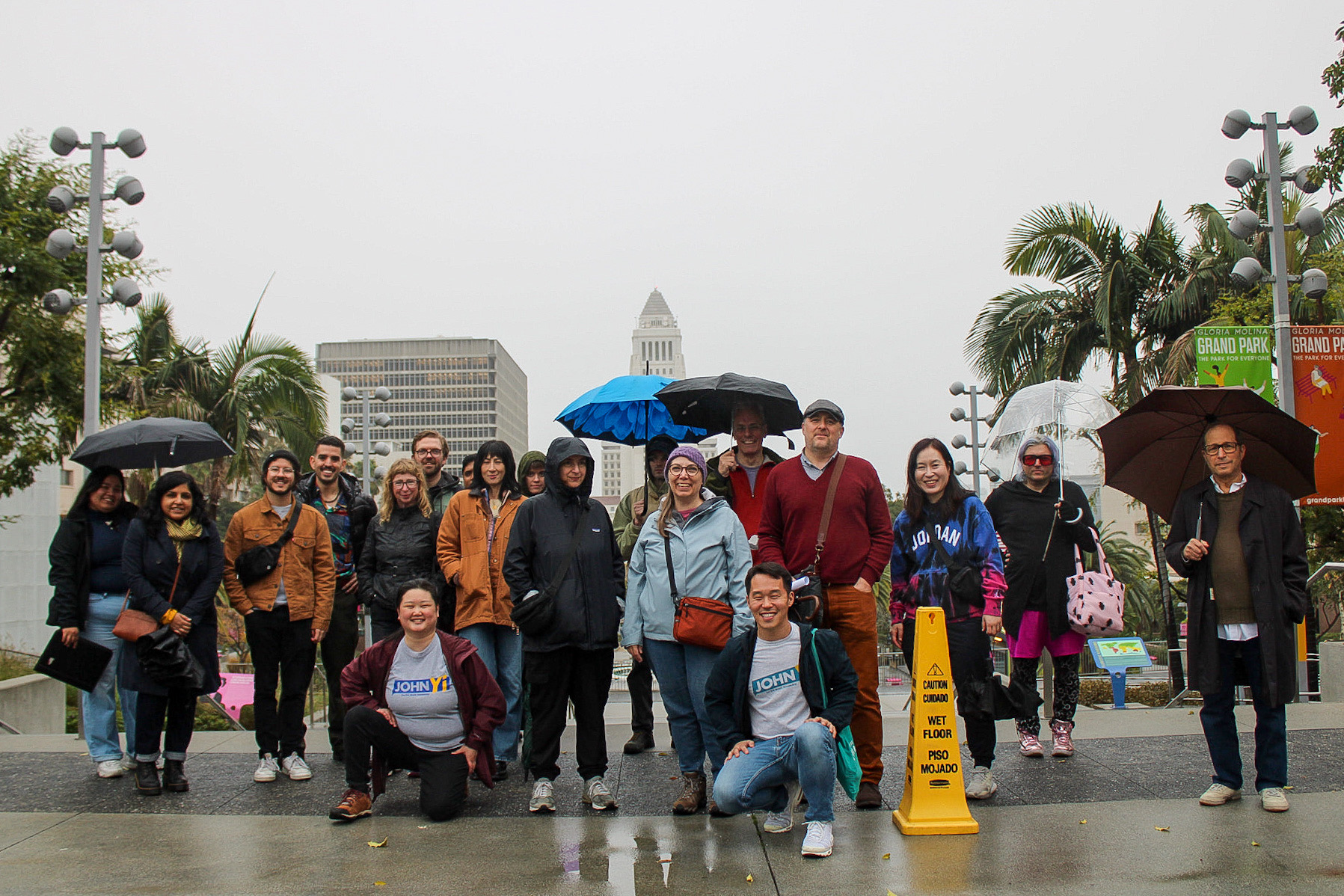
Late last year, California State Assembly candidate John Yi asked me if I’d like to lead a walk of a Downtown neighborhood within the borders of Assembly District 54. I immediately agreed. John had already led a walk of Koreatown. I’d attended his walk of Little Tokyo, led by Kevin Keizuchi. It was just a question of which neighborhood and when. Winnie Fong had already spoken for Chinatown. That left the Arts District, the Bong District, Bunker Hill, the Civic Center, Dogtown, El Pueblo, and the Wholesale District. Any of those could be fun — although a walking tour of the Bong District would be a very short walk. Bunker Hill struck me as the best opportunity to examine the different approaches Los Angeles has taken to urbanism — and it’s a pretty neighborhood to walk in the rain — which there’s a decent chance of in Los Angeles’s mid-winter. So I chose that.
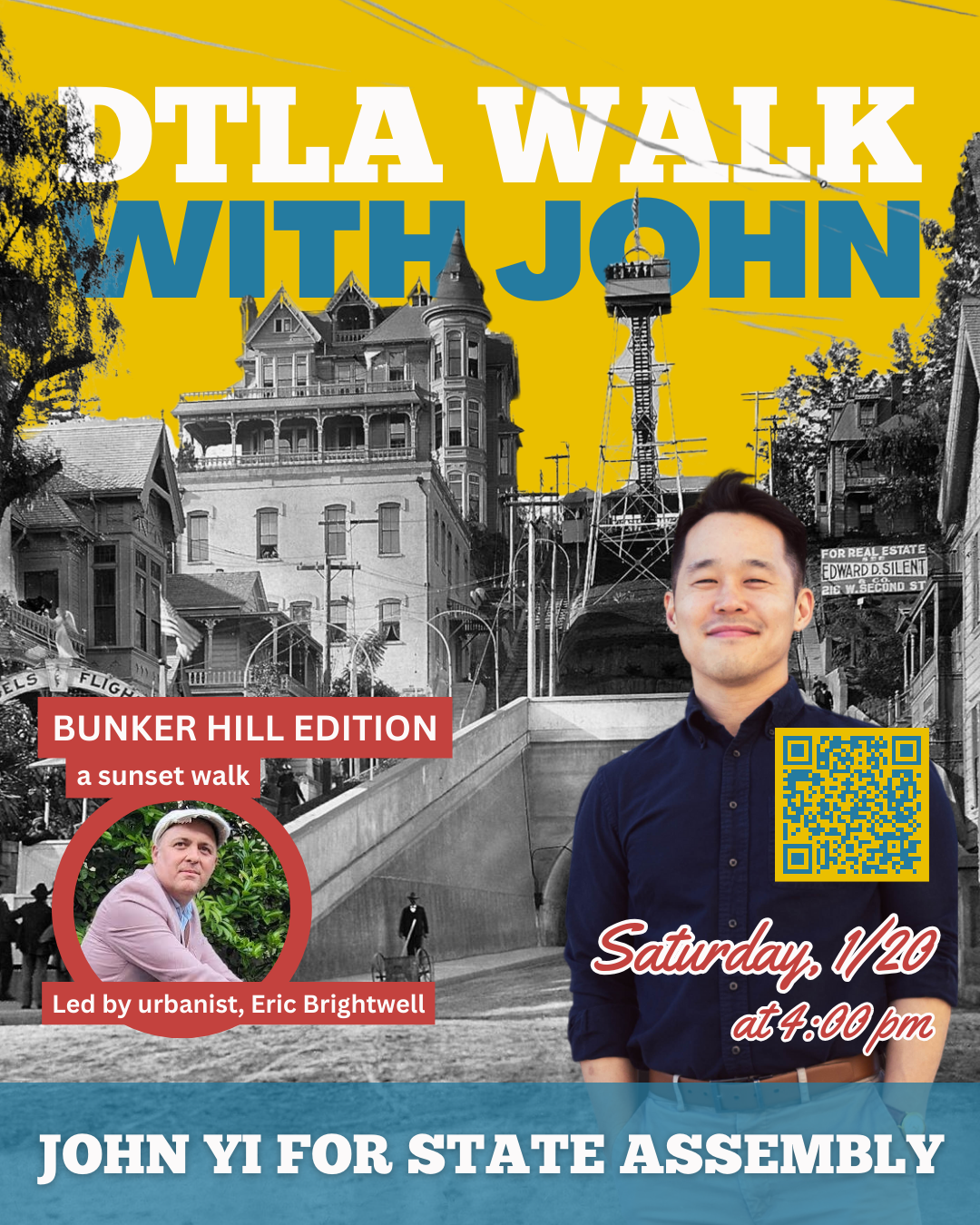
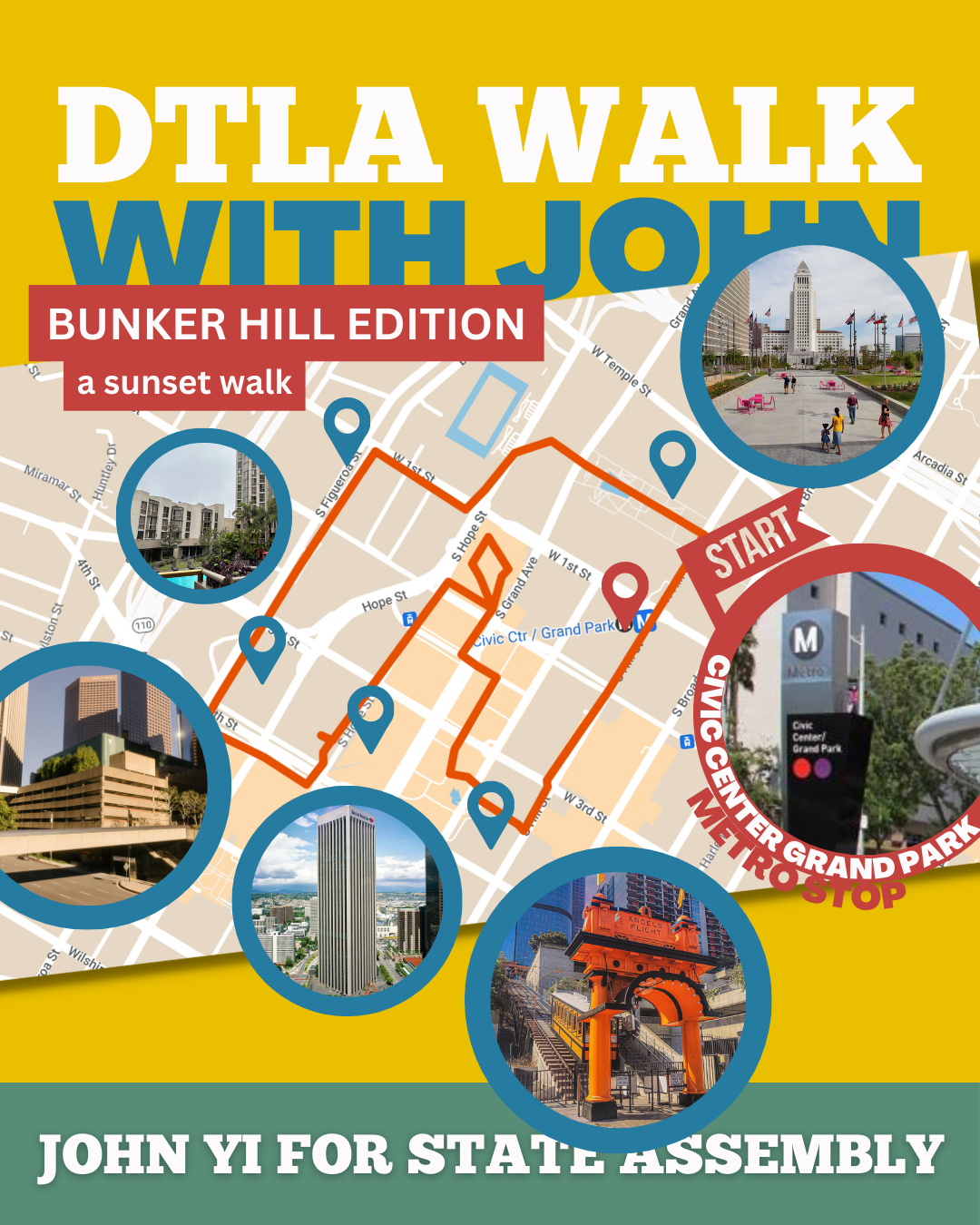
John also presented me with two dates. I decided on the latter because on the former, Katy Go (library lovers — check out her LAPLog) was scheduled to lead a tour of the Central Library that I wanted to attend. Unfortunately, COVID-19, which we collectively seem to have decided to refer to in the past tense, proved to still be very much a present tense thing that had different plans. A month later, I’m still coughing and congested — but at least I was over with COVID in time to lead the walk.
JOHN YI, CALIFORNIA STATE ASSEMBLY, AND DISTRICT 54
I first became aware of John Yi when he became the Executive Director of Los Angeles Walks, a venerated organization that has for 26 years been focused on fostering a safer, more walkable Los Angeles. But what really got my attention were John’s Instagram posts that reveal his deep insights, understandings, frustrations, and sense of humor as a transit advocate in Los Angeles. So when a car-free friend, MaryAnne hosted an event for John at BCD Tofu House, I rode my bike into District 54 to meet the candidate and find out more about his campaign.
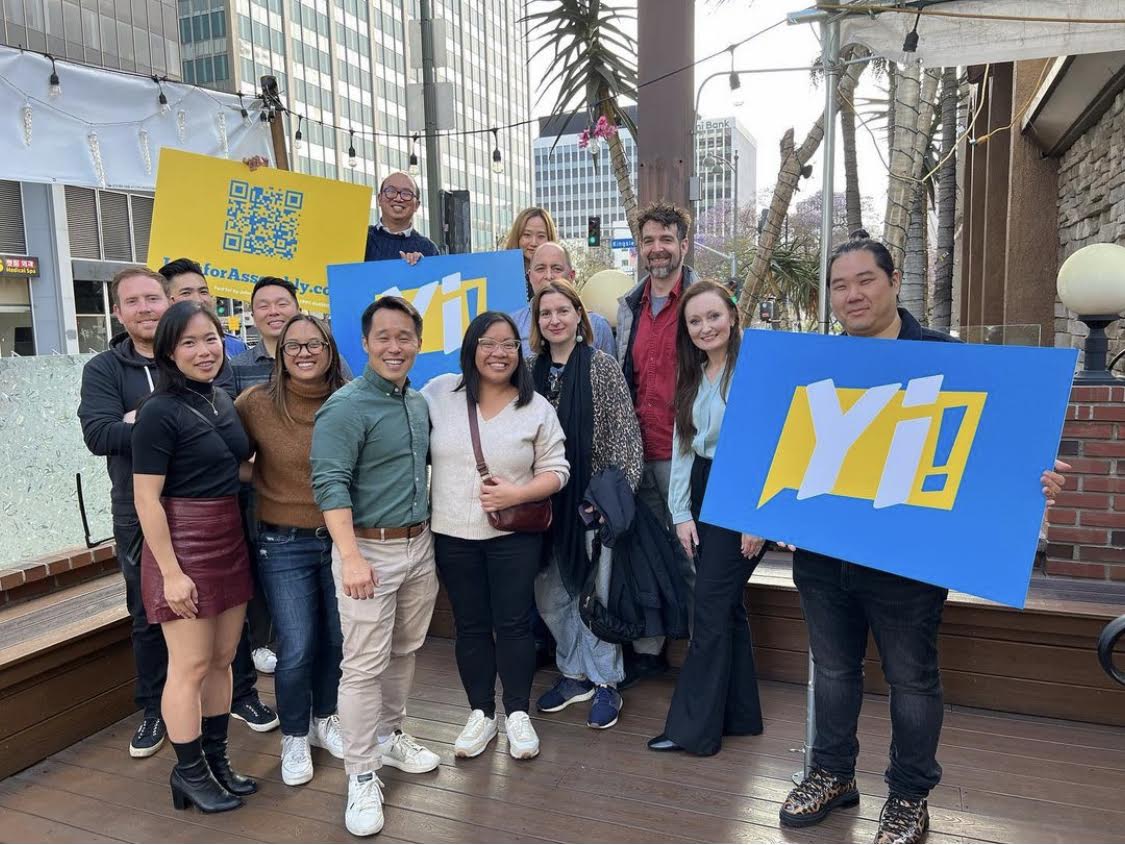
John recently stepped down to run for his Assembly seat. For those who don’t know, the California State Assembly is one of the two houses of the California State Legislature. The other is the California State Senate. The boundaries of California State Assembly District were redrawn at the end of 2022 and now include much of Downtown, Westlake, Pico-Union, Koreatown, Little Bangladesh, Filipinotown, part of East Hollywood — and the suburban cities of Vernon, Commerce, and Montebello.
I actually live in California State Assembly District 52. So why am I concerned with who represents District 54? I’m concerned because the re-drawn district is the dense, populous, urban core of Los Angeles. Koreatown, Westlake, and East Hollywood are the most populous and most densely populated neighborhoods in Los Angeles. In all three neighborhoods, more than two-thirds of residents are foreign-born. Most come from Armenia, El Salvador, Guatemala, Korea, and Mexico. John speaks English, Spanish, Korean, and Russian — which is hugely important in such a multilingual district where English is often a second language. And as the former executive director of Los Angeles Walks, he understands the epidemic of car violence Angelenos face. In Los Angeles, cars kill more people than all homicides — and cars are the number one killer of children. Finally, as the heart of the city — the policies enacted in District 54 hopefully have the potential to spread to surrounding districts, like the one in which I live. He supports universal healthcare, renters’ rights… well, just check out his priorities and endorsements.
That is why, even though I can’t vote for him, I’m encouraging those who can to do so.
Disclaimer: the views expressed herein are my own and not necessarily those John Yi.
One other note: unless otherwise specified — all images courtesy of Phoebe Chiu or Mauricio Neyra.
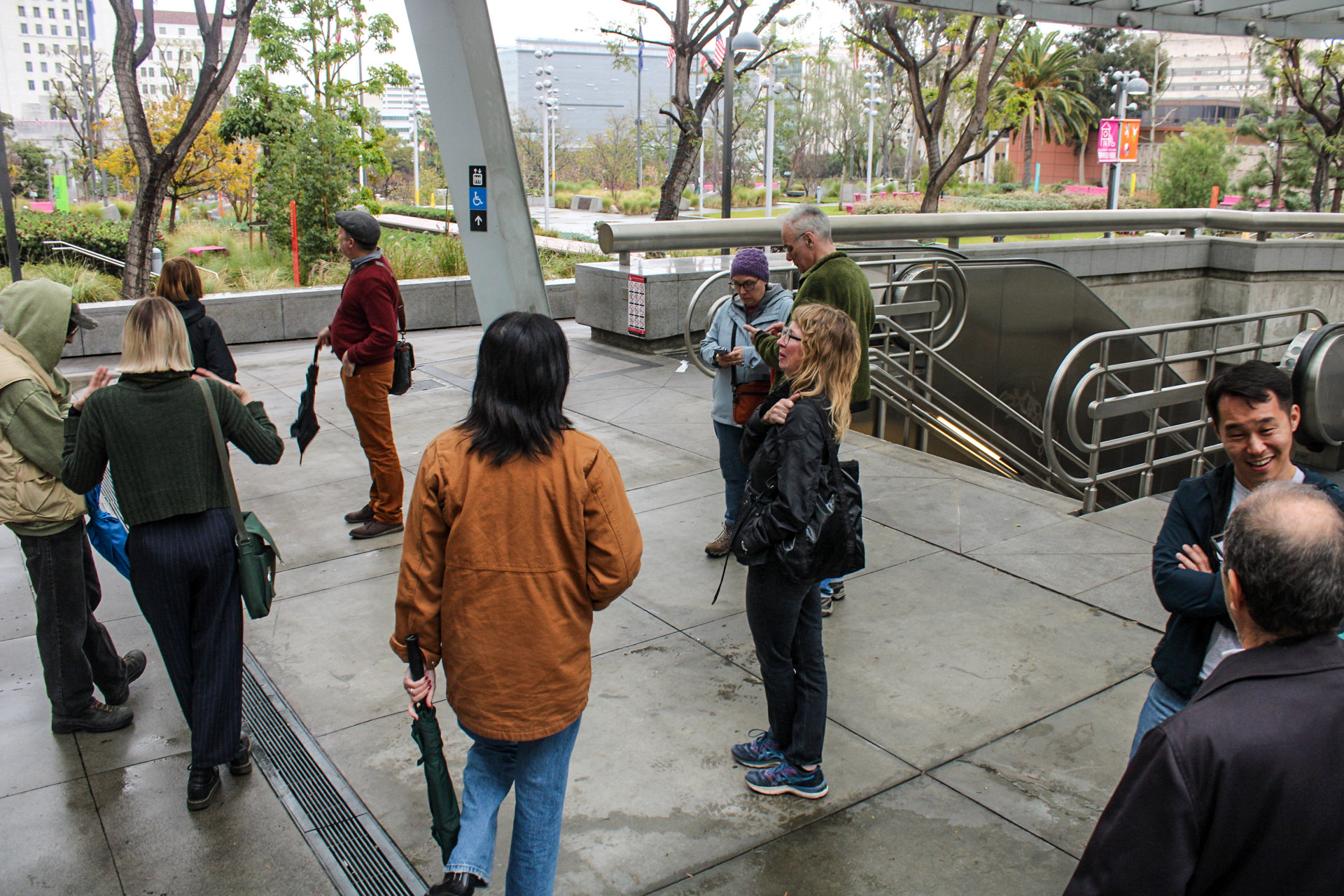
We began our walk at the north entrance of Civic Center/Grand Park Station, in Gloria Molina Grand Parkhttps://grandparkla.org/. This iteration of the park made its debut in 2012. It began as Civic Center Mall in 1960 — the centerpiece of Los Angeles’s then-new Civic Center. I asked attendees to guess what it had been before it was a park before revealing the answer. Those who guessed “surface parking lot” guessed correctly.
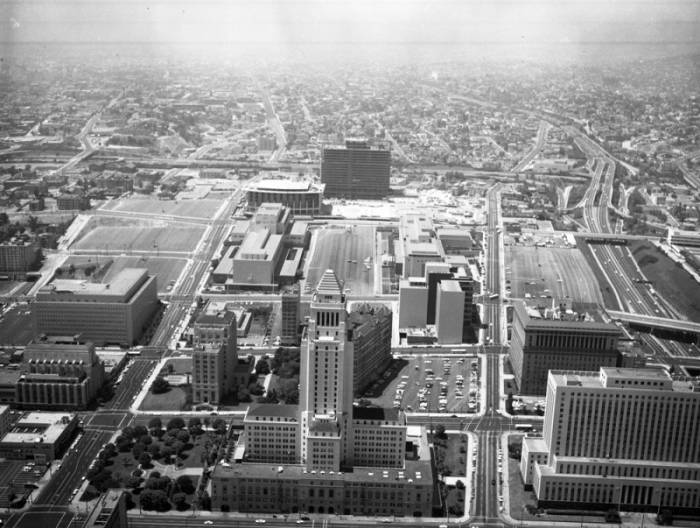
Back then, city workers could stare out the windows of surrounding buildings at a vast car storage area they nicknamed “Auto Atoll” and “Bumper Butte.” By the 1970s, it was on its way to becoming more park like and yet, after 64 years, one still can’t stroll through this park without having to suffer the indignity of pressing beg buttons because it is unnecessarily sliced through by both Broadway and Hill Street. Parks, of course, should provide respite from cars — but in Los Angeles it is not atypical for motorist convenience to be prioritized above all. Echo Park is sliced in two by the Hollywood Freeway. MacArthur Park was sliced through by Wilshire Boulevard back in the 1930s. 138 years after its creation, Los Angeles’s oldest, large park — Elysian Park — still has seven parking lots but zero bus stops and no sidewalks or bicycle lanes along its primary avenue, which is instead configured like a freeway, with six lanes for cars. We dutifully tapped our beg buttons like lab rats before ascending Bunker Hill.
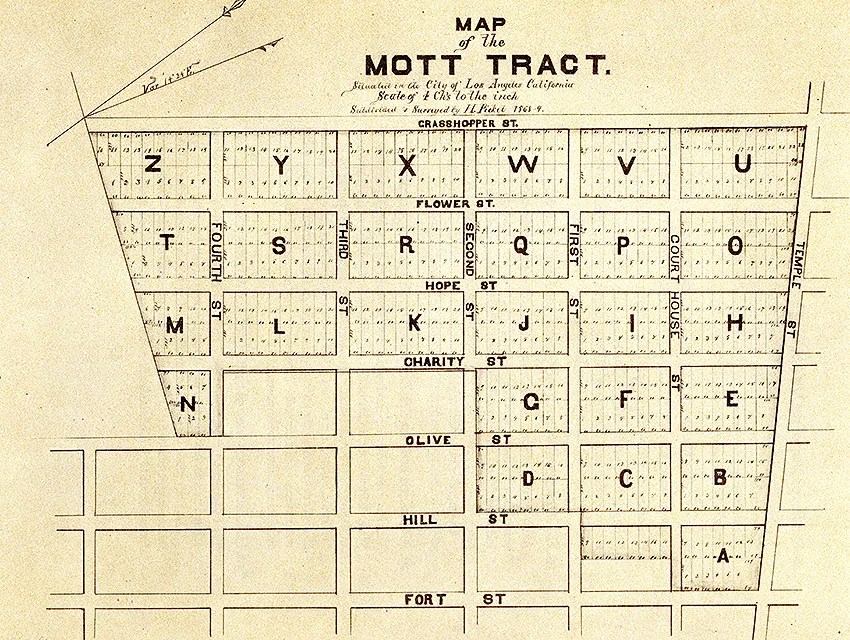
Bunker Hill is named after the famed Boston hill of the same name. Whislt strolling through Grand Park’s Court of Historic Flags, I noticed that the Bunker Hill Battle Flag was one of those on display. In 1869, Los Angeles’s second Quebecois mayor, Prudent Beaudry, along with his partner, Stephen Mott, subdivided the Mott Tract atop the hill. Some consider Bunker Hill to have been Los Angeles’s first suburb. Los Angeles, then, was only home to about 40,000 people so. Can a neighborhood be sub-urban when its part of a town still too small to be considered urban?
Whatever the case, it was one of the first residential districts of Los Angeles and, given its position atop a hill, was developed with mansions in the Eastlake and Queen Anne styles for wealthy Angelenos. As the city moved west, so too did most of the city’s toffs. Their abandoned mansions were subdivided into smaller quarters and a heterogenous population of Filipinos, Italians, Koreans, Mexicans, Natives, Russians, and others move in. It became a popular setting for hard boiled detective novels, film noir, and nudie cuties. I highly recommend checking out Kent McKenzie’s film, The Exiles (1961). I hear lots of recommendations for John Fante’s Ask the Dust, too — but I’ve not read it, yet. I’m currently reading Fante’s previous book, Wait Until Spring, Bandini, which takes place in Colorado.
In 1949, Los Angeles adopted the Los Angeles Master Plan, which called for the redevelopment of its civic center. The National Housing Act of 1949 was also passed that year, which allotted federal money for cities to clear “slums and blighted land for public or private redevelopment.” Los Angeles, thus, began acquiring land on Bunker Hill, in Chavez Ravine, and in Dogtown — and displacing their inhabitants in the name of urban development.
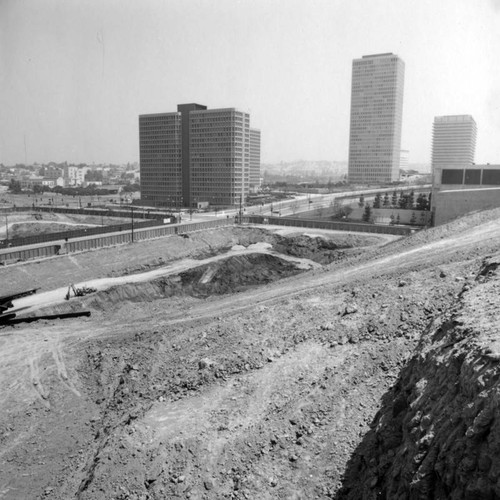
THE MUSIC CENTER
The passage of the G.I. Bill; municipal annexations to the north, west, and south; the development of post-Second World War suburbs; the construction of the region’s first freeways; and the US Supreme Court’s ruling that racist housing covenants were unconstitutional all fueled white flight and with it — much of Downtown’s wealth. The redevelopment of Bunker Hill was part of a top-down plan to reinvigorate the Downtown region. The Bunker Hill Redevelopment Project began in 1955 and 69 years later is juuust about complete. One of the centerpieces of the redeveloped Bunker Hill would be the Music Center. Welton Beckett designed the Ahmanson Theatre, Dorothy Chandler Paviliion, and Mark Taper Forum in then popular New Formalist style — a groovy update of Neoclassicism the results of which often remind me of Lady Elaine Fairchild’s Museum-Go-Round. Fundraising for the Music Center began in 1955 and it was completed, twelve years later, in 1967.
JOHN FERRARO BUILDING
Behind it is the John Ferraro Building. It was designed by the firm of Albert C. Martin and Associates in the Corporate International style. Its landscape was designed by Cornell, Bridgers and Troller. At night, its especially beautiful with its glowing lights reflected on its giant moat — both appropriate symbols of its tenant — the Los Angeles Department of Water and Power. No one, perhaps, photographed it more effectively than Julius Shulman. And, just as there are punchable faces, the John Ferraro strikes me as a crunchable building because, for whatever reason, its reminds me of so many of the buildings Godzilla seemed to relish in the destruction of.
PROMENADE PLAZA
Our next stop was Promenade Plaza — a snaky five-story low-rise that feels curiously out of place the heart of an urban center. But Promenade Plaza was built in 1980, when the word “urban” was, for many, a racially coded euphemism bordering on a slur. One strategy was to build designs meant to evoke suburbia and Promenade Plaza reminds me of something you might see on the coast of Redondo Beach rather than the coast of the 110 Freeway. The building isn’t entirely suburban, though, as mixed-use commercial and residential designs were not terribly common in the suburban 1970s and ’80s. It also has a nice, untitled sculpture by Sheldon Caris, and is home to the downtown outpost of vegetarian Vietnamese institution, Âu Lạc.
PROMENADE TOWERS
Down the hill — and past the Robert Evans Alexander-designed Bunker Hill Towers (which I didn’t talk about) — are the Promenade Towers — yet another approach to urban architecture. The Promenade Towers are a four building complex designed by Kamnitzer & Cotton-Abraham Shapiro & Associates and completed in 1985, at which time they were the largest residential colony in the city. To me, their size makes more sense in a region like Downtown than their five-story neighbor up the hill — but their jagged and monolithic design is ugly — and not just banally ugly like a Geoff Palmer development — but aggressively, beautifully, and brutally ugly — like a Soviet housing estate. The gray skies and heavy drizzle only added to their grim allure.
SECOND STREET TUNNEL
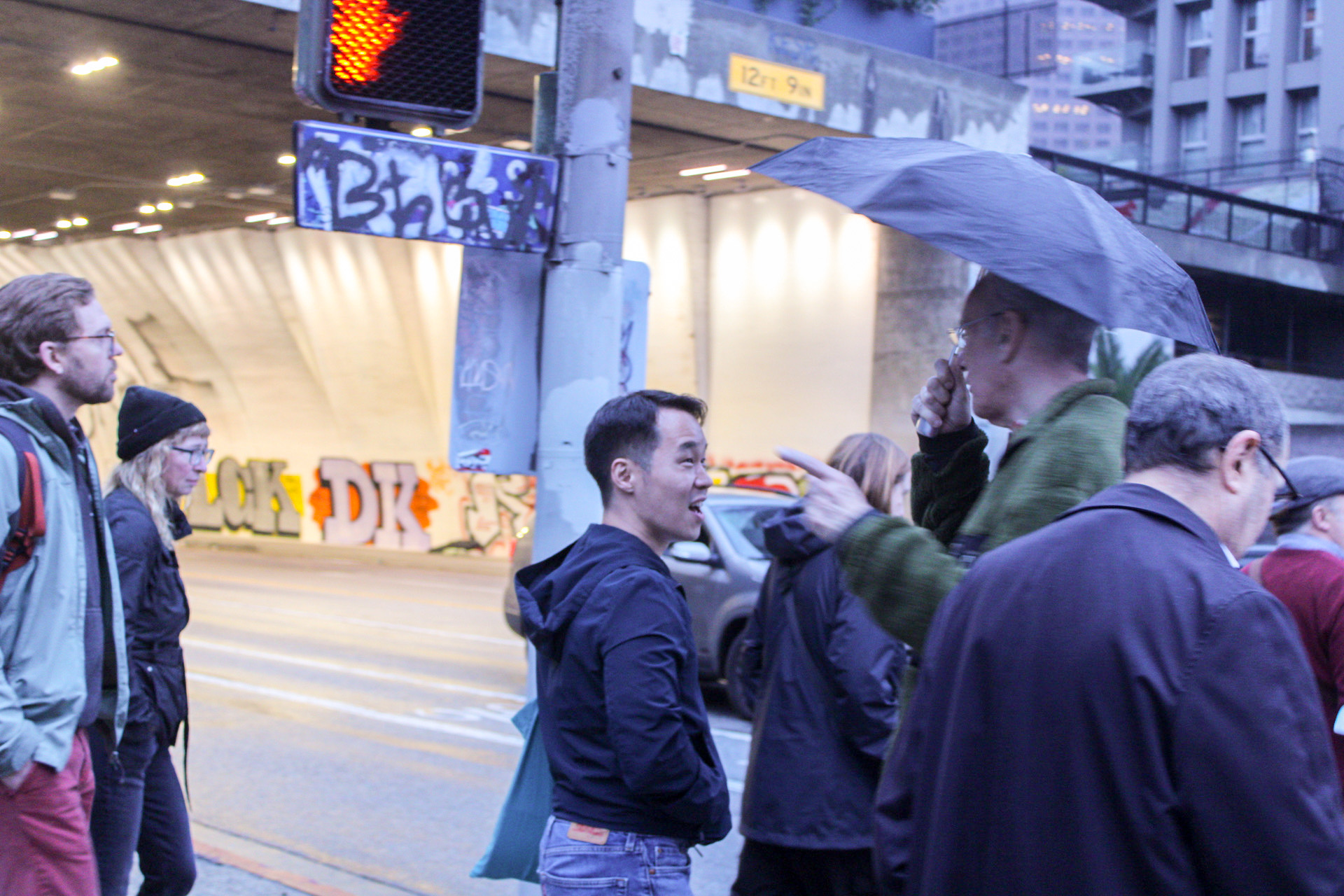
We stopped at Second Street Tunnel, built between 1916 and 1924 in a fruitless effort to ease traffic. It is one of the most photographed and filmed features of Los Angeles, thanks to its glazed white tiles. The tiles were imported from Germany, which was controversial during the First World War. Nowadays, the tiles are heavily tagged and large chunks of them are missing. The gray concrete beneath is sloppily painted white. The run-down state of this beautiful tunnel is, to me, disgraceful — but I suppose if you only experience it on a television screen or from behind the windshield of a car, you might be less bothered.
EXCHANGE SQUARE
I next turned the groups attention cater corner to yet another attempt to instill the urban core of the nation’s second most populous city with a bit of suburban charm. The low-rise Exchange Square was built in 1978 for the Pacific Stock Exchange. When it opened in 1979, its name had already been changed to the Gilbert W. Lindsay Mall. It was later named Figueroa Courtyard. In 2017, some colorful paint was added and some apolitical faux Banksys where thrown up when it was rebranded Park DTLA. Because of its lush landscape, it’s often referred to as “the Park” or “the Garden” but, it it is either, it is a private one protected from would-be visitors be jail-lake bars, gates, and in the back, razor wire.
DOWNTOWN LA PEOPLE MOVER
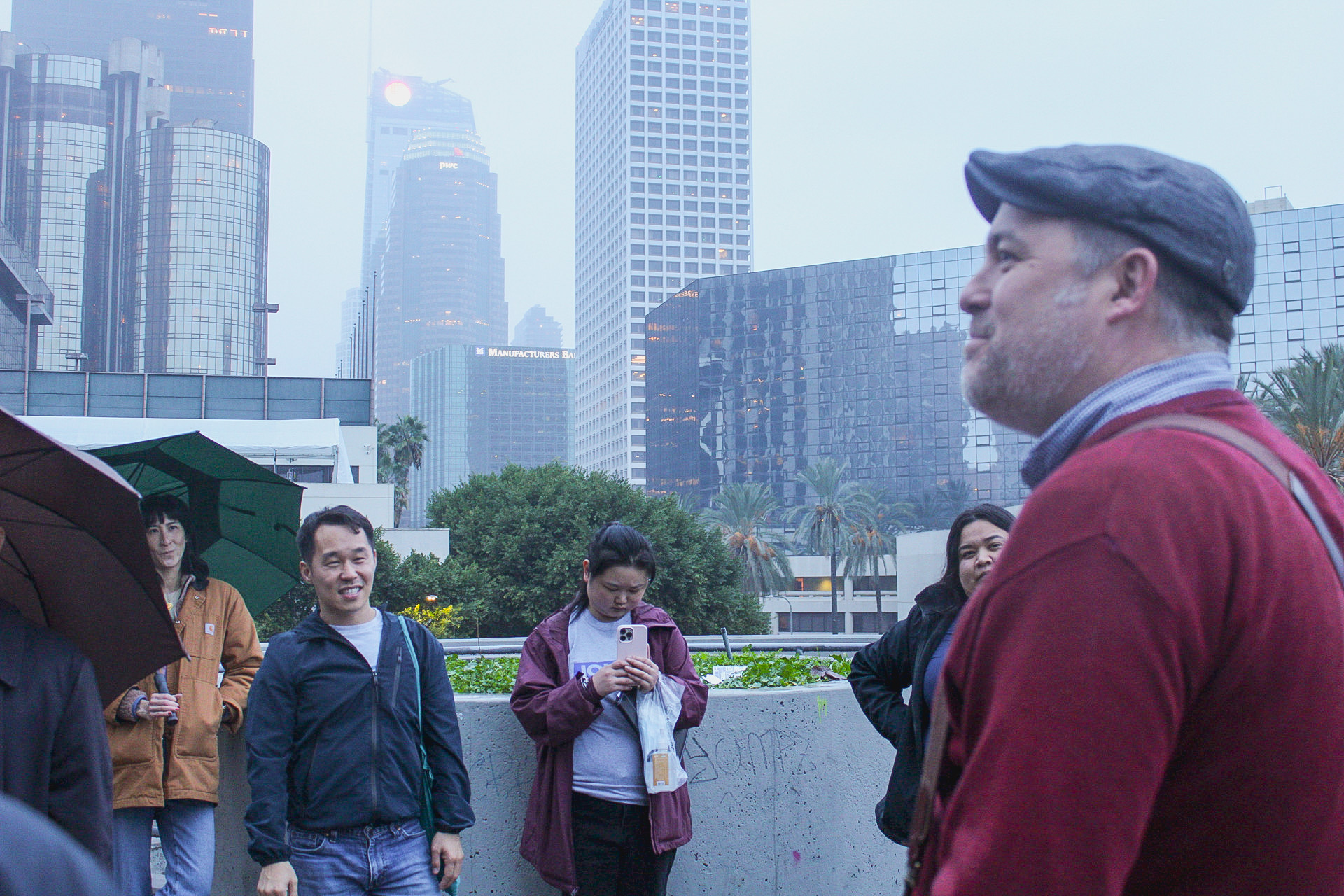
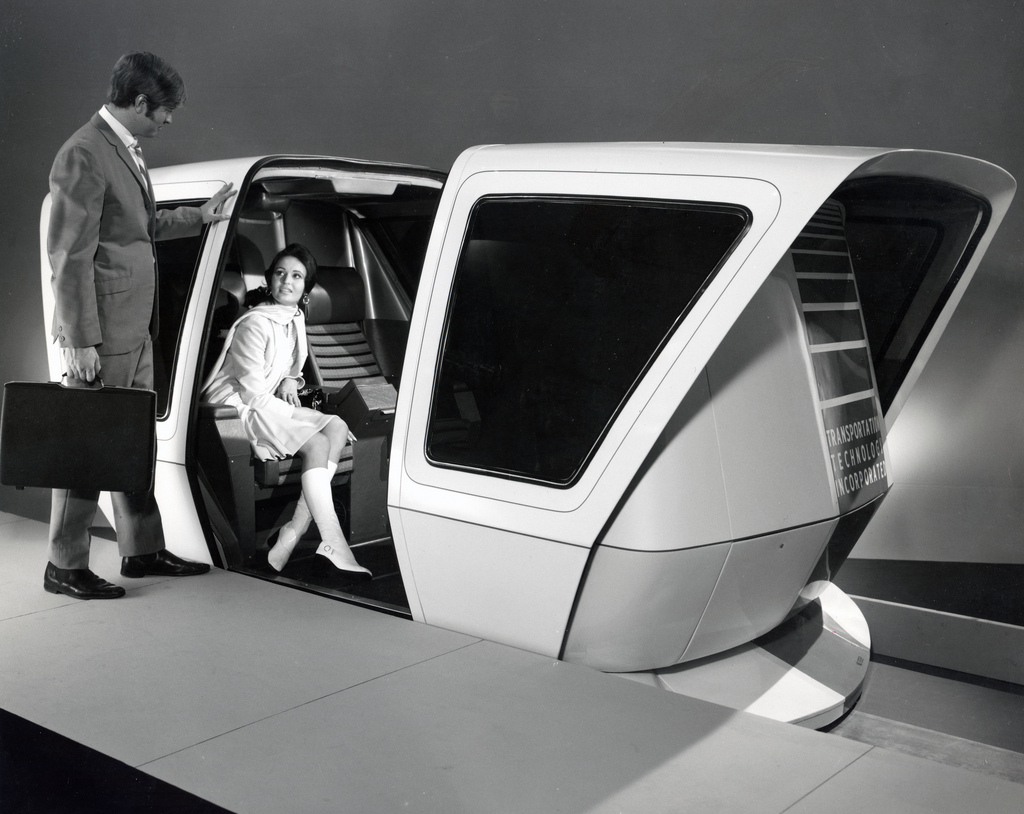
At the corner of Figueroa and 3rd streets, we ascended a circular staircase to the Calvin S. Hamilton Pedway. In 1973, the Downtown People Mover was proposed as yet another solution for traffic. In this vision of urbanism, pedestrians would be removed from the street where they were in the way of cars. Instead, they would traverse Bunker Hill and the Financial District in tiny pods accessed by an elevated pedestrian walkway. This modally segregated streets cape would likely have resulted in bleakness on both levels — but the idea, back then, seems to have been to spend as little time outside as possible and in arcology-like structures where all of ones needs could presumably be met. The people mover, obviously, was never built so today the pedways are used by those seeking a bit of exercise — or privacy. After we crossed a pedestrian bridge, we descended by back to an almost unimaginably bleak stretch of Figueroa. Despite Hamilton’s ‘70s vision of the future being no longer fashionable, I still think that the city should build the Downtown LA People Mover — with the 1970s designs. Look around Southern California. We’ve got live steamers, Rick Caruso’s mall trolleys, and theme park trains and monorails that are utterly useless as mass transit but that people nonetheless line-up to ride. I’ve been on Angels Flight with kids who liked it more than anything else they experienced during their visits here.
THE BONAVENTURE
At 4th Street, we started to ascend Bunker Hill again. Across the street towered the John Portman designed Bonaventure Hotel — another relic of the 1970s future. It was built atop Los Angeles’s long abandoned 1920s subway. Instead of incorporating the tunnel into a pedestrian entrance, the Bonaventure’s concrete pilings cleaved the tunnel in two. Ostensibly providing access to the Bonaventure are two of the Calvin S. Hamilton Pedway bridges; one from the World Trade Center (the doors of which were locked) and the other from the YMCA, which would’ve require a bit of an indirect detour. From our vantage point, it was not obvious how or where else one might enter — which, again, is I think the point of an arcology-like atrium hotel that is only slightly less imposing than Portman’s similar follow-up Renaissance Center in Detroit, which is appropriately and prominently featured in the urbanist essay film, Robocop. I have been inside the Bonaventure, though, and I recommend to anyone who hasn’t been that they rectify that situation as soon as is practical. The atrium is dazzling, dizzying, and disorienting. If they ever converted one of the hotel’s towers to residences, I know some people who’d jump at the chance to live there.
ULYSSES AND PLOP ART
At Hope Street, I directed the group’s attention across 4th toward a sculpture that looks a bit like a pile of discarded polyvinyl chloride tubes. I again offered the group the opportunity to earn 100 points if they could guess the name of the sculpture. No one guessed. “It’s ‘Ulysses,’ of course!” I joked — because Ulysses is a prime example of plop art. Plop art — a pejorative play on pop art — like this is usually the result of California’s defunct Community Redevelopment Agency having demanded that big developments on Bunker Hill devote a portion of their budget to public art. The results, almost always, are non-representational, interchangeable sculptures that have no obvious meaning or connection to their settings and appear to have been ‘plopped” in front of skyscrapers. Although “plop art” is usually used in a derogatory fashion, I am a fan because although contemporary in their design, the whole concept seems so old fashioned to me at this point — a relic of the cityscape I saw and imagined as a child in the 1970s and ‘80s.
BANK OF AMERICA PLAZA
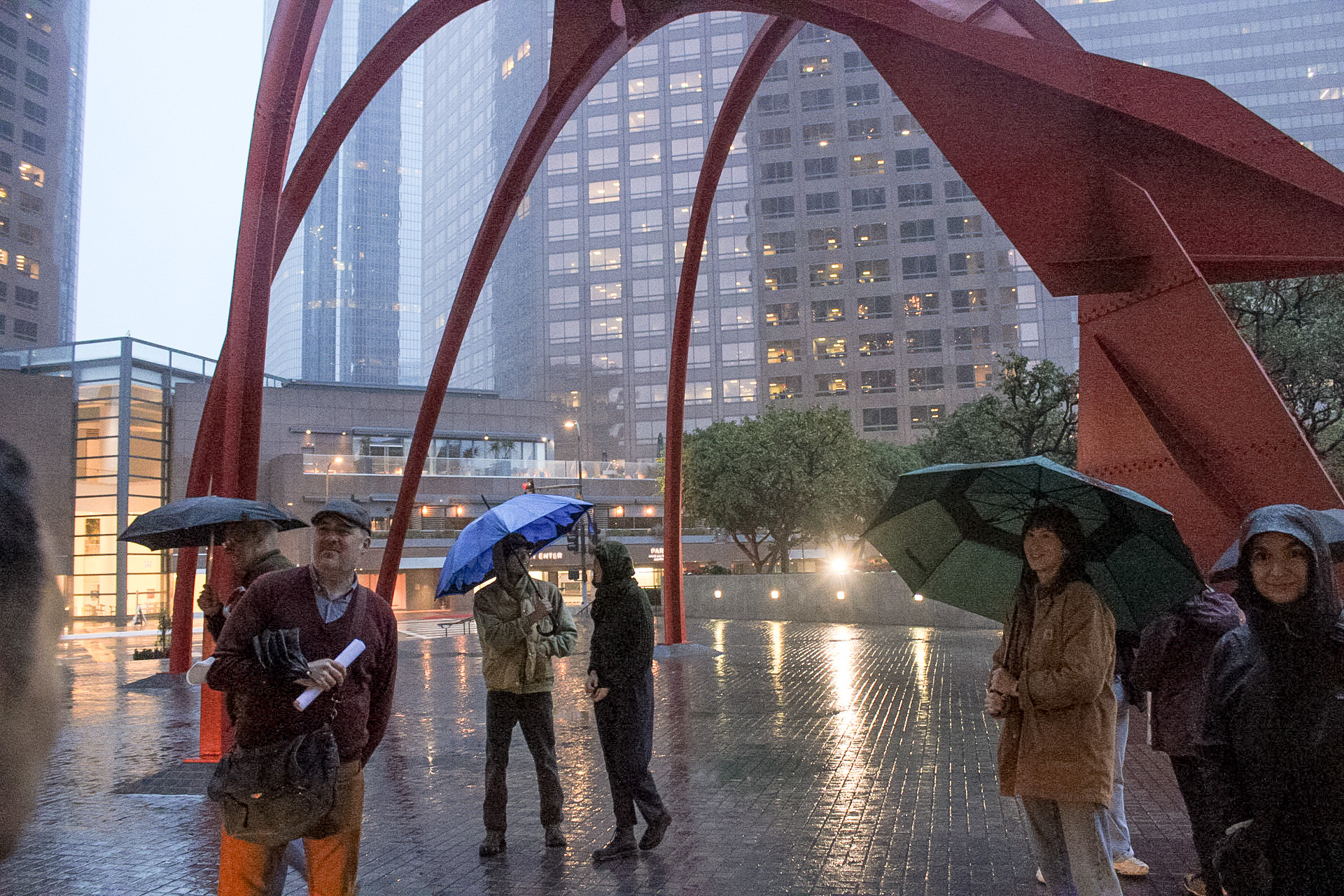
We ascended a short flight of stairs to Bank of America Plaza — one of my favorite areas of Bunker Hill. Here, on a landscape designed by Peter Walker, four waterfalls cascade into a subterranean pool below. Only the waterfalls weren’t falling, at the moment — even though the rain had started to get heavier. Most of the offices below — aside from a Kaiser Permanente clinic — were emptied out during the height of the COVID pandemic, when everyone seemed to agree that working in their living room was preferable to a glassy office looking out at a subterranean garden. Above, it was confirmed by participants, the Bunker Hill Farmers Market is back on Tuesdays. We wound our way through another piece of plop art — surely one of the best — Alexander Calder’s Four Arches. Looking skyward, I noticed that the tops of the 55-story Bank of America Center and neighboring high-rises were shrouded in clouds.
UTILITY BUILDING
As we walked north on Hope Street, we passed a utility building. In December, when I previewed this walk with my friend, Mike, I rattled off some facts about our surroundings in order to get a sense of how long the walk would take. A stranger asked me about the utility building we were passing. Luckily, I had researched it too as best I could. i could not find a lot of information about it, though. It was built in 1956. It was formerly operated by Veolia Energy. The sign in front now named another, equally unfamiliar company name. I’m not sure what type of plant it is — but there are concrete planters with dead tree stumps behind a razor-wire topped fence that suggest that at one time, at least, there were modest efforts to beautify it that were long ago abandoned. I have a thing for utilitarian architecture, though, which I feel most people fail to appreciate because its design is dictated by its purpose rather than an architect’s imagination. For example, if the Terminal Island Treatment Plant’s egg-like pods had been built for string quartets or modern dance performances instead of digesting sewage, I think they’d be considered an architectural landmark. I hope if this plant is ever closed, they repurpose it as a brewery or industrial music venue or something.
GRAND AVENUE ARTS/BUNKER HILL STATION
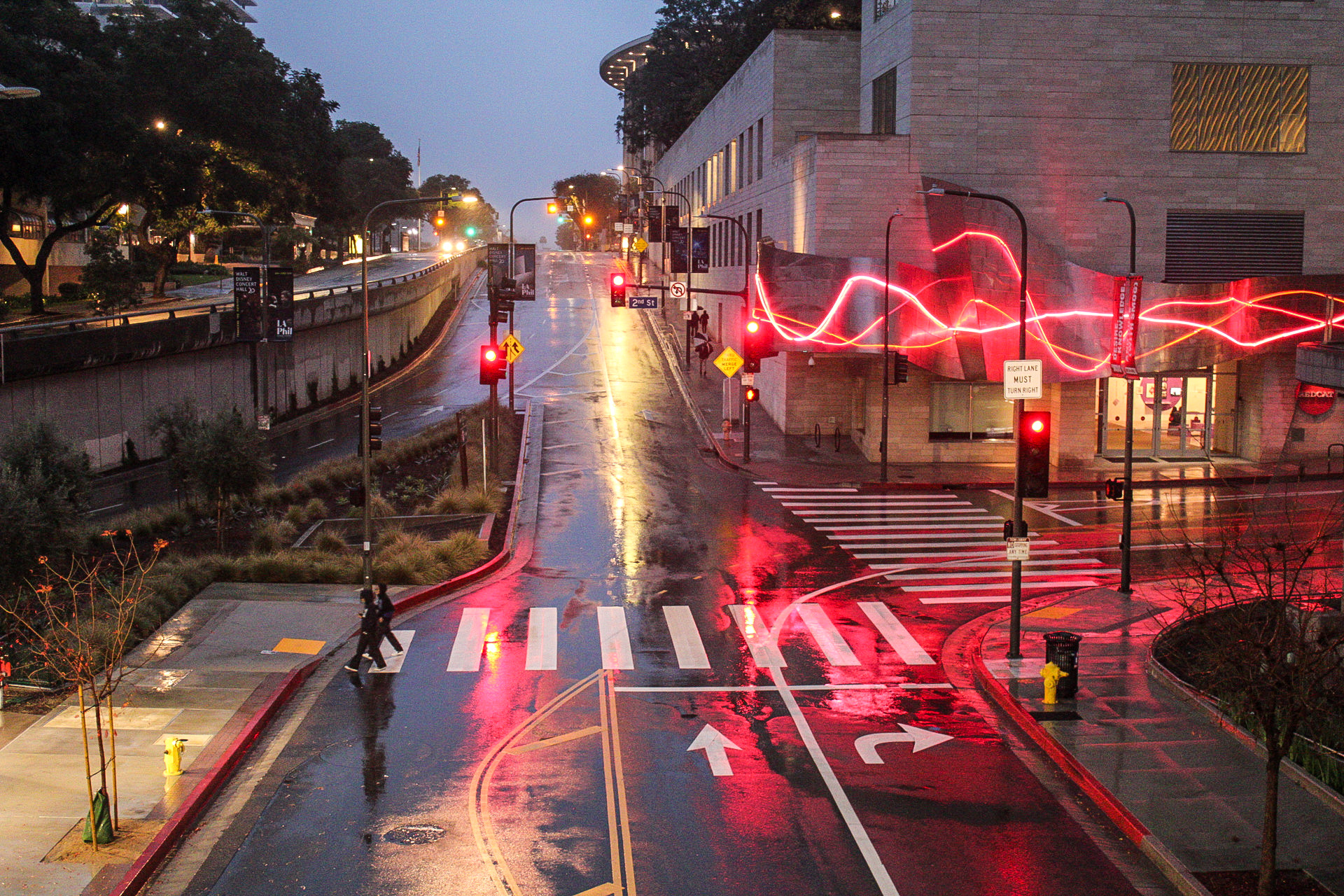
Our next stop was the Grand Avenue Arts/Bunker Hill Station. Located not on Grand Avenue but rather, at the intersection of 2nd Place and Hope Street, it was originally known as 2nd Place/Hope Station. Its platforms are located 30 meters below ground, making it the deepest station in the network. I mentioned to the group that when it was being constructed, I asked Metro if it was cover for an expedition to the fabled Lizard People’s Catacomb City, which was taken seriously enough by the city in 1934, it was covered in The Los Angeles Times and an engineer was allowed to sink a shaft beneath Fort Moore Hill in search of gold. Metro’s response was a wink emoji. Having ridden truly amazing metro systems in Seoul, Taipei, and Tokyo — I hate that Metro never builds stations with restrooms, shops, bakeries, restaurants, art galleries, or even vending machines inside. Most Metro stations here have all the charm and sense of place of a subterranean parking garage. The ones built for the Regional Connector, however, at least have some decent station art and I recommended that any participants with TAP cards enter the station to take a loot at Pearl C. Hsiung’s piece, High Prismatic and then take the skybridge over Hope to meet the rest of us next to Otium at the green space above West General Thaddeus Kosciuszko Way — a street the city had originally resisted thus naming because it was too long to fit on a street sign until Mary Dziadula and the Polish community pressured them into relenting.
BLUE RIBBON GARDEN
We passed The Broad — a fine museum designed by Diller Scofidio + Renfro which, because of its Instagrammability, is familiar to everyone. We crossed 2nd Street and climbed the stairs to the Blue Ribbon Garden — only to find the gates to it were all locked. There was no performance in Walt Disney Concert Hall the night and so it was supposed to remain open until 10:00. I skillfully pretended that I had known that the park would be closed because I wanted to make a point about privately-managed public spaces and pointed across the street to the Grand By Gehry, completed in 2022, and one of finals pieces in decades-long redevelopment of Bunker Hill.
CALIFORNIA PLAZA & ANGELS KNOLL
Beginning with my Elysian Heights Walk, I’ve started designing my walks so that the half-way point of each is near the end and beginning of the route — in case anyone needs or wishes to leave early for whatever reason. This was that point in the walk and some of the participants peeled off having had enough of the walk, the rain, or possibly both. The walk got even nicer afterward, though, as we walked through California Plaza, I pointed out how much more pleasant it was — although segregated from a car-dominated street — than the Calvin S. Hamilton Pedway — because there are things along it that you’d want to walk to and from. A group of young dancers walked out of the Coburn and we could see people inside the Omni where there seemed to be some sort of presentation.
We walked past the Museum of Contemporary Art. Its building, designed by Arata Isozaki, is decidedly less Instagrammable than the museum across the street and I doubt that that many visitors from one cross the street to the other. Both are nice although. Both are primarily devoted to post–Second World War artists from the US and Europe. That said, they’re highly distinct. The art at MOCA is generally, I think its safe to say, more challenging — whilst the art at the Broad, to paraphrase a friend, is the collection you’d expect of a billionaire.
California Plaza in the rain is peaceful and pretty… although by this point, there were puddles deep enough that my shoes were wet. We stopped above California Plaza Park which, before its pool was replaced with grass, was the Water Court. It still hosts Grand Performances — a free summer performance series. I mentioned having attended a night of poetry organized by Mike the Poet and I swear I heard someone gasp. On the other side of the amphitheater, we looked over Angels Knoll, really the last undeveloped piece of Bunker Hill. One and Two California Plaza were designed by Arthur Erikson Architects and completed in 1985 and ’92. Angels Knoll was to have been the site of Three California Plaza — but it wasn’t built. in 2008, Jacci Den Hartog designed a landscape of benches and trees. One of the benches was featured prominently in the 2009 film, (500) Days of Summer. A fence was erected around the Knoll in 2013. Now, a contract has been awarded to MacFarlane Partners and Peebles Corporation who intend to build Angels Landing — the design of which calls for the preservation of at least some of the green space.
ANGELS FLIGHT
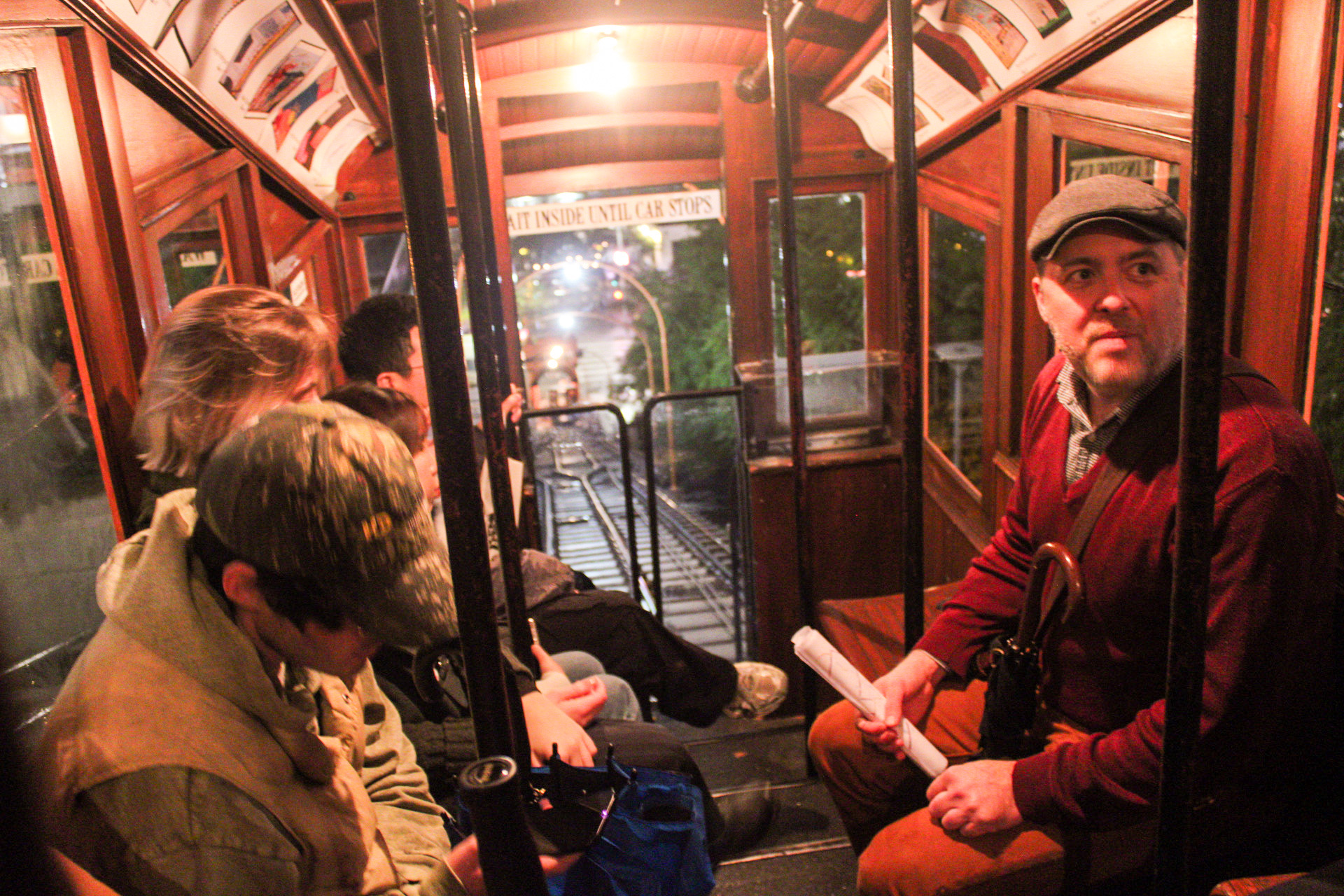
We descended the hill on Angels Flight. I gave people the option of taking the stairs down — saving themselves the dollar fare (or fifty cents with a TAP card). Happily, everyone opted to take the world’s shortest railway — and for some it was their first time. Someone said it was serving Studio Ghibli vibes. The funicular rail first began operation in 1901 above the 3rd Street Tunnel, when Bunker Hill was ten meters taller. It ended operation in 1969 and re-opened at its new location in 1996. At the bottom of the hill, we said goodbye to a few more people.
LA CITA
Although technically beneath Bunker Hill, I wanted to talk a bit about La Cita because I feel like bar history is often under-researched, overlooked, and marginalized. The margins are where most of what’s interesting happens. Things are not interesting because simply because they are marginalized, rather they are marginalized simply because they are interesting. La Cita’s building was constructed in 1897 and was originally a three story hotel. One of the first tenants of the commercial ground floor was the Suititorium Dye House. In the 1910s and ‘20s it was home to Pacific Hat Works. The first bar to have opened there was the loftily named New Palace Café, which occupied the ground floor by 1940. Its owner was a former bootlegger. Bar history, in my experience, loves to claim ties to bootlegging and in the 2000s, “speakeasy” lost its true meaning and was applied to every cosplay dive with a “secret” password. The New Palace’s owner, Daniel Rissman, was the real deal, though, as he was convicted and had a long list of aliases including Daniel Kissman, David Danielson, and Daniel Harris. I recently heard a bit of advice about aliases. They said you should always stick with your first name and just change the family name. That way, if someone calls you by your given name, you’ll respond appropriately wheres if you have a bunch to keep track of, you’ll get tripped up.
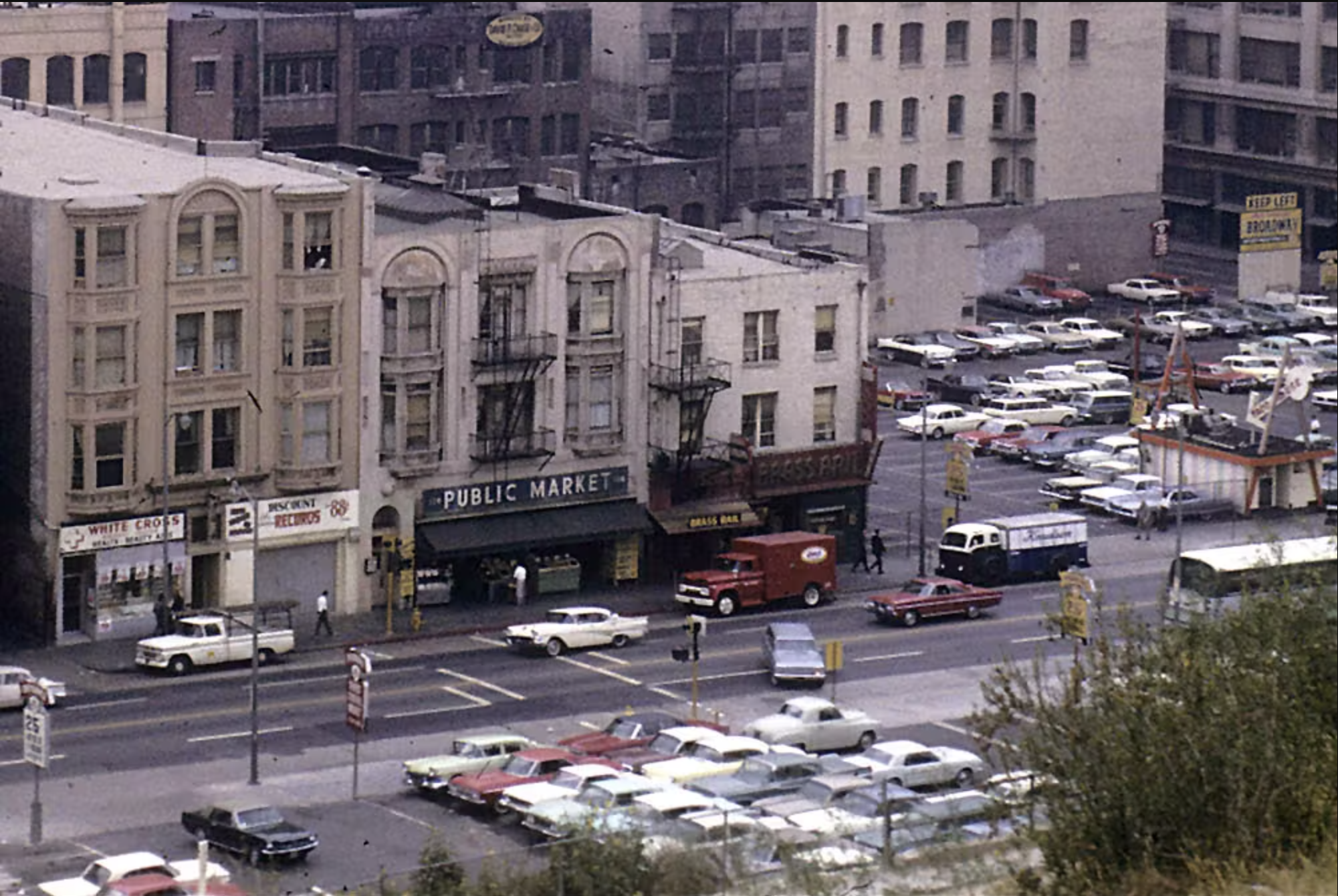
Anyway, a Russian named Al Daswick took over the space and named it the Brass Rail, which seems to have been a popular bar name in those days. This Brass Rail remained in operation with that name until at least 1966, when there were still two stories above it. The demographics of Downtown were changing, however, and Daswick rebranded his bar La Cita and changed the decor to appeal to Latino clientele. It some point, the two upper stories were removed although, bizarrely, I can’t make out when. After Al Daswick died, his sun Gregory Daswick took over and ran it until 2006. That year, Carl Lofgren, David Neupert, Jeff Seomones, and Pete Lenavitt took over. I recommended to the assembled that if they felt like a drink after the walk to check out both the interior and back patio, which have highly distinct atmospheres.
GRAND CENTRAL MARKET
Grand Central Market, of course, probably needs no introduction for most Angelenos. I do remember coming there, however, in the 1990s when there were many empty stalls and Sarita’s was – unbeknownst to me — the latest tenant. I tried to remember what other tenants were around back then: Chiles Secos, China Cafe, Valeria’s. It’s thriving now and has lots of good options although some are gone. Anyway, a good place to grab a bite for anyone hungry after the walk.
THIRD STREET TUNNEL
The 3rd Street Tunnel is more brightly lit now then it used to be. It’s not featured in a lot (or any) car commercials or films because, well, it’s not especially attractive. It is historic, though. In fact, having been built beginning in 1899, it’s probably the oldest remaining human-made feature on (or in) the hill. It was built to better connect Crown Hill to Downtown when Bunker Hill was still developing. Its construction was overseen by C. L. Powell, who’s criminal negligence cost the lives of John Vicentini and Major W. T. Labie in 1900, when they were entombed in of of the project’s several cave-ins. It opened to the public in 1901. A journalist at The Los Angeles Times was not impressed although I am, by their writing, which I read aloud:
The new Third-street tunnel is a veritable stench in the nostrils of the public. It is a cesspool of filth, a hotbed of disease. Stagnant pools of malaria-infested mud and water are here, there and everywhere throughout the 350 yards of Cimmerian gloom. Filthy seepage water drips over the sidewalk and roadway throughout its entire length. At night its Stygian darkness is unlighted by a single ray, while the periodically-falling plaster from the arch overhead is a constant menace to life.
LAST SURFACE PARKING LOT
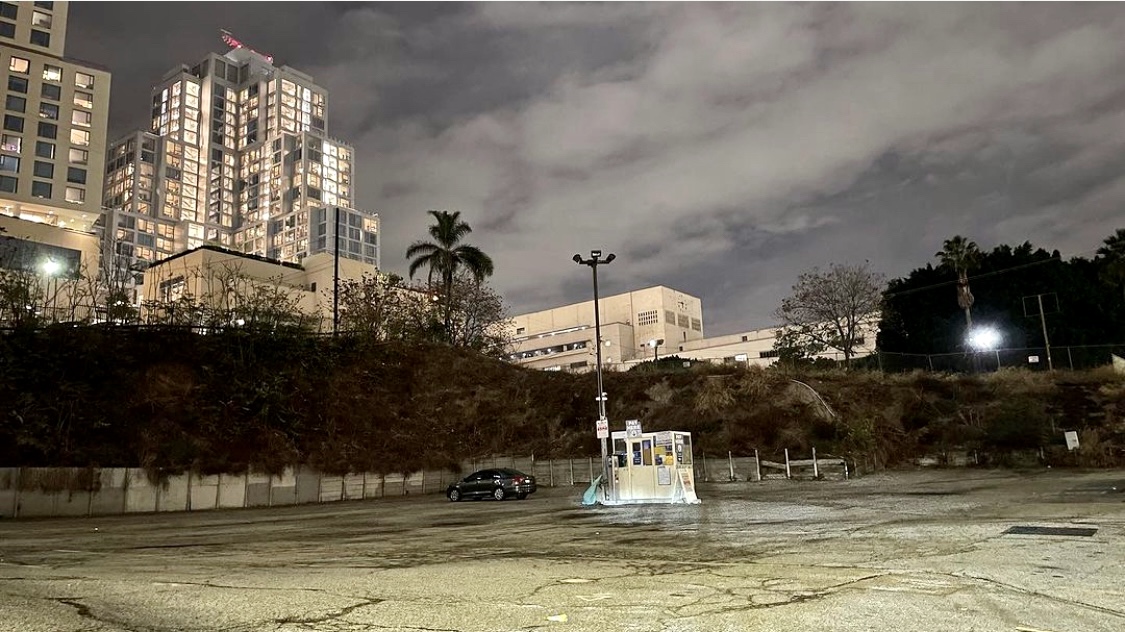
Our penultimate stop was a humble, stand alone, surface parking lot — the last one on Bunker Hill. It was paved in 1955. Before that, it had entirely been covered with homes. Homes felled to create car storage in the name of urban development. This lot, presumably, will someday be developed with residences again but I asked those remaining to think about the redevelopment of Bunker Hill in comparison with the revival of the Arts District and the Historic Core.
In the Arts District, in 1981, the city passed the Artist in Residence Ordinance in 1981, which allowed artists to live in old industrial buildings until they became so desirable, within twenty years, that they were converted into luxury lofts almost no artists can afford. In the Historic Core, the city passed the Adaptive Reuse Ordinance in 1999, that essentially said that commercial offices could be developed into residences and that parking minimums would be waived. The hugely expensive, heavy-handed, top down development of Bunker Hill, on the other hand, began 69 years ago with the Redevelopment Plan for the Bunker Hill Urban Renewal Project and it’s still night quite done.
Support Eric Brightwell on Patreon

Eric Brightwell is an adventurer, essayist, rambler, explorer, cartographer, and guerrilla gardener who is always seeking paid writing, speaking, traveling, and art opportunities. He is not interested in generating advertorials, cranking out clickbait, or laboring away in a listicle mill “for exposure.”
Brightwell has written for Angels Walk LA, Amoeblog, Boom: A Journal of California, diaCRITICS, Hey Freelancer!, Hidden Los Angeles, and KCET Departures. His art has been featured by the American Institute of Architects, the Architecture & Design Museum, the Craft Contemporary, Form Follows Function, the Los Angeles County Store, Sidewalking: Coming to Terms With Los Angeles, Skid Row Housing Trust, the 1650 Gallery, and Abundant Housing LA.
Brightwell has been featured as subject and/or guest in The Los Angeles Times, VICE, Huffington Post, Los Angeles Magazine, LAist, CurbedLA, Office Hours Live, L.A. Untangled, Spectrum News, Eastsider LA, Boing Boing, Los Angeles, I’m Yours, Notebook on Cities and Culture, the Silver Lake History Collective, KCRW‘s Which Way, LA?, All Valley Everything, Hear in LA, KPCC‘s How to LA, at Emerson College, and at the University of Southern California.
Brightwell is currently writing a book about Los Angeles.
You can follow him on Ameba, Duolingo, Facebook, Goodreads, iNaturalist, Instagram, Letterboxd, Mastodon, Medium, Mubi, the StoryGraph, Threads, TikTok, and Twitter.


