
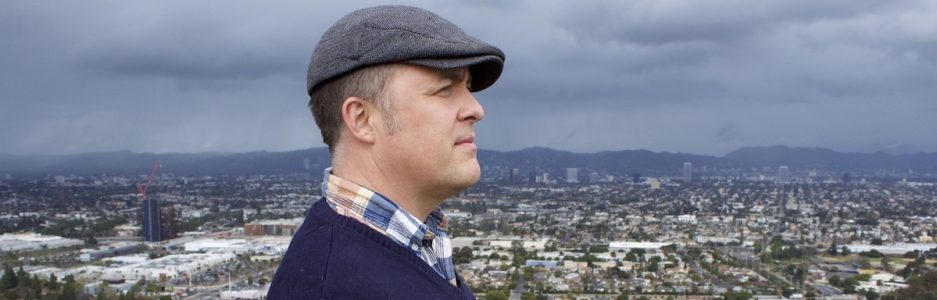
Taix will serve its last meal on 29 March 2026 – the birthday of famed post-Impressionist, Georges Seurat. I have always enjoyed my visits to Taix, whether for food, drinks, friendship, or to see Australian legends, the Cannanes, perform at a banquet room there, as I did back in 2015. It’s a place that I also enjoyed seeing, whether from the window of a bus, the seat of a bicycle, or on foot.
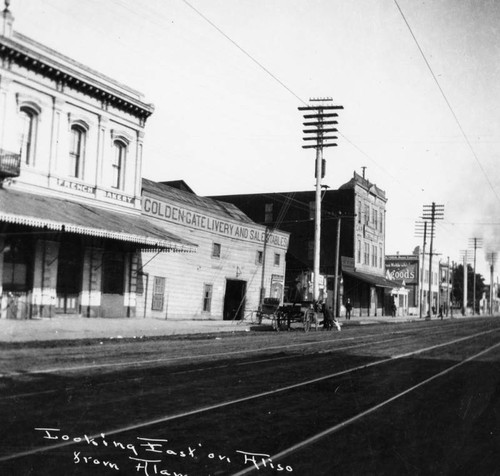
Taix’s roots were planted in Frenchtown, a vanished enclave that’s mostly forgotten today but that, in the late 19th century, thrived between (and overlapped, somewhat) Little Tokyo to the south, Sonoratown to the west, and Chinatown to the north. Louis Bouchet (sometimes spelled Bauchet — the source of the street name), arrived in Mexican Los Angeles in 1828 and made wine from Mission grapes. A Bordeaux native Jean-Louis Vignes, moved to what became Frenchtown in 1831, and established a vineyard and winery near the intersection of Commercial and Vignes streets – the latter named after him. By 1850, two years after Los Angeles had become an American city, it was the winemaking capital of the entire nation.
The vineyard was named El Aliso, after the 400-year-old tree that marked the center of the Tongva village of Yaangna. The Philadelphia Brewery was built around it in 1874 and it died in 1891. The dead tree was chopped down for firewood and today a plaque marks the spot, across the street from Platinum Showgirls Gentlemen’s Club.
Drawn to California by the Gold Rush and, more often than not, having come up empty handed, many French settled west of the vineyard, where boarding houses like the Pyrenees and the French Consulate popped up around Alameda and Aliso streets in order to cater to the French population that, at its peak, numbered around 4,000. French was actually the city’s second-most spoken language, in those days. Los Angeles even had three Francophone mayors: Damien Marchessault (1859-1865), José Mascarel (1865-1866), and Prudent Beaudry (1874-1876).
As the city urbanized, railroads arrived; and as railroads arrived, the city urbanized further. The trains brought Anglos, whose Germanic language overtook the Romance tongues. At the same time, a devastating blight then-known as the “Anaheim disease” killed many of the remaining wine grapes. Frenchtown persisted, however, for a time. In 1893, an Aix-en-Provence-born restaurateur, Philippe Mathieu, bought a delicatessen on Alameda. In 1908, he opened his own place on the same street, Philippe’s. Some time later, at a different location, they would serve the first “French Dip” sandwich.
Even earlier, members of a large shepherding family had migrated from Laye, Hautes-Alpes to Frenchtown – around 1870. One, a man named Marius Taix, had established the Taix French Bread Bakery at 321 Commercial Street in or after 1884 (it first appears in city directory’s in 1894). Marius’s brothers, Adrien and Ernest, founded the European Bakery at 1st and Alameda. Marius’s brothers, Adrian and Joachim, opened the second Taix bakery, Taix Brothers French Bakery, over at 1550 Pico Boulevard, in 1905. Maison Nouvelle moved over from Broadway to the other half of the building in 1906. Over the next few years, the family’s fortunes took a dark turn. Adrian died at the Patton Asylum in May 1911. Marius’s sister, Leonie Allemand, died in September 1911. Joachim died of an illness in January 1912.
Taix French Bakery, on Pico Street, remained in business at least until 1919. Marius demolished his own bakery and, on its site, built the three-story Champ d’Or Hotel in 1912. The ground floor was rented as a retail space. Marius died in 1926. In 1927, his son, Marius Taix Jr. (born 13 June 1893) took over the restaurant space and opened Taix French Restaurant in early 1927.
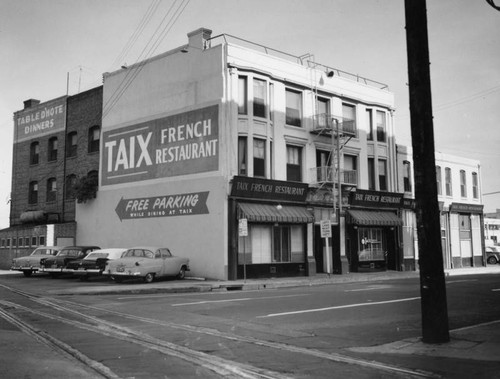
Taix, c. 1956 (Los Angeles Public Library Photo Collection)
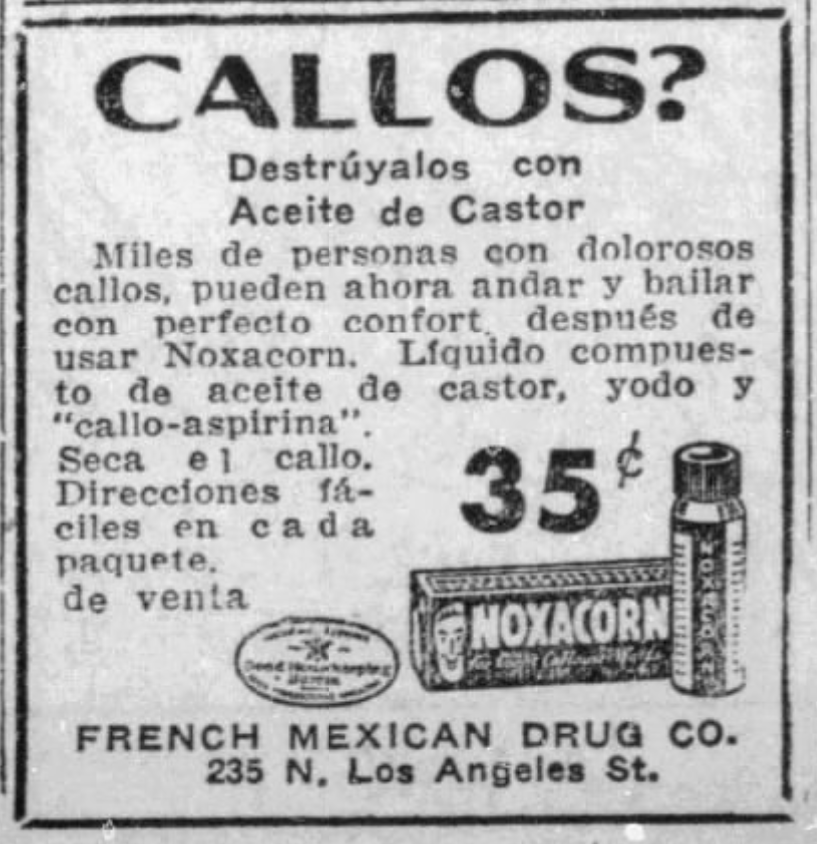
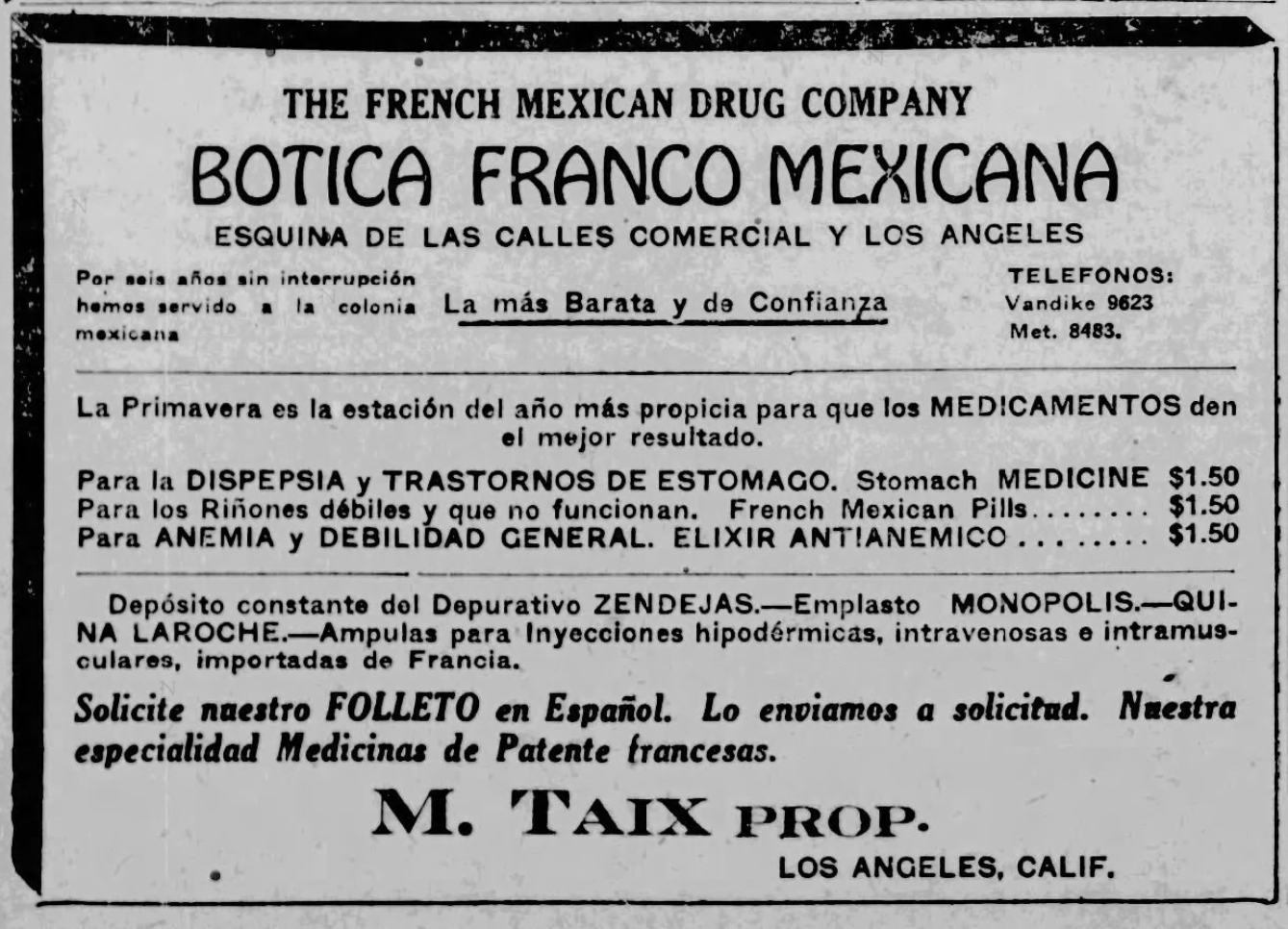
Marius Jr. was a pharmacist by trade. He had, until then, primarily concerned himself with running the French-Mexican Drug Company over on Los Angeles Street. Taix continued to run the pharmacy after establishing Taix, enlisting the help of baker and restaurateur, Paul Louis Larquier to run the restaurant. Marius’s sons, Raymond and Pierre, meanwhile, were charged with washing dishes there. The kitchen, naturally, specialized in cuisine bourgeoise, but the menu also included Mexican dishes.
Meanwhile, in what was then the northwest section of the city, the suburb of Echo Park was nearing the end of a construction boom that had begun in the 1900s. Its development had been fueled by several factors. There was, most importantly, mass transit. This section of Sunset Boulevard was created by the Los Angeles Ostrich Farm Railway Company in 1886, which was followed by the Pacific Electric Railway Company‘s Glendale-Burbank Line and San Fernando Line. Reservoir No. 4 had become Echo Park Lake in 1892. The Lake Side Tract had opened around 1895. The first permanent film studio in Los Angeles opened in nearby Edendale in 1909 and transformed that tract into the first West Coast hub of filmmaking.
What’s now the sprawling property of Taix was home to several homes and businesses, located at a nexus of multiple streetcar lines. In 1906, Charles H. Roberts had built a seven-room home at 1911 Sunset Boulevard. Mary Roberts died in 1910. By the 1910s, Lex Muncy and his wife, Mrs. Lex Muncy, lived in the home. The property was used as both a home and “oil station.” In the 1920s, it was expanded and a garage opened next door, at 1921 Sunset. Around 1925, Silver Lake resident, Owna Spaulding, bought the home and converted it into a rooming house. A store room was constructed and various other buildings; Echo Park resident Joseph Ignatz opened a grocery store, and in 1927 (the year Taix opened in Frenchtown), the garage was converted into a residence.
BOTWIN’S
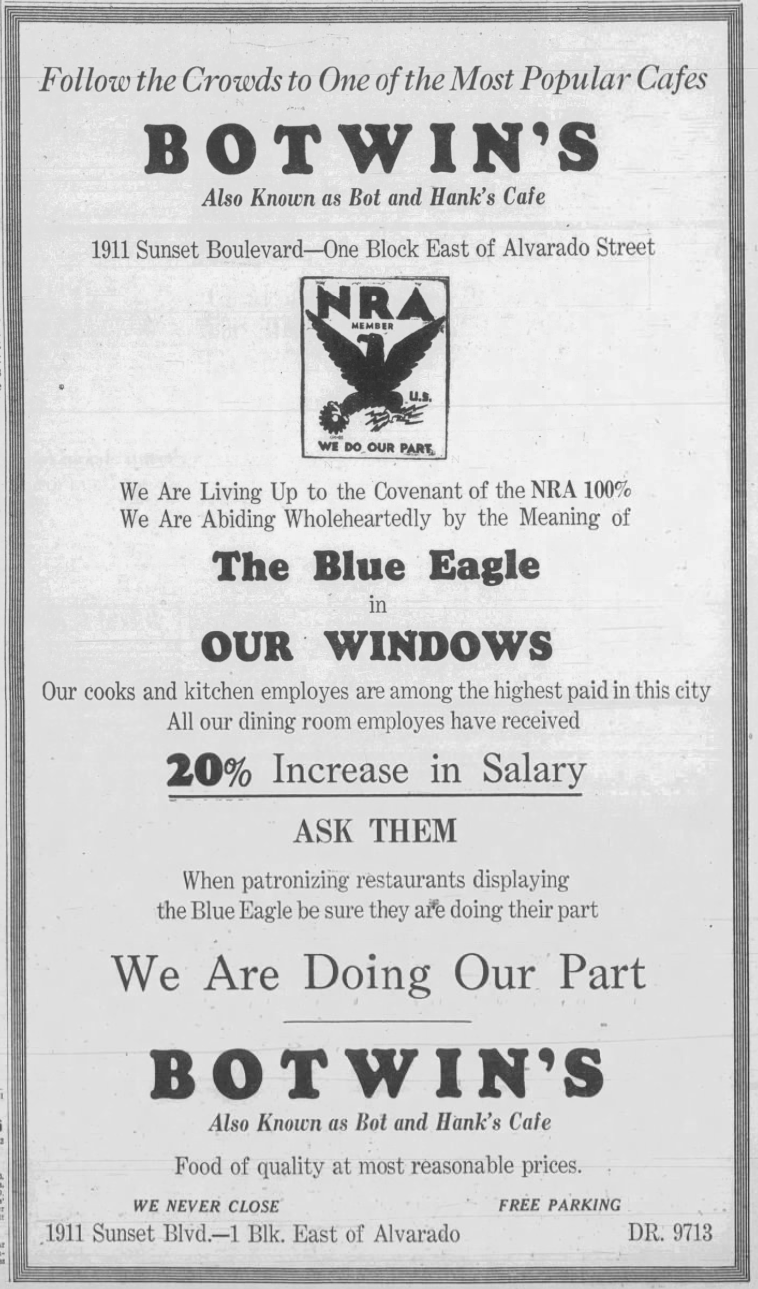
In 1929, Spaulding built a new structure on the lot, designed by Edgar E. Butler, and rented it to Noah Samuel Botwin. Botwin opened a cafe called Botwin’s Cafe. From roughly 1931 until roughly 1934, it was known as Bot & Hanks Cafe, presumably when Botwin added a business partner. The advertising, bizarrely, highlighted the NRA rather than its menu – but it was known for steak, seafood, and cocktails. Botwin expanded his restaurant in 1938. In 1939, there was a shootout between police and a gang from Belvedere outside of Bowtin’s following a robbery. By 1940, Croft’s store was a liquor store owned by W.B. Taylor. The sign east of Taix was installed in 1947.
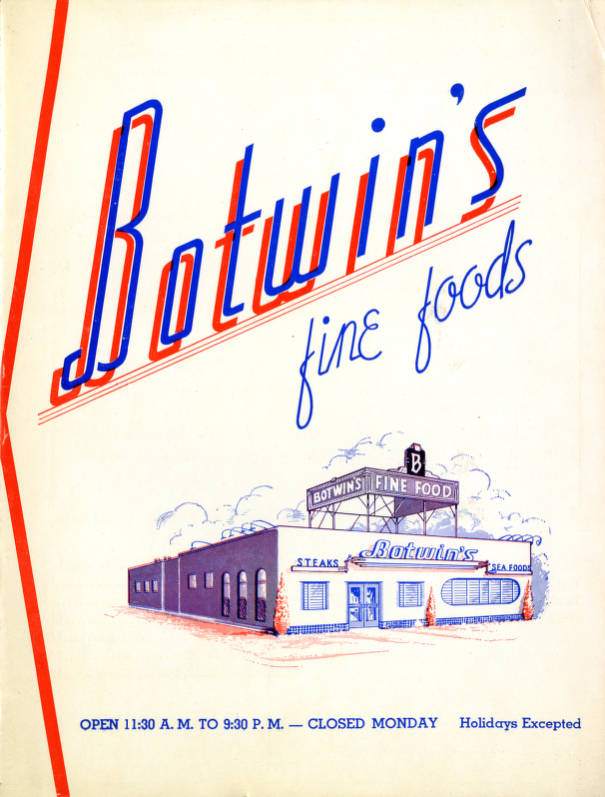
Aerial images of the current Taix building reveal it to be an assemblage of several buildings along Reservoir Street and Sunset – requiring so many substantial renovations that the County Assessor gives it a construction date of 1929 – but an “effective” construction date of 1953. By 1951, Botwin had expanded into a neighboring business to create Botwin’s Cafe & Sierra Room. The latter, it was noted, was decorated with a painting of Mammoth Lakes. 1953 was also the year that Botwin was appointed a City Health Commissioner by Mayor Norris Poulson. In 1955, Botwin was involved in a liquor license payoff and, when exposed, resigned from his city position but Bowtin’s Cafe & Sierra Room remained. Botwin’s closed around June 1961, after more than thirty years in business. Noah’s wife, Iola, died in April 1966. He followed her that November.
RAFAEL’S
The Botwin’s space then became the short-lived Rafael’s. The cocktail lounge, the Sierra Room, remained. The owner, Rafael Monzo, had formerly worked at the Brown Derby and Ambassador Hotel’s Cocoanut Grove, both in Wilshire Center (in what’s now Koreatown). Organ music at Rafael’s was provided by the mononymous Johan. Monzo was one of the most recognized figures in the city’s restaurant scene and his tenure was important for introducing “Continental” cuisine to the area. The Renault Owners Club even met there – until it closed in or after May 1962.
LES FRERES TAIX
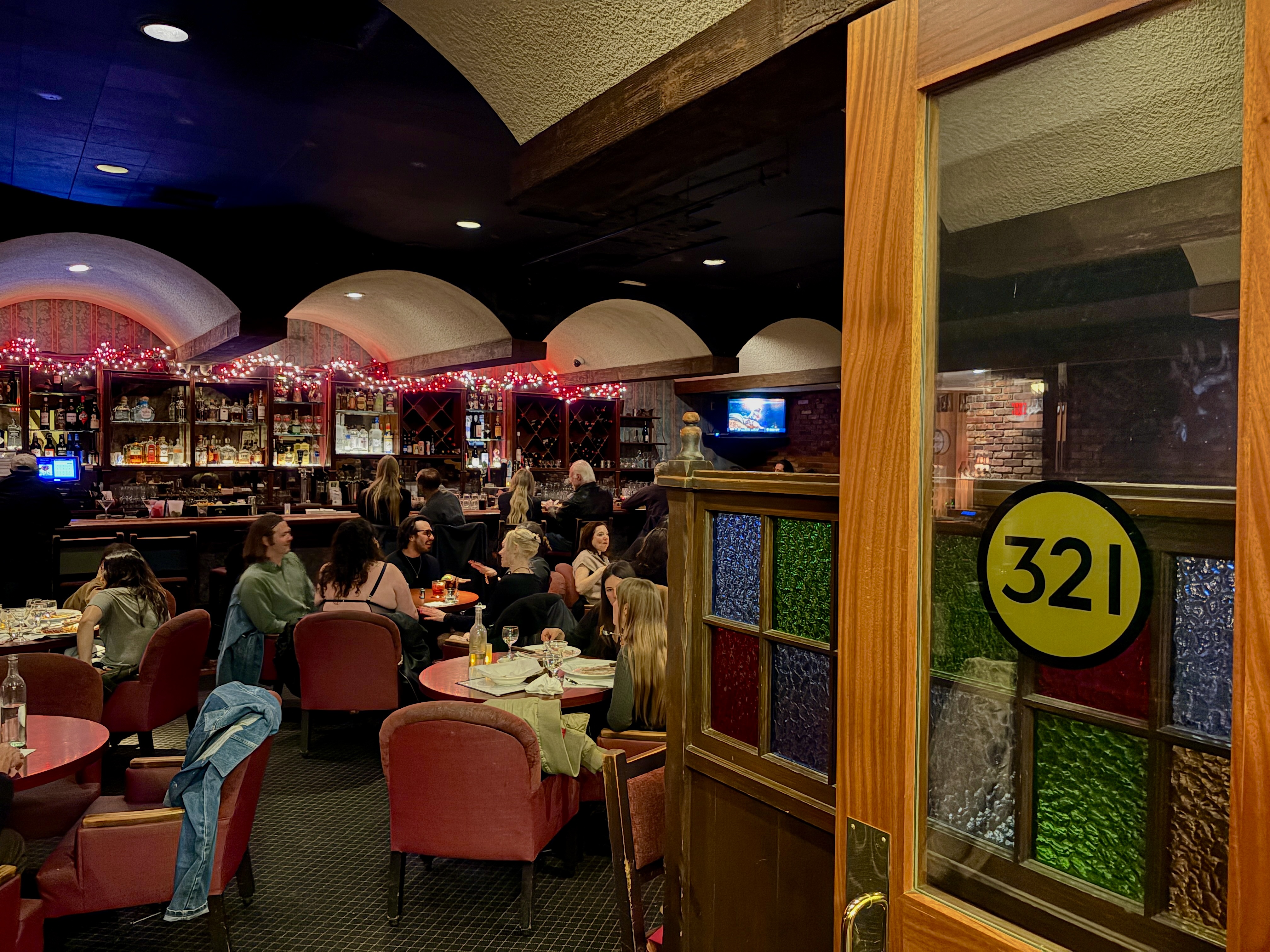
In October 1962, Marius Taix Jr.’s sons and former dishwashers, Raymond and Pierre, opened their restaurant (with Lucille Cordelia Taix‘s husband, John August Narp) in the former Botwins called Les Frères Taix Restaurant. The cocktail room, the 321 Lounge, was a nod to the address of the original Taix, which continued to do business Downtown, even though Frenchtown, itself, was no more. Philippe had decamped for Chinatown when its location of the previous 26 years was demolished to make way for the destruction/construction of the 101 Freeway. Les Frères Taix was the fourth restaurant or bakery bearing the Taix name and, rather than stumble over French “r”s, people took to referring to it as “the new Taix.”
Larquier died on 13 July 1964. The original Taix, where he worked, closed on 12 October 1964. The “new Taix” became the only Taix. The original home of Taix was demolished, along with ten other buildings from the 1880s, so that the city could build a structure for car storage. The parking garage was demolished and replaced with the Metropolitan Detention Center, construction of which began in 1986. Pierre Leon Taix died on 8 February 1986.
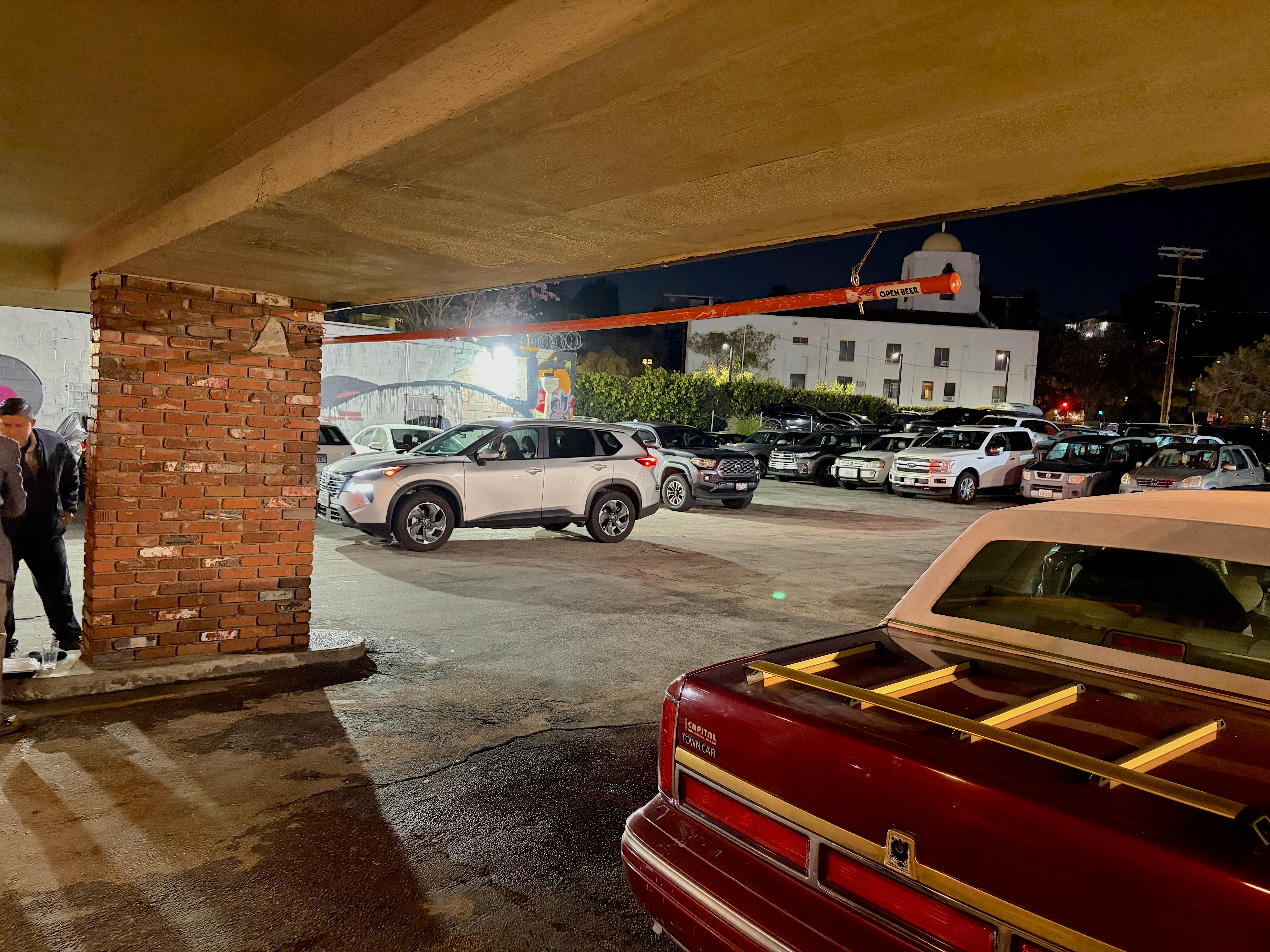
The new Taix underwent major expansions, alterations, and renovations throughout the 1960s.. Adjacent buildings were demolished so that a surface parking lot could be built in 1966 and expanded in 1967, as dictated by “big government” since Los Angeles’s arbitrary parking mandates first went into effect in 1930. A partial basement was added in 1968. Taix is a large restaurant, occupying 18,418 square feet (1711 square meters). The parking lot, though, is huge – 25,613 square feet (2,300 square meters). There were, though, and are other ways of getting there. Although the San Fernando, Hollywood Boulevard, and Glendale-Burbank lines were discontinued in 1952, ‘54, and ‘55; respectively; Metro’s 92 route (which mostly follows the route of the Glendale-Burbank Line) was launched by Metropolitan Coach Lines in 1955 and Sunset has had bus service since the 1930s.
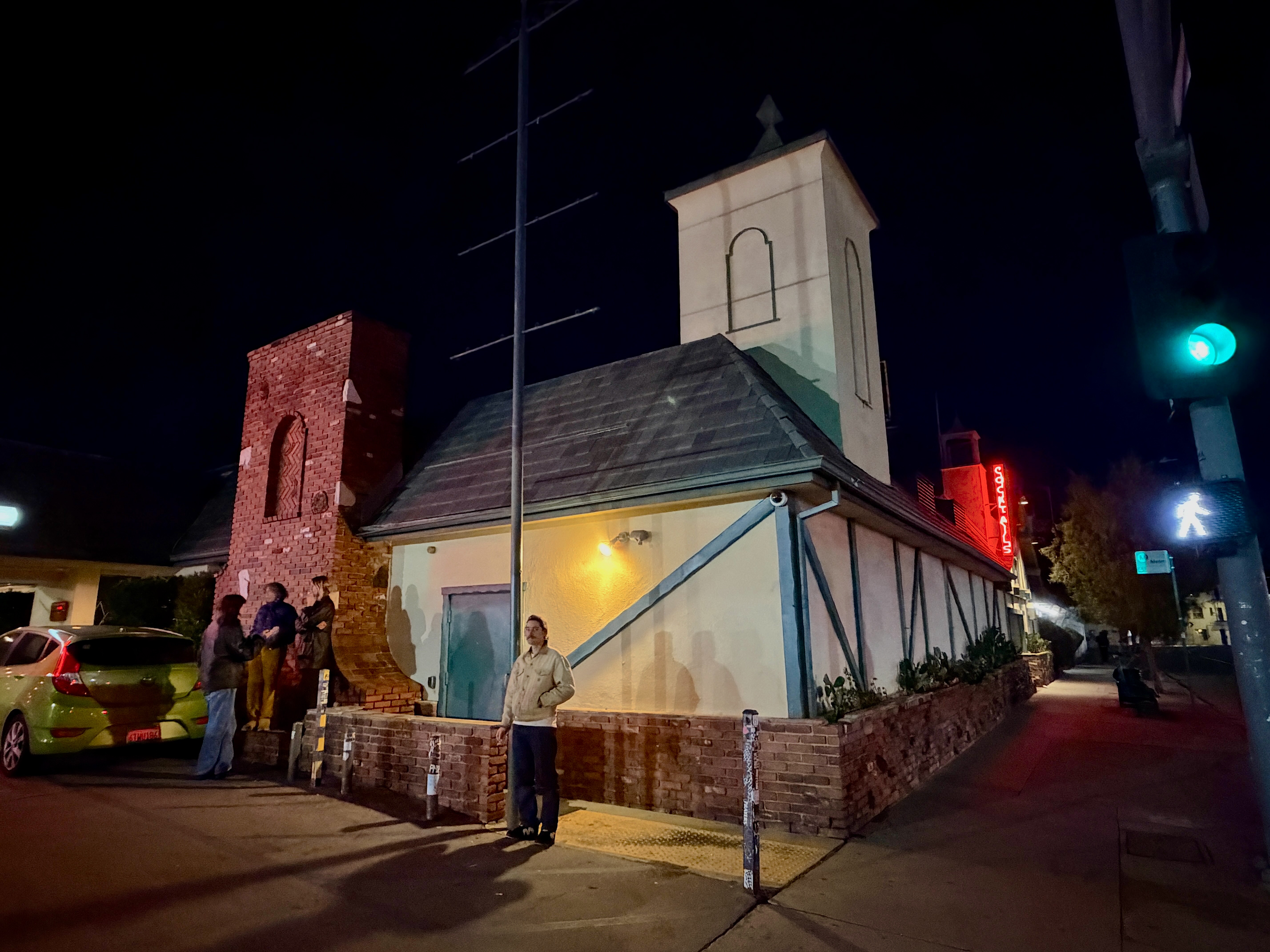
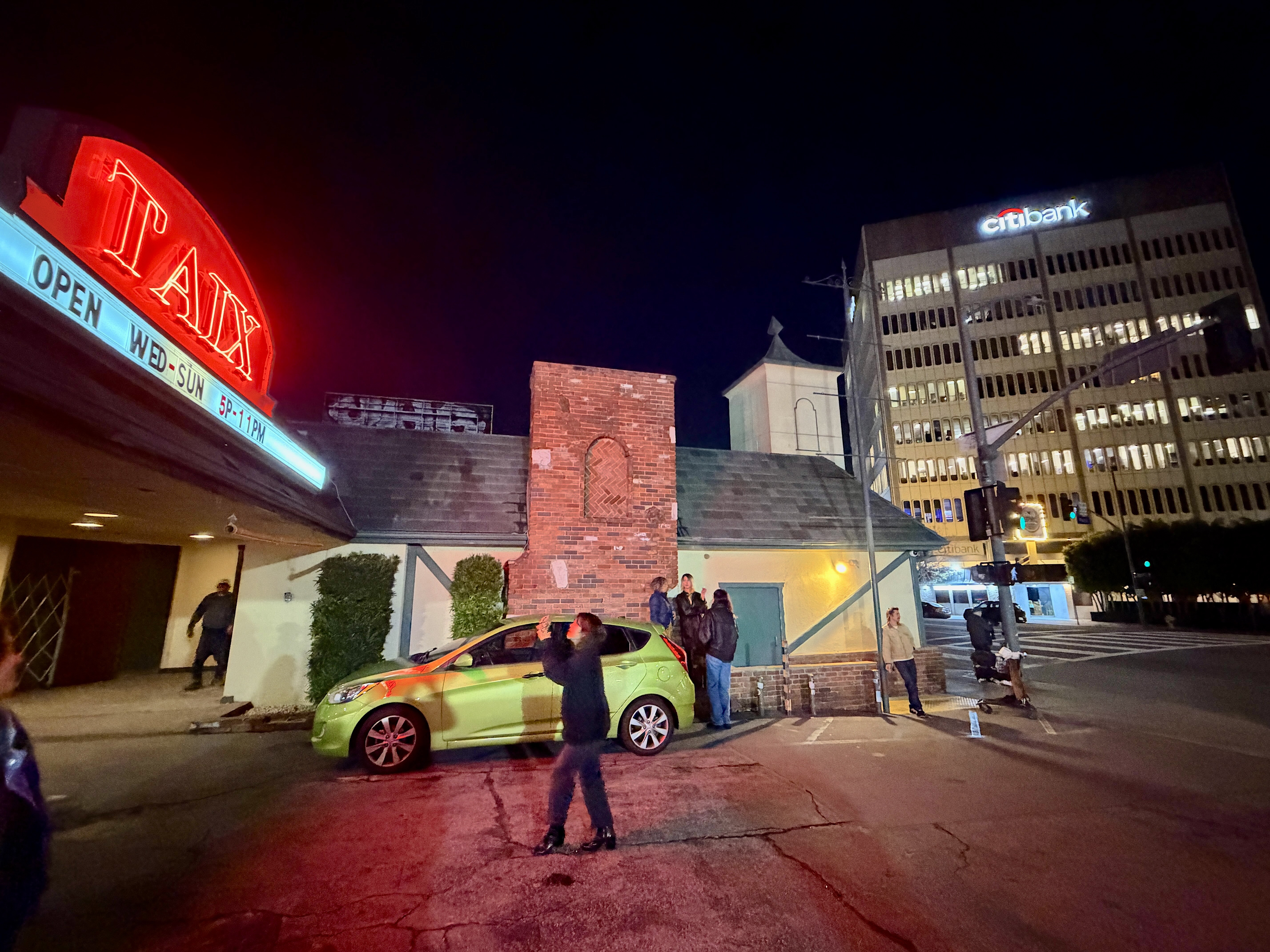
In 1973, artist Ed Ruscha drove his pick-up truck beyond the Sunset Strip, for the first time, to this end of town. The images of Taix that he captured reveal an exterior that looks pretty much indistinguishable from the version that we have today, it’s Norman Revival-style remodeling apparently complete. Subsequent street views reveal that the sign stating “Les Frères Taix” was replaced with a Tricolore sign, simply stating “Taix” in or after 1998. That sign, in turn, was replaced with the current one around 2010. Judging from the immaculate vibes inside Taix, today, I’d wager that the interiors, then, were pretty much as they are now. The ‘60s time capsule aspect of Taix, as is true with a lot of older restaurants, is what brings to them more than their menus.
There were more changes at Taix in the 1970s and ‘80s. In 1979, the wine shop was closed and converted into another banquet room. Taix has so many banquet rooms… but America’s and Los Anglees’s drinking habits were changing as the ‘70s transitioned into the ‘80s. Chardonnay was about to explode in popularity… along with White Zinfandel. Millennials and younger will have no concept, either, of how ubiquitous “wine coolers” were back then. Bartles & Jaymes, Seagram’s, Sun Country Cooler, White Mountain, Matilda Bay – once popular “starter booze” brands that will probably remain completely unfamiliar to anyone under 40 unless Decoder Ring dedicates an episode to them.
Michael Taix, son of Raymond, began his role as a manager in the 1980s and took over day-to-day operations in 1991. Raymond Marcell Taix died on 10 October 2010. In July 2012, City Council declared the intersection of Sunset and Park Avenue, Taix Square. The sign states, “Taix Square Established in 1927 by Marius Taix Jr. City of Los Angeles” which, whilst true, is a bit misleading – suggesting as it does that this restaurant opened in 1927 when, in fact, it opened in 1962 – which is still pretty old by Los Angeles restaurant standards – but, as I see it, there’s no reason to imply that the original Taix, which was founded in ‘27, moved to Echo Park, since it didn’t. In my mind – Taix Restaurant and Les Frères Taix were related but two different places on account of, you know, them both existing at the same time at different addresses, with different names, with different owners, different employees and, presumably, at least slightly different menus.
But that’s a minor grievance. Don’t even get me started on how disingenuous it is to refer to unimproved intersections as “public squares.” If I were to write the text of the sign, it would say, “Park/Sunset Car Sewer – a dangerous intersection with no pedestrian improvements, no traffic calming, no aesthetic considerations, and nothing beyond this dumb sign to suggest any historical significance to the building in front of which it exists.” Those “ceremonial” squares are nothing but photo-ops for city councilmembers and an excuse to pat one’s self on the back for a job well done for doing next-to-nothing.
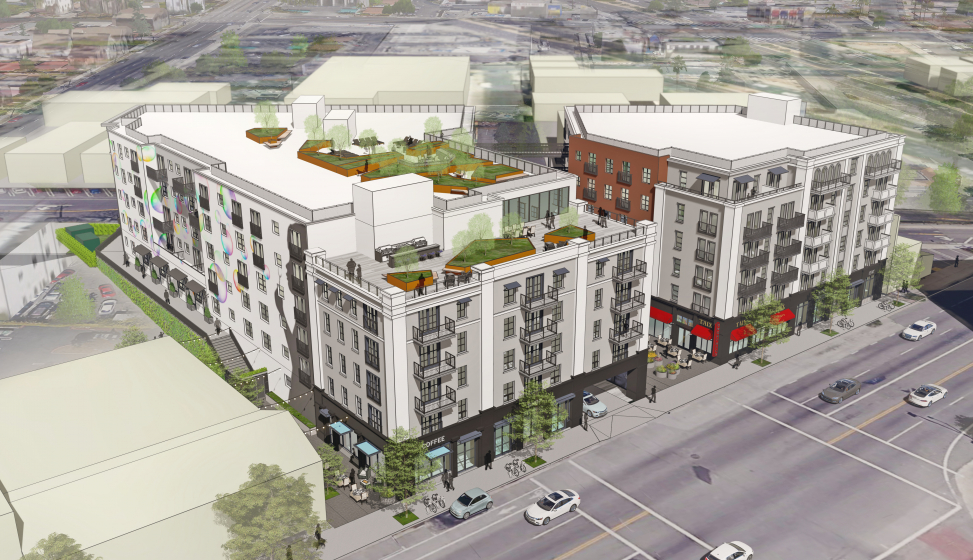
In 2019, Mike Taix sold the building to Holland Partner Group for roughly $12 million dollars, after which the restaurant leased the space. In May 2020, the Holland Partner Group announced their intention to demolish the building and replace it with a six-story, mixed-use mid-rise called Taix Square. Although designed by AC Martin, the renderings depict a development that’s decidedly reminiscent of Geoff Palmer‘s fauxtalian freeway fortresses — complete with streetlife-stifling gangways. The effect, as with Palmer’s constructions, looks like a prison designed by someone raised in an outlet mall… less Empire Français and than Empire Inland.
The Silver Lake Heritage Trust submitted a proposal to designate Taix as a Los Angeles Historic-Cultural Monument (LAHCM) that September and it was unanimously approved by the Cultural Heritage Commission on 17 December 2020.
Then-CD 13 councilmember Mitch O’Farrell intervened to water down the proposal, so that HCM status would only be applied to two of the restaurant’s neon signs and its cherry wood bar. The result was that Holland Partner Group could avoid the Environmental Impact Report typically required for the destruction of an HCM – a move the Los Angeles Conservancy set a “dangerous precedent” by hollowing out the city’s preservation laws for the benefit of developers. O’Farrell eventually lost his re-election bid in 2022 and the 30-year Glassell Park resident moved back to Oklahoma.
In the other corner, Mike Taix stated the building was too large, too expensive to maintain, and functionally obsolete. If he and his wife, Karri, wish to retire from the restaurant business, that’s their right – and if none of their family want to enter the restaurant business, that’s also theirs. Mike Taix argued that a smaller space for a “New Taix” was essential to preserve staff jobs. Some YIMBYs argued that the creation of 166 new housing units (including 24 low-income units) was more important than preserving a building that really wasn’t that great. Besides, once the generic new building is completed, around 2030, a new version of Taix will move into the ground floor.
MY TAKE
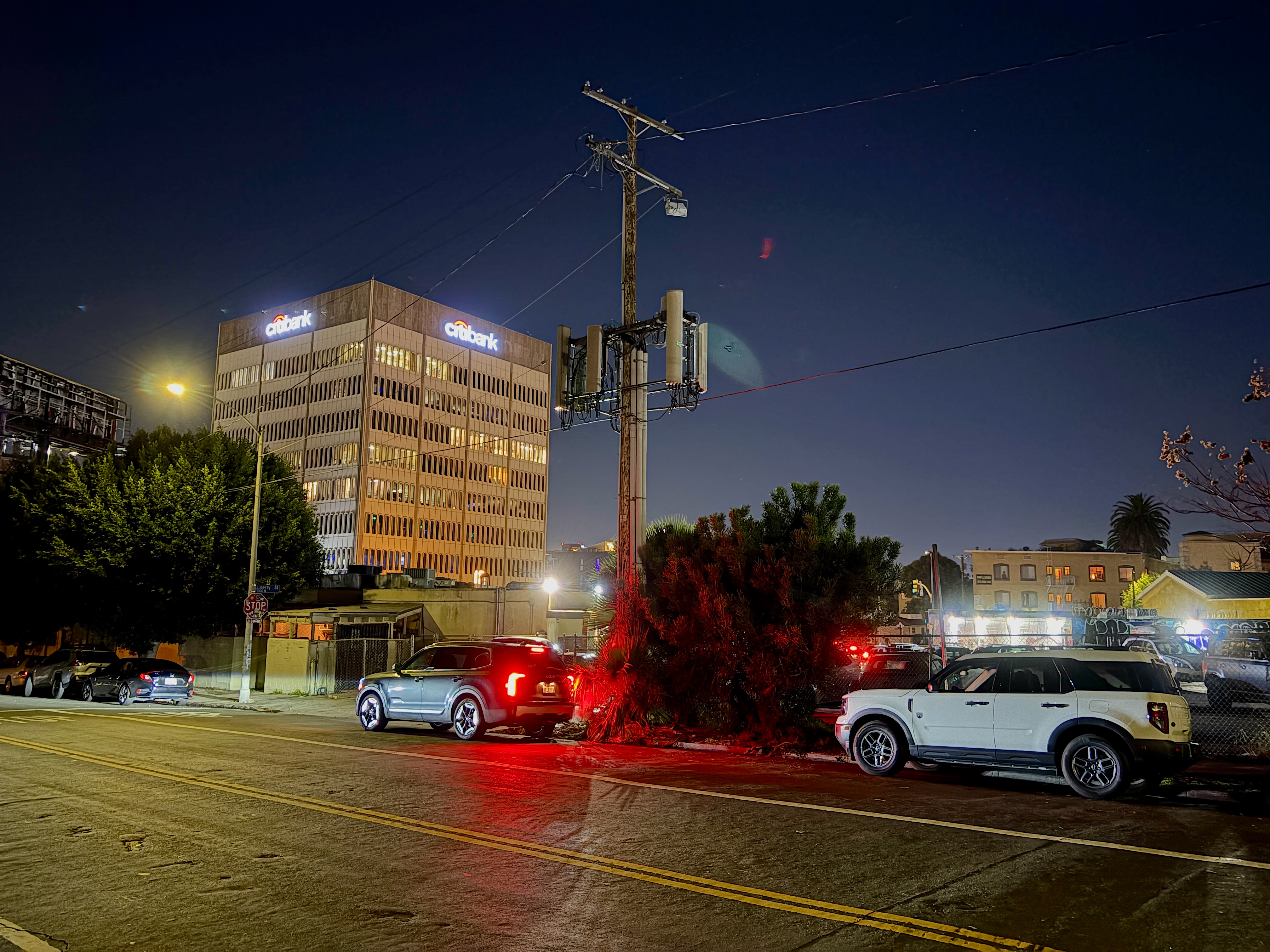
My take is somewhere in between. I can’t imagine a place where six-stories would strike me as inappropriately tall. Six-to-ten stories is the height range, of most of my favorite, pleasantly dense, walkable neighborhoods. Besides, there’s the iconic, eight-story Park-Sunset Building across the street that was built 61 years ago, when fewer Angelenos were apparently terrified of offending God with their Midrises of Babel. We do need more housing. And, as much as I like Taix, I don’t usually visit more than a couple of times a year.
On the other hand, we need more truly affordable housing – like social housing. There are 100-story buildings with the footprint of Taix’s parking lot and if more space was desired, knocking down the Smog Check Revival box next door wouldn’t trigger too many people. Build the tower without parking and you’ll assure that the people who move in are open to walking next door to Taix, expanding the restaurant’s base whilst preserving the building. But, to be honest, I like the building itself at least as much as the restaurant. Poor people, like myself, are capable of appreciating beauty, kitsch, historical significance, and charm, too – and I think a mix of attractive buildings makes for a better neighborhood.
The new building is scheduled to take three and a half to four years to build. Realistically, that means four to five years. Does anyone really think that Taix is going to re-open there after having been closed for five years? And, if it does, place your bets now on how long it remains a tenant of the new building. If Taix, in its current form, is unsustainably big with too many banquet rooms and dining rooms, perhaps they could’ve divided it back into smaller spaces and brought back the wine shop. If you want to attract Millennials and Gen Zers, just stock it entirely with a mix of natural wines and NA ones.
But it’s too late now. No one listened to me nor was anyone obligated to. Because not enough people wanted to eat here, this charming building will fall and it will be replaced with something charmless but that provides a few units of housing for some affluent, overseas, non-occupant investors. I suppose I should be happy that at least the bland new building won’t incorporate the facade of Taix. Façadism is the architectural equivalent of Ed Gein wearing masks made of corpseskin…. something even more awful, in other words, than generic mix-users with gangways.
The era of “formal-ish” dining ended before my time. Growing up a child of the 1980s, I never experienced places with giant dining rooms and multi-course meals or butter-and-cream-heavy French cooking. Julia Child’s The French Chef ended its run the year before I was born. When I went to France as an exchange student, we were more likely to be served paella, fish, or rabbit on a spit… all of which contributed to my decision to stop eating animals… except pâté. I didn’t know what pâté was – just that it was tasty and packed alongside camembert, Nutella, and bread for my school lunches.
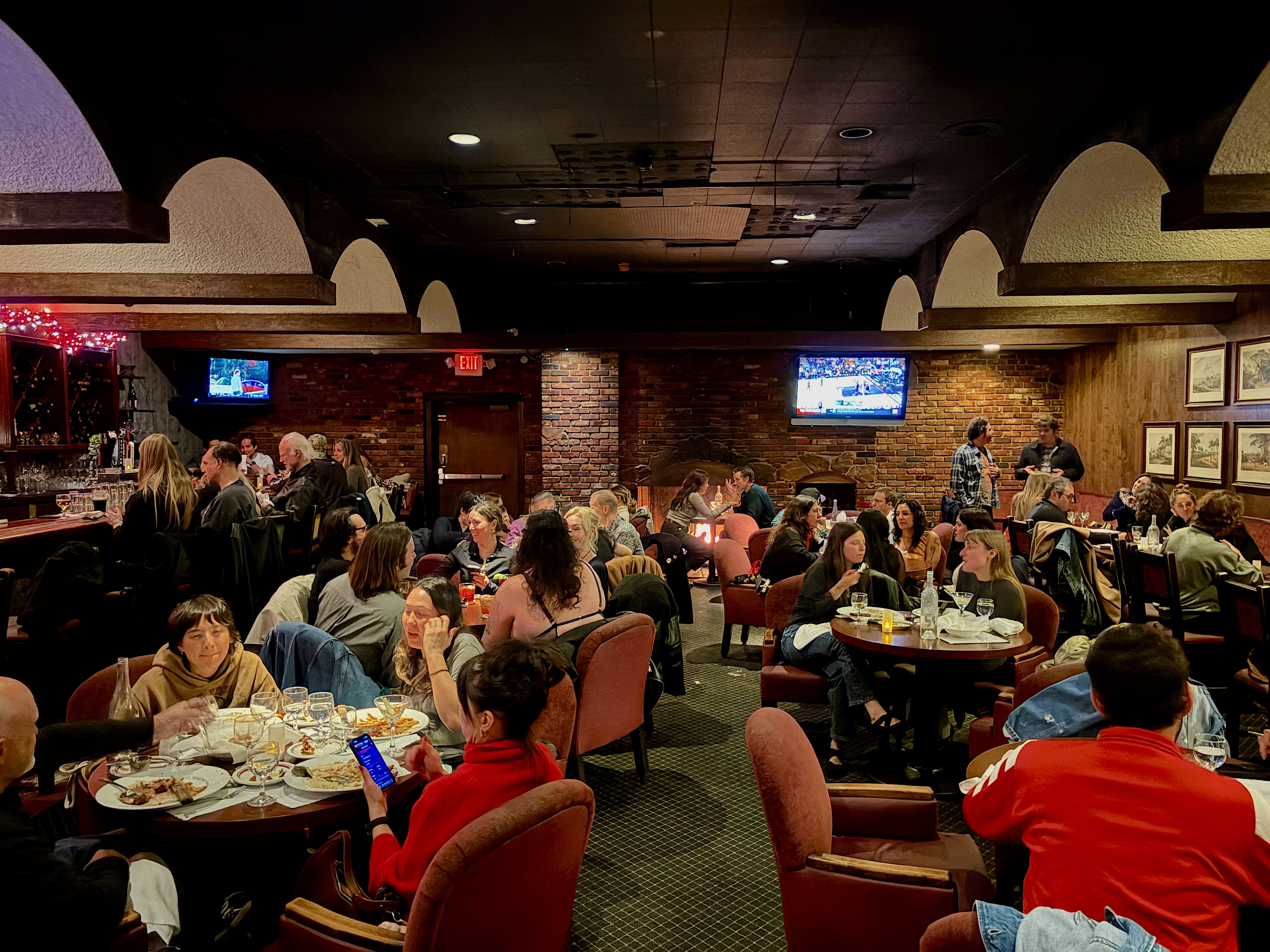
The menu at Taix, therefore, feels to me like it’s from another era… although they have admirably made attempts to cater to some of the more common dietary restrictions. There are numerous dishes marked vegan, vegetarian, and gluten free. The prices are modest – maybe even a bit less than you’d expect. I’ve gone to Taix for drinks, though, more often than dinner… but when several friends reached out about going for supper before it closes, I was all, “bien sûr. Allons-y!”
Taix is huge – it comes from an era when large groups of people dined out, more frequently, at places like Arcadia’s Derby, Atwater‘s Tam O’Shanter, Burbank‘s Smoke House, Clearman’s North Woods Inn, Fairfax’s Canters Deli, Hollywood Heights’ Yamashiro, Monterey Park’s Luminarias, Pico Rivera‘s Dal Rae, Rosemead’s closed Bahooka, and Vernon’s demolished La Villa Basque. Those days are gone. People get robots to deliver food to their door and then complain about having to retrieve and take it back to bed where they have romantic meals doomscrolling with their AI companions.
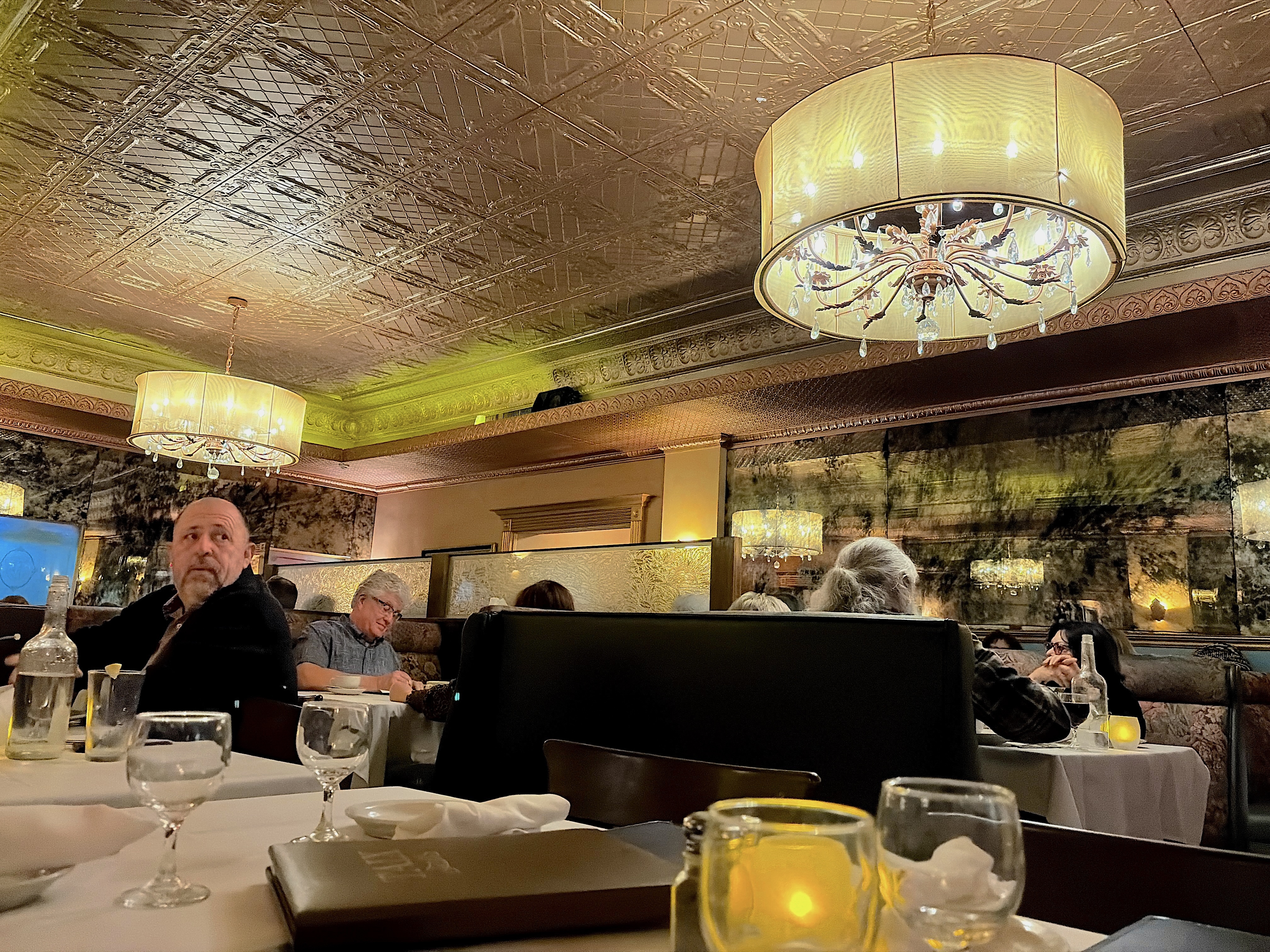
It was nice to have one more go ‘round with Taix. We were seated in the dining room with the Hollywood Regency vibes: antiqued veined mirrors, long booths, and giant, drum-shaded chandeliers, tin-plated steel ceilings. It looked like a dining room from – and I mean this in the best possible way – Point Break. It’s the kind of place you can imagine Liberace going on a date with Liza Minelli. Half of us got the soup of the day – a vegan navy bean soup – and salad (mixed greens with vinaigrette, caesar, and wedge. Jackie and Mike got Chicken a la Diable. Una got a mushroom risotto and a French 75. It was packed, of course, we were all too full afterward to look at the dessert menu.
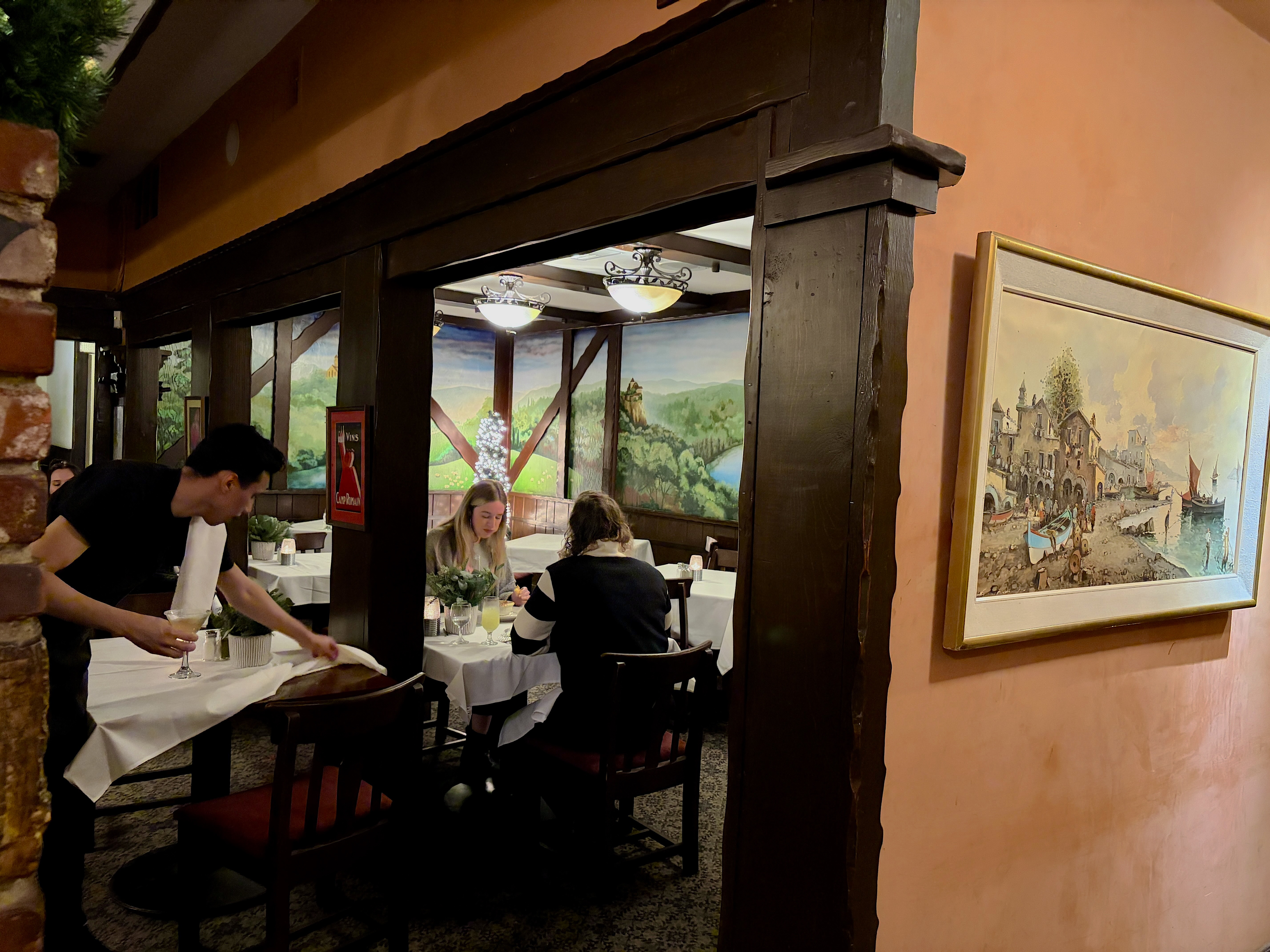
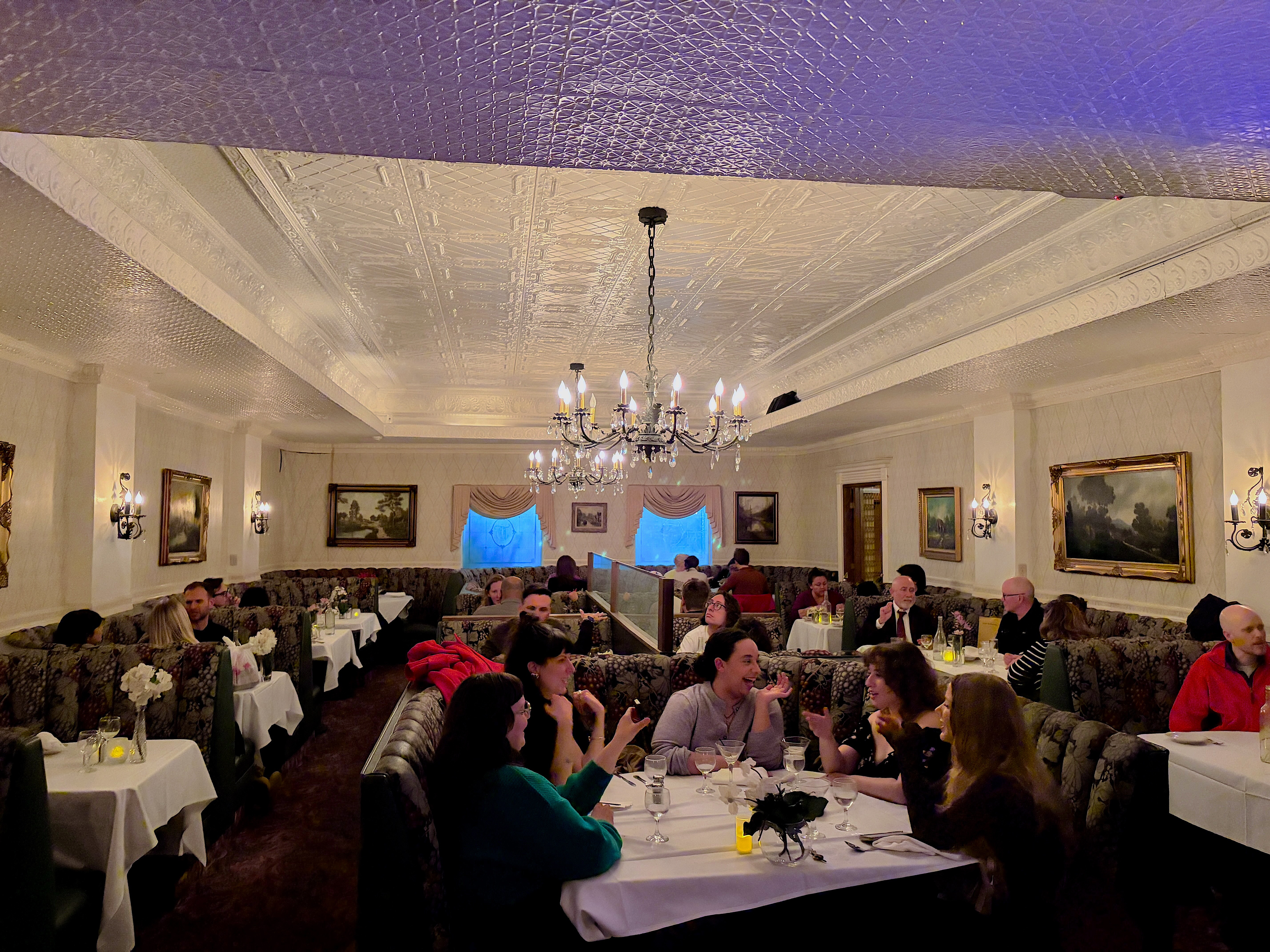
Instead, we wandered around, taking pictures. Just as I’d never been in the room in which we’d dined, nor had I the only slightly smaller dining room beyond that, decorated with framed paintings and heavy, folded window valances – even more Old Hollywood than the preceding room, like something from a Bette Davis film set during la Belle Époque. There’s also the small Rhône Room with the long table and a mural that Jackie once accidentally damaged in a “Mr. Bean moment.”
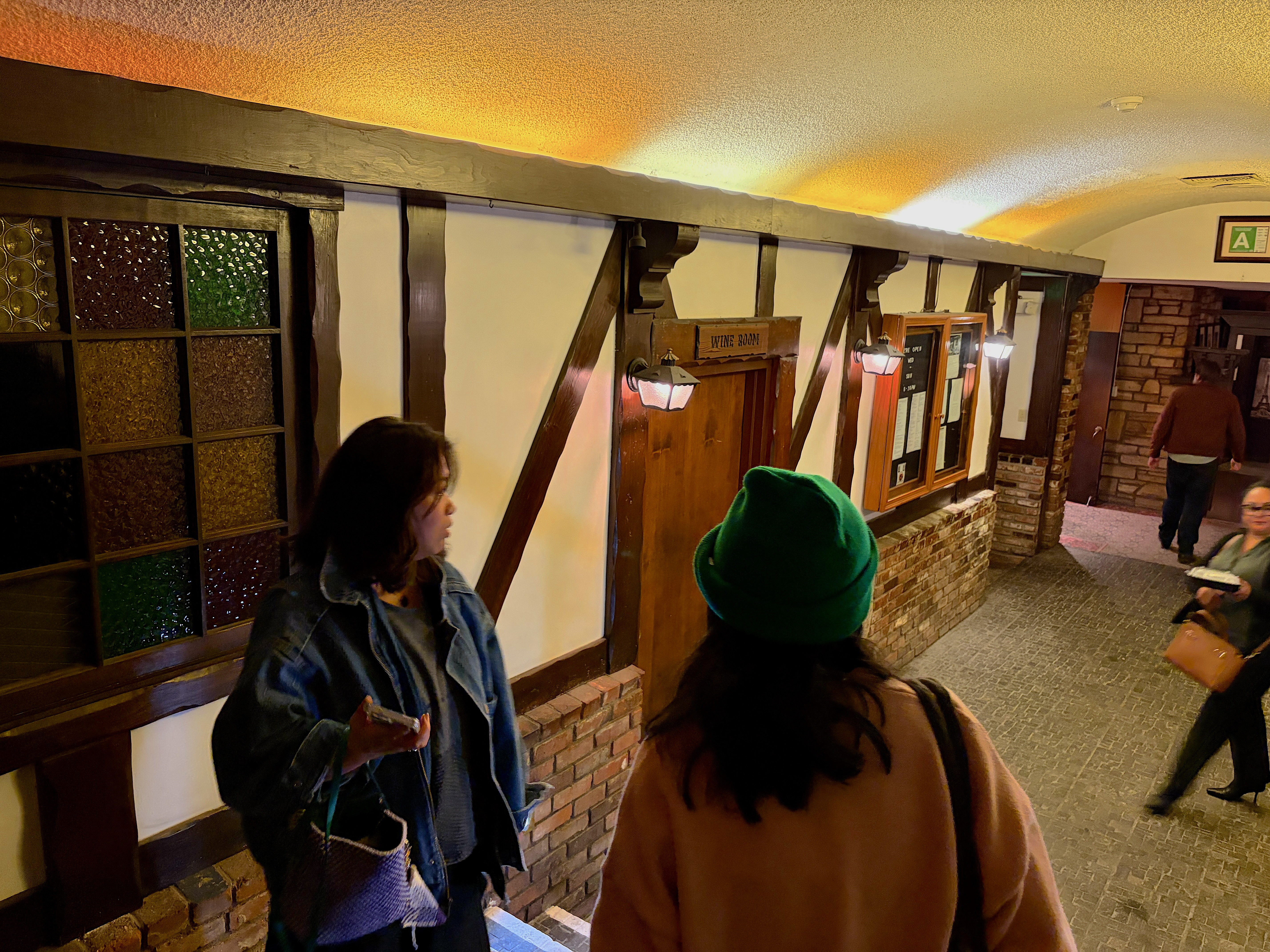
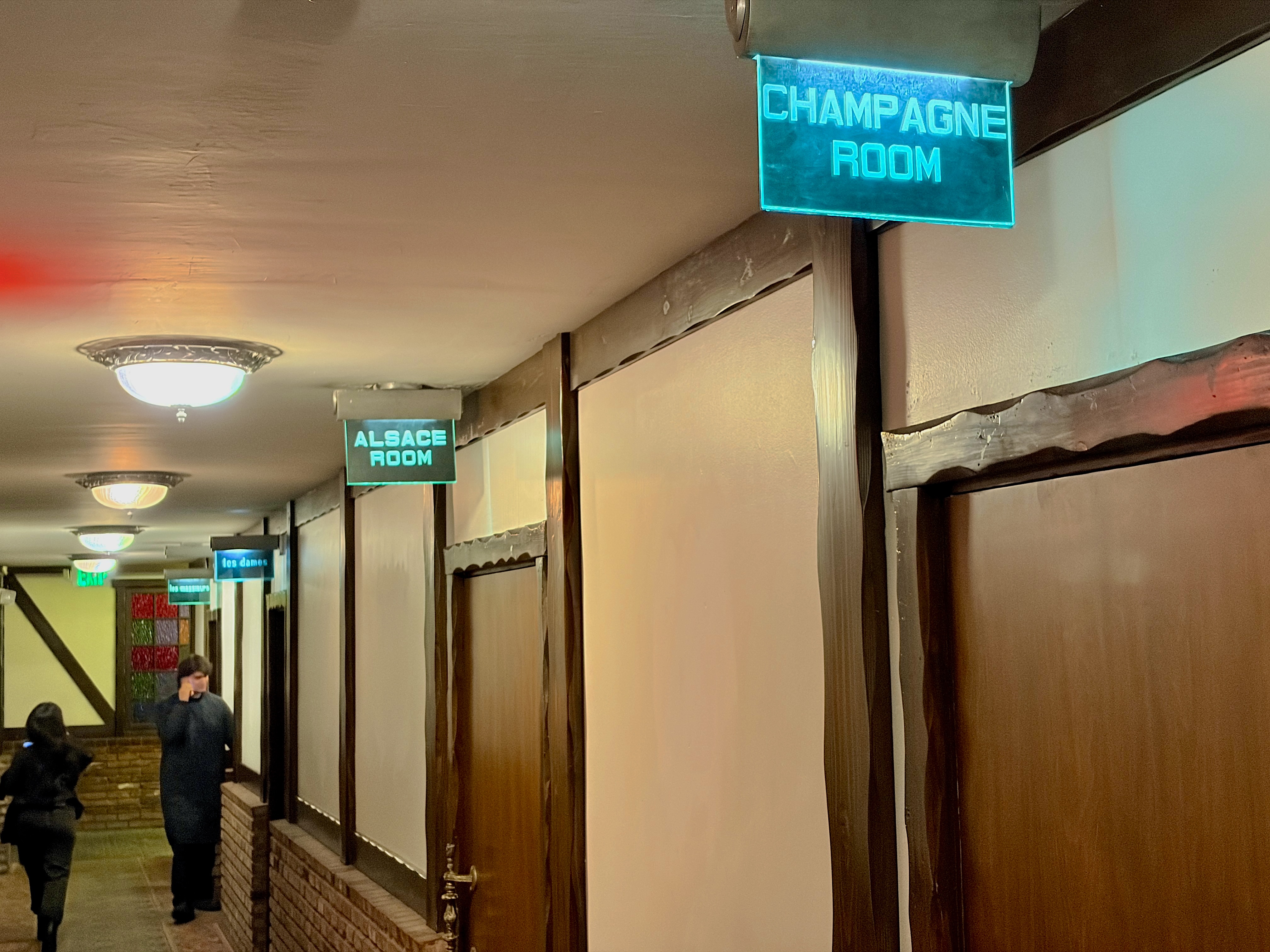
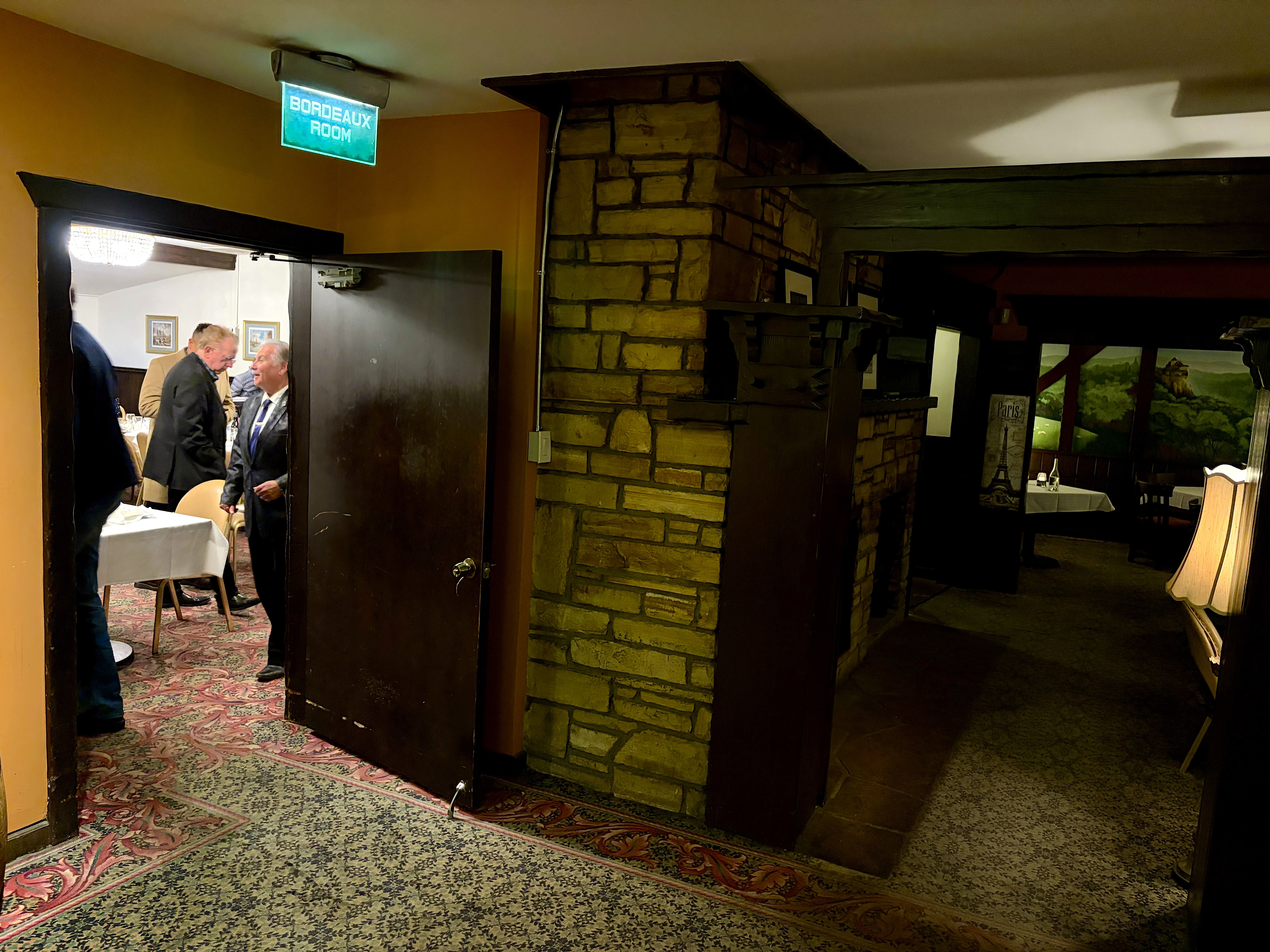
There’s the colorful, hammered glass and the cozy 321 lounge. I tried the locked doors to the Bordeaux, Champagne, and Burgundy rooms. There was a meeting of the Newman Club in one of them and we chatted, briefly, with the men… vests under leather-elbowed jackets and arms folded behind backs. He said that they’d been meeting there for I don’t remember how long – but despite my memory lapse regarding that detail, I do remember that he said it was “a night to remember.”
I suppose that part of living in a city is dealing with constant change. Cities are not museums preserved in amber — but nor should we demolish everything for luxury housing or car storage… especially for as long as there are surface parking lots just waiting to be developed. But, I suppose, every business closes eventually. Since I’ve lived in Los Angeles, I’ve had to bid farewell to more than a few that were dear to me: All’ Angolo, Alpine Village, Auto Bar, Baguette Express, Bahooka, Beer Town, Brouwerij West, the Cha Cha Cha, the Continental Shop, Craby Joe’s, Dinner Haus M, Ebisu, Eddie Brandt’s Saturday Matinee, Egyptian Lover’s, GALRARASL, Haru Ulala, Japan Arcade, Jurassic, the King Eddy, Los Amigos Mall, Mary’s Gate Village, Norwood Court, Nueva Rincon, Nyala, OB Bear, Papa Cristo’s, Paru’s, the Port of LA Waterfront Line, Port’s O’ Call Village, Rudolpho’s, Sassony Arcade, Skooby’s, Soju Town, and even Souplantation… le sigh. C’est la vie, je suppose!
Support Eric Brightwell on Patreon

Eric Brightwell is an adventurer, essayist, rambler, explorer, cartographer, and guerrilla gardener who is always open to paid writing, speaking, traveling, and art opportunities. He is not interested in generating advertorials, cranking out clickbait, or laboring away in a listicle mill “for exposure.”
Brightwell has written for Angels Walk LA, Amoeblog, Boom: A Journal of California, diaCRITICS, Hey Freelancer!, Hidden Los Angeles, and KCET Departures. His art has been featured by the American Institute of Architects, the Architecture & Design Museum, the Craft Contemporary, Form Follows Function, the Los Angeles County Store, Sidewalking: Coming to Terms With Los Angeles, Skid Row Housing Trust, the 1650 Gallery, and Abundant Housing LA.
Brightwell has been featured as subject and/or guest in The Los Angeles Times, VICE, Huffington Post, Los Angeles Magazine, LAist, CurbedLA, LA Times 404, Marketplace, Office Hours Live, L.A. Untangled, Spectrum News, Eastsider LA, Boing Boing, Los Angeles, I’m Yours, Notebook on Cities and Culture, the Silver Lake History Collective, KCRW‘s Which Way, LA?, All Valley Everything, Hear in LA, KPCC‘s How to LA, at Emerson College, and at the University of Southern California. He is the co-host of the podcast, Nobody Drives in LA.
Brightwell has written a haiku-inspired guidebook, Los Angeles Neighborhoods — From Academy Hill to Zamperini Field and All Points Between; and a self-guided walking tour of Silver Lake covering architecture, history, and culture, titled Silver Lake Walks. If you’re an interested literary agent or publisher, please out. You may also follow on Bluesky, Duolingo, Facebook, Goodreads, iNaturalist, Instagram, Letterboxd, Medium, Mubi, Substack, Threads, and TikTok.

.


 Eric Brightwell
Great article, Mr Brightwell! Learned a lot about early L.A.! You have a fantastic memory and wonderfully whimsical style for gift-wrapping this sprawling city’s complex history into fascinating essays.
Particularily enjoyed: “People get robots to deliver food to their door and then complain about having to retrieve and take it back to bed where they have romantic meals doomscrolling with their AI companions.”
Got to revisit Taix Restaurant soon – and also see that plaque marking Yaangna Village, the original heart of Los Angeles – and so many other places you’re mentioned!
LikeLike