This piece was originally written for “Ask Silver Lake.” “Ask Silver Lake” is dedicated to exploring the history and insights of our community. If you have questions or ideas you’d like us to consider, please drop a comment or send them to outreach@silverlakenc.org.
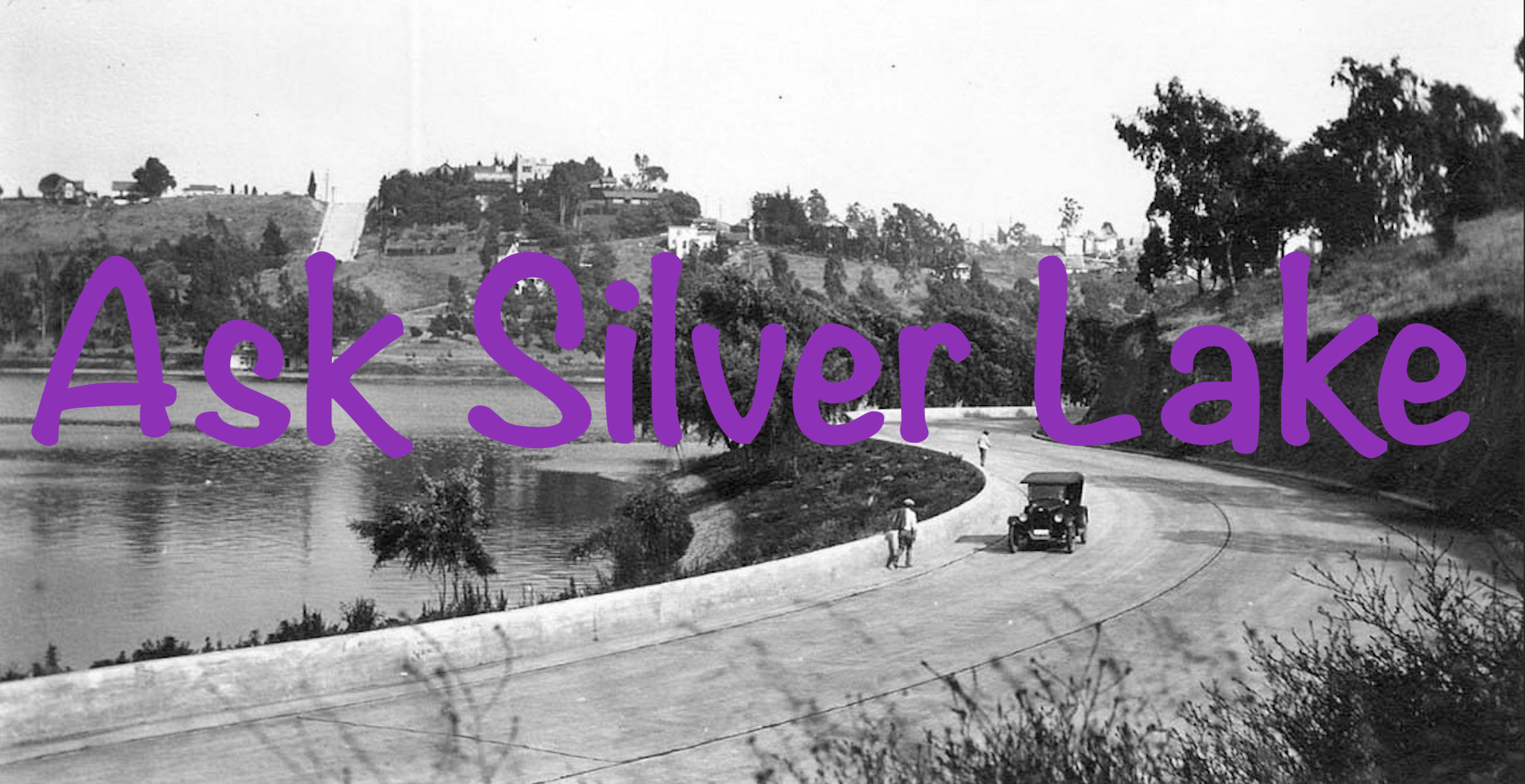
The subject of this month’s “Ask Silver Lake” is Silver Lake’s historic gay bars and other third places. It was written for Pride Month and seemed like a natural subject given Silver Lake’s decades-long identity as Los Angeles’s gayborhood. As was so often the case, however, I turned to have bitten off more than I could chew and here it is, let’s just say, fashionably late.
Third places, for the unfamiliar, are social spaces that are neither home (the first place) nor work (the second place). Third places include places like arcades, barbershops, bookstores, bowling alleys, coffee houses, community gardens, houses of worship, libraries, music venues, open streets events, public parks, &c. They are utterly essential in establishing and maintaining community. Third places are also essential to the well-being of the individual . For marginalized subcultures, they’re lifelines. Worryingly, though, third places are also in decline as humans increasingly deny their intrinsically social nature in favor of solitary pursuits like streaming, scrolling, and bed rotting.
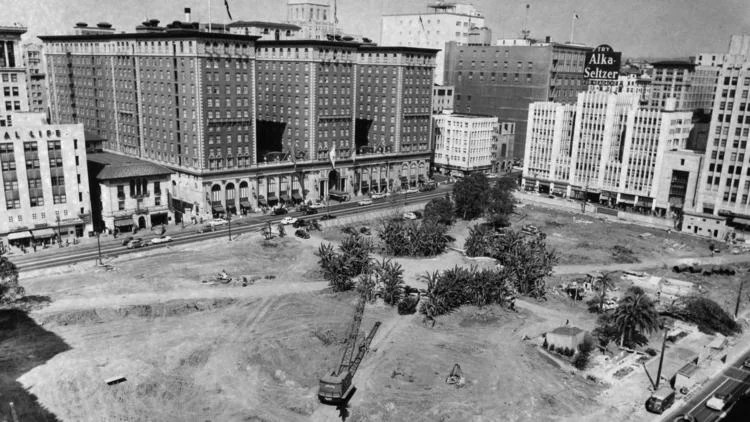
We can be sure that there have been gays in Silver Lake since it came into existence. From its earliest years, it attracted all manner of open-minded artists, Bohemians, and seekers. With homosexuality carrying the threat of loss of employment, a prison term, and lifelong registration as a sex offender, early Silver Lake gays were understandably closeted. Not that there weren’t rumors about some of its well known residents. There were those who said that the inhabitants of the Crestmount Estate — film star Antonio Moreno and oil heiress Daisy Canfield — were in a lavender marriage. Across the reservoir, in his grand Villa Capistrano, America’s first drag superstar and lifelong bachelor, Eltinge, lived a comfortable existence with his mother. Things began to change in 1950, when Harry Hay‘s International Bachelors’ Fraternal Order for Peace and Social Dignity morphed into the Mattachine Foundation. Meanwhile, in Downtown, Pershing Square was denuded of trees in 1951, in part to allow for the construction of five levels of car storage — but also at least partly to discourage cruising. Until then, it had been the centerpiece of the Run — an underground network of gay-friendly businesses and spaces. Not coincidentally, Elysian and Griffith parks, which frame Silver Lake, emerged as popular cruising spots.
Elsewhere in the city, there were gay speakeasies at least as early as the 1920s but it wasn’t until the early 1960s that Silver Lake’s (and East Hollywood‘s) gay bars began to quietly proliferate. These early bars tended to developed along a similar trajectory. A cafe would open and, before long, the owner would apply for a liquor license. This would be followed by the addition of a pool table, a piano, and a “cafe dancing” permit. Following a change of ownership or management, the windows would be boarded up and/or painted over. In 1964, two guy guides appeared, including Directory Services, Inc.’s Directory 43, The Advocate‘s Barlfy West, and Bob Damron‘s Address Book. All took a page from black motorist guides like The Negro Motorist Green Book and, before them, Jewish travel guides like The Jewish Vacation Guide, which catalogued spaces where their users could find amenities whilst avoiding confrontations with bigots.
As someone who has written a little bit about bar history, I have always found bars to be a particularly difficult (if not unrewarding) subject. They are not, generally, of architectural not and historians seem to regard them, on the whole, as unworthy of recognition. Plaques or stanchions are rare. On top of that, firsthand accounts are degraded not just by time but the effects of alcohol (and other drugs). Gay bars are even harder to research. The owners of them, naturally, did the best, generally, to keep their identities secret. Their patrons, over time, however, have helped fill in many blanks in the official record. Figures like Alexei Romanoff, Mark Simon, Walter Johnson, and an anonymous Redditor have all provided invaluable information.
Hopefully you, the reader, can fill in even more. Please share your additions, images, corrections, and memories in the comment section. Cheers in advance!
THE HY SPOT (1960 – c. 1971 | 1941 Hyperion Avenue | Also at this address: The Shingle Shack, Headquarters, Jack Wrangler’s Cruise Bar, Hyperion Lumber Company, and Cuffs)
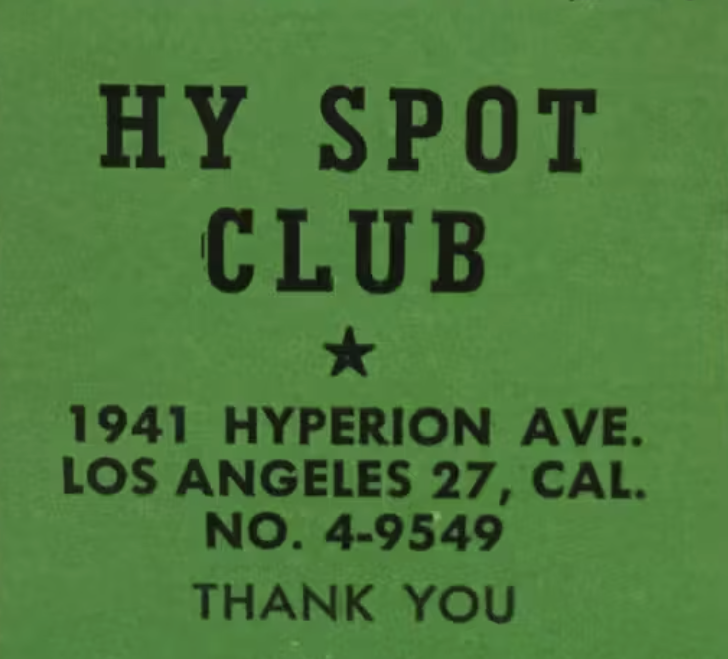
The first gay bar in Silver Lake (although, according to the Neighborhood Council borders, actually in Los Feliz) was almost certainly the Hy Spot Club. The building in which it was located— a nondescript black box (with a red door and incongruous barbershop pole) at 1941 Hyperion Avenue — has sat empty for five years. There are no obvious indications of its historic significance.
The Hy Spot Club opened in February 1960. In 1961, its owner applied for a license to sell beer. Like the gay bars that followed, it probably didn’t cater primarily to gays from the get-go but, by 1962, gay activist Alexei Romanoff was already tending bar there. In the 1971 edition of The Gay Guide, the writer noted:
Now this place is a riot. (That was a bad word to use) What we mean is that this joint jumps. You can almost tell by the stuttering in the mad, mad, mad… Both Wally and Woody are the kind of guys that you would like to be around, never a dull moment.
Was “Woody” P. N. Woodward — who opened Woody’s Hyperion Lounge down the street a few years later? It was, after all, around that time that the Hy Spot ceased to operate under that name — circa 1971. As was so often the case with gay bars, however, it was followed by another gay bar at that location (the Shingle Shack), and several other gay bars after that.
ANNA’S BAR-B-Q/ANNA’S STUDENT PRINCE (1961-1965 | 3335 West Sunset Boulevard | Also at this address: On Sunset and The Mine Shaft)
A restaurant called Anna’s Bar-B-Q opened at 3335 Sunset around 1961. By 1964, when it appeared in the gay guide, Directory 43, it was listed as Anna’s Student Prince and identified as a coffee shop. It’s not clear who Anna was, if anyone, but by 1965, the coffee shop would be known as On Sunset and then appeared in Damron’s Address Book.
NEW FACES (1962-1967 | 4001-4007 West Sunset Boulevard | Also at this address: Joker, The Gay’m, Sunset East Showbar, Circus of Books
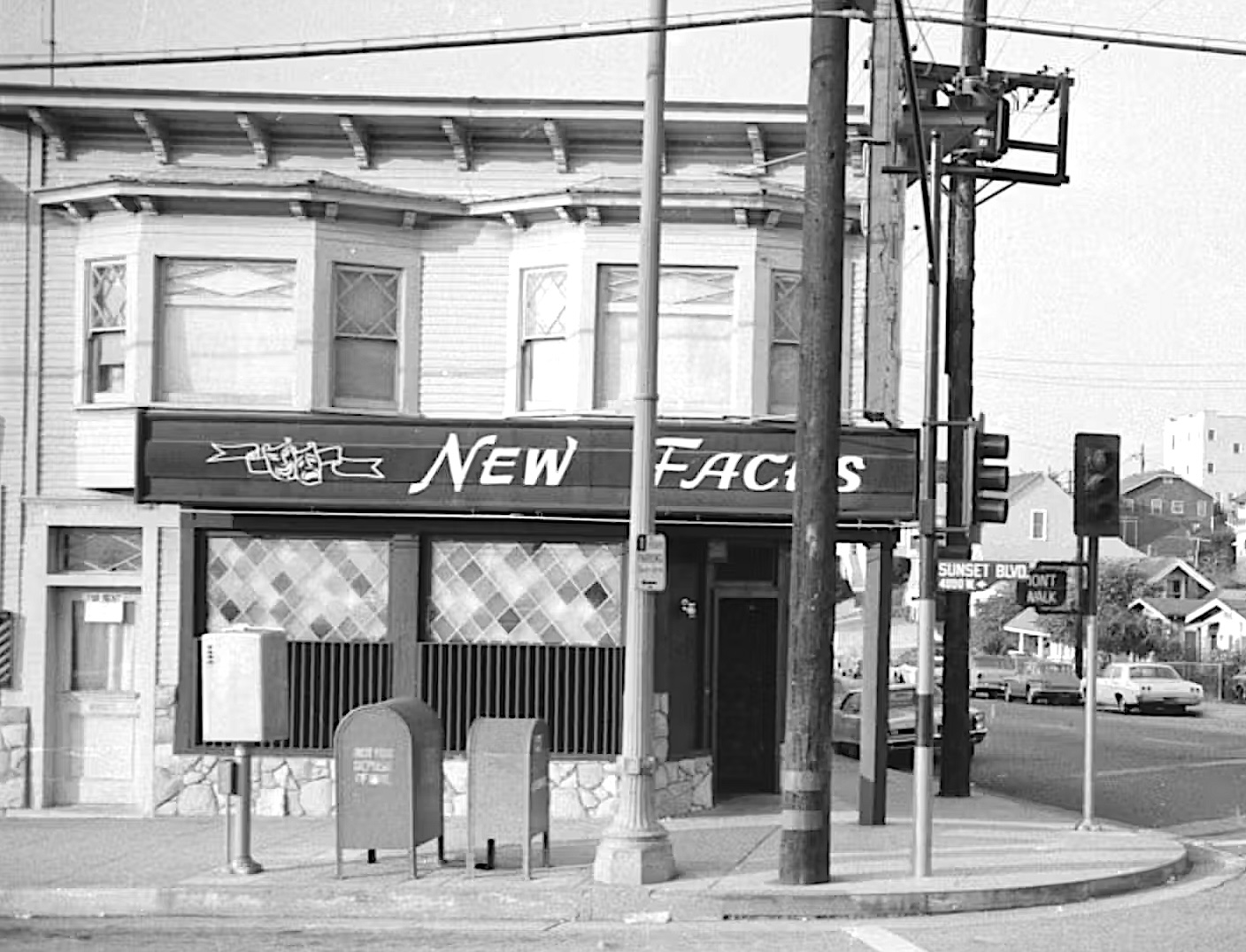
New Faces opened at 4001 Sunset in 1962. The building, constructed in 1911, had originally housed a small market. In 1921, it was transformed into H.A. Bauman Drug after the previous owner “moved east.” In the 1930s, there was Sam’s Buffet and, in the 1950s, Bartlett’s Fountain & Grill. After the Cuban Revolution, when refugees briefly transformed this stretch of Sunset Boulevard into Little Havana, a restaurant called Eliborio opened there. By 1961, it was home to a short-lived restaurant called Casa d’Oro. It was apparently home to Paddy’s Pub after that.
In 1962, when a businesswoman named Lee Roy poached Romanoff from the Hy Spot for New Faces, which they ran for five years. On 1 January 1967, a mob of LAPD officers assaulted the New Year’s Eve celebrants at New Faces after doing the same at the Black Cat. In the melee, manager William Morgan was beaten and left bleeding on the ground. Five LAPD officers beat and kicked the bartender, Robert Haas, breaking his jaw and rupturing his spleen before charging him with felonious assault of an officer. Because she was dressed up for New Year’s in a gown — but bore a gender-ambiguous name — the cops wrongly assumed the the single mother, Lee Roy, was “masquerading” and beat her mercilessly — breaking her collarbone and afterward, dragged her onto the street. Rather than apologize, the cops continued to raid New Faces nightly until the owners understandably threw in the towel on 21 January 1967. The space would afterward become a restaurant, Smorgasbord, before a second stint as a gay bar, Joker.
CASITA DEL CAMPO (1962-present)
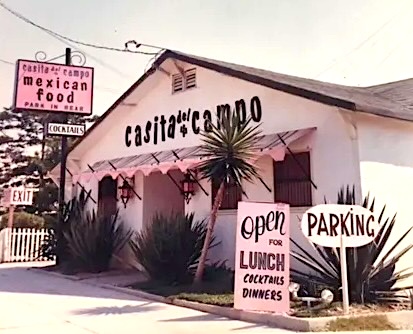
Casita del Campo isn’t technically a gay bar — but you’d be forgiven for regarding it as one — albeit one that also serves Mexican food. It does have a popular bar, though, and it has since its inception been popular with gay clientele — including Hollywood figures like Rock Hudson. It was founded in May 1962 by dancer Rodolfo “Rudy” Martin del Campo, his wife, Helen Silver, and his sister, Beatriz. In 1965, Rudy del Campo began a relationship with one of the restaurant’s waitresses, Nina Souza, and three years later he divorced his wife. For years, Casita del Campo hosted gay cabaret performer Rudy de la Mor, whom the LA Weekly would later describe as the “gay Victor Borge.” In 1994, a drag venue, the Cavern Club, opened in the restaurant’s basement under the direction of Mr. Dan (Dan Derkacz) and DJ Paul V (Paul Vitagliano). Today, more than 60 years later, it continues to serve the community under the ownership of Rudy’s and Nina’s son, Robert del Campo.
EXPLORER (c. 1962- 1973 | 612 North Hoover Street | Also at this address: The Woodshed, One Way, and The Exile)
Explorer opened at 612 North Hoover in the Dayton Heights section in or before 1962. The building, constructed in 1922, had been home to Selma Silverstone’s dry goods store until a bar opened there around 1950. That same year, patrons Kenneth R. Orr and William Sweet engaged in a knife fight that left one seriously injured. In 1953, another bar — or merely a new owner — John F. Strain took over.
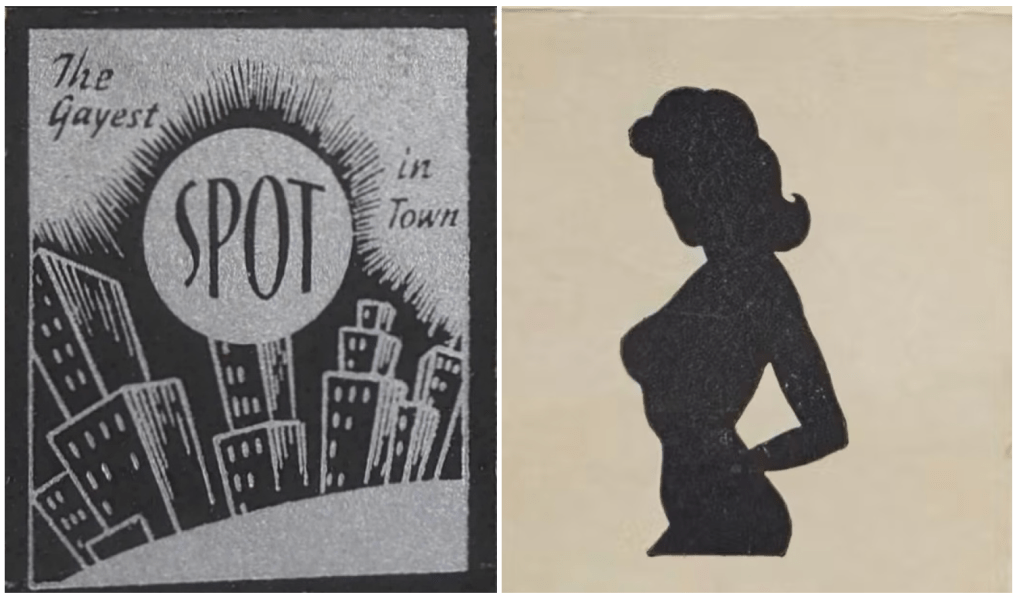
An early matchbook advertising it featured the silhouette of a woman with back arched and hands on hips — likely as cover for its true orientation. By September 1962, there were want ads in The Los Angeles Evening Citizen News for a bartender at Explorer. The bar was listed as for sale in 1963 with the word “gay” in quotes. Other bars in the same listing were tagged “B’hemian” or “piano” — all of which suggest gay-friendly venues. Although “gay” had been used by homosexuals since at least the 1920s, mainstream America only understood “gay” to mean carefree and fun until the late 1960s. Since ads charged by the word, I doubt it was included as a throwaway adjective — but rather as code. As was also often the case with gay bars of the era, Explorer was represented by a fixer known as a “beer bar consultant” — in this case, Stan Zachary. Other matchbooks from Explorer also listed the similarly space age-inspired Satellite (on the East Hollywood side of Dayton Heights) and Jupiter (address unknown) — promoting all three, simultaneously, as the gayest spot in town. Explorer closed around 1973 and likely continued another gay bar, the Woodshed.
THE PLACE (c. 1963-1971 | 1087 Manzanita | Also at this address: Don’s Male Box and Detour)
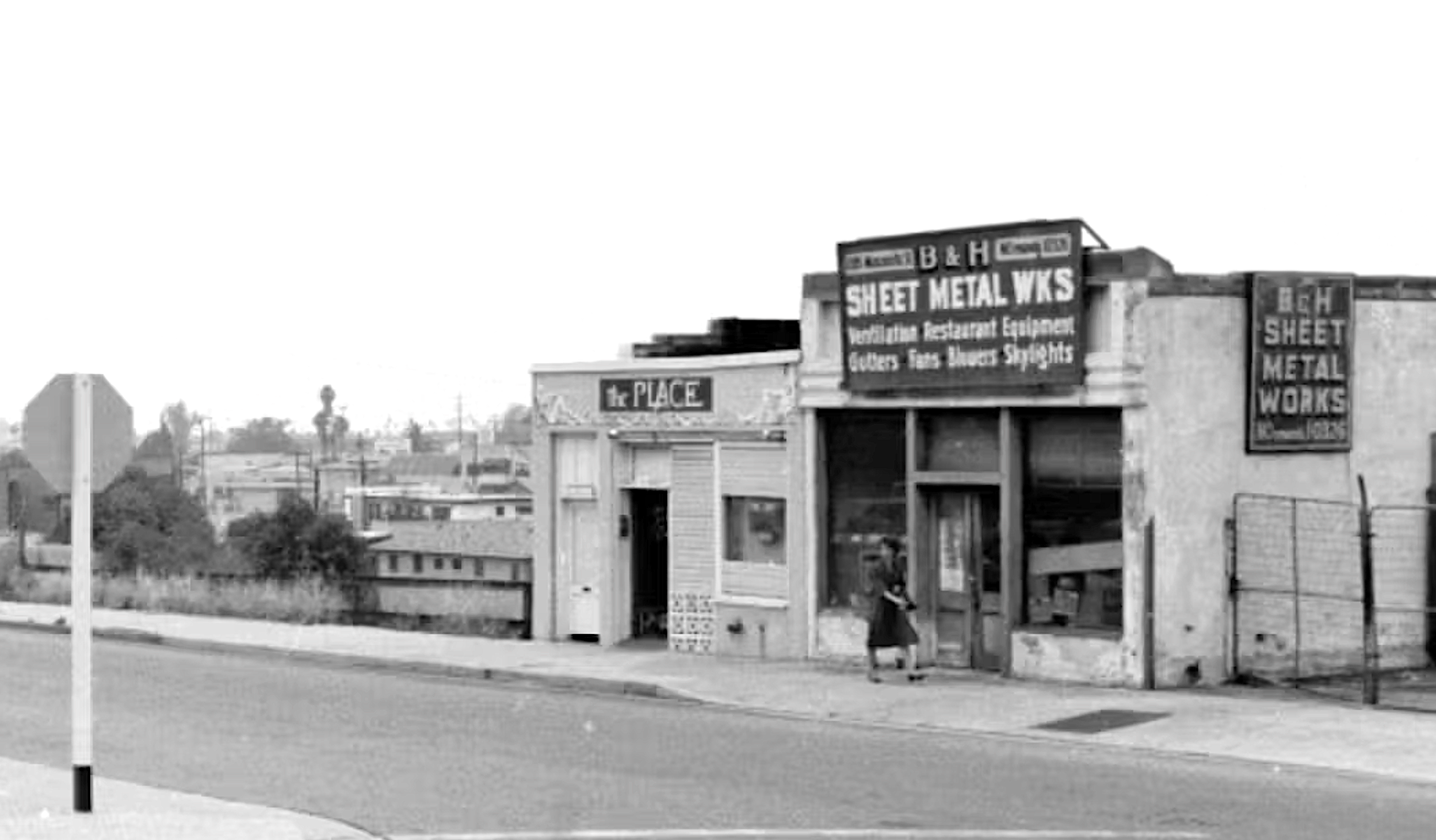
The commercial duplex at 4100 Sunset Boulevard (and 1087 Manzanita Street) began life in the 1920s as the Day and Night Market. The split addresses make its historical record somewhat convoluted but, in its early years, it was also home to Lewin Brothers Market, Sunset Storage, Bros Storage and Furniture (not a gay bar), and other businesses. In 1963, Samuel Gilbert applied for a permit to open a cafe there and, in 1964, Bernard Gilbert applied for a beer license in what had previously been a vacant space. There may have been a bar called Curly’s first but, by at least 1966, it was known as the Place (aka, apparently, “Connie’s The Place”), which shared the building with B&H Sheet Metal Works. The Place remained at that… place until around 1971.
THE BLACK CAT (1964-1967, 2012-present | 3909 West Sunset Boulevard | Also at this address: The Buswhacker, Tabasco’s, Basgo’s Disco, Le Barcita)
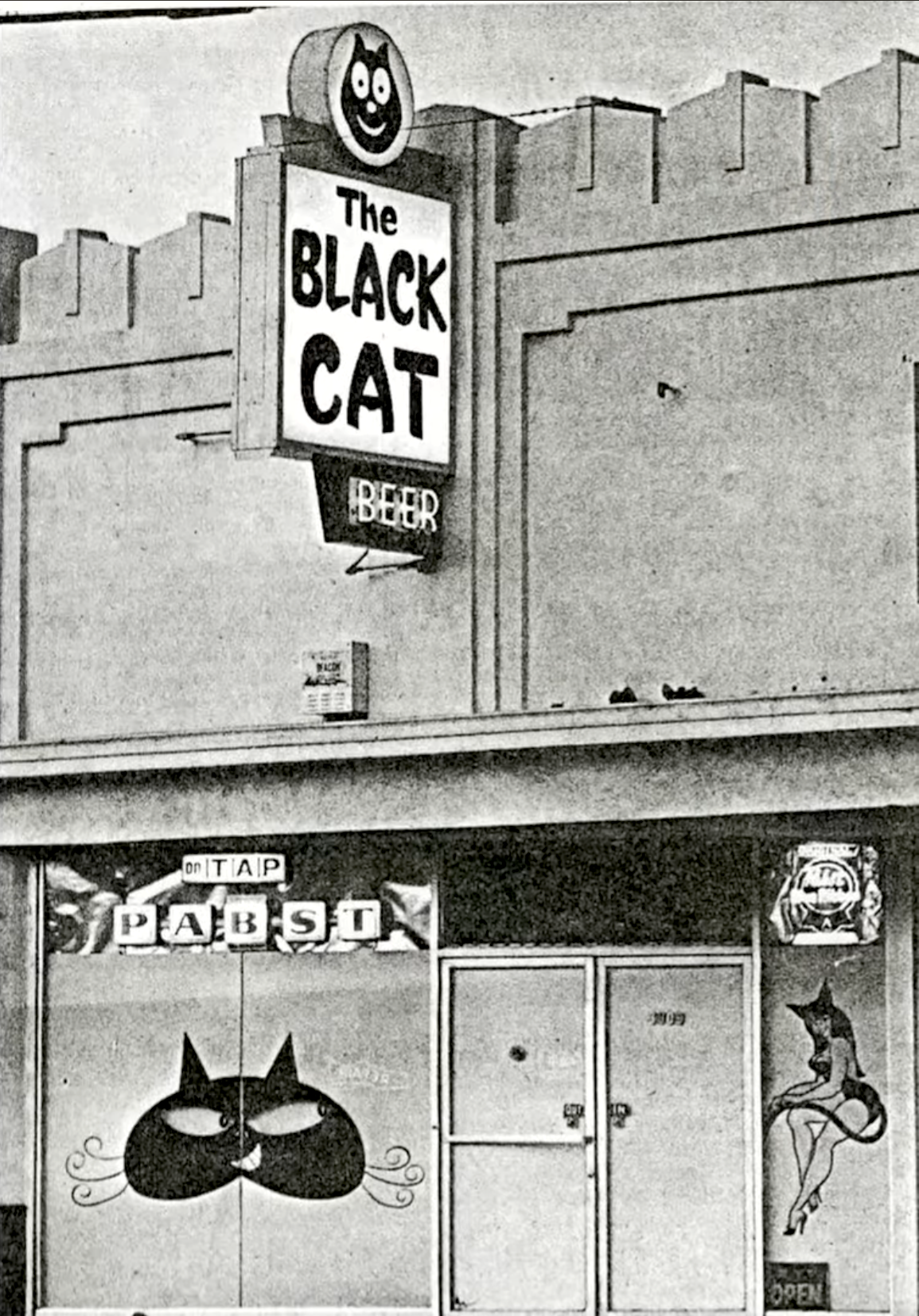
Despite most historical accounts, Vernon W. Wockenfuss founded the Black Cat in 1964. It was not, initially, a gay bar. In fact, Wockenfuss marketed it as an “exclusive Playboy-style club.” Hugh Heffner had opened the first Playboy Club in 1960. Waitresses there wore Bunny suits. At the Black Cat, it seems, they word a feline variation. The sign, created by Electrical Displays Co. in 1965, incorporated the same visual double entendre much later employed by Hooters. Wockenfuss had previously operated the Cricket Club in Lynnwood. No word on whether or not the female staff there were required to dress like Orthoptera.
Wockenfuss sold the bar to Wallace J. Golish and Howard E. Hogate in May 1965. In June, they added a pool table. That September, Steve Wesley Slepicka attempted a stick up. A 31-year-old patron named Francis Arruda attempted to thwart the robbery by chucking a pool ball at the criminal. Slepicka responded with a bullet to Arruda’s gut. The bartender, Patricia King, handed over $107 from the register. Slepicka, a convicted car thief, was arrested that November and his gun was subsequently linked to a murder in Watts. Arruda, meanwhile, survived and the following November, welcomed (with his wife) twin boys into the world.
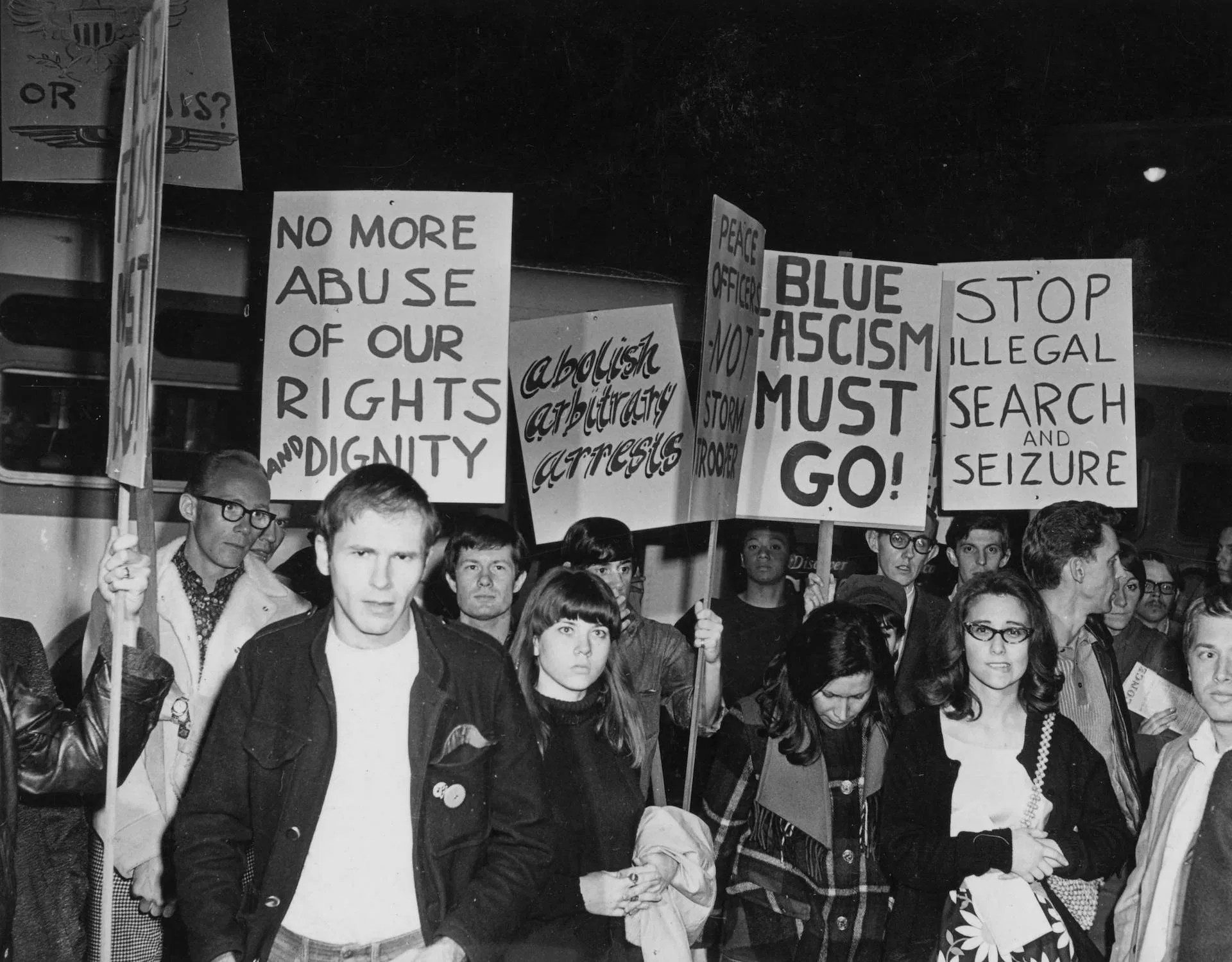
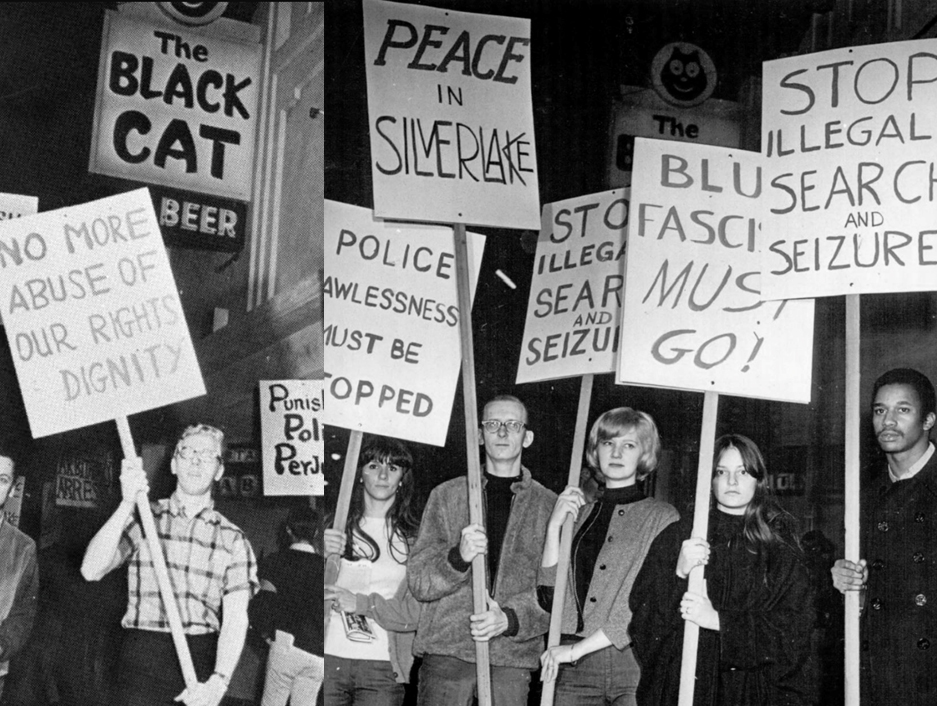
By October, the Black Cat was attracting a new clientele after an apparent change in management. On 31 December 1966, in anticipation of Ronald Reagan taking office as governor, eight to twelve undercover LAPD officers entered the Black Cat as the clock approached midnight. When the clock struck twelve, bar patrons shared a customary New Year’s kiss, which provided police with an excuse to riot. Joining them were twelve uniformed officers, who burst into the bar to provide back-up. Several patrons were pursued down the block to New Faces, where more patrons were violently abused.
When the smoke cleared, fourteen patrons were charged with lewd conduct, including Charles Talley and Benny Baker, who were forced to register as sex offenders. The pair responded by taking their case to the US Supreme Court, where, backed by the ACLU, their lawyer made legal history by being the first to openly argue that gay individuals are entitled to equal treatment under the 14th Amendment’s Equal Protection Clause. The Supreme Court, however, declined to hear their appeal.
On 11 February, the newly-organized PRIDE (Personal Rights in Defense and Education) organized a protest against police brutality in front of the bar — one of the first organized gay rights protests. PRIDE also launched a local newsletter, The Los Angeles Advocate, which later transformed into the nation’s “queer paper of record,” the Advocate. Unmoved, the state suspended the Black Cat’s liquor license on 21 May and, shortly after, the Black Cat closed. By 1975, however, it was operating as Lenny’s Place, but before long, it would resume operation as a series of gay bars, beginning with the Bushwhacker.
THE 4 POSTER (1965-1975 | 2939 West Sunset Boulevard | Also at this address: Hungry Savage and Good Company L.A.)
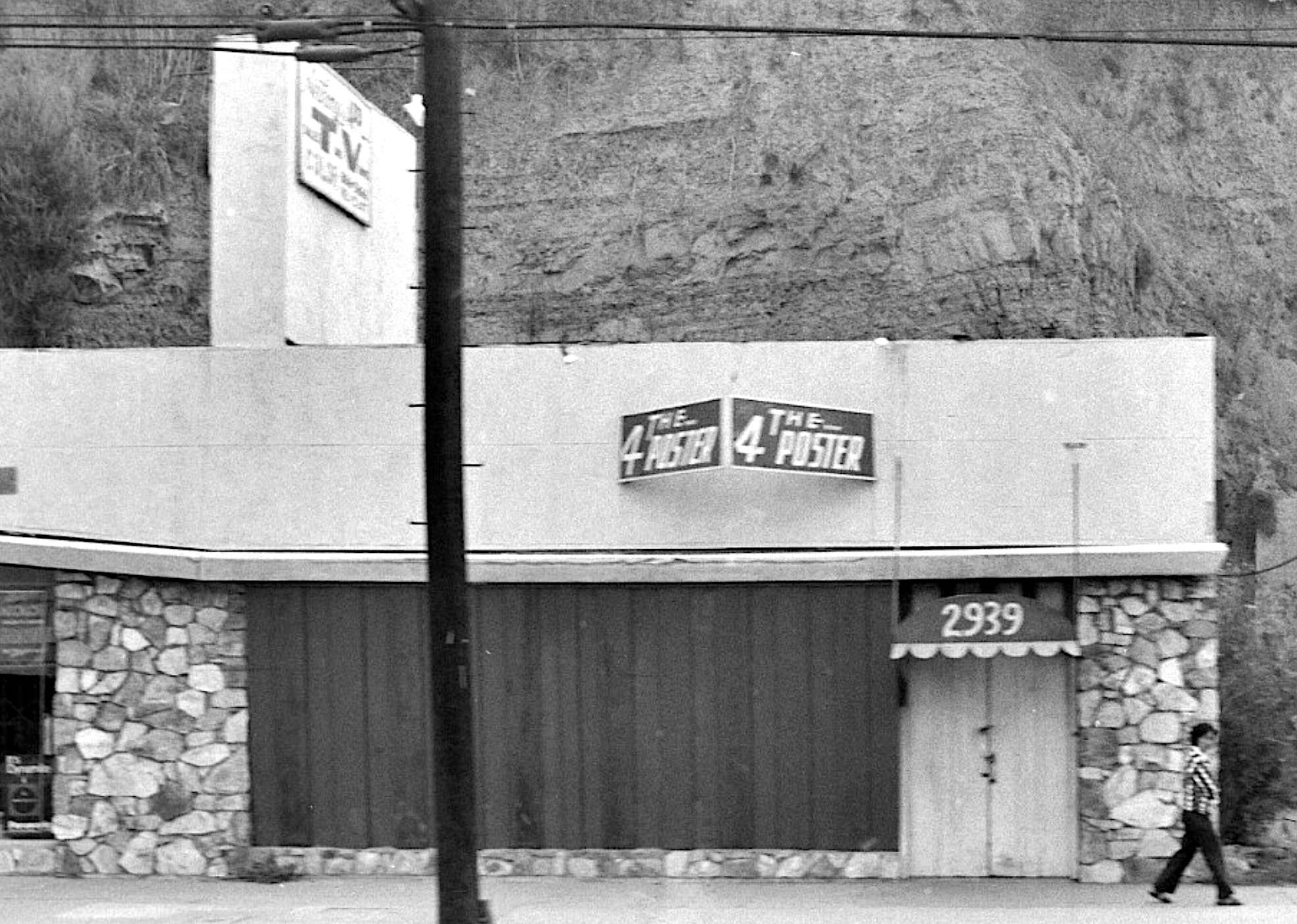
In 1960, The Twist Inn opened at 2939 Sunset Boulevard. Its owner, Mell Elizabeth Fletcher, sold it to William Wilson and Walter J. Egan, who continued to operate it as the Twist Inn until 1964, when they were trying to unload it, stating in an ad that it “did 70 kegs b/4 closing. owner in trble [sic].” This was, apparently, the same Walter J. Egan who in 1986 was convicted of federal influence-peddling when he was a City of Carson councilman. “Trble” kept on coming for him when, whist serving his one-year-sentence, was sued by his own mother for $1.5 million. Ads for the Twist Inn referred to it as “gay,” a “gay spot,” and “a real gay spot” before it re-opened as The 4 Poster. It remained there until at least 1975, after which it became Hungry Savage.
THE LONGHORN (1965-1968 | 3111 West Sunset Boulevard | Also at this address: Little Cave)
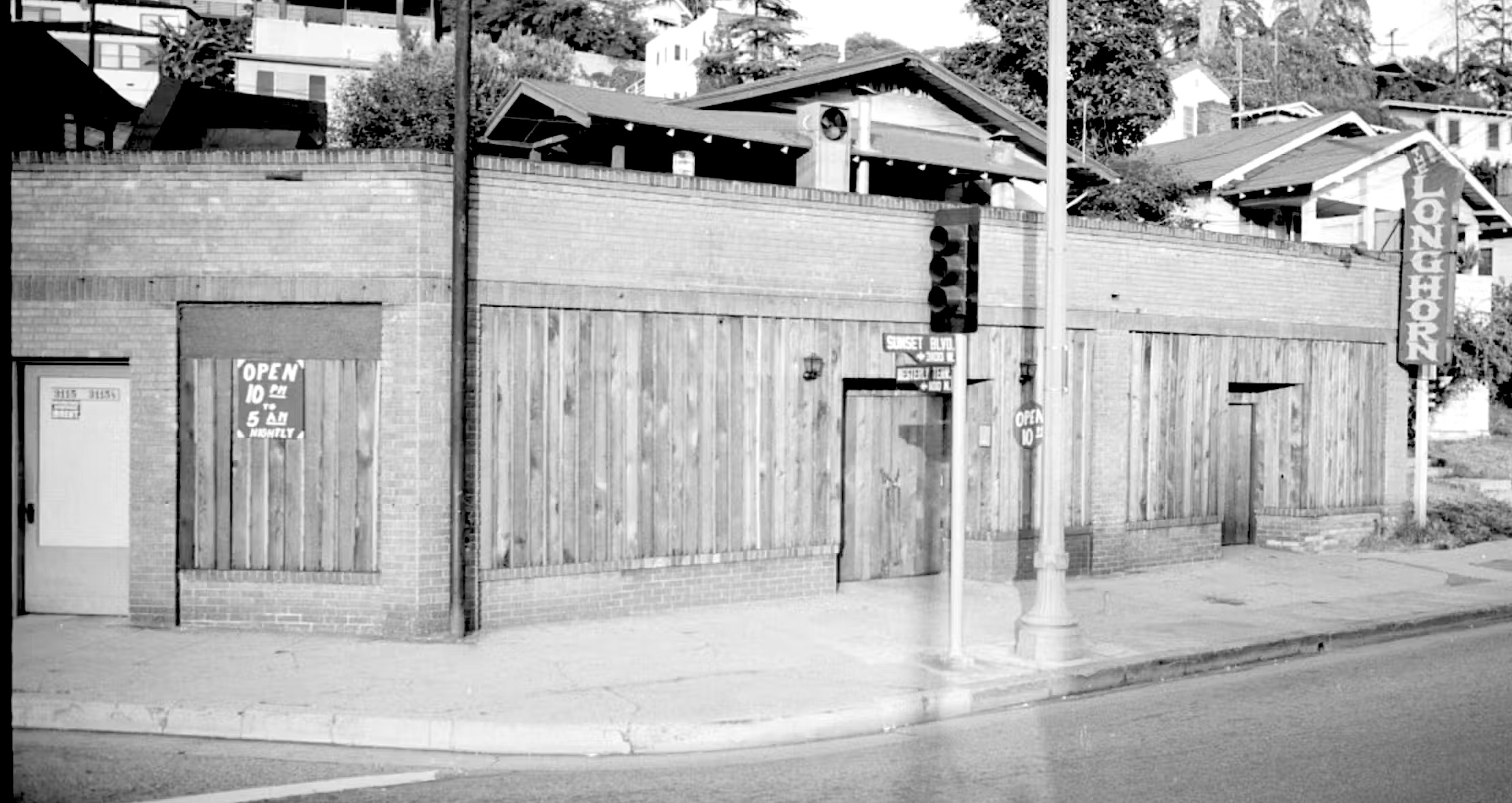
The Longhorn opened in 1965 at 3111 Sunset Boulevard — a building that had previously been home to several laundromats, including Soft Water Laundrette, Thompson Self Service Laundry, Westerly Cleaners, and Vendome Cleaners. It was at the latter, in 1929, that a 20-year-old employee, Clarence Abel, died from tetanus after stepping on a nail there. The Longhorn closed in 1968 and became another gay bar, the Little Cave.
ON SUNSET/THE MINE SHAFT (1965-c. 1967 | 3335 West Sunset Boulevard | Also at this address: Anna’s Bar-B-Q and Anna’s Student Prince)
In June 1965, Donald H. Dupuis, Stanley “Rex” Ramseyer, and Richard A. Valentino applied for a beer and liquor license at their coffee shop, On Sunset. By 1967 (minus Valentino), Dupuis and Ramseyer were running the business as the Mine Shaft, when they applied for a pool table license. It seems to have closed not long after. By 1973, it was vacant. Ramseyer eventually retired to Palm Springs and died there in 2018. In the 1990s, the former Mine Shaft temporarily housed the Hollywood Sunset Community Clinic (Hollywood Sunset Free Clinic) during an expansion of their home across the street. Later, it was home to the church, El Centro de Vida Abundante. Its current tenant, Stark Waxing Studio, opened there in 2006.
RAMM’S HEAD (1965-1973 | Also at this address: Butch Gardens, The Yellow Brick Road, and Stud Two)
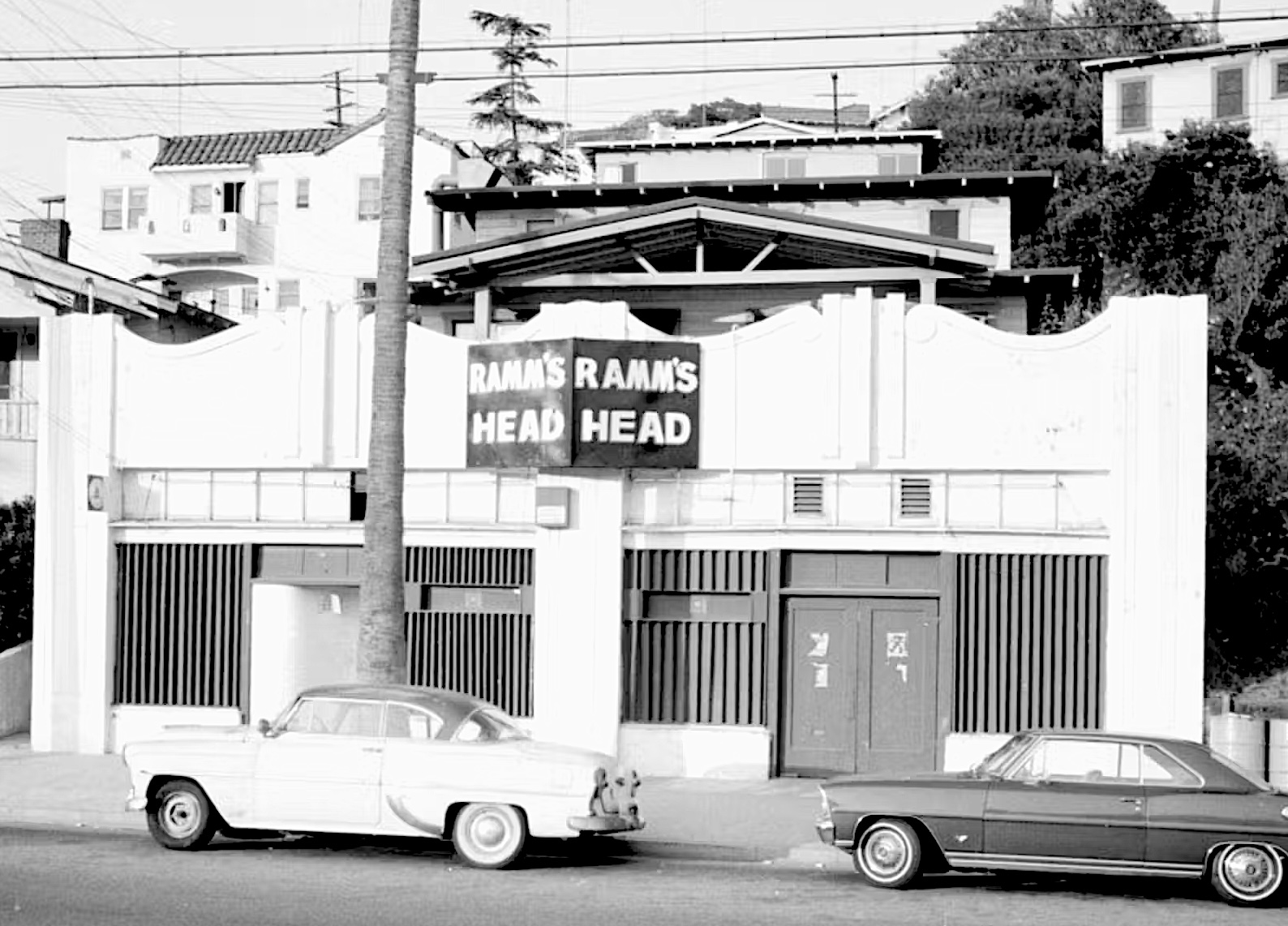
A week after the LAPD’s notorious raid of the Black Cat and New Faces, the cops raided another gay bar down the street, Ramm’s Head. Ramm’s Head opened in 1965 in a 1936 Art Deco store at 3037 Sunset Boulevard. It had been a dance club since at least 1949, but in 1952 re-opened as the New Trophy Dash Club, an event promoted with a performance by the legendary “King of the Honkers,” “Big Jay” McNeely. By 1954, it had been reborn as the Music Inn, a venue that featured musicians from across Europe and Asia, as well as live performances of plays. Briefly rebranded the Bamboo Inn, it kept the phone number that had been assigned to the Music Inn. Ramm’s Head remained in operation at least as late as 1973, when it was listed in Barfly West with the code, “D.Y.W.” — “Drag You Wanda” — meaning it hosted drag nights. That year, it became another gay bar, Butch Gardens.
HYPERION BATHS (1966-1981 | 2114 Hyperion Avenue)
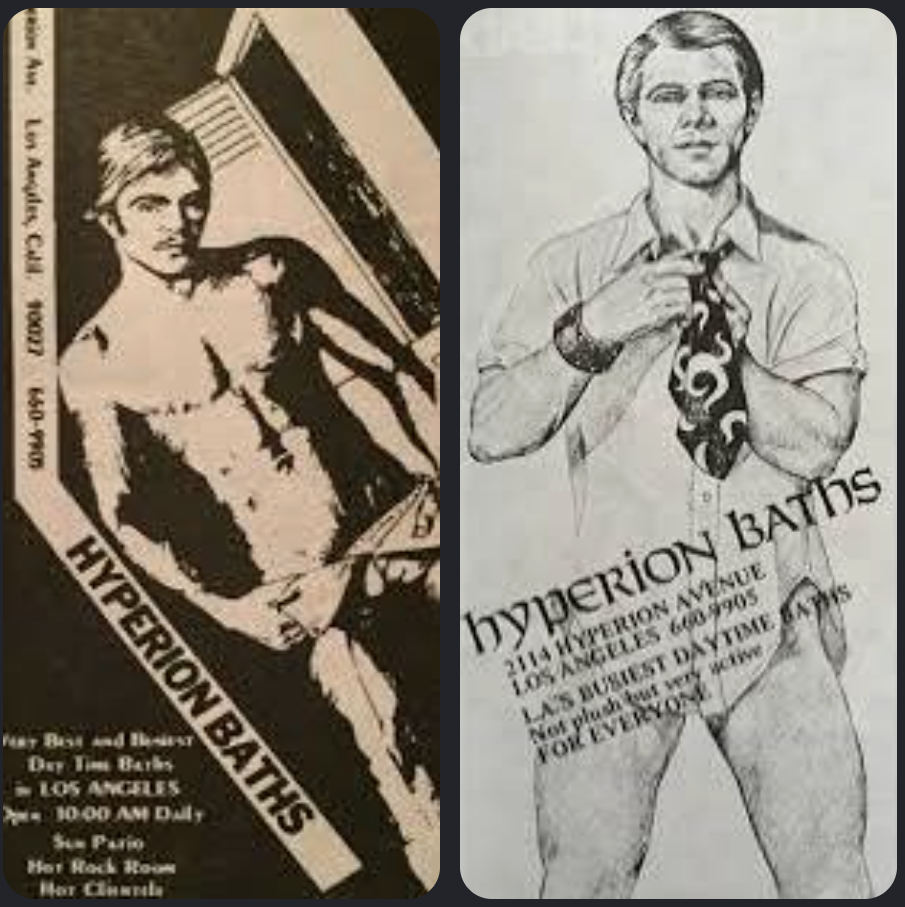
The first Silver Lake bathhouse was likely Hyperion Baths (aka Hyperion Health Club), which opened at 2114 Hyperion Avenue in or around 1966. The building, at that time, was only a few years old, having been constructed in 1962. The owner of the bathhouse was a Detroit-born Polish Jew, Eugene Lewis Milewski, who’d shorted his family name to “Milew.” With his Milew Enterprises, he’d establish a small empire of gay businesses with North Hollywood’s Regency Club, Atwater Steam Baths, and (in the city’s gayborhood) the Toy Tiger, Silver Saddle, and Detour. In 1982, Milew and Mark S. Schwind co-founded Ambassador Beauty College in Burbank. Milew later retired to Palm Springs, where he died in 2012.
As private spaces, gay bathhouses added a layer of privacy not afforded to gay bars, where police routinely arrested patrons for same-sex dancing, touching, or even flirting. Since bathhouses didn’t serve alcohol, they avoided liquor board oversight and could remain open after hours. Instead, these venues operated as legitimate wellness facilities centered around communal steam rooms, saunas, showers, and hot tubs. This setup provided a plausible legal alibi, as nudity was entirely expected within the facility. Front desk personnel could effectively deny entry to unwanted outsiders or, in the event of a law enforcement raid, activate a concealed warning buzzer to alert patrons inside. While the LAPD wasn’t above raiding bathhouses, since they were known to attract closeted businessmen, politicians, and actors — there was political risk to accidentally exposing members of the city’s upper class.
In 1981, the gay Republican chairman of the Silver Lake Merchants’ Association, Steve Downard, bought Hyperion Baths in 1981 and converted it into the city’s only “co-sexual bathclub,” Healthworks. After an aggressive anti-bathhouse ordinance was passed, however, Downard shut down the operation in 1986 and today the building is home to Hyperion Chiropractic & Acupuncture — a business whose clients are dealing with a different sort of kink.
JOKER (1967-1971 | 4001-4007 West Sunset Boulevard | Also at this address: New Faces, The Gay’m, Sunset East Showbar, and Circus of Books)
The former New Faces was re-born as Joker in 1967. In 1971, it became the Gay’m.
THE SHED (1968-1972 | 4219 Santa Monica Boulevard | Also at this address: Outcast, Gauntlet II, and Eagle L.A.)
The Shed opened at 4219 Santa Monica Boulevard in 1968 on a site that had previously served as various machine and appliance shops. 1968 was also the year of the first Gay-In nearby at Griffith Park, which took place on 30 May of that year and was a major step in the increased visibility of the gay community. The Shed closed in 1972. No other information has come to light but after it closed, it remained a gay bar continuously for more than half a century. It began its next chapter as Outcast.
PATINO’S COCKTAIL LOUNGE (1968-1973 | 2538 Hyperion Avenue | Also at this address: The Toy Tiger and The Other Side & Flying Leap Cafe)
Patino’s Cocktail Lounge was founded in late 1968. The building, at 2538 Hyperion Avenue, had been constructed in 1963 and originally operated as offices and a garage. It was a piano bar and was likely in operation until around 1973, when it became the Toy Tiger (which used the same phone number, suggesting a possible degree of continuity).
WOODY’S HYPERION LOUNGE (1968-2002 | 2812 Hyperion Avenue | Also at this address: MJ’s)
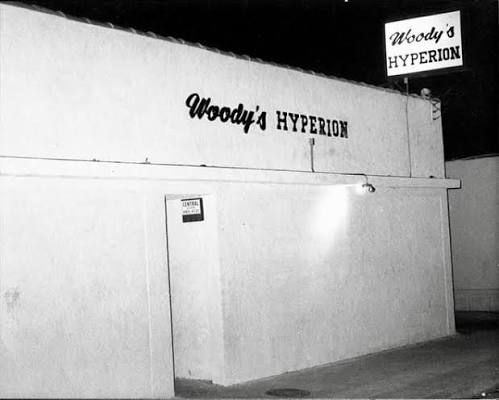
P. N. Woodward founded Woody’s Hyperion at 2812 Hyperion Avenue in late 1968. It was also often referred to as both Woody’s and The Hyperion. In 1982, one of its bartenders, Gary Bond, was the president of the Southern California Gay Bartenders Association. In 1991, DJ Paul V launched the club night, Spit. It closed in 2002 and became the clubbier (but still gay) MJ’s.
LITTLE CAVE (1969-1994 | 3111 West Sunset Boulevard | Also at this address: The Longhorn)
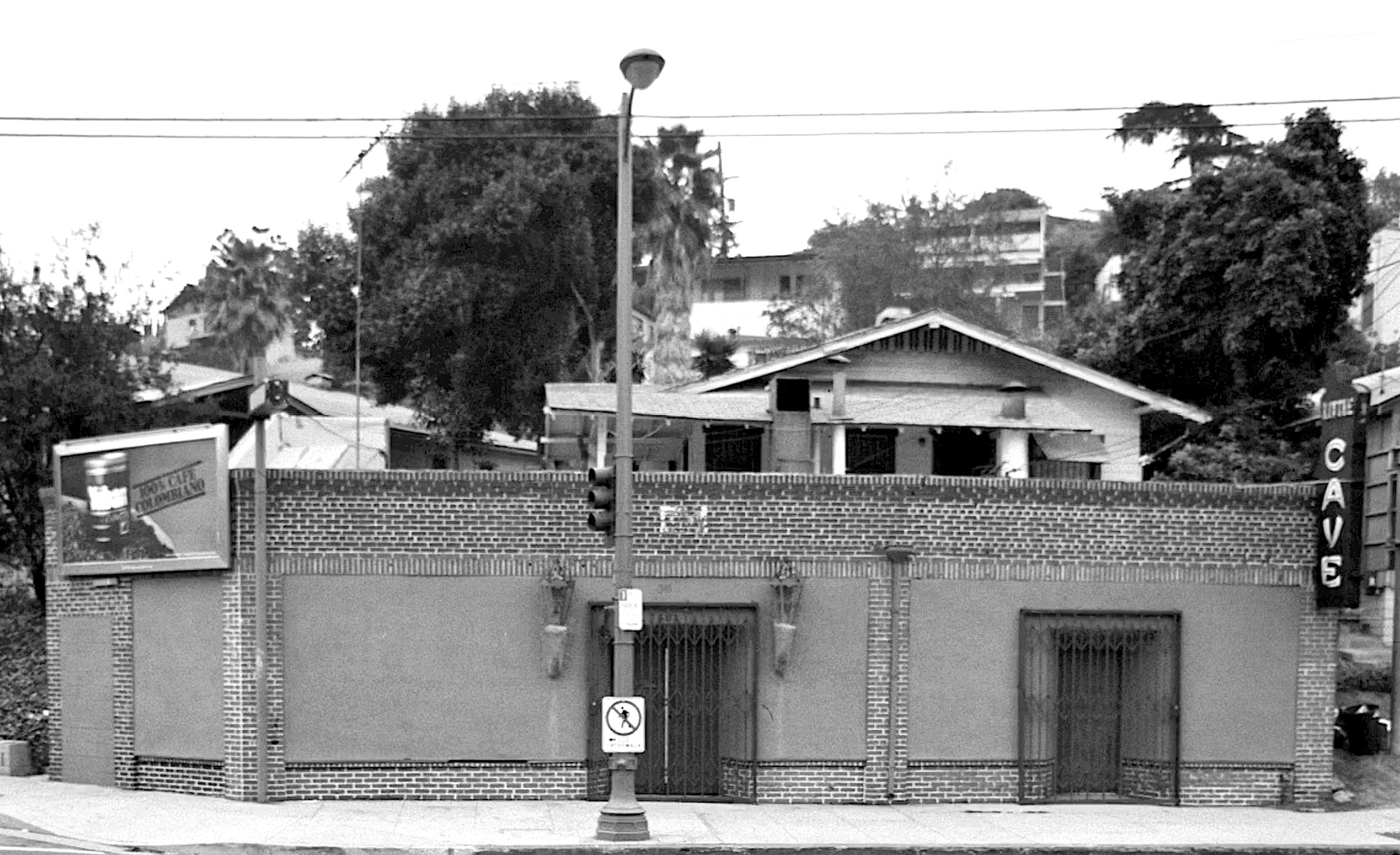
Paul Julian took over the Longhorn and, around 1969, transformed it into a piano bar known as the Little Cave. It was still in operation at least as late as 1992. In 1994, however, Julian filed and was granted a permit for demolition. The Little Cave was intentionally caved in, leaving behind a retaining wall that has been since then been decorated by murals including, currently, one by Deity Art. Next to the ghost bar is a billboard that Jordan Bromley has for years used to reassured us, “I Like You Very Much.”
THE GAY’M (1971-1972 | | Also at this address: New Faces, Joker, Sunset East Showbar, and Circus of Books)
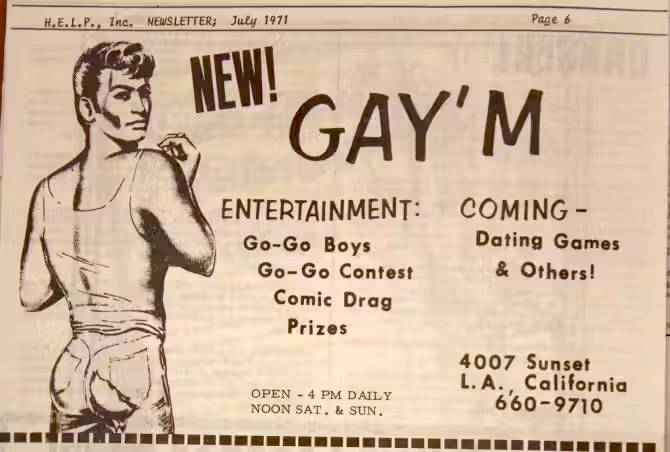
By 1971, when the Gay’m opened, the meaning of “gay” was widely understood even in the mainstream. Several events had, by then, taken place that radically raised the profile of the gay rights struggle. The Stonewall Riots had taken place in New York City in June 1969 and catalyzed the formation of the Gay Liberation Front. A second Griffith Park Gay-In had seen the relaxed festival atmosphere of the first take on a more radical orientation.The third, and final Gay-In, had taken place on 5 April 1970 and was organized by Gay Liberation Front/Los Angeles who openly confronted the LAPD when they attempted to violently displace them from the park. The Gay’m, meanwhile, next became the Sunset East Showbar.
THE SHINGLE SHACK (1971-c. 1975 | 1941 Hyperion Avenue | Also at this address: The Hy Spot, Headquarters, Jack Wrangler’s Cruise Bar, Hyperion Lumber Company, and Cuffs)
In 1971, the historic Hy Spot was reborn as the Shingle Shack, which used the same phone number as the Hy Spot. It appeared in the HELP (Homophile Effort for Legal Protection) newsletter from May 1971 and Barfly West in 1973. HELP was founded in Los Angeles in 1968 as a legal defense fund and counseling network for those arrested by the LAPD vice squad. It continued to operate as the Shingle Shack at least as late as 1975, when it was listed in that year’s Gay Guide.
DON’S MALE BOX (1971-1974 | 1087 Manzanita Street | Also at this address: The Place and Detour)
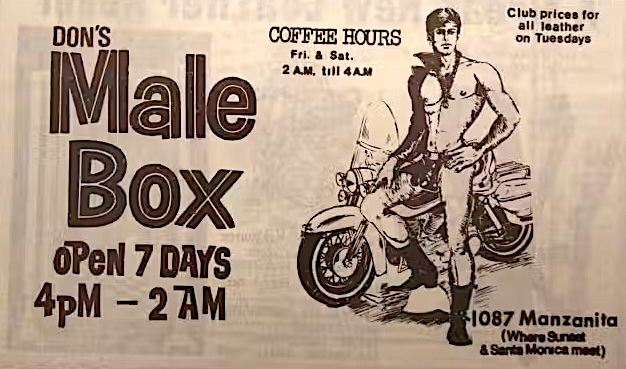
According to at least one source, the Place became the Queen’s Attic in 1971. I can find no record of a bar here with that name. What is known is that it was in 1971 that the dry, private club, Don’s Male Box, opened in that commercial duplex City documents list it as a “bar & auto repair” — which is actually the category listing of several gay venues of the era. Damron’s Address Book from 1974 states: A. C. K. P. (Air-Conditioned, Cruisy, Kinky, Private). As the listing suggested, Don’s Male Box was a private gay men’s club, not a bar. Neither was it a bath house. Club’s like Don’s were somewhat tolerated by the police since the activities they facilitated were seen as preferable to cruising in public spaces like the nearby Sunset-Myra Overpass (nicknamed “Planet Myra”). These newer facilities didn’t bother with any pretenses of being health spaces. Steam rooms, pools, and saunas made way for dark, often grubby, mazes of cubicles and play spaces designed explicitly for adult activities. Around 1974, Don’s moved to 11725 Victory Boulevard in North Hollywood where it operated as the MB Club until 1984. A second location opened at 4550 Melrose Avenue in the Wilshire Center district, operating as the MB Club until it closed on 11 January 2004. Don himself died a few years later.
OUTCAST (1972-1983 | 4219 Santa Monica Boulevard | Also at this address: The Shed, Gauntlet II, and Eagle L.A.)
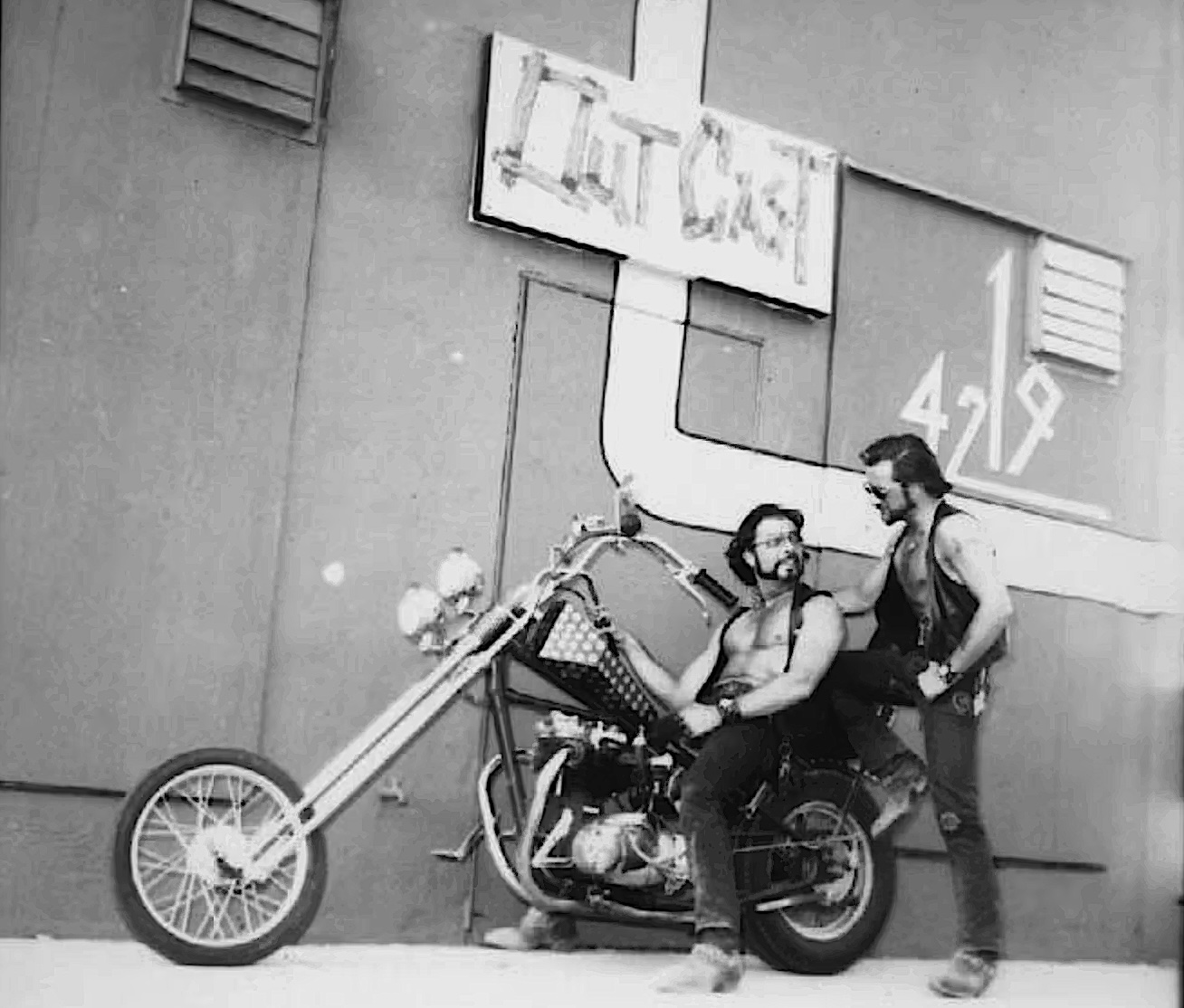
The former space occupied by the Shed was taken over by a leather bar, Outcast, in 1972. It was alcohol-free, which allowed it to operate after 2:00 am — providing a late-night third place alternative to the 24-hour donut shops that had previously helped fill that role for gays and trans Angelenos — and also, often, police officers. Outcast remained in business there until 1983, when it was taken over by the second location of the Gauntlet II.
SUNSET EAST SHOWBAR (1972-c. 1975 |.4001-4007 West Sunset Boulevard| Also at this address: New Faces, Joker, The Gay’m, and Circus of Books)
In 1972, the Gay’m became Sunset East Showbar, which closed sometime around 1975 and became the Chop Suey Family Restaurant. It would become a gay-catering business, again, with the establishment of Circus of Books in 1985.
THE AT CENTER (1973-present | 1773 Griffith Park Boulevard)
In 1971, a different side of the bar scene took shape at the AT Center. In 1969, seven alcoholics met in the hope of establishing a branch of Alcoholics Anonymous that was just for gays. Not recognizing “closed” meetings, AA requested that they not use their name — although the organization gave their blessing to utilize their tenets, traditions, and meeting format. The AT Center still operates at 1773 Griffith Park Boulevard.
BUTCH GARDENS (1973-1977 | 3037 West Sunset Boulevard | Also at this address: Ramm’s Head, The Yellow Brick Road, and Stud Two)
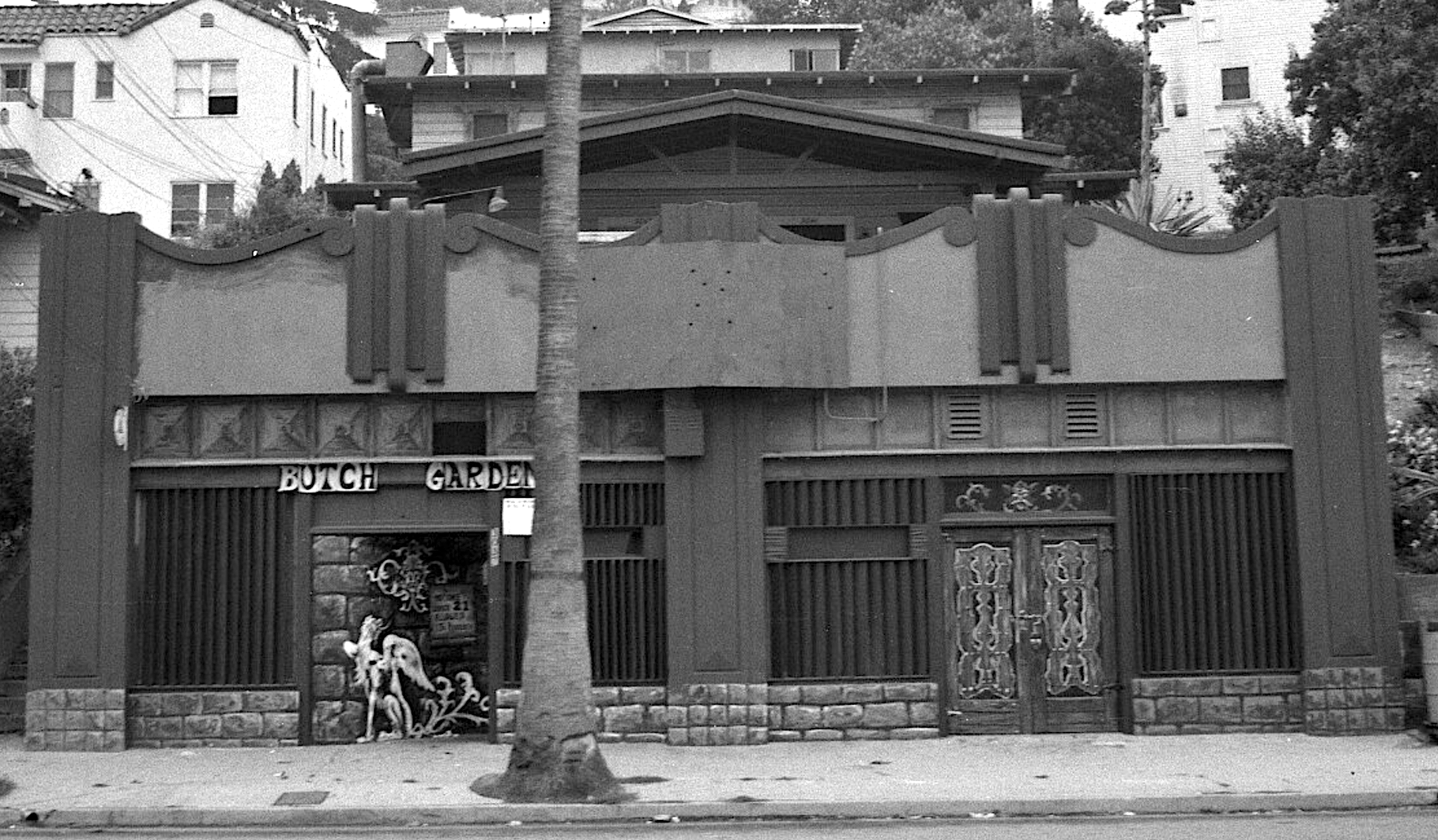
In 1973, Ramm’s Head was reborn as Butch Gardens. Butch Gardens was apparently quite a political hotspot and was visited by Vincent Bugliosi in his campaign for Los Angeles County District Attorney as well as Burt Pines who sought to court the gay vote during his run for Los Angeles City Attorney. Pines also hired gay activist Rand Schrader. He defeated Roger Arnebergh, who had aggressively weaponized the LAPD’s vice squad against gay bars.
Butch Gardens’ clientele was primarily Latino and included famed artist Glugio “Gronk” Nicandro. Around 1978, another Latino patron and artist, Teddy Sandoval, created his imprint, The Butch Gardens School of Art
EL CONQUISTADOR (1973-2013)
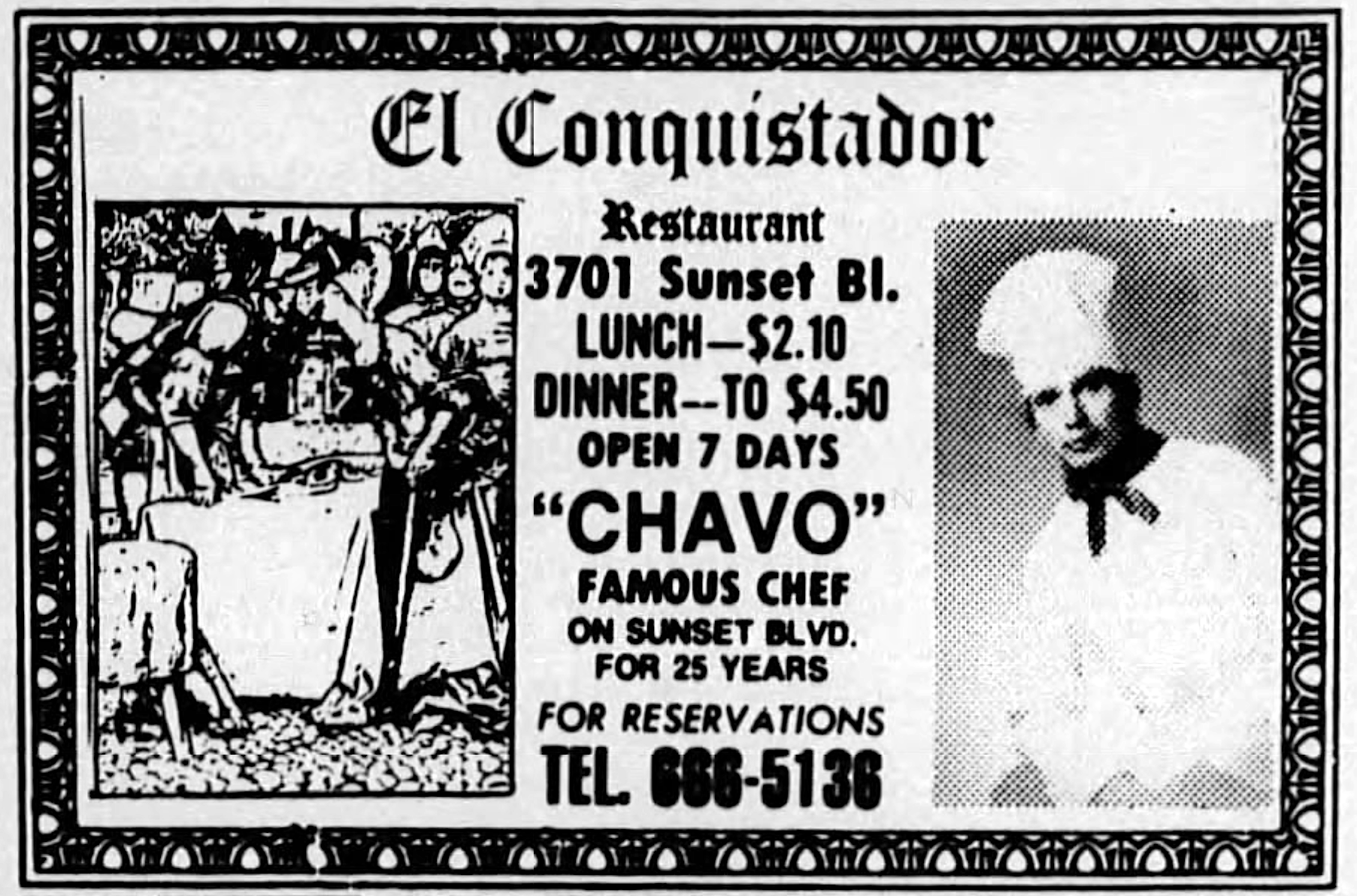
Jesse Pinto and Alberto Curiel opened El Conquistador in 1973 making it likely the first Silver Lake restaurant owned by openly gay restaurateurs — and almost certainly the first openly gay Latino restaurateurs. The building in which it’s located was constructed in 1934. In the 1950s, it was home to a cleaners. In 1969, it was home to Aqualibria, which, by 1971, was home to the vegetarian restaurant named Zap! which, before the year ended, was rebranded My Brothers’ Keeper by owner Chris Dutra. In 1973, Luther Burbank McKeen opened the macrobiotic and organic Sunset Trip Inc. That was followed by El Conquistador which, although not a gay bar, is probably best remembered, nevertheless, for its margaritas. It closed in December 2013, after forty year in business, when a new landlord, Sunset Triangle Partners, dramatically raised the rent. It was followed by El Condor, which will have its last day of service on 31 August 2026. A buyer in Taiwan purchased the building in 2025 and dramatically raised the rent.
THE LEATHER HORSE (1973 | 4100 West Sunset Boulevard | Also at this address: Detour)
When the other half of the commercial duplex was home to Don’s Male Box, the 4100 Sunset side was briefly home to a bar called the Leather Horse. It was listed in that year’s Barfly with the code, A. W. — short for “All Welcome” — in other words, the entire spectrum from gay men to lesbians, and everyone in between. It was next home to Detour, which took over the entire space.
THE MEN’S ACTION CENTER (1973-1988 | 2801 Hyperion Avenue)
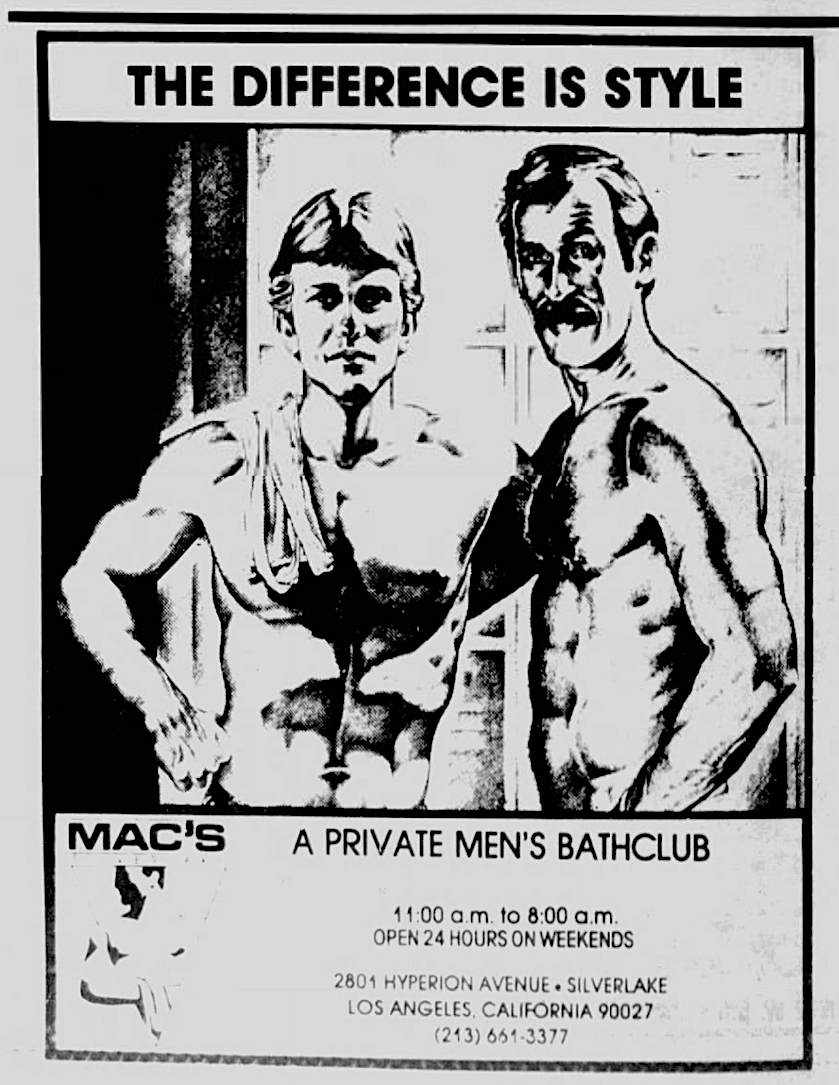
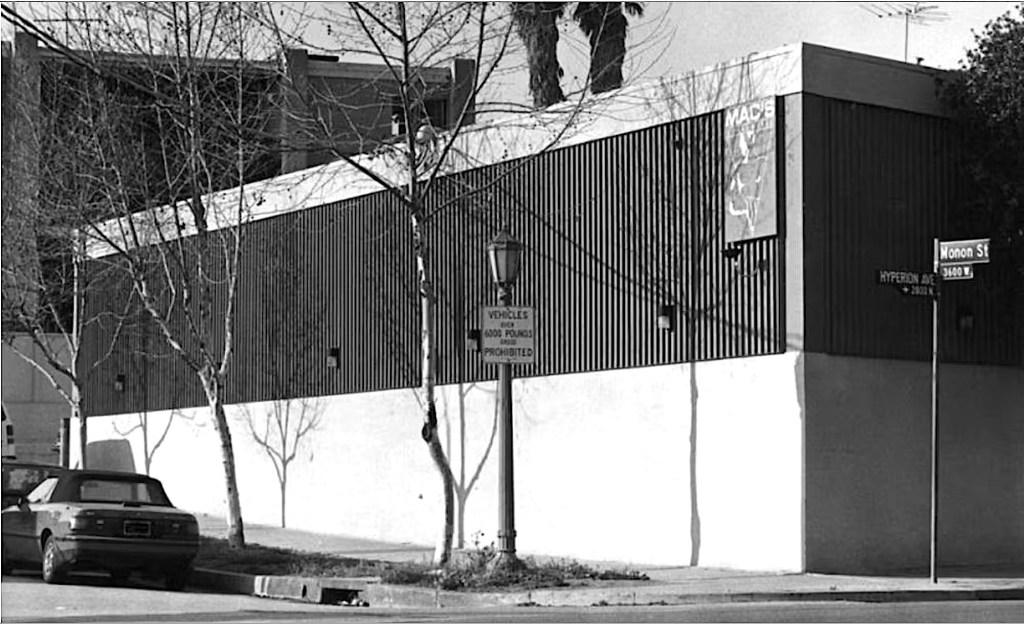
The Men’s Action Center (MAC’s) opened at 2801 Hyperion Avenue in 1973. The building, constructed in 1953, had previously served as the headquarters of Hudson Oxygen Therapy Sales Co. Under owner Bill Carey, the space was transformed into a bathhouse with a dance floor, a cineam, and self-defense classes. A writer at The Los Angeles Times called it the “Cadillac of bathhouses.” Los Angeles County health officials ordered MAC’s (and two other bathhouses) to close in 1988, which they did.
THE TOY TIGER (1973-c.1987 | 2538 Hyperion Avenue | Also at this address: Patino’s Cocktail Lounge and The Other Side & Flying Leap Cafe)
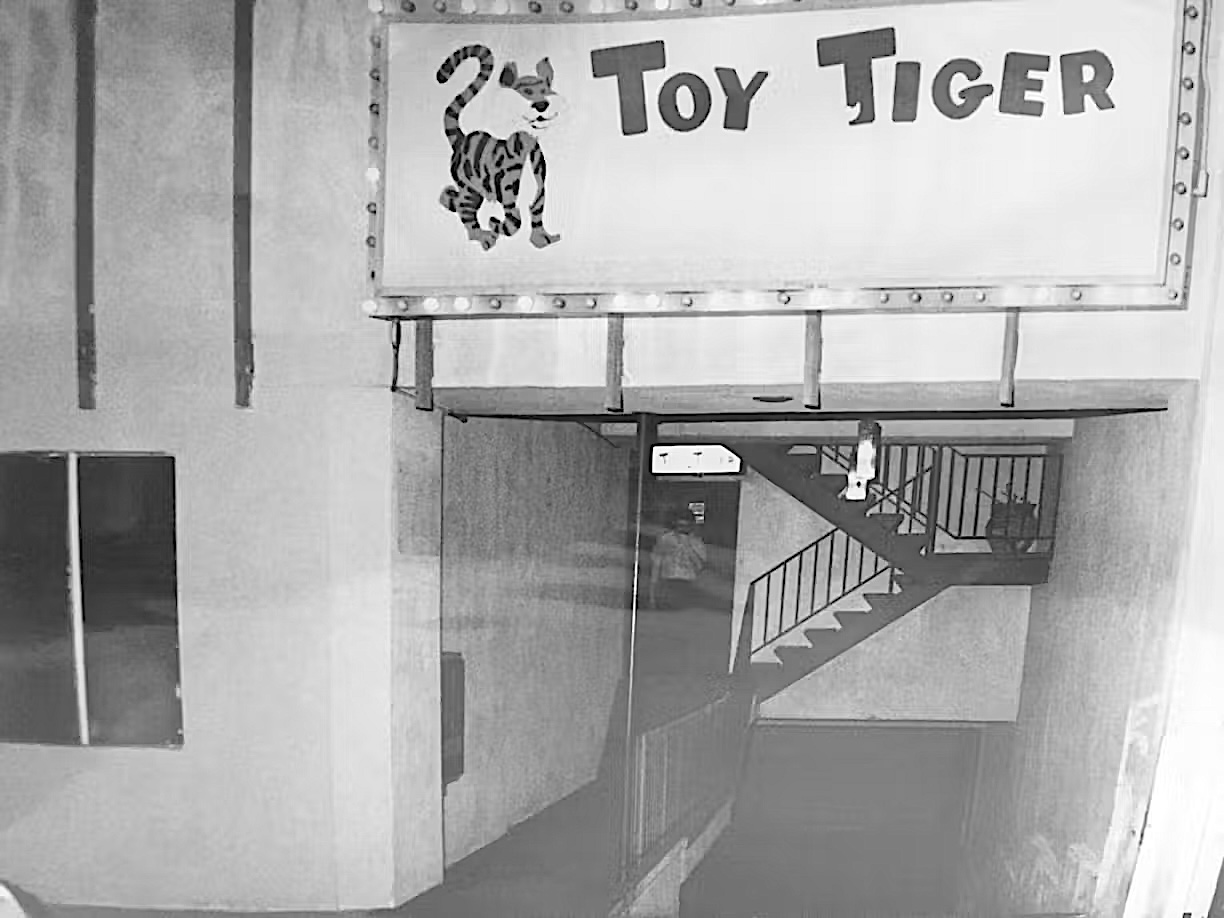
In 1973, Patino’s Cocktail Lounge was reincarnated as the Toy Tiger. It often featured entertainment from cabaret performer Rudy de la Mor. Barfly West noted it featured entertainment and drew a mixed crowd. Damron noted in his guide that the crowd was “O” for “older.” Walter Johnson described it as a “sweater bar.”
It appears to have closed around 1987. By 1991, the building housed the headquarters of the National Black Gay and Lesbian Planning Office. By 1992, it was home to a gay Latino arts non-profit called VIVA! (founded in 1987 by Aleida Rodriguez, Luis Alfaro, Marcus Kuiland-Nazario, Mike Moreno, and Roland Palencia).
The commercial space, meanwhile, was home in the early 1990s to a Mexican restaurant called Sabor, which was succeeded in 1995 by Lo Sabroso and Houston’s Bistro. In 1997, Paul Hargis revived the gay piano bar there with The Other Side and the Flying Leap Cafe. All of the bars there were the focus of a 2006 documentary, The Other Side: A Queer History’s Last Call (directed by Jane Cantillon and updated in 2013). It closed in June 2012, was followed by Hyperion Public (currently looking for a new home), and is now home to the recently-opened Thai on Hyperion.
THE WOODSHED (1973-1977 (612 North Hoover Street | Also at this address: Explorer, One Way, and The Exile)
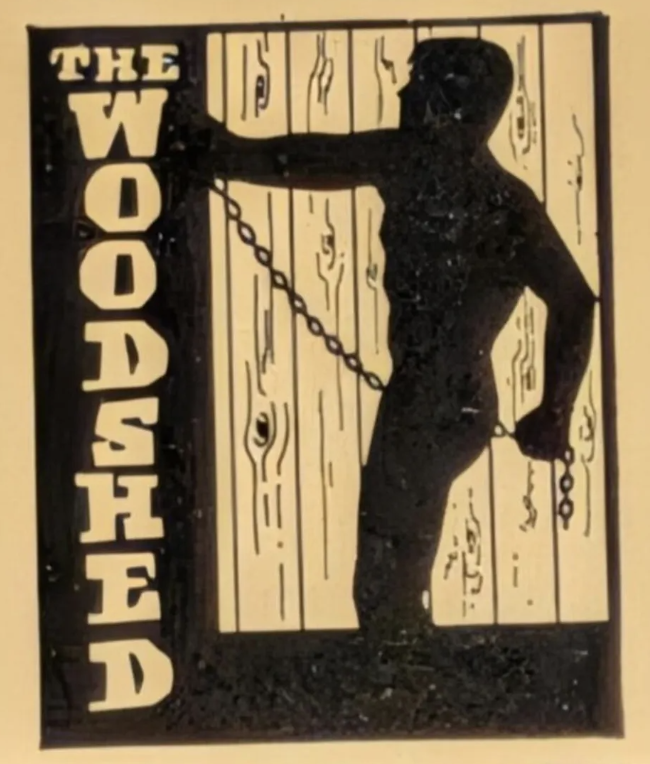
There was a mysterious gay bar called the Woodshed that I only came across in researching this piece. Evidence of its existence is limited entirely to a single matchbook I saw for sale on Etsy. We know from its address, 612 North Hoover Street, that it took over the space from Explorer, which closed in 1973. Explorer’s phone number, as listed on its matchbook, was the older style NOrmandie 5-9127. The Woodshed’s was (213) 660-9847. Its matchbook swapped Explorer’s female silhouette with a more overtly gay silhouette of a man against a wooden fence with a chain. We don’t know when it closed but we do know that the better-known One Way opened at the same address in 1977, so probably shortly before then.
THE SILVER SADDLE SALOON AND SPA (1974-c. 1987 | 4356 West Sunset Boulevard| Also at this address: The Bulldog, Joly’s, and Akbar)
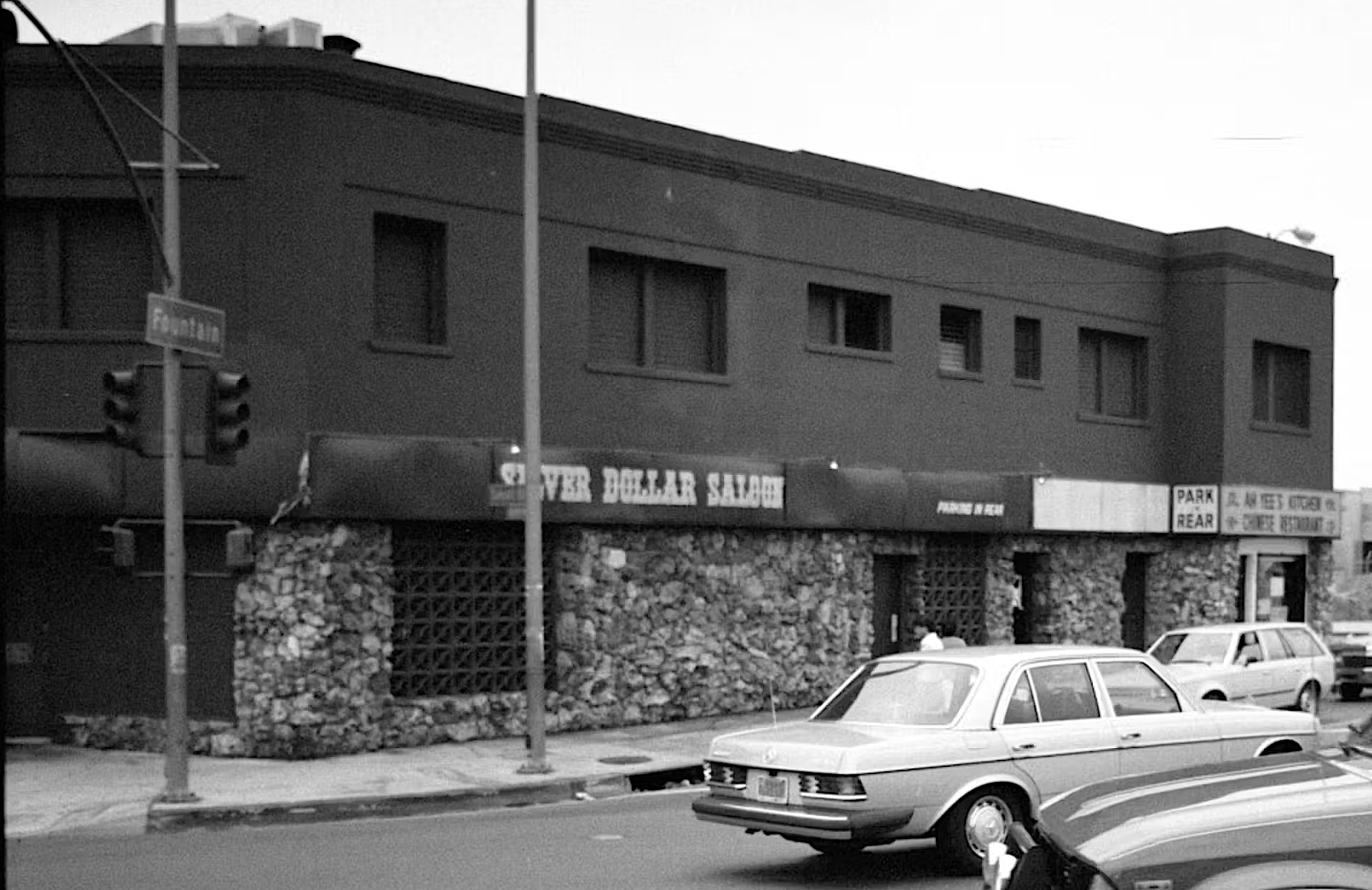
The Silver Saddle Saloon and Spa took over Chico Avilez’s Mr. C’s Club around 1974, when Eugene Milew bought the space. The building, built in 1916, had hosted numerous businesses previously, including — from the mid-1930s until 1951 — an Italian deli run by James Mosca aka “Jimmy Fly.” In 1947, the deli was robbed by men posing as LAPD officers. It was also that year that Mosca was charged (along with eleven others) with diverting 2 million pounds of rationed sugar.
The Silver Saddle was a combination bathhouse and “Castro clone” bar occupying two floors. Upstairs was the spa, open 24 hours a day. Downstairs was the saloon. One shiny silver matchbook design depicted a cowboy in jeans and a cowboy hat for the saloon… and a cowboy in a cowboy hat (but no jeans) for the spa. Although indelibly connected, they also seem to have operated with some independence. A photo from 1975 shows a sign for the Silver Saddle Spa and the sign for Mr. C’s has come down but has not yet been replaced by the Silver Saddle Saloon. The Saloon may have closed before the Spa. Milew owned the building until at least 1987. It was apparently known as the Bulldog for a spell but by 1990, it was home to Red’s Fountain Club.
THE FROG POND (1975-1988)
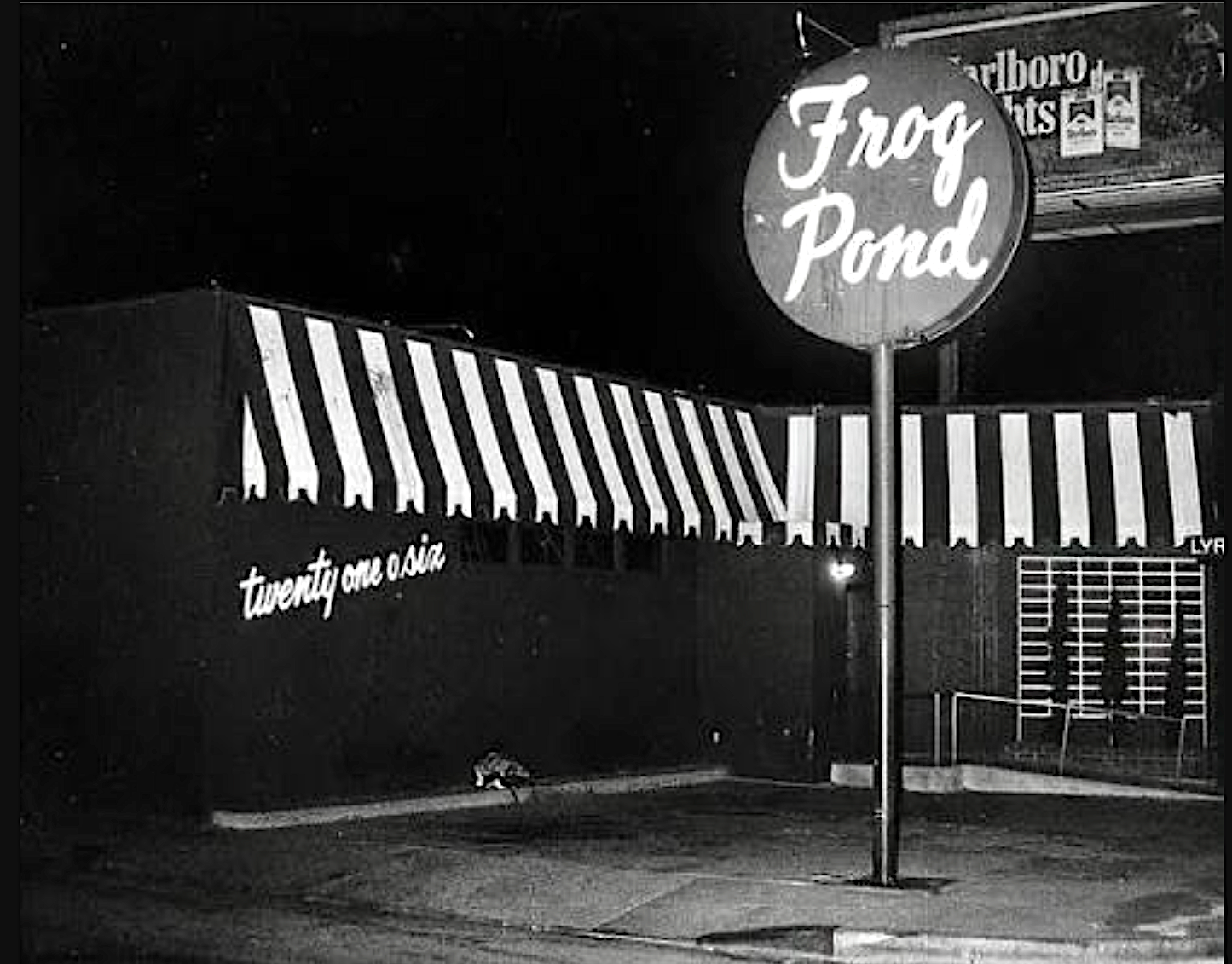
In 1975, Leland Gustave Feltrop and Robert “Bob” White bought a bar at 2106 Hyperion from Don Allen and opened The Frog Pond. The Frog Pond was a cafe and hosted art shows, live music, and live performances from mimes (and one has to assume, other sorts of performers). The cafe and its patrons were apparently the frequent target of homophobes and criminals. One night, instead of rocks, a firebomb was thrown. Another night, two patrons were murdered outside during a mugging. Although the California Consenting Adult Sex Act of 1975 had decriminalized homosexuality, many gays were still wary of cops. After all, even after the law had been passed, over 100 officers (with helicopters above) had swarmed West Hollywood’s Mark IV Baths during a fundraiser for the Gay Community Services Center and charged 42 attendees with violating “involuntary servitude” laws. That December, community members at the Frog Pond formed the Sunset Junction Neighborhood Alliance, which, in 1980, organized the first Sunset Junction Street Faire to bring the community together.
After White’s partner, Art Fredette, died of cancer, White hanged himself in the kitchen of the Frog Pond in May 1985. Community members, including Michael McKinley, took over the business and kept it going until 1988. McKinley kept the street fair going until 2011, when it was cancelled at the last minute. The Sunset Junction Neighborhood Alliance, under McKinley’s leadership, launched the Silver Lake Farmers Market in 2001. The former Frog Pond, meanwhile, became the new home of the Company of Angels theater company in 1989. Since 2003, it’s been the Lyric Hyperion, which has a cafe and often features queer comedy and drag performances in its theater.
HUNGRY SAVAGE (1975-1981 | 2939 West Sunset Boulevard | Also at this address: The 4 Poster and Good Company L.A.)
Around 1975, the politely named Four Poster was reborn as Hungry Savage. The bar remained in operation until around 1981, after which it became Good Company L.A.
HEADQUARTERS (1975-1978 | 1941 Hyperion Avenue | Also at this address: The Hy Spot, The Shingle Shack, Jack Wrangler’s Cruise Bar, Hyperion Lumber Company, and Cuffs)
Around 1976, the Shingle Shack re-opened as Headquarters. It kept the old Hy Spot phone number. In 1978, it became Jack Wrangler’s Cruise Bar.
DETOUR (1977-2001 | 1087 Manzanita/4100 Sunset | Also at this address: The Place, Don’s Male Box, and Leather Horse)
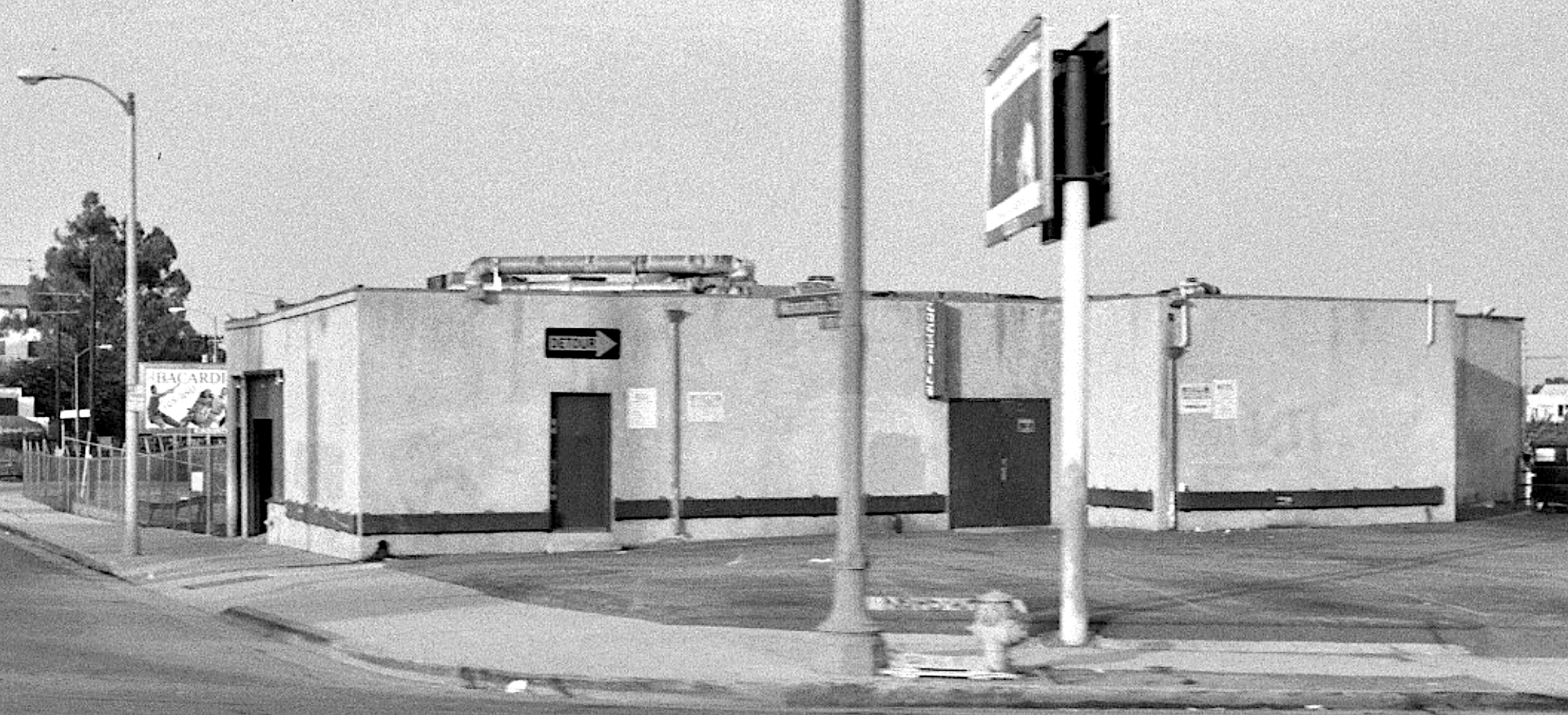
In 1977, a building alteration expanded the bar space at 1087 Manzanita/4100 Sunset into both sides of the commercial duplex, likely marking the dawn of Detour — a long-lived “leather and Levi” bar. Early on, Detour made an appearance in Edmund White’s 1980 book, States of Desire: Travels in Gay America. In the early 1980s, it boasted video games, sawdust floors and DJs. The LA Weekly named it one of Los Angeles’s “best Levi Bars” (along with West Hollywood’s The Spike). It was open until 2001, when it was bought by designer and restaurateur Sandy Gendel. It was then briefly known as the Manzanita Room, the parking lot of which hosted the Jackie Beat-MCed Queen of Silver Lake Pageant that year. In the summer of 2001, it became the 4100, which is still in business today — although Sherman Oaks-based mega-developer Frost/Chaddock sought and was granted permission to demolish it in 2021, after a city-commissioned historical resource evaluation reported that the property lacks the necessary “historical significance, architectural distinction, and integrity” to make it worth preserving.
ONE WAY (1977-1993 | 621 North Hoover Street | Also at this address: Explorer, The Woodshed, and the Exile)
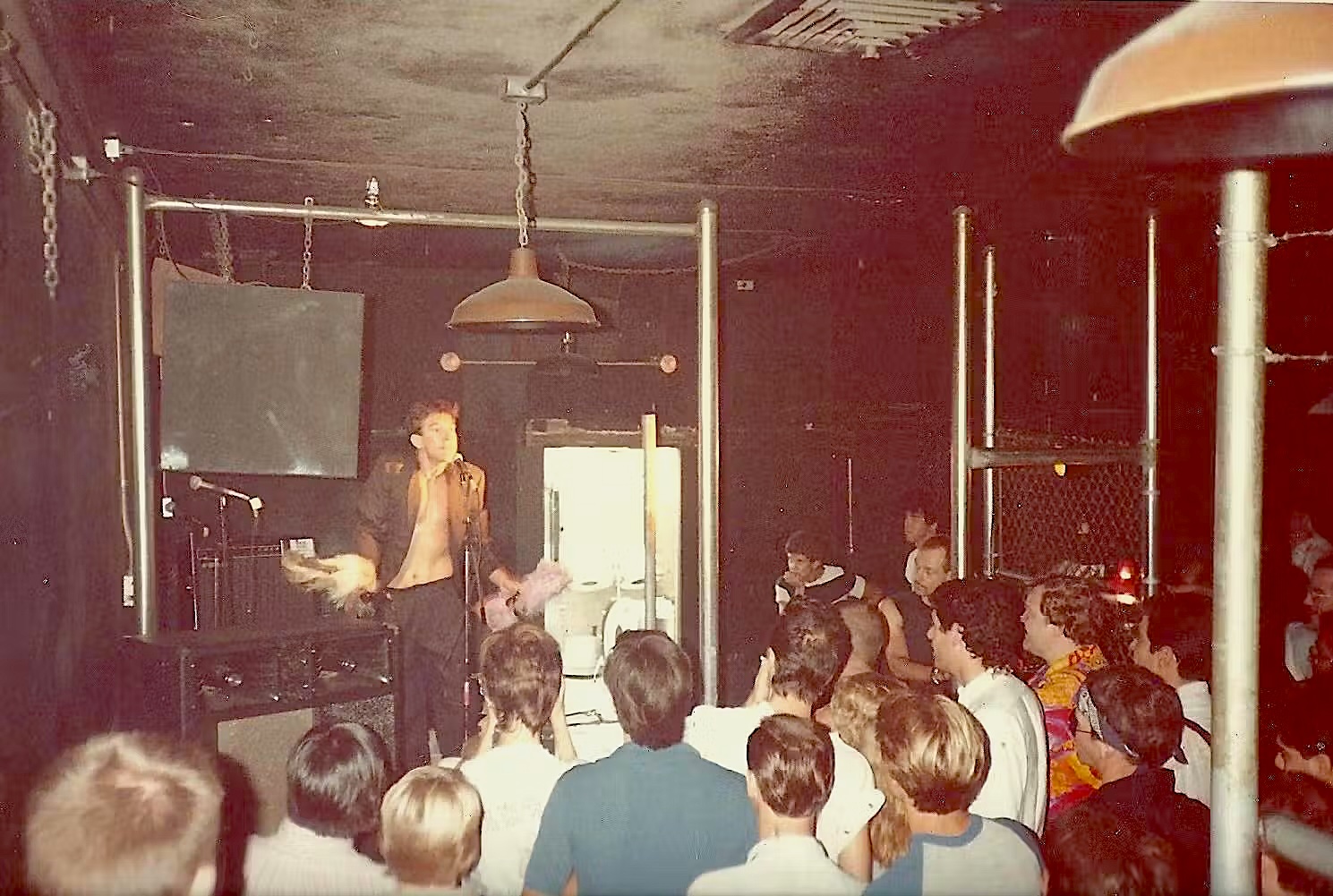
One Way opened in 1977 in what had previously been the Woodshed. Beginning in July 1982, the venue hosted the monthly, Sunday afternoon The-o-ret-i-cal parties organized by promoters Jim Van Tyne and Jim Tousling. Those parties featured acts like Age of Consent, Christian Death, Nervous Gender, Party Boys, Red Wedding, and Wild Kingdom — acts that attracted a mixed crowd of gays, goths, leather men, punks, and deathrockers. The parties were also notable for integrating avant-garde performance art and spoken word, serving as an early venue for performers like Ron Athey, Sean DeLear, and Vaginal Davis, whose performances were staged on beer cases and plywood against the bar’s interior chain-link fencing. In November 1987, One Way was raided by the LAPD for overcrowding. The One Way continued on, though, until 1993. Apparently, after that, it was home to a club called the Exile for about a year until it moved somewhere in the northern end of Elysian Valley.
JACK WRANGLER’S CRUISE BAR (1977-1980 | 1941 Hyperion Avenue | Also at this address: The Hy Spot, The Shingle Shack, Headquarters, Hyperion Lumber Company, and Cuffs)
In 1977, the former Shingle Shack changed to the Jack Wrangler’s Cruise Bar. Born John Robert Stillman, Jack Wrangler was the nom de porn of a then-famous performer at the peak of his popularity. Despite its name, there’s no widely known official connection between the bar and the actor — just as there was no official connection between the latter and the Wrangler brand of western workwear after which he named himself in homage. In his autobiography, The Jack Wrangler Story: What’s a Nice Boy Like You Doing in a Business Like This?, he mentions making promotional appearances at bars across the country but nothing about this particular watering hole. Wrangler’s (as it was also often referred to) closed in 1980 and became another gay bar, the Hyperion Lumber Company.
THE YELLOW BRICK ROAD (1977-1978 | 3037 West Sunset Boulevard | Also at this address: Ramm’s Head, Butch Gardens, and Stud Two)
Around 1977, Butch Gardens became the Yellow Brick Road, which changed names again around 1978. It’s doubtful that the reference to the 1939 Judy Garland film Wizard of Oz is lost on anyone. The yellow brick road of Oz was also referenced in Elton John‘s “Goodbye Yellow Brick Road,” which had been a hit single in 1974. Around 1978, the wistfully named bar was taken over by Stud Two.
BODY BUILDERS GYM (1978-2023 | 2516 Hyperion Avenue | Also at this address: Rodeo Athletic Club)
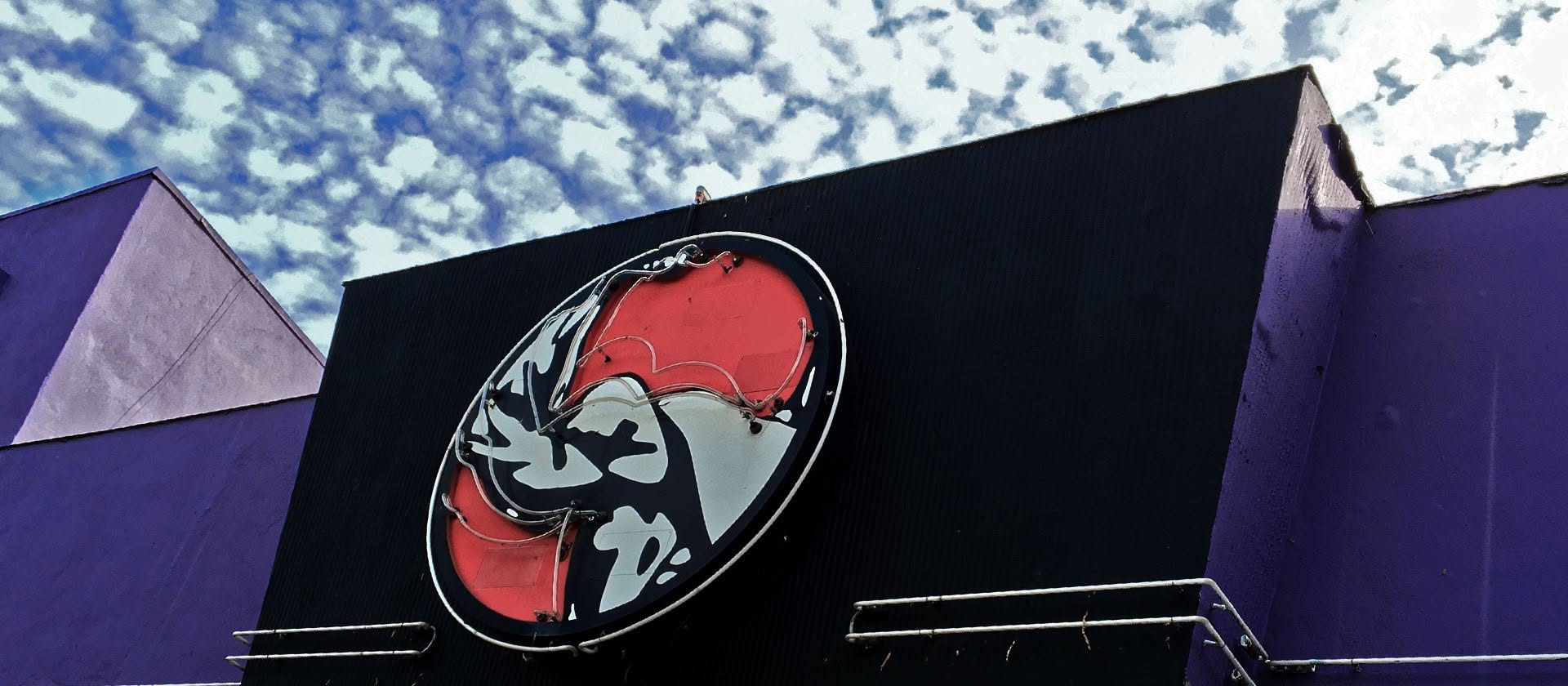
With their communal showers, mirrored workout spaces, and image-conscious clientele, gymnasiums have long served as hubs of queer culture. For newcomers, the YMCA often served as a gateway into a particular city’s gay underground. By the 1970s, gymnasiums and disco converged in places like Body Center, which John Blair opened in the Hollywood-Highland neighborhood in 1972. Following a similar model, Bruce Chan and Kurt Thomas opened Body Builders Gym in Silver Lake (taking over the former Bobb’s Beauty Salon) in November 1978. Both venues frequently sponsored local queer athletic teams and neighborhood events. In 2000, the gym was purchased by Jackie Joniec and her nephew, Erik Flowers, who shut down the venue in January 2023, after which it was taken over by the queer-owned Rodeo Athletic Club.
STUD TWO (1978-1980 | 3037 West Sunset Boulevard | Also at this address: Ramm’s Head, Butch Gardens, and The Yellow Brick Road)
Don and Emiel opened the original Stud at 4216 Melrose Avenue in January 1974 — a bit west of Silver Lake. The “hunky western & leather bar” would, after its 1988 closure, be followed by Zone, Griff’s, and, for 27 years, Faultline. Meanwhile, in Silver Lake, Stud Two took over Yellow Brick Road around 1978. Its stint there was much shorter than the original Stud. In fact, when Stud Two closed, it was the last of the gay bars at that address. In 1980, it was reborn as the Oriental Nights Klub, better known as “the O.N. Klub” or simply “the O.N.” The O.N. was a famous dance club that featured many rising mod revival and second wave ska acts and attracted a high profile following. After the O.N. closed, the space hosted a succession of businesses including, currently, Body Dada Silver Lake.
A DIFFERENT LIGHT (1979-2011 | 4014 Santa Monica Boulevard)
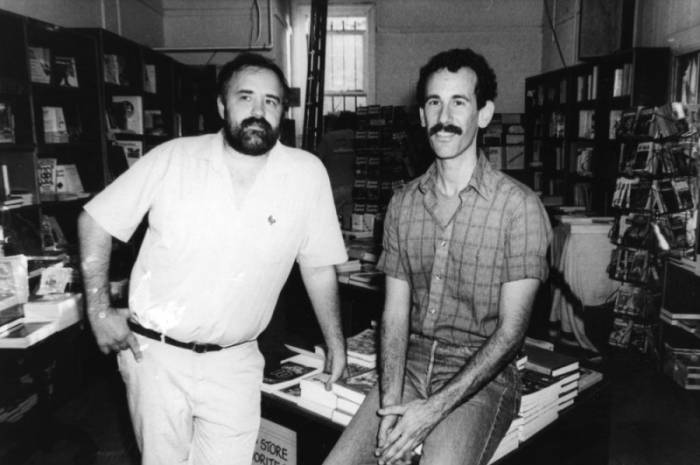
In 1979, George Leigh, Norman Laurila, and Richard Labonté opened a gay bookstore, A Different Light, at 4014 Santa Monica in the Sunset Junction district of Silver Lake. At the peak of A Different Light’s popularity, there were also locations in the Castro, Greenwich Village, and West Hollywood. The first — and final — author to give a reading there was John Rechy, author of 1963’s City of Night and a dozen other works. In 2011, as the Silver Lake Neighborhood Council’s Urban Design & Preservation Committee was seeking a Los Angeles Historic-Cultural Monument designation for the 83-year-old building, it was demolished by Frost/Chaddock. For the last fifteen years, the site has been a vacant lot.
FOUR QUEENS CAFE (1979-1982)/MARSHALL’S ROOST (1982)
The Four Queens Cafe opened a block over from One Way, at 574 North Hoover Street, in 1979. The building was constructed in 1958 and was, in the 1960s, a coffee shop. Before the Four Queens Cafe, it was the Scorpio Rising Theater. Being alcohol-free, it was allowed to legally operate after 2:00 am. By 1982, it had been replaced by another alcohol-free cafe, Marshall’s Roost. It’s unclear when it closed but by 1990, it was home to Art “N” Barbee — a barbecue joint-meets-art gallery. Today the space is home to the Hoover Village Psychic.
CREST COFFEE SHOP (1980-2000 | 3721 Sunset Boulevard)
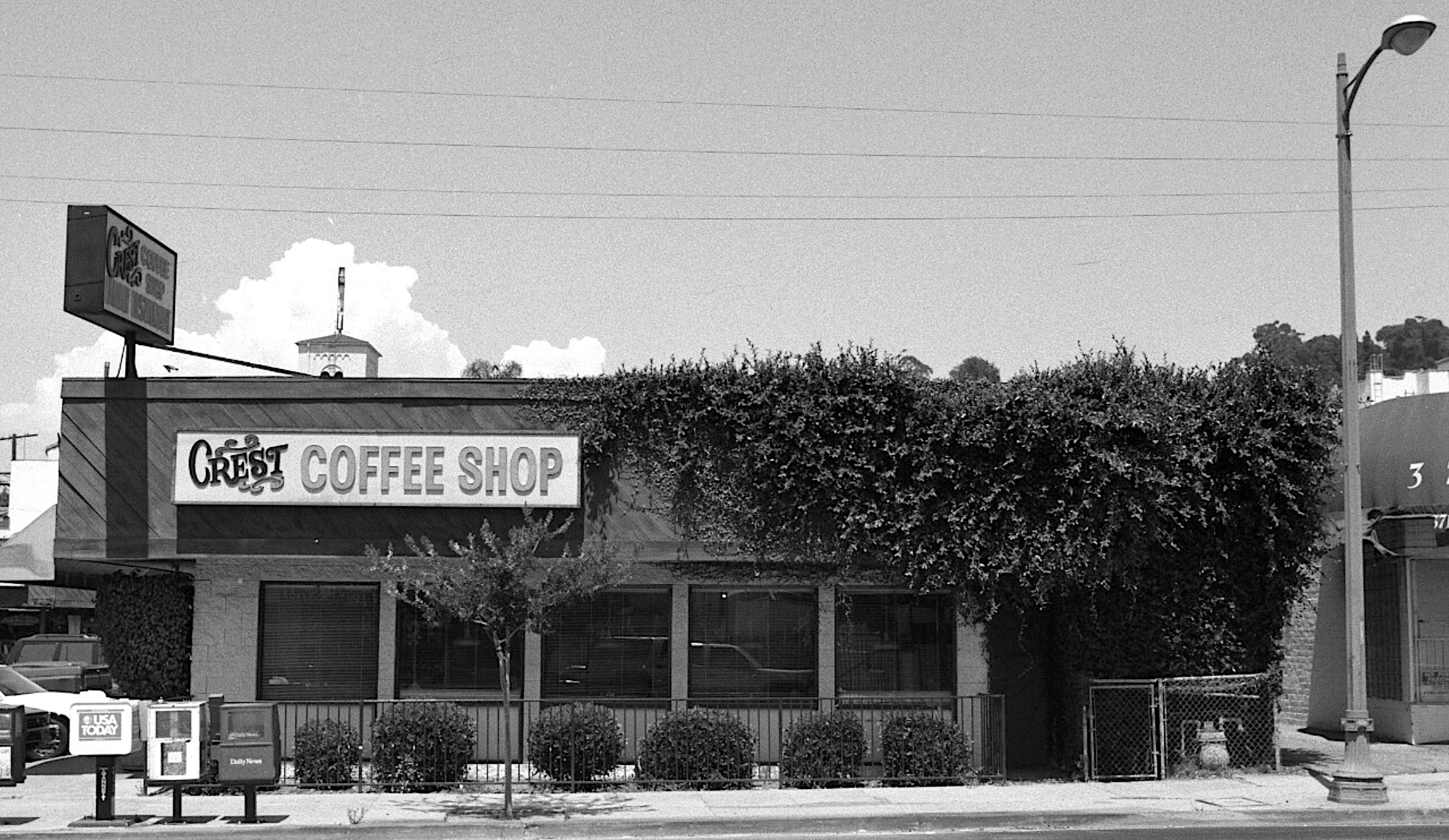
Crest Coffee Shop opened at 3721 Sunset Boulevard in 1980. It served as a neighborhood organizing hub during the HIV/AIDS crisis, hosting weekly Friday meetings between activist Ivy Bottini and Dr. Michael Gottlieb for the AIDS Informational Network, whilst mobilizing patrons to raise vital funds for Aid For AIDS. In 2000, then-new owner Ron Martinez re-branded it Crest on Sunset. In 2004, Martinez again re-branded it, Good Microbrew & Grill. In 2016, Ryan Floyd transformed it into 33 Taps.
1800 HYPERION CLUB/SWAP MEAT (1980-1982 | 1800 Hyperion Avenue | Also at this address: Hyperion Club, King of Hearts, and Exxile)
The 1800 Hyperion Club, an adult men’s club, opened in a former sign shop at that address that had been constructed in 1936. That company, Pacific Maintenance Co., created the Cinerama’s iconic sign. The owner, Howard A. Mathisen, was an avid bowhunter who, in 1947, killed a bear by shooting it with an arrow after it got into an apiary. 1800 Hyperion seems to have also operated as Swap Meat, which was listed at the address in 1981. It was shut down along with Pure Trash by irate neighbors in 1982. Around 1983, it was followed by King of Hearts.
HYPERION LUMBER COMPANY (1980-1981 | 1941 Hyperion Avenue | Also at this address: The Hy Spot, The Shingle Shack, Headquarters, Jack Wrangler’s Cruise Bar, and Cuffs)
On 9 August 1980, Wrangler’s transitioned into Hyperion Lumber Company (also known as the Lumber Yard). A year later, it became Cuffs — the last gay bar to operate at this address.
JUNGLE (1980 | 3626 West Sunset Boulevard | Also at this address: Club Flamingo, 3626 Sunset, 3626 Club, and Being Alive!)
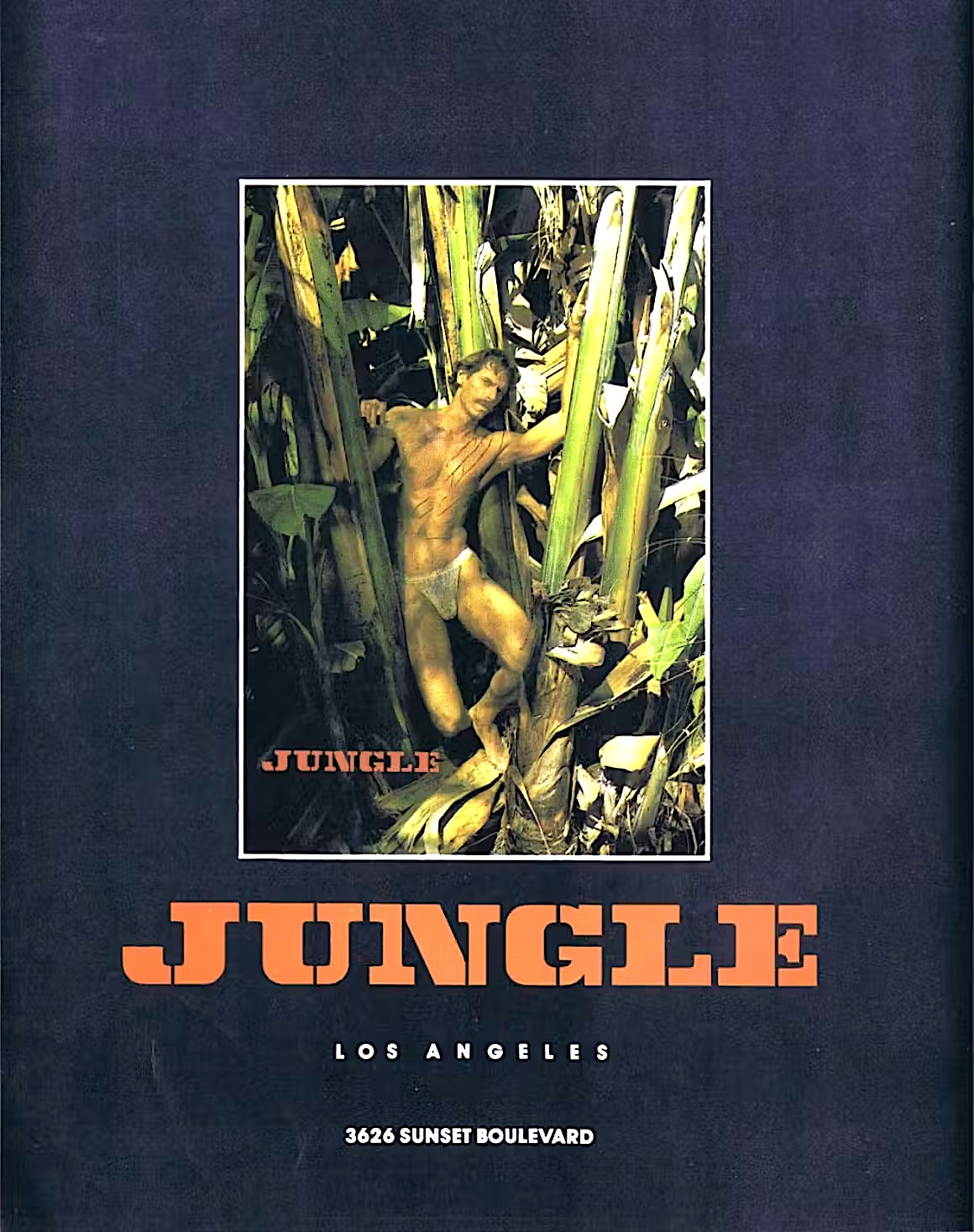
Jungle opened in 1980 at 3626 Sunset Boulevard, in a building constructed in 1924. In the 1930s, it was home to Don’s Quality Meats (not a gay bar). In the 1950s and early ’60s it was home to the Airport Cafe. A pool table permit was applied for in 1963. Jungle closed in 1982 but was followed by a succession of gay bars, beginning with the lesbian Club Flamingo.
THE NEW YORK COMPANY BAR & GRILLE (1980-1993 | 2470 Fletcher Drive)
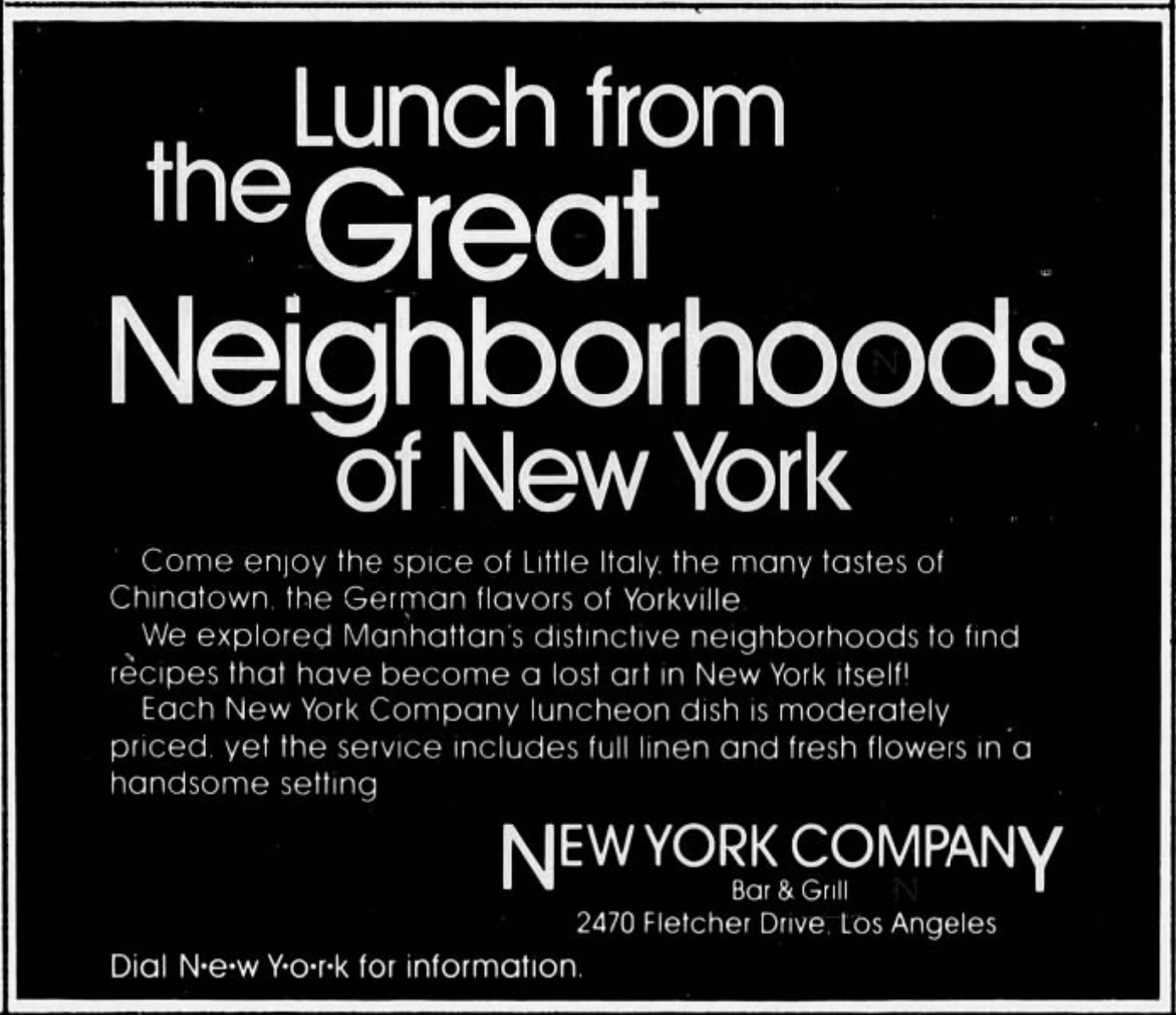
The New York Company Bar & Grille opened at 2470 Fletcher Drive in 1980. The address had by then been home to a series of slightly odd businesses. In 1957, Leonard Kanner’s Leonard’s Spa Cafe opened — a piano bar/spa that, despite that description, doesn’t appear in any known gay guides. In 1967, it became the Spa Restaurant & Cocktail Lounge which, like its predecessor, was apparently not a primarily gay business. The New York Company, however, was. It was declared (along with Mary’s Place) the “best gay restaurant” in The LA Weekly in 1982. In 1983, they declared it home to the best greyhounds. It also had a cabaret which featured, amongst others, Rudy de la Mor (who died in 2013). In 1993, the New York Company moved uptown to 4600 Hollywood Boulevard in Little Armenia — where Cheetah’s Gentleman’s Club opened in 1997. The old location, meanwhile, also became a strip club — first Extasy and then, in 1999, Star Strip Too. Since 2006, it’s been home to Silver Lake Caregivers Group.
PURE TRASH (1980-1982 | 1903 Hyperion Avenue)
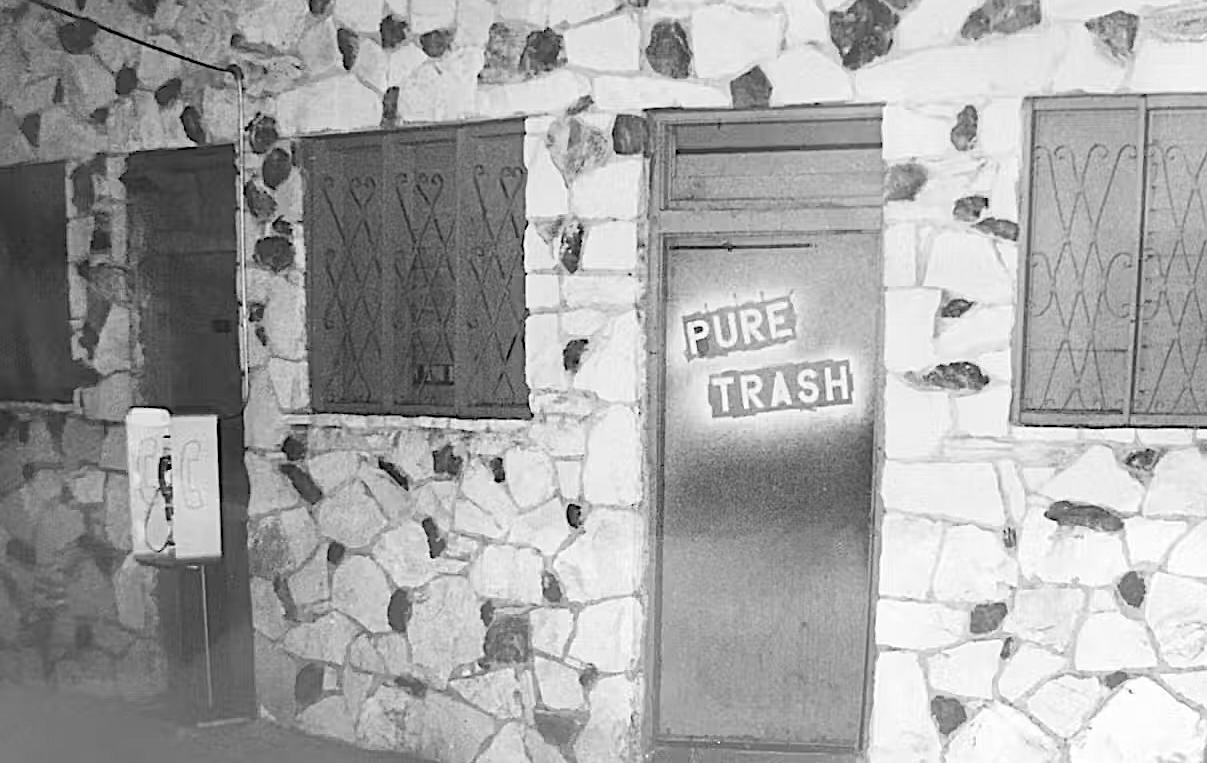
The space at 1903 Hyperion had existed since 1924, had first been a bar around 1950, but didn’t become a gay bar until 1980, when Pure Trash — a new wave and progressive disco (with leather and Levi leanings) opened there. It immediately ran afoul of its residential neighbors, whose complaints led to its shutdown in 1982. Their complaints may not have been without basis in fact. Damron noted, favorably, that it was “2 trashy floors” and that the clientele included johns.
In 1985, an entrepreneur named Larry Lloyd added soundproofing and upgrades for a disco he planned to appeal to “gay male yuppies” but was denied a liquor license. Alleging homophobia as the reason, he nevertheless pivoted toward his next idea, a restaurant there that was aptly to have been named Plan B. Since then, it’s cycled through many businesses including galleries, a poke joint, a vape shop, and currently, Reunion & Company.
CUFFS (1981-2001 | 1941 Hyperion Avenue | Also at this address: The Hy Spot, The Shingle Shack, Headquarters, Jack Wrangler’s Cruise Bar, and Hyperion Lumber Company)
The short-lived Hyperion Lumber was transformed into the long-running Cuffs in 1981. In 1983, nearby neighbors alleged that Cuffs operated after-hours and formally protested its Type 48 liquor license renewal. The bar prevailed, however. In 1998, Cuffs appeared in John Huckert‘s independent thriller, Hard, where the film’s protagonist tracks a serial killer there into the city’s leather and S&M subculture. Cuffs closed in 2001 and sat empty for years until 2007, when the bar and live music venue, Hyperion Tavern, opened there. Since it closed down in 2020 during the COVID-19 lockdown, this space — home to the first gay bar in Silver Lake — has sat empty.
THE GREY FOX (1981 | 2375 Glendale Boulevard | Also at this address: Le Bar)
The Grey Fox opened around 1981 at 2375 Glendale Boulevard — a building noteworthy for having been owned, since at least the 1950s, by Latinos and for also having been home to a series of Latino businesses. It took over the space previously occupied by William H. Cortez’s Casa Cortez, which followed Casa Bernal, and before that, La Ronda. The Grey Fox was apparently a gay restaurant. It’s not clear when it closedm but by 1983, it had been replaced by the Latino gay bar, Le Bar.
THE LEAN TWO (1981-1982)
In 1981, an after-hours gay cafe called The Lean Two opened at 610 North Hoover Street. It was next door to One Way until at least 1982, around which time it closed.
THE BUSHWHACKER (1982-1983 | 3909 West Sunset Boulevard | Also at this address: The Black Cat, Tabasco’s, Basgo’s Disco, and Le Barcita)
The former Black Cat, in 1982, re-opened as the Bushwhacker, seemingly marking the return of gay bars to the address. Its logo — a cowboy boot with a spur — strongly suggests that it was a “Levi” bar. In 1982, Damron noted that it “looks promising,” but it was also short-lived, becoming Tabasco’s in 1983, which kept the phone number.
GOOD COMPANY L.A. (1982-1984 | 2939 West Sunset Boulevard | Also at this address: The 4 Poster and Hungry Savage)
Hungry Savage became Good Company L.A. in 1982, which closed in 1984 and was followed by Latin Flame, ending the building’s run of gay bars. Latin Flame was followed by Mi Nayarit, which was followed by Johnny’s. Johnny’s became Stinkers in 2008, a truck stop-themed bar that catered to the hipster subculture associated with the 1990s and early 2000s. In 2010, it became Thirsty Crow, which remains there today.
HALSTED’S (1982-1983 | 2453 Glendale Boulevard)
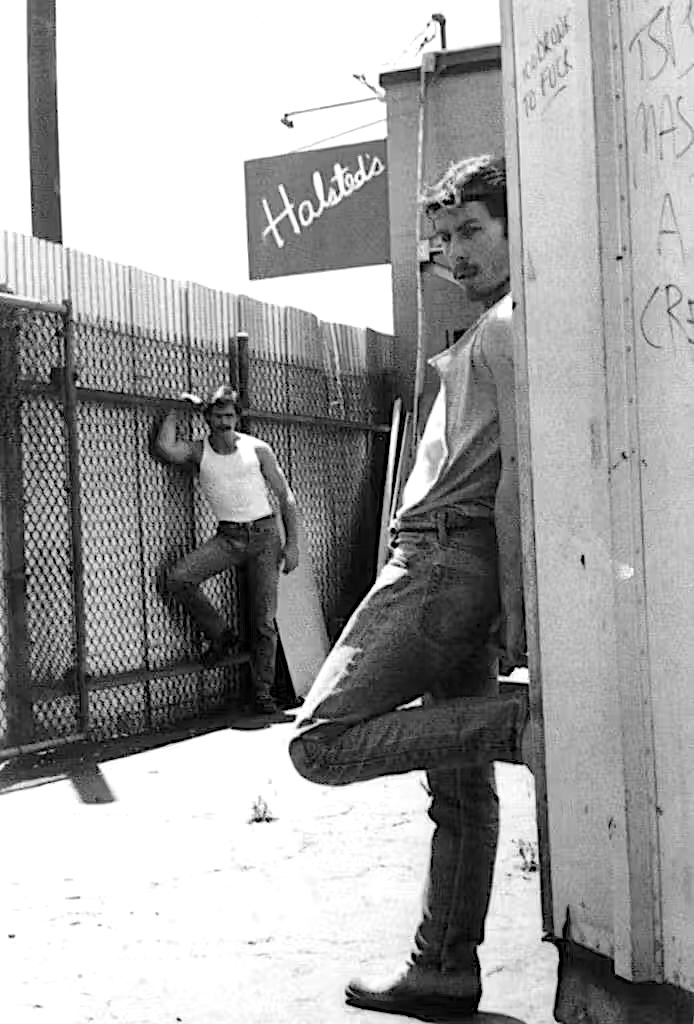
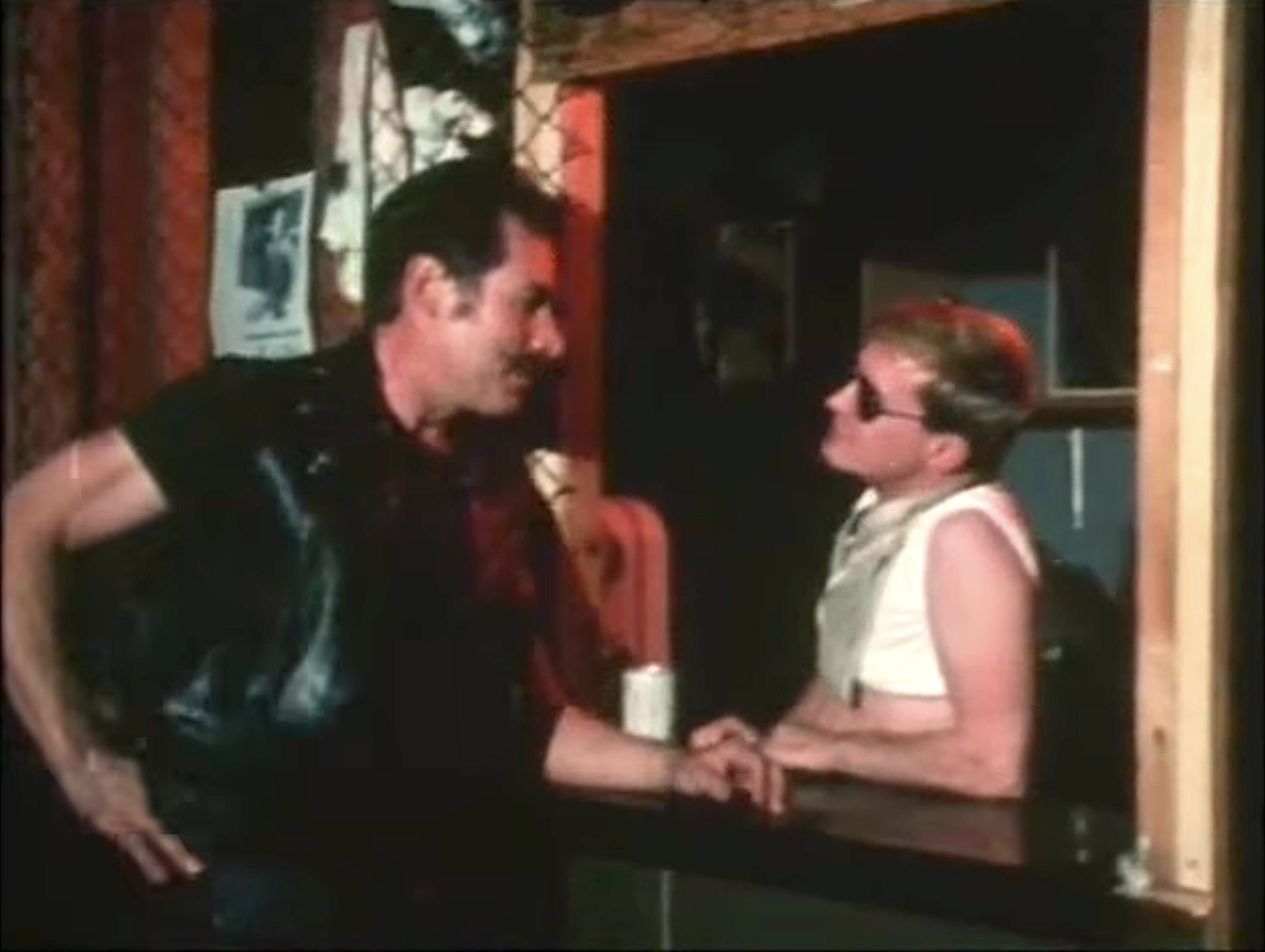
Fred Halsted opened a club, Halsted’s, at 2453 Glendale Boulevard in 1982. Halsted was an underground filmmaker best known for his experimental film, L.A. Plays Itself — which includes footage of the final Griffith Park Gay-In. The club’s layout included four truck trailers meant to recreate the vibe of New York City’s Meatpacking District. A Night at Halsted’s, filmed in 1982, was Haltsted’s last film. The club closed in 1983 with Halsted claiming that there weren’t enough freaks in Los Angeles to have kept it in business. He committed suicide in 1989.
MARY’S PLACE (1982-c. 1987 | 4114 Santa Monica Boulevard)
Mary’s Place opened at 4114 Santa Monica Boulevard by 1982, when it was listed in The LA Weekly, along with the New York Company, as one of Los Angeles’s best gay restaurants. Its owners, Mary Whalen and Vernon Chase, kept it open until at least 1984 — probably 1987. The building which housed it was constructed in 1950. By 1988, it was home to the Italian restaurant Puran’s. It’s currently home to Bulan Thai — opened by Pornphan Charoensit in 2007 and currently operated by Narintr Ruengsamutr.
CLUB FLAMINGO (1982-1985 | 3626 West Sunset Boulevard | Also at this address: Jungle, 3626 Sunset, Club 3626, Being and Alive!)
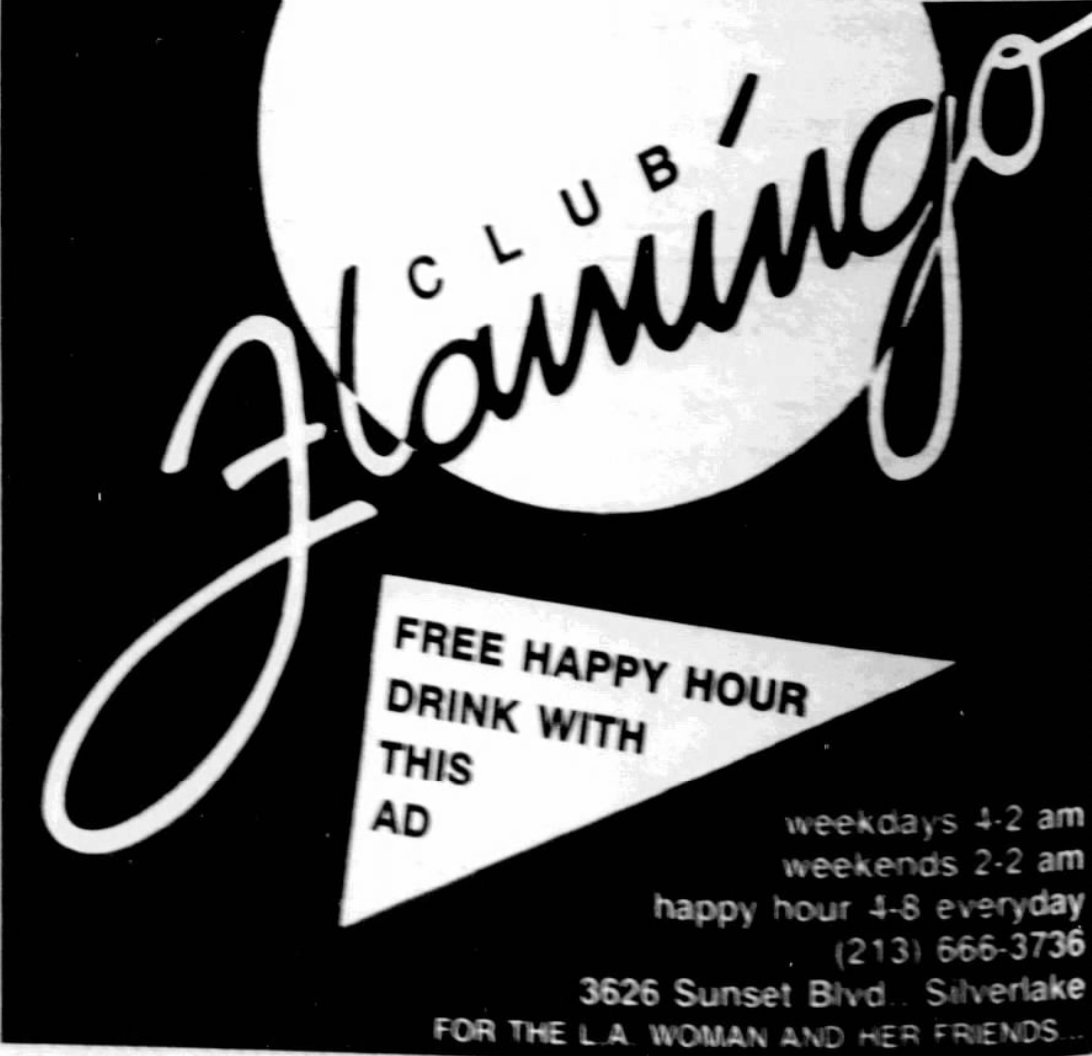
The lesbian club, Club Flamingo, took over Jungle in the autumn of 1982. It was billed as “the Party Bar for the L.A. Woman and her friends.” There was live entertainment from acts like Kim Cummings & High Rise, “progressive dance-rocker” Bobby Borrelli, and ex-husband-and-wife cabaret duo Wayne and Brenda (Wayne Moore and Brenda Silas-Moore), who were then a staples of gay restaurants and cocktail lounges. In 1984, The LA Weekly named it “Best Neighborhood Lesbian Bar – Silver Lake” (Palms was “Best Neighborhood Lesbian Bar – West Hollywood”). It closed in 1985 and seems to have operated simply as 3626 Sunset.
RUDOLPHO’S (1982-2008 | 2500 Riverside Drive)
The building at 2500 Riverside Drive was constructed in 1932. For decades, it was home to a location of the soda fountain chain, Currie’s Ice Cream. This location and seventeen others were boycotted in 1955 for their policy of not hiring black employees. That location closed around 1965. After a stint as a fabric store in the late ‘60s and ‘70s, it became a bathhouse called California Men’s World — which its tempting to assume was a gay venue but about which little is known. In 1982, Rudy del Campo of Casita del Campo opened another restaurant there, Rudolpho’s. Like Casita del Campo, Rudolpho’s was more than a restaurant, hosting music and dance nights like the razabilly Be-Bop Battlin’ Ball as well as gay salsa nights (Salsa con clase) and more. In 1993, Mr. Dan and DJ Paul V launched their punk-dance masquerade night, Dragstrip 66. Rudolpho’s closed in 2008 and went through spells as Home, Ivanhoe, and now, Casa Chida.
GAUNTLET II (1983-2005 | 4219 Santa Monica Boulevard | Also at this address: The Shed, Outcast, and Eagle L.A.)
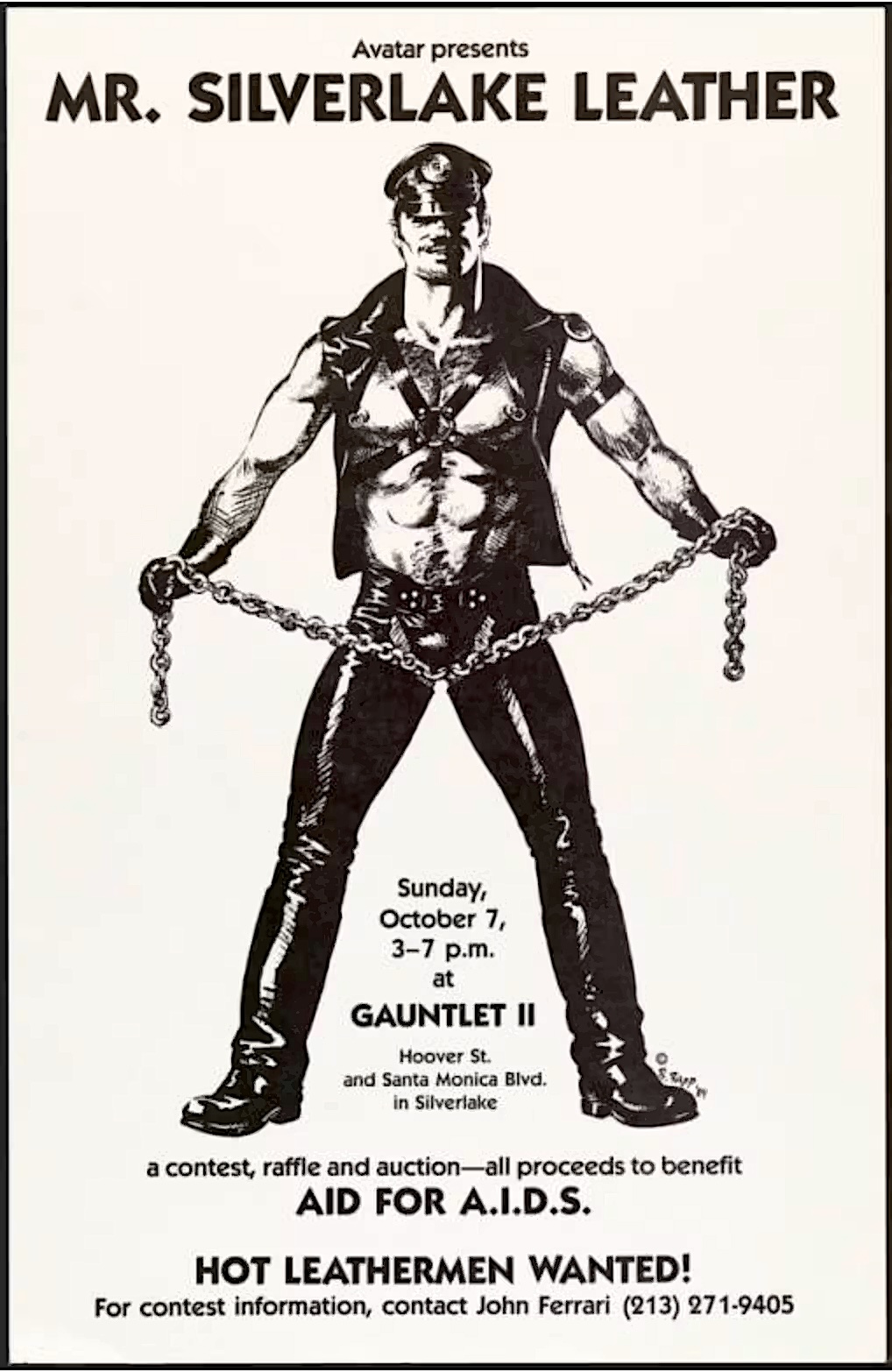
In 1983, the former home of the Outcast became the Gauntlet II. Dale Habberstad and his partner Zack opened the original Gauntlet in Central Hollywood around 1965, when it appeared in Damron’s Address Book. The building which housed the early leather bar was demolished in 1968. After a long gap, Habberstad took over Outcast and opened the Gauntlet II in 1983. In 1984, it hosted the first annual Mr. Silverlake Leather. Gauntlett II was also an important live music venue, hosting many bands from the queercore scene at its 1990s club night, the Freak Show. It closed in 2005 and was taken over by Eagle L.A. Habberstad died in 2009.
TABASCO’S (1983-1984 | 3909 West Sunset Boulevard | Also at this address: The Black Cat, The Bushwhacker, Basgo’s Disco, and Le Barcita)
Jack Heywood took over El Cid around 1983 and, also that year, took over the Bushwhacker, and renamed it Tabasco’s. It appeared in Damron’s Address Book in 1983 and ’84, where he denoted that the disco was popular on weekends. In 1984, however, new owners took over and transformed it into Basgo’s.
KING OF HEARTS (1983-1996 | 1800 Hyperion Avenue | Also at this address: 1800 Hyperion, Swap Meat, King of Hearts, the Exxile)
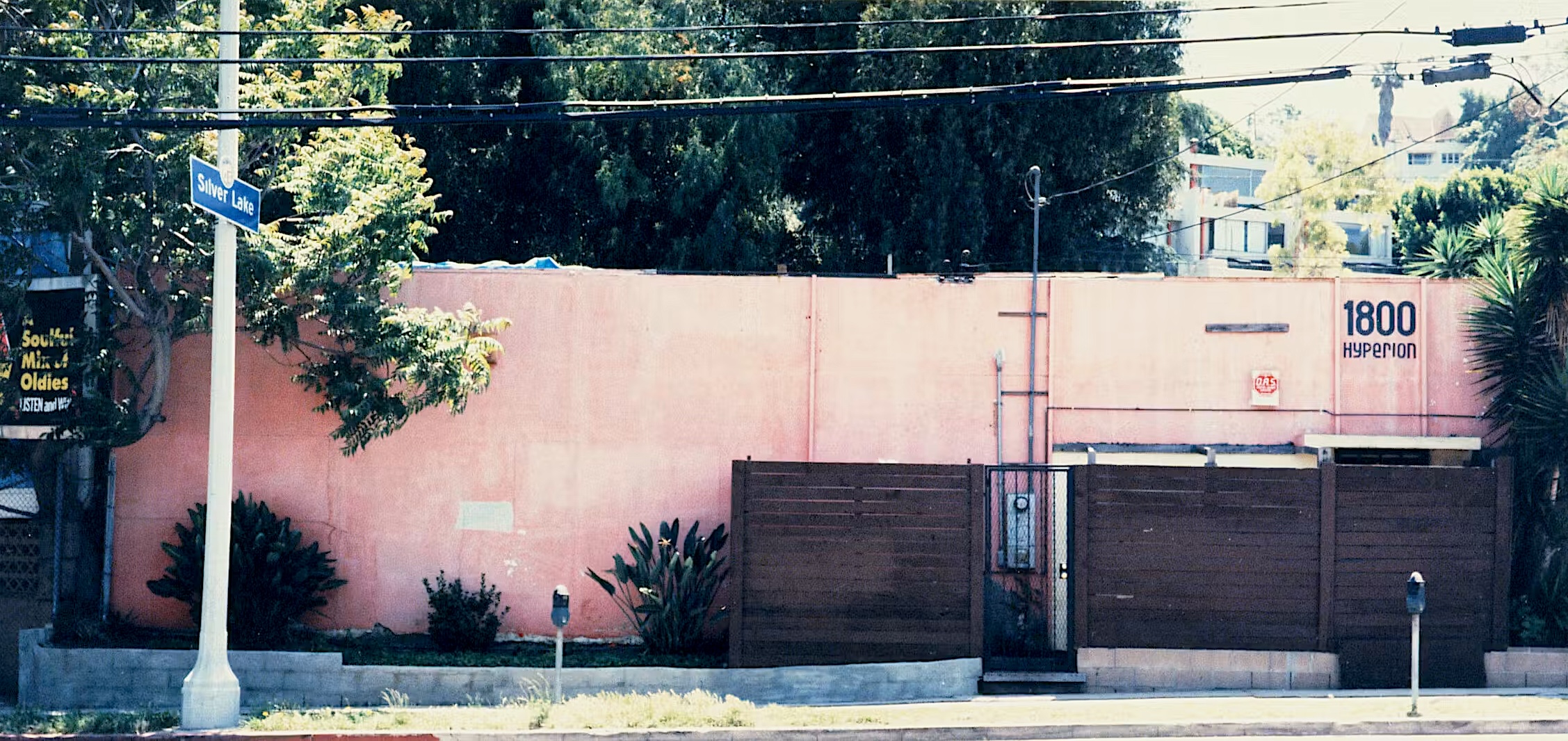
After the Hyperion Club was shut down, it re-opened in 1983 as the King of Hearts, another private adult men’s club. It remained in operation until 1996. After that, it became the Exxile, which advertised itself as “A Private Men’s Club Now Open Nightly.” It remained in business until 2001.
LE BAR (1983-2005 | 2375 Glendale Boulevard | Also at this address: The Grey Fox)
From 1983 until 2005, it was the gay Latino bar, Le Bar, owned by José Martinez. That year, a group of business partners from Seattle bought the building and opened the faux-Mexican Cha Cha Lounge. To preserve the memory of its gay Latino past, they commissioned an artist to paint portraits of the displaced drag performers atop their new bar’s tables.
THE SALVAGE YARD (1983-1991 | 1935 Hyperion Avenue)
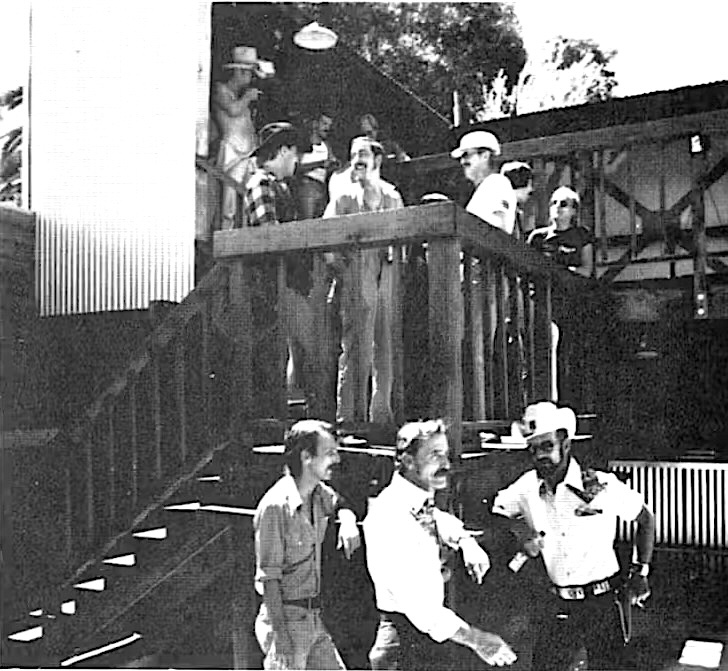
After Pure Trash’s closure, the owners moved down the street to 1935 Hyperion Avenue, where in 1983 they took over the former Hyperion Theater (and before that, New Playwrights Theater) to open the Salvage Yard, which remained in operation until 1991.
BASGO’S DISCO (1984-1992 (3909 West Sunset Boulevard | Also at this address: The Black Cat, The Bushwackerm Tabasco’s, and Le Barcita)
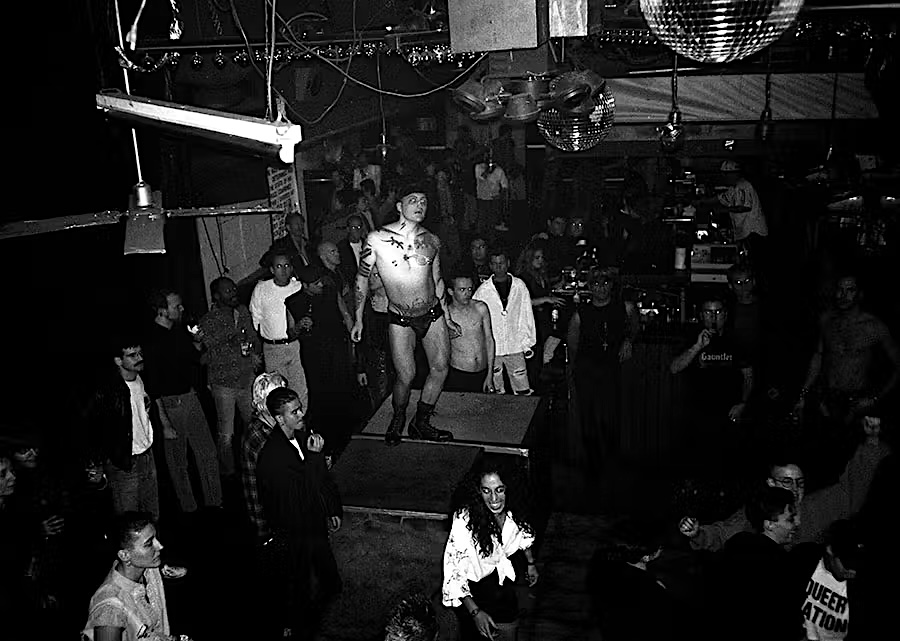
In 1984, new owners Basil and Gordon combined their names to transform the former Tabasco’s into Basgo’s Disco, which hosted a transgressive club night called Club F*ck! and featured performers like Vaginal Davis and Ron Athey before it moved to Dragonfly in Hollywood. In 1992, it was featured in the nunsploitation comedy, Sister Act. It was shut down in 1992 following charges of serving alcohol to underage patrons.
CIRCUS OF BOOKS (1985-2016 | 4001 West Sunset Boulevard | Also at this address: New Faces, Joker, The Gay’m, and Sunset East Showbar)
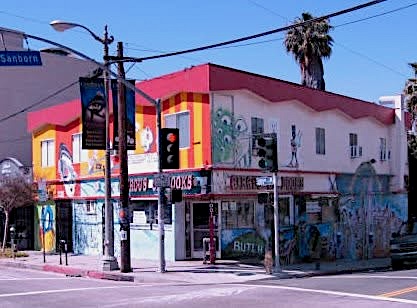
In 1985, Barry and Karen Mason opened Circus of Books in the space that had, two decades earlier, been home to historic New Faces and which apparently hadn’t been a queer-catering business since the mid-1970s closure of Sunset East. It was the second location of Circus of Books, the first having opened in 1982 in West Hollywood. Despite its name, it carried adult books, movies, magazines, and paraphernalia. It also wasn’t strictly gay in its orientation, although the Masons estimated that fifty percent of the customers were. With the rise in popularity of the internet, sales decreased and the couple closed their store in August 2016, after which Joaq and Luis Bobadilla opened MOTA (Medicine of the Angels) there. In 2019, the Masons’ daughter, Rachel, completed her documentary, Circus of Books.
THE NIGHTHAWK/THE PROWL (c. 1985 – c. 2007 1064 Myra Avenue)
The anonymous warehouse at 1064 Myra Avenue was constructed in 1948 and was originally the office of Richard Douglas van Horne. In the 1950s and ‘60s, it was home to a battery shop called Golden State Enterprises. By the end of the decade, it was an office furniture store. In 1986, it appeared in the classified section of Drummer, a leather/S&M magazine, which hints that by then it had transitioned into a private adult men’s club called the Nighthawk. In 1995, it appeared in photographer Dean Sameshima’s work, Untitled (15 rooms, 1 locker room, 3 bathtubs, 2 leather slings 1995). In 1996, after it was cited for zoning violations, the owners sought a zone variance to “continue an existing private gay men’s club with incidental sexual encounters.” By October 1997 it was operating as the Prowl.
3626 SUNSET/3626 CLUB (1986-1989 | 3626 West Sunset Boulevard | Also at this address: Jungle, Club Flamingo, and Being Alive!
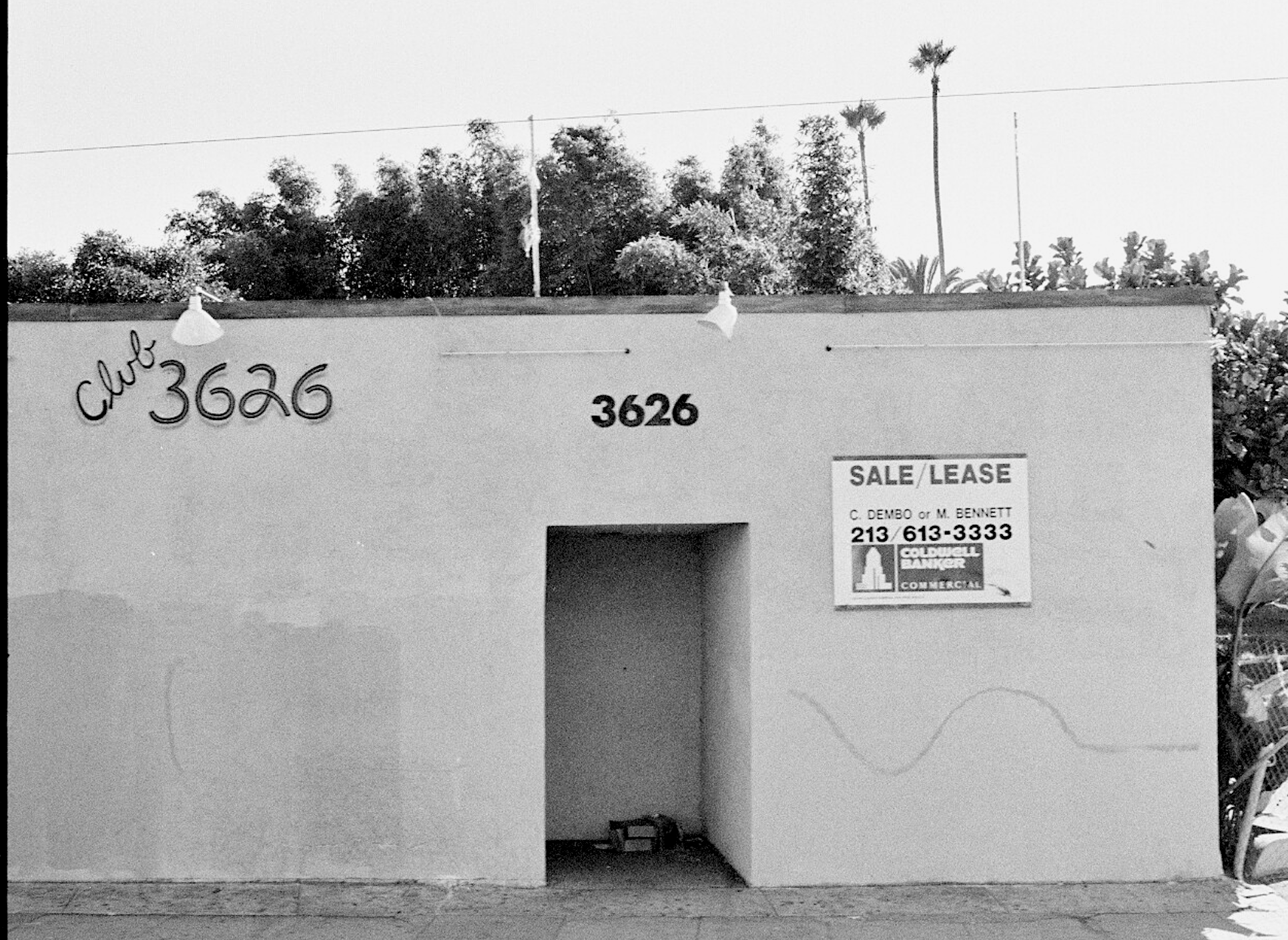
After Club Flamingo ended in 1985, the venue was advertised merely as 3626 Sunset in 1986. By 1987, it hosted a series of weekly and one-off events with names like Armageddon, Club Secrets, and Z. By 1989, the venue was branded the 3626 Club, although it was gone by 1990. The space had already enjoyed a relationship with activists and, in 1988, co-hosted Lesbian/Gay Latino Heritage Week there with VIVA! After 3626 Club closed, the space would be taken over by the HIV/AIDS non-profit, Being Alive!, founded by John Mohr, Rick Ewing, and Ron Rose. They remained in the space until 2004, when.real estate developer and restaurateur Dana Hollister bought the space and opened Cliff’s Edge there. Cliff’s Edge ultimately closed in 2020 and, the following spring, it reopened as Bacari. Being Alive LA, meanwhile, still operates the Being Alive Harm Reduction Center in West Hollywood.
Roughly twenty gay bars, cafes, and discos opened in Silver Lake in the first half of the 1980s. Only a few have opened since — and all in spaces where there were already gay bars. Most closed. A deadly medical condition that had disproportionately affected gay men was given a name, AIDS, in 1982. In 1983, HIV was first isolated and identified as the cause. In 1985, the Los Angeles County Board of Supervisors passed an ordinance to regulate — and effectively close — gay bathhouses. Another followed in 1988.
It was around that time that Troy Perry’s Metropolitan Community Church — the nation’s first primarily gay Christian Church — opened a chapel at 1924 Hyperion Avenue. Ironically, in 1993, the space became Basic Plumbing, Silver Lake’s last bathhouse. In 1995, it was cited for zoning violations. Basic Plumbing’s owners, Lee Struwe and Hosea Cobb, fought for a zoning variance and prevailed… but closed in 2001. In 1997, “No Cruising | No U-Turns Midnight to 6am” signs were installed along Griffith Park and Silver Lake boulevards. Although the “No Cruising” signs have often been decried as a relic of a more openly homophobic era, it would seem that the truth is more complicated. The signs were installed when Jackie Goldberg — the first openly homosexual member of Los Angeles City Council — represented CD 13. The “No Cruising” portions of the signs were taken down in 2011 following action by the Silver Lake Neighborhood Council. The restrictions against U-turns, for whatever reason, remained until 2024, when council members Nithya Raman and Hugo Soto-Martínez had them removed. By then, all of the once numerous gay bars and clubs along nearby Hyperion had been gone for years and “dating” apps had largely moved cruising online.
But even before apps, far fewer gay bars opened in and after the 1990s, although there were notable exceptions. In 1993, the owner of Le Bar opened a sister bar, Le Barcita, in the former location of the Black Cat, which was designated Los Angeles Historic-Cultural Monument No. 939. It closed in 2011. The Flying Leap & Other Side took over the old Toy Tiger space in 1997, which closed in 2012. Eagle LA took over Gauntlett II in 2006 and (partnering with Rough Trade, which opened in 1999), launched the annual Off Sunset Festival to keep leather alive. Ruby Fruit had a couple of goes at reviving the lesbian bar from 2023 until 2025.
Even though it opened in the 1990s (and, is technically, in East Hollywood), no history of Silver Lake’s Golden Age gay bars and third places would be complete without a more detailed account of how Akbar came to be. Following the closure of the Silver Saddle and a purported, if brief, stint as the Bulldog the building there became home to Joly’s, following the departure of Red’s Fountain Club. Joly’s traced its origins all the way back to 1948, when it was likely founded by Julian Joly on Western Avenue. Several owners later, in 1965, it appeared in Damron’s Address Book. Catering to older clientele, it was derisively nicknamed “the Wrinkle Room.” Joly’s left Koreatown after 1987 and re-emerged in Silver Lake around 1991. Scott Craig and Peter Alexander entered the dingy bar filled with mirrors and fake hanging plants in 1995 to make the owner an offer. On New Year’s Eve 1995, it re-opened as Akbar, named after one half of the duo in Matt Groening‘s Life in Hell comic strip. In 2023, after 28 years, the pair sold the bar to longtime employees Albert Loya and David LeBarron.
Since the gay community took root in Silver Lake in the mid-20th century, demographics and attitudes have changed. No longer is there a strict division between gay and straight businesses. The sports bar, 33 Taps ,was founded by a gay man. The women’s sports bar, Trophy Wife (now Untamed Spirits), was opened, for example, by a lesbian couple. You won’t find either in a gay guide. Nor will you find queer-owned restaurants like Bé Ù, Jewel (RIP), and Pine & Crane…. nor businesses like Bar Keeper, Indigo Fitness, Vinovore, Wildfang nor any other gay-owned Silver Lake businesses. You won’t, in fact, find any gay guides. The 52nd and final edition of Bob Damron’s Address Book was printed in 2019. The LAPD long ago ended its openly hostile policies and there have been openly gay captains, commanders, and deputy chiefs. Today the threats are less tangible but include gentrification, “dating” apps, “social” media, extractive delivery apps, ongoing motonormativity, or loneliness reframed as “solomaxxing.” As a friend of mine used to say, “You don’t know whether or not your life will change if you go out — but you know it won’t if you stay in.”
FURTHER RESOURCES
- One Archives
- Queer Maps (2019) by Chris Cruse
- Gay Bar: Why We Went Out (2021) by Jeremy Atherton Lin
- “Excerpts & Fragments” by Paul Mpagi Sepuya and Los Angeles Nomadic Division (LAND) at 2413 Hyperion
Support Eric Brightwell on Patreon

Eric Brightwell is an adventurer, essayist, rambler, explorer, cartographer, and guerrilla gardener who is always open to paid writing, speaking, traveling, and art opportunities. He is not interested in generating advertorials, cranking out clickbait, or laboring away in a listicle mill “for exposure.”
Brightwell has written for Angels Walk LA, Amoeblog, Boom: A Journal of California, diaCRITICS, Hey Freelancer!, Hidden Los Angeles, and KCET Departures. His art has been featured by the American Institute of Architects, the Architecture & Design Museum, the Craft Contemporary, Form Follows Function, the Los Angeles County Store, Sidewalking: Coming to Terms With Los Angeles, Skid Row Housing Trust, the 1650 Gallery, and Abundant Housing LA.
Brightwell has been featured as subject and/or guest in The Los Angeles Times, VICE, Huffington Post, Los Angeles Magazine, LAist, CurbedLA, LA Times 404, Marketplace, Office Hours Live, L.A. Untangled, Spectrum News, Eastsider LA, Boing Boing, Los Angeles, I’m Yours, Notebook on Cities and Culture, the Silver Lake History Collective, KCRW‘s Which Way, LA?, All Valley Everything, Hear in LA, KPCC‘s How to LA, at Emerson College, and at the University of Southern California. He is the co-host of the podcast, Nobody Drives in LA.
Brightwell has written a haiku-inspired guidebook, Los Angeles Neighborhoods — From Academy Hill to Zamperini Field and All Points Between; and a self-guided walking tour of Silver Lake covering architecture, history, and culture, titled Silver Lake Walks. If you’re an interested literary agent or publisher, please out. You may also follow on Bluesky, Duolingo, Facebook, Goodreads, iNaturalist, Instagram, Letterboxd, Medium, Mubi, Substack, Threads, and TikTok.


Thank you Eric for this exhaustive list the deep gay history of Silver Lake! This is a neighborhood I lived in from 1983-2022, when I was gentrified out. I was already haunted knowing what things were 4 or 5 businesses ago but this is incredible! After the Teddy Sandoval show at VPAM I had to find out that the bar Butch Gardens (number one best name) later became the ON club. anyway, memory lane but I wanted to write and leave a message that I’m both impressed and moved. –Ron Athey
LikeLiked by 1 person
Thanks Ron! I just updated it, hopefully for the last time (for a while) by incorporating a couple of places I’d left out and a few corrections. Thanks for being part of Silver Lake’s culture and history — and yes, Butch Gardens is still the best name!
LikeLike