In 2028, Los Angeles will host the LA28 Olympic and Paralympic Games. It will be the third time Los Angeles has hosted the Switzerland-based International Olympic Committee‘s competition. It will also be the city’s first time hosting the Paralympics. The Olympic Games are scheduled to take place from 14-30 July 2028 — in 996 days. The Paralympic Games will follow from 15-27 August 2028.
Hosting the Olympic Games is typically a massive financial drain on host cities and countries — thanks to thanks to factors like corruption, cost overruns, and the burden of maintaining “white elephant'”venues after the event.. That’s why Boston, Budapest, Calgary, Denver, Hamburg, Innsbruck, Kraków, Munich, Oslo, Rome, Sapporo, Stockholm, Tehran, and Toronto have all rejected or backed out of hosting or bidding for the event. Maybe they won’t be as burdensome for Los Angeles — routinely ranked the third-largest economy of any metropolis in the world — the wealthiest city in the wealthiest state in the wealthiest country on Earth. On the other hand, despite its wealth, Los Angeles has managed to get itself into a budget crisis thanks to unsustainable spending and fiscal mismanagement. That’s why groups like NOlympics LA have opposed Los Angeles hosting the Games — in addition to displacement, exploitation, evictions, empowering the police state, eroding democracy, &c.
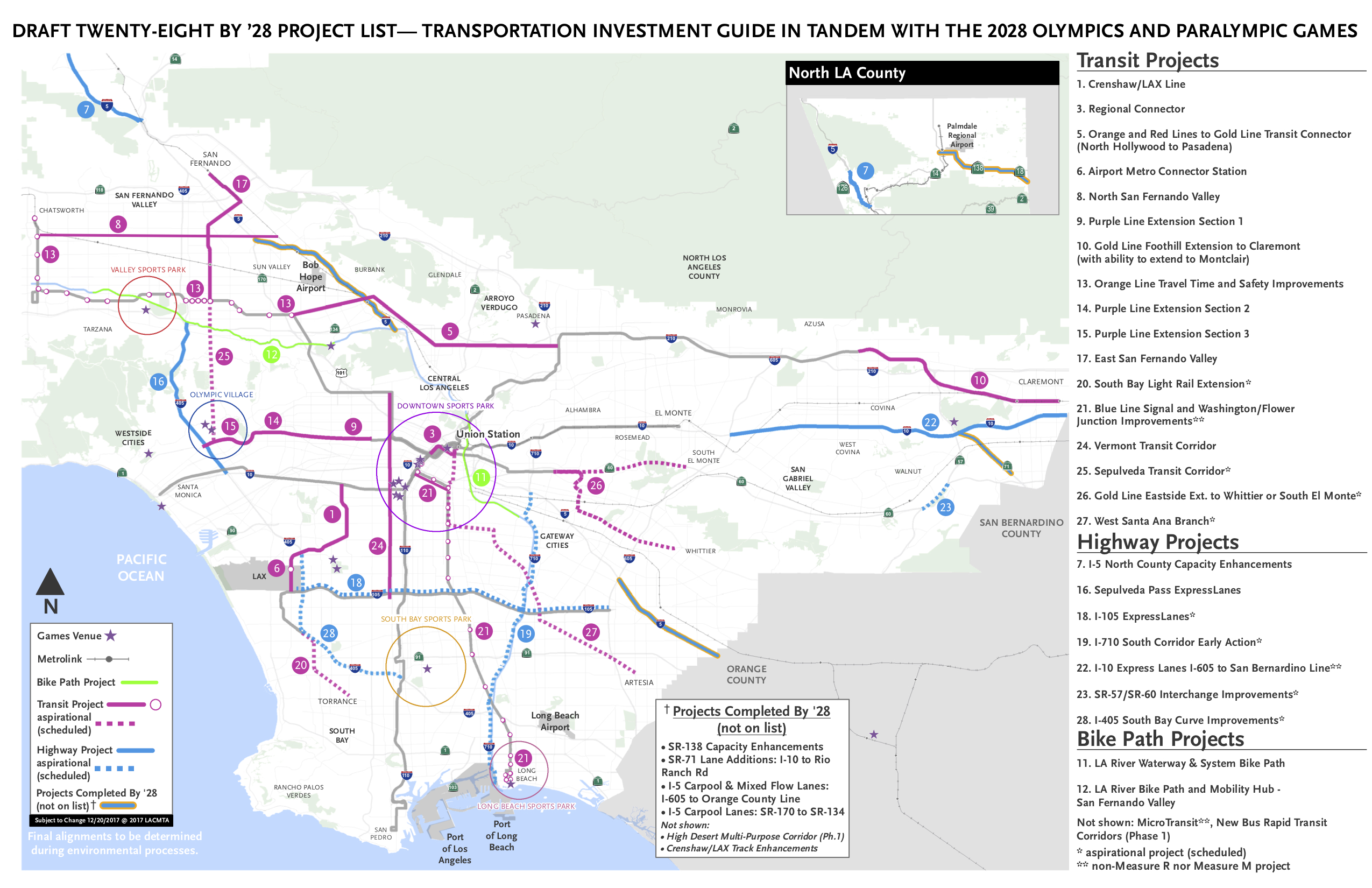
On the other hand, there are Olympics boosters who point to purported benefits the Games will bring. There’s “28 by ’28” — an initiative to fast-track mass transit projects. As a car-free Angeleno, I appreciate that — although I’d like to see us prioritize improving transit all the time, not just on the rare occasions we’re hosting major international sports events. There’s also the cultural exchange. I love chatting with tourists about the city and hearing about their cultures — although I also think Los Angeles should create its own international Los Angeles Games, to be held regularly. It could focus on regionally popular competitive pastimes like association football (soccer), badminton, bar trivia, baseball, basketball, beach volleyball, BMX, bowling, dodgeball, go-kart racing, hot-rodding, lowriding, mahjong, mini-golf, mural painting, pickle ball, ping pong, roller derby, skating, skimboarding, and surfing.
These Olympics promise to be different. The LA28 Games are focused on sustainability and adaptive reuse. That means no new permanent venues being built specifically for the event. Of course, being serious about sustainability means not just using existing facilities but reducing the use of private automobiles — the biggest contributor within the transportation sector of greenhouse gas emissions in the US. That’s why Los Angeles Mayor Karen Bass promised a “no-car Games” on 10 August 2024… although, three days later, in an interview on KCRW‘s Press Play, she “walked” it back to a less ambitious “transit-first games.”
Mayor Bass was in Paris when she said “no-car” and was likely inspired by that city’s hugely reduced car dependancy. Under Mayor Anne Hidalgo, major traffic arteries (including the expressways along the Seine) were converted into pedestrian and cycling paths, thousands of car storage spaces were removed, 180 kilometers (112 miles) of permanent protected bicycle lanes have thus far been installed, driving restrictions are implemented on high air pollution days, over 300 car-free streets have been created near schools, and the government has invested €41.5 billion (the equivalent of $48.215 billion) in the Grand Paris Express in order to expand the rail system to the city’s largely working class suburbs.
Meanwhile, in Los Angeles, our efforts to reduce car-dependency have been far more modest. A block of Broxton Avenue was converted into Broxton Plaza, a few bus lanes have been created, and 26 beige signs have been installed over hostile intersections designating them “public squares.”
But is a no-car Games really too ambitious? “Nobody drives in LA,” as they say. Between 1908 and 1913, Los Angeles built a 375 kilometer (233 mile) aqueduct to steal water from the Owens Valley. This is the city that, in the wake of a series of floods, channelized over 800 kilometers (500 miles) of streams, rivers, and other waterways (and entombed over 4,500 kilometers (2,800 miles) beneath). This is the city that, in the name of “urban redevelopment,” demolished entire neighborhoods like Bishop, Bunker Hill, Dogtown, La Loma, and Palo Verde and turned three of them into a sea of car storage. This is the city that displaced more than 50,000 Angelenos in order to build interstate freeways through working class neighborhoods. And now you’re telling me that painting a few bus lanes, increasing mass transit frequency, and building some bike lanes just isn’t realistic?! A century ago, people started referring to Los Angeles as “19 suburbs in search of a metropolis.” Today, it’s more like 19 million metropolitans in search of suburbia.
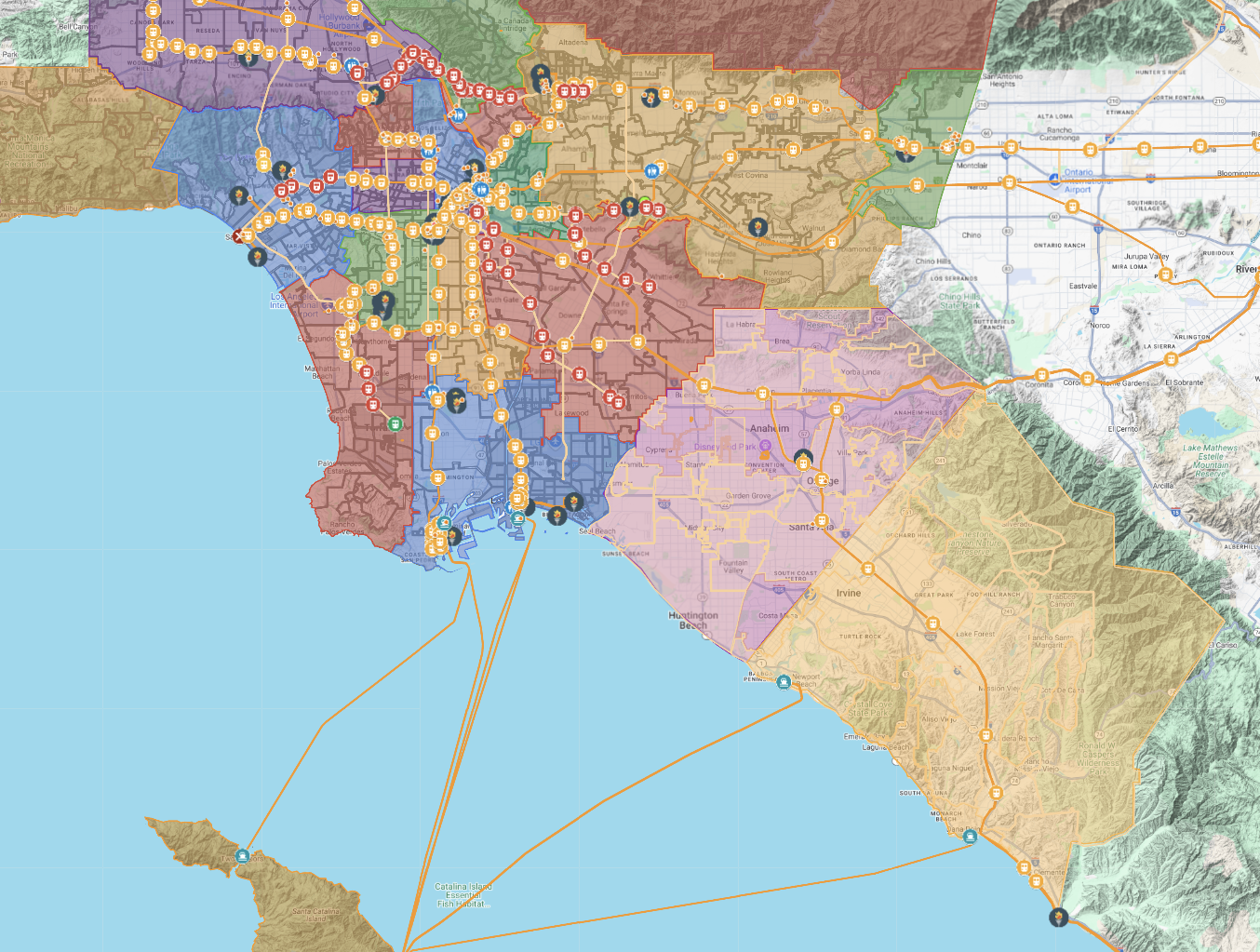
The thing is, Los Angeles already has the second-largest mass transit in the US. Every single venue that will host Olympic events is already served by mass transit. To have a no-car Olympics we just need to build on that — and unlike paving riverbeds, demolishing neighborhoods, or stealing water — better mass and active transit would actually benefit everyone. What’s more, local leaders are also in the process of identifying potential locations for “fan zones” or “live sites” — mostly parks and plazas that will host live screenings, entertainment, vendors, and interactive elements. That will also free Angelenos from having to lug their cars around the city.
Even if city official have abandoned the dream of a no-car Games, there’s no reason you have to. To aid you, I’ve created a map that identifies all of the Olympic venues (I’ll add the fan zones/live sites when they’re pinned down) and includes fixed rail and relevant bus routes — plus nearby and transit-accessible attractions.
Subscribe to Torched for ongoing and in-depth coverage on LA28.
Support Eric Brightwell on Patreon

Eric Brightwell is an adventurer, essayist, rambler, explorer, cartographer, and guerrilla gardener who is always seeking paid writing, speaking, traveling, and art opportunities. He is not interested in generating advertorials, cranking out clickbait, or laboring away in a listicle mill “for exposure.”
Brightwell has written for Angels Walk LA, Amoeblog, Boom: A Journal of California, diaCRITICS, Hey Freelancer!, Hidden Los Angeles, and KCET Departures. His art has been featured by the American Institute of Architects, the Architecture & Design Museum, the Craft Contemporary, Form Follows Function, the Los Angeles County Store, Sidewalking: Coming to Terms With Los Angeles, Skid Row Housing Trust, the 1650 Gallery, and Abundant Housing LA.
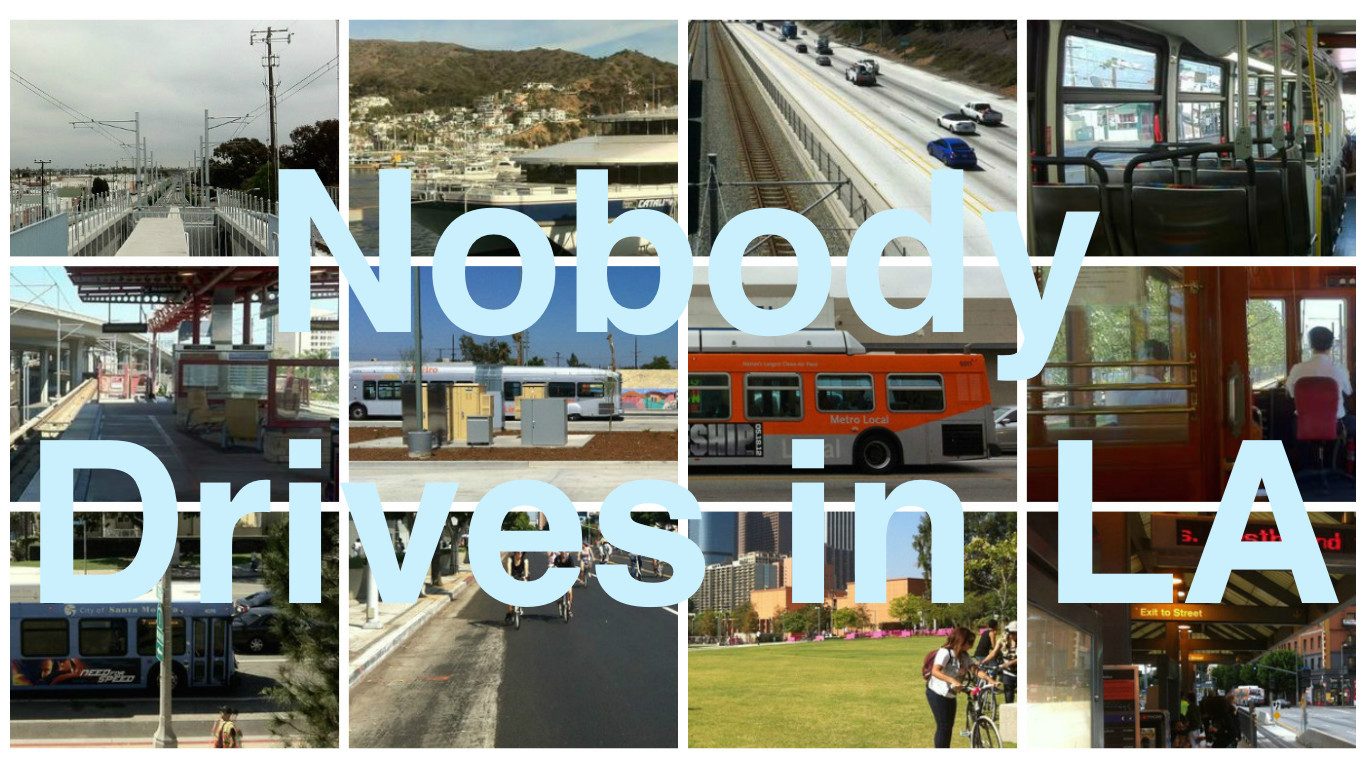
Brightwell has been featured as subject and/or guest in The Los Angeles Times, VICE, Huffington Post, Los Angeles Magazine, LAist, CurbedLA, LA Times 404, Marketplace, Office Hours Live, L.A. Untangled, Spectrum News, Eastsider LA, Boing Boing, Los Angeles, I’m Yours, Notebook on Cities and Culture, the Silver Lake History Collective, KCRW‘s Which Way, LA?, All Valley Everything, Hear in LA, KPCC‘s How to LA, at Emerson College, and at the University of Southern California. He is the co-host of the podcast, Nobody Drives in LA.
Brightwell has written a haiku-inspired guidebook, Los Angeles Neighborhoods — From Academy Hill to Zamperini Field and All Points Between, that he hopes to have published. If you’re a literary agent or publisher, please contact him.
You can follow him on:
Bluesky, Duolingo, Facebook, Goodreads, iNaturalist, Instagram, Letterboxd, Medium, Mubi, Threads, and TikTok.


 Eric Brightwell