INTRODUCTION
13 August 2023 was the 25th anniversary of my first visit to Los Angeles. All those years ago, I wrote entries in a journal. At first, the accounts of the days’ adventures had a diaristic air. After a few days on the road, however, I started just jotting down one and two-word notes with the intent of fleshing them out later. Some, like “Koreatown,” open the floodgates of memory. Others, like “67’s Flashback” leave me scratching my head. I think that the idea was to turn them into LiveJournal entries.

Whatever the case may be, I never got around to revisiting them until now. I have endeavored here to provide as honest an account of those days as the passage of 25 years’ time allows. 25 years, though, is 25 years. The Christian gospel was written 36 years after Jesus‘s crucifixion and there are so many inconsistencies with it (and subsequently written gospels) that the Bible’s editor included four. And a road trip, no matter how transformational to those involved, is arguably less consequential than the life and death of the Creator‘s only son.
❦
AFTER GRADUATING
I graduated from the University of Iowa in 1997. So did my friend, and roommate, Seth. Seth is a year younger than me but I took a year off from college in an unsuccessful attempt to save up some money delivering pizza and flowers (for two different employers). This was the 1990s — a time when a student could pay for an education at a state school with a couple of part-time minimum wage (plus tips) jobs.
Armed with a major in Film Studies and a minor in English, I was fully equipped for a life of menial labor. Delivering for Happy Joe’s Pizza & Ice Cream didn’t make me happy but did provide me with free personal-pan pizzas. Working at Every Bloomin’ Thing, where I spent my shifts delivering flowers, listening to audio books, and massaging my co-workers, was quite enjoyable. People waiting for pizzas feel are demanding and impatient. They expect delivery drivers to break traffic laws putting themselves, the public, and wildlife at risk just because, although you’ve made no agreement with them, they expect it to be free if the delivery takes longer than half an hour. With the notable exception of brides — people receiving flowers are usually emotionally moved. Their delivery is usually a pleasant surprise. Tips are rare, though, and occasionally a very old woman will complain if the arrangement hasn’t been sullied with the addition of Baby’s-breath — a visually unremarkable flower that smells like sour milk spit-up but was apparently once considered an essential part of any floral arrangement.
When it was slow at Every Bloomin’ Thing, I’d sometimes go swimming or run errands like picking up breakfast for my co-workers. I was one of the few people I knew with a cell-phone — a 1997 Motorola Star — and because I was constantly driving around, easily reachable, and probably not busy — even friends would call me to ask — if it’s not too much trouble — to bring them, say, a bag of Skittles. Over time, I grew to dislike the constant interruption of a ringing phone and would trade it for a pager until 2007 or so — when people still called them “cell phones” but stopped making phone calls with them.
As unworried as I generally was, I knew all the same that I didn’t want to live in Iowa forever. In fact, I’d never really wanted to live there at all. I was born there — although not by choice — and our family moved to Kentucky likely before I ever placed my feet on Iowa soil. I ended up there again, though, because I reckoned that life anywhere was preferable to the one my father had planned — of life at Admiral Farragut Academy. And so I ran away from home — and came to the state where my deceased mother’s family lived.
Iowa, itself, is not near the top of my list of favorite states. Most of the state (then, anyway) was a patchwork of corn and soybean fields punctuated by small towns, hog lots, and grain bins or silos. Some farmers favored John Deere, others Case International. Everyone, though, seemed to agree that Chevy was the only type of car and Pepsi the only brand of (soda) pop.
Some of the towns were alright. I liked Iowa City and Ames well enough — the homes, respectively, of the University of Iowa and Iowa State University. Des Moines — despite being the state’s closest thing to a city — was pretty dull although there was a bar there that hosted a night called “Ally McBeer” because patrons would gather there to watch Ally McBeal. They showed Melrose Place — one of my favorite shows — beforehand and I’d stick around after for the headliner, despite not being a fan. It may sound strange but back then that sort of thing was popular and I would go to bars — even though I had a television at home — to watch the Simpsons. Third places and all that.
Cedar Rapids, the second largest metropolis (with over 100,000 residents!) was known as the “city of five smells” on account of its various industrial processing plants. Riverside‘s claim to fame is that Captain Kirk will be born there in 2233. The town hosts an annual event called Trek Fest. Decorah has its charms and hosts an event called Nordic Fest. Waterloo and the Quad Cities were appealing in an almost southern way. Columbus Junction, a migrant town, had a famous swinging bridge and convenience stores that sold plantain flavored bubble gum. West Liberty had the Eulenspiegel Puppet Theatre. Amish Stringtown had a market that sold Mentos in bulk. In Kalona, you could watch cheese curds being made. Quaint charms, all, but not charmless. Not that much fun either, if I’m honest.
For proper fun, I’d sometimes drive all the way across the state line to Hannibal, Missouri — birthplace of Cliff Edwards and Mark Twain — and home to a bar that where patrons dances to booty bass. Even dance clubs in Iowa City were more likely to play gratingly MOR, undanceable songs by Hootie & the Blowfish and Shawn Mullins. There was a goth-industrial night, Stigmata, the occasional barn-rave where trance was played — and jungle was common in basement parties. My efforts to ignite a UK Garage craze weren’t going anywhere, though.
But I didn’t want to leave Iowa because of the lack of Southern hip-hop or speed garage — it was the realization that winter was coming. One winter day, the previous winter, I was walking through the Ped Mall and looked, as one did. in those days, to the temperature display on the corner of the bank in order to find out how cold it was. I learned several things — the time and temperature, that Celsius and Fahrenheit cross paths at -40 °, and that because one could learn this tidbit firsthand just by going outside, I did not want to experience a temperature that low again — unless I was somewhere more exciting, like Antarctica or Enceladus.
I had a couple of ideas about where I might like to move. At the top of the list was New Orleans. New Orleans was where all the good music came from in the late 1990s. Cash Money and No Limit, mainly, but also Big Boy, Take Fo’, Tombstone, Untouchable, &c. I had a couple of friends in New Orleans, too, although neither of them seemed to be living lives with anything approaching stability. The weather in New Orleans would surely drive me mad, too. As much as I disliked blisteringly cold winters that scar your ears, heat and humidity are even worse… although there is something not entirely unappealing about imagining myself sweating through a seersucker suit, drinking mint juleps on a porch, and mopping my neck with a pocket square.
My other choice was Seattle. I’d never been the the Pacific Northwest but Twin Peaks and Northern Exposure had both made pretty compelling cases for the region. And the weather — gray and gloomy — appealed to me strongly. The Pacific Northwest looked like a place one could pull off wearing tweed. I applied to the University of Washington to study Forestry. I was notified by school officials that there was a dorm room reserved for me. My counselor, however, had not sent off some document or other in time and it was suggested that I enroll at the University of Iowa and then transfer, after a semester, to UW. At U of I, I had the exact opposite problem. I was accepted but I had no dorm room. I was placed in a student lounge with about a dozen other students where we slept in bunk beds until dorm rooms opened up.
I didn’t know a lot of other places I might consider. I liked Memphis a lot — but I hadn’t seen enough places to make an informed decision. Back then, I’d lived in four states — Iowa, Florida, Kentucky, and Missouri. None of them were exactly calling to me. I’d been to Alabama, Arizona, Arkansas, Georgia, Illinois, Indiana, Kansas, Mississippi, New Mexico, Oklahoma, Texas, and Wisconsin. As much as I liked some of them, I didn’t imagine living in any. Seth had a proposal. How would I like to drive him to Chino in my beige 1988 Ford Taurus? I was game — so long as we didn’t take a direct route. I wanted to see more of the Plains and Mountain West. After I dropped Seth off at home, I’d head up the coast to the Pacific Northwest.
Chino is a suburb of Los Angeles in San Bernardino County. I didn’t really have any interest in Los Angeles. Like many people who’ve never been to it, I had a pretty strong and negative opinions of it. I had run away from Florida, after all, why would I want to run to an imitation of it? Los Angeles’s boosters — and Hollywood — all tout its many non-native palms, the freedom of freeway gridlock, lifestyles of the rich and vulgar, and sleb tours as chief amongst its appeals. You’ll love our Spanish Colonial strip malls and our historic Hollywood sign, built, um, in 1978. Oh, and please never go east of the Los Angeles River or south of the 10 because you’ll instantly be murdered in a drive-by shooting.
The only real selling point for Los Angeles to me was that I had friends from college who had chosen, after graduating, to move there. It wasn’t always obvious to me why. Our friend, Christian, was from Pomona, so his moving back to his childhood home made since. Same for Stella, who’d moved back to Monterey Park after graduating from Grinnell. On the other hand, I honestly had no idea why our friends/exes Drea and Rebecca — both from the Middle West — had ended up there. Drea was working at Penny Lane, a record store on the Third Street Promenade. I’m not sure what, if anything, Rebecca was doing for work although it seemed as though they all worked at Bob Dylan‘s coffee shop at some point or other.
❦
LEAVING IOWA
It was decided. On 7 August 1998, Seth and I packed our things into the beige 1988 Ford Taurus with only about 50,000 miles on it. It had been my grandmother’s car. She lived in rural Iowa and she’d used it, almost exclusively, to transport groceries from the Hy-Vee back to her and my grandfather’s place.. Otherwise, she preferred to ride a bicycle unless the roads were too icy. In that case, she’d walk. My grandfather, on the other hand, was not into cycling or walking. He took pride in having owned, over the course of his life, 38 cars. Usually he drove big models — like Chrysler LeBarons. There were exceptions, though, like a Renault hatchback.
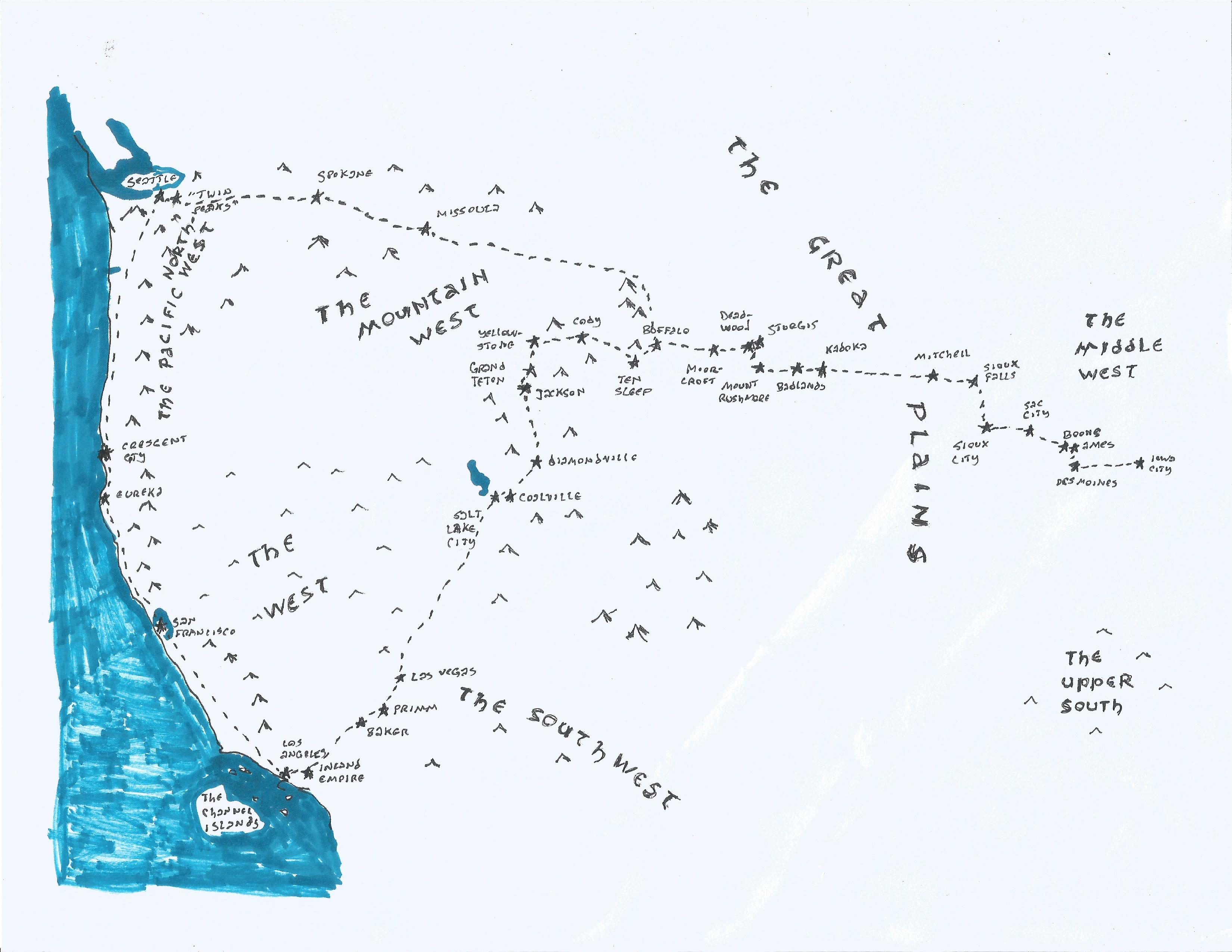
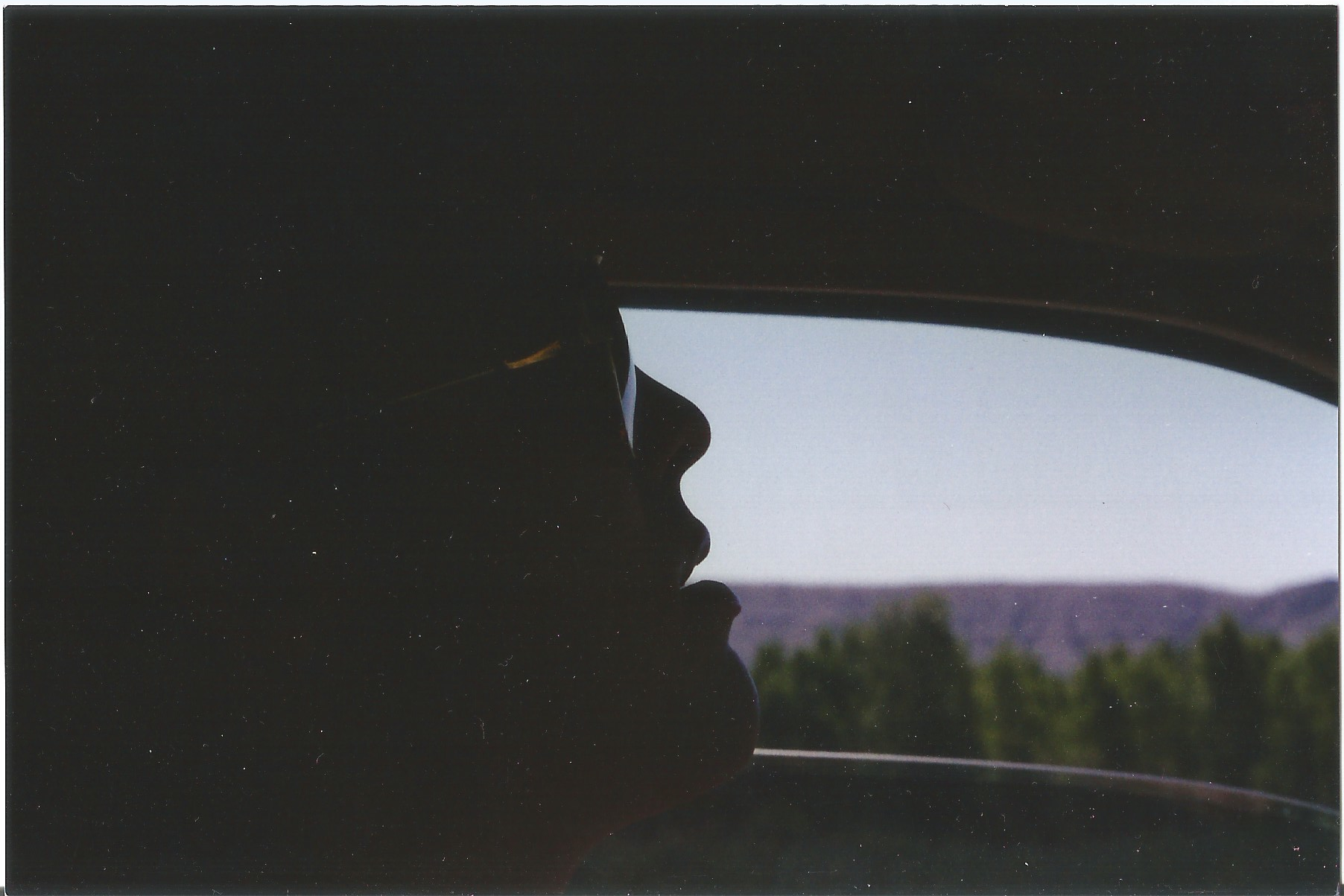
Seth and I christened our road trip “Seth & Eric’s Airconditionerless Adventure” because the air conditioner in the Taurus no longer worked. And it was on its third transmission — despite being an automatic. Other than that, it at least looked as good as a beige 1988 Ford Taurus could. Seth brought a portable CD player so that we wouldn’t have to listen, exclusively, to the radio. I brought what I felt was Western road trip-appropriate music — Country and “Pritnear Country”— Buck Owens, Gram Parsons, Simon Bonney — that sort of thing.
Seth had also worked at Every Bloomin’ Thing. That evening we had a send-off dinner across the street at the Wig & Pen with our co-workers: Angela, Denise, Lissa, and Jen. A pitcher of Bass and a pitcher of Guinness were used to make black and tans. After that — and our goodbyes — we set out for Des Moines. There we stopped to visit and say goodbye to more friends — Kim, Matt, Mike, Pete, and Pete’s friend, Justin — and to visit another bar. Afterward, Seth and I followed Pete back to his place in Ames, where we arrived after midnight and presumably crashed on the floor of his place — a converted attic in a Mock Tudor house where the walls didn’t reach the angled ceiling, giving every space — most embarrassingly, the bathroom — the feel of a cubicle rather than an actual room.
On the 8th, Seth and I drove to Boone, a small town outside of Ames, where my Aunt Rebecca lives. My grandparents (her parents) were visiting because my cousin, Vanessa, was graduating. Vanessa’s dad, Celeste, was there, too. I hadn’t seen him in over a decade but we spoke little. My aunt gave Seth and I a tour of her property — the Shivvers Nature Sanctuary — two pound cakes, and two peppers. Gramps slipped me $100 and said “gas is more expensive out there.” Seth and I still had unsettled business in Iowa, though, and we headed back to Ames to play a croquet match with Pete. Seth won. The ashes were coming to California. We left Pete with one of the pound cakes and headed out.
❦
SOUTH DAKOTA
Seth and I headed west. I’d never been to to Western Iowa before. I doubt very much that he had, either. It’s hard to imagine two U of I students having any business out there. The entire west seemed to stretch out before us as we drove toward the setting sun. My only trip to the West, before that, had been on Boy Scouts trip to the Grand Canyon when I was in junior high. This and everything beyond was unfamiliar territory.
We stopped in Sac City to get snacks and gas. We drove through Sioux City and onto Sioux Falls. It was dark by then and we had to pullover to scrub bug guts off of the windshield because we could no longer see. In Sioux Falls, we decided to dine at a place called Szechwan Chinese Restaurant. It was one of those old school American Chinese places with a pagoda and shishi guarding the entrance that cultural gatekeepers (most of them not Chinese) deride as “inauthentic.” The laminated menu was one of those ones that has a story that you can read as you wait for service. Usually they’re about how the owner had a dream and the restaurant you’re reading a menu inside of is the culmination of it. This one was was about, among other things Chinese man’s legendary love of sex and women.
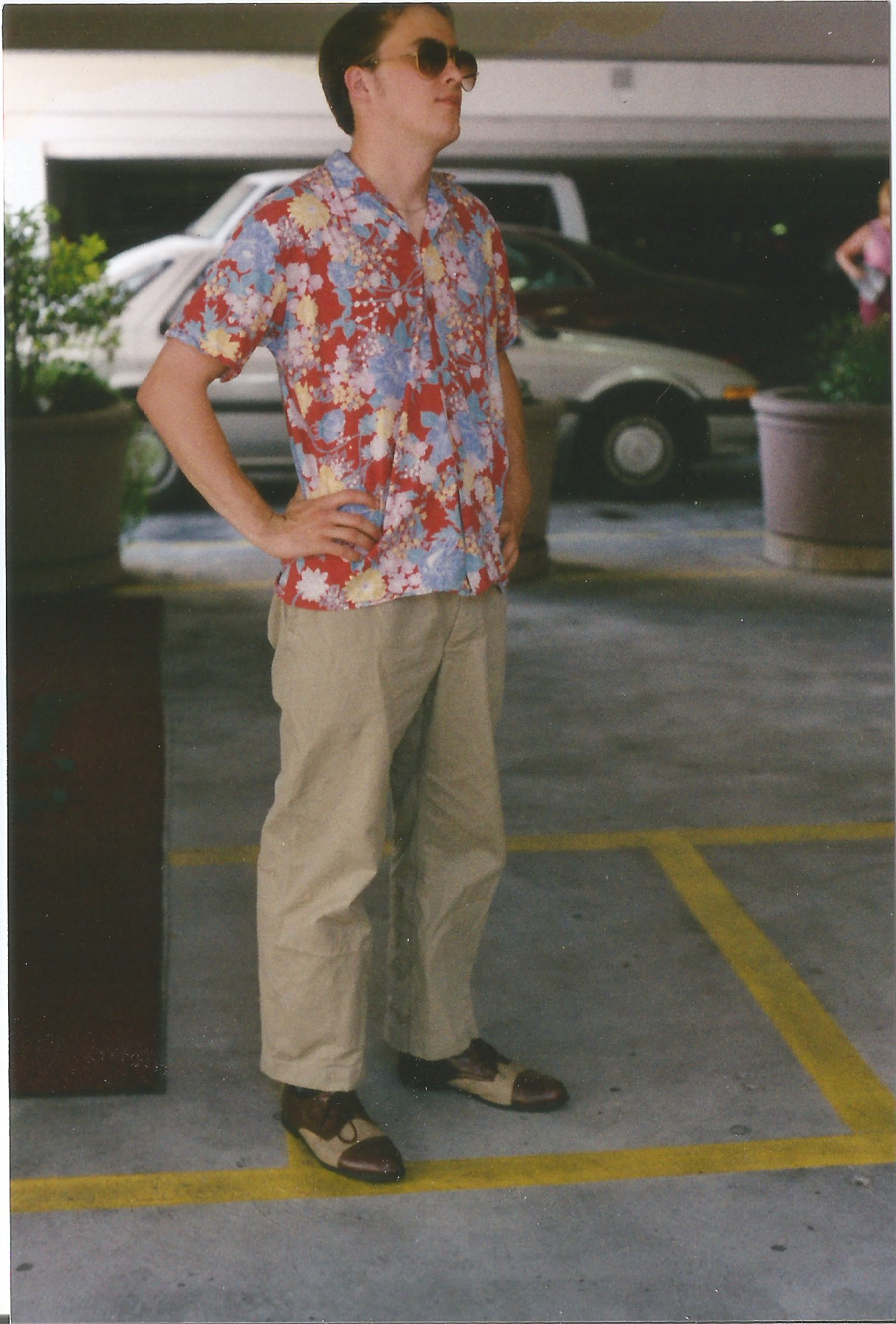
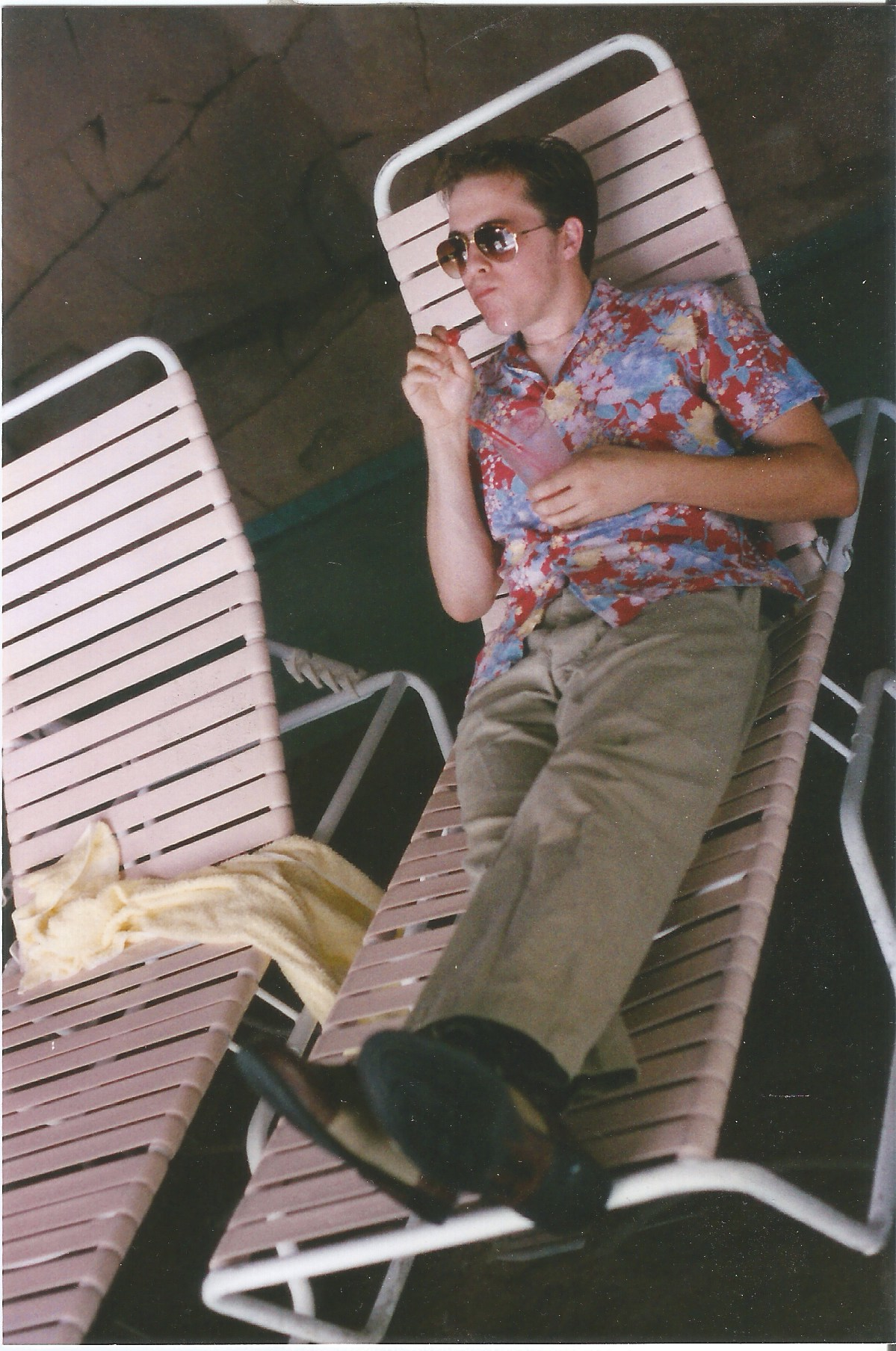
As we worked our way through the enormous portions, an employee (or the boss) stopped by our table to chat. We told him about our trip. He offered us some advice. Of motels he said, “nobody there — no stop.” He advised us to avoid Denver because “the mountains are a big wall.” Of Las Vegas, he excitedly told us, “go to New York, New York!” My fortune cookie read “more money and travel is in your future.” After our meal, we stopped at Randall Foods to stock up on supplies, including some brown-lensed aviator glasses that Seth and I would do our best to work into every photo we took.
It was late when we rolled into Mitchell to see the Corn Palace. The Corn Palace occupied a surprisingly important space in my mind —despite never having been to South Dakota until that evening. When I was young, my mom had gone to South Dakota on some sort of archaeological expedition or something. There, she had procured for me a felt banner from the Corn Palace as a souvenir. While she was out-of-state, my dad allowed me to watch all of the television that I wanted to. I watched re-runs of Bewitched and I Dream of Jeannie because they had animated opening sequences and I hoped they would turn into cartoons at some point. I also watched re-runs of Gilligan’s Island and Happy Days, which were sufficiently cartoonish without any actual animation. My dad had seized the opportunity of my mother’s absence to pay daily visits to a married lady friend. After my mom got back to Missouri, my dad and his lady friend abandoned their respective spouses and set off together, eventually moving together to Florida. I heard it ended in divorce, too.
In person, the Corn Palace was smaller than I had expected. It was undergoing a restoration, at the time, with some of the old ears of corn in the process of being replaced by new ones. And it was closed — but it was after midnight, so that was to be expected. Around this time, naturally, Seth and I thought we’d look for a motel. We found no vacancies in Mitchell. We then drove through several towns with motels, none of which, to our surprise, had vacancies. One town looked more like an abandoned film set than an actual community but included what looked like a motel. We heard the voice of the man from Szechwan Chinese Restaurant in our heads, “nobody there — no stop.” We drove on. After a couple of hours, we stopped in Kadoka for gas. We were getting desperate. I asked the attendant, a bleach blond with drawn-on eyebrows, why there were no vacancies anywhere. She told us that it was on account of the Sturgis Rally — an annual motorcycle rally that neither Seth nor I had ever heard of before. She assured us that we’d find no vacancies in either Dakota. Our best bet, she said, was to “find a biker bimbo and share her.” We instead opted to share a bottle of NoDoz before heading back out into the night.
We next stopped at a brightly lit Happy Chef for a bite. It was about 3:30 in the morning and we were hungry again. In the adjacent booth, a loud father loudly tried to wow his family — and seemingly any within earshot — with presidential trivia and stories about snipers and mine removal. Seth fell asleep once we got back to the car. I pointed the Taurus toward the Badlands. We were still in them when the sun began its ascent. Seth woke up and asked if I’d driven us to another planet. It was serenely quiet and peaceful. A gentle breeze blew and we stretched our legs.
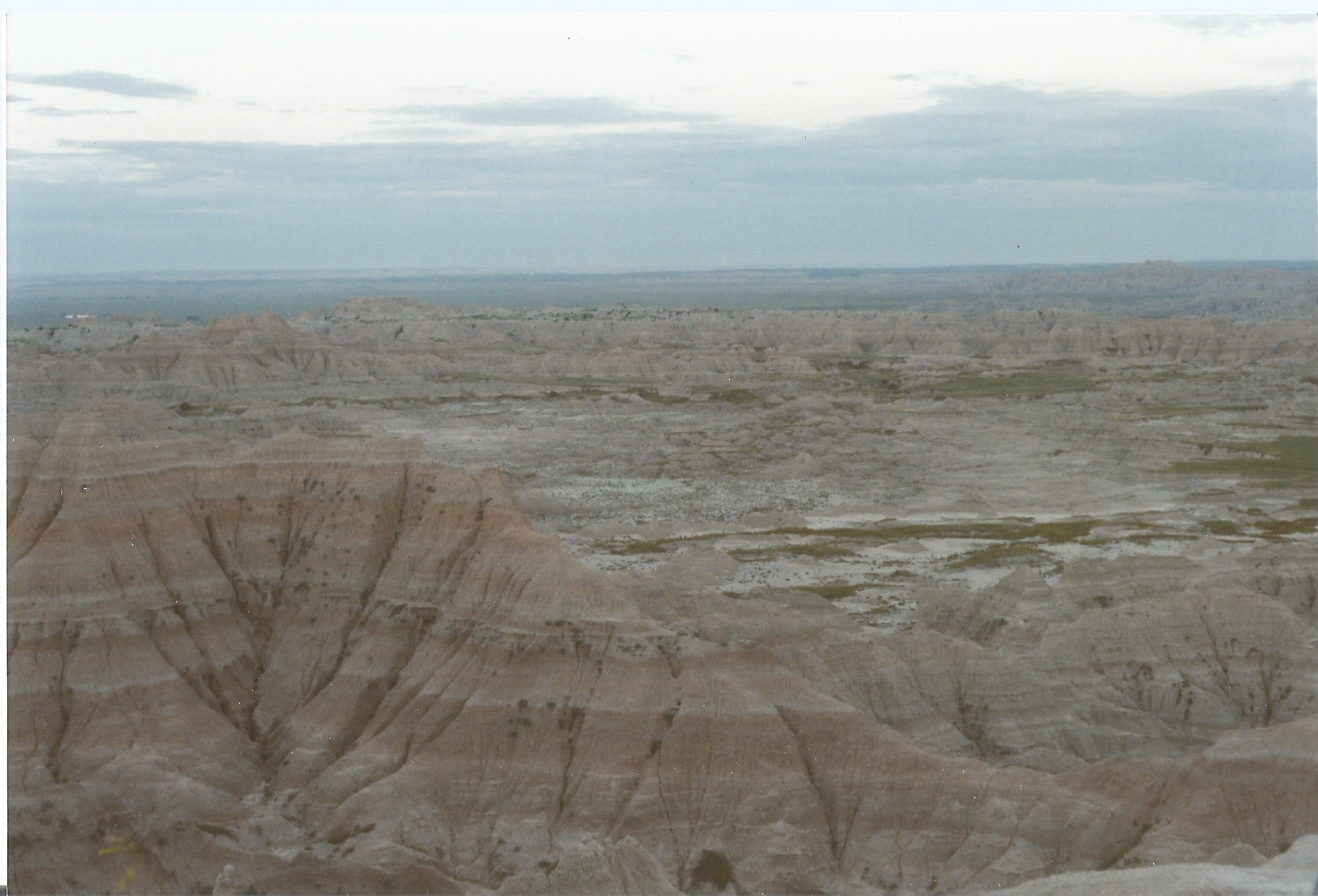
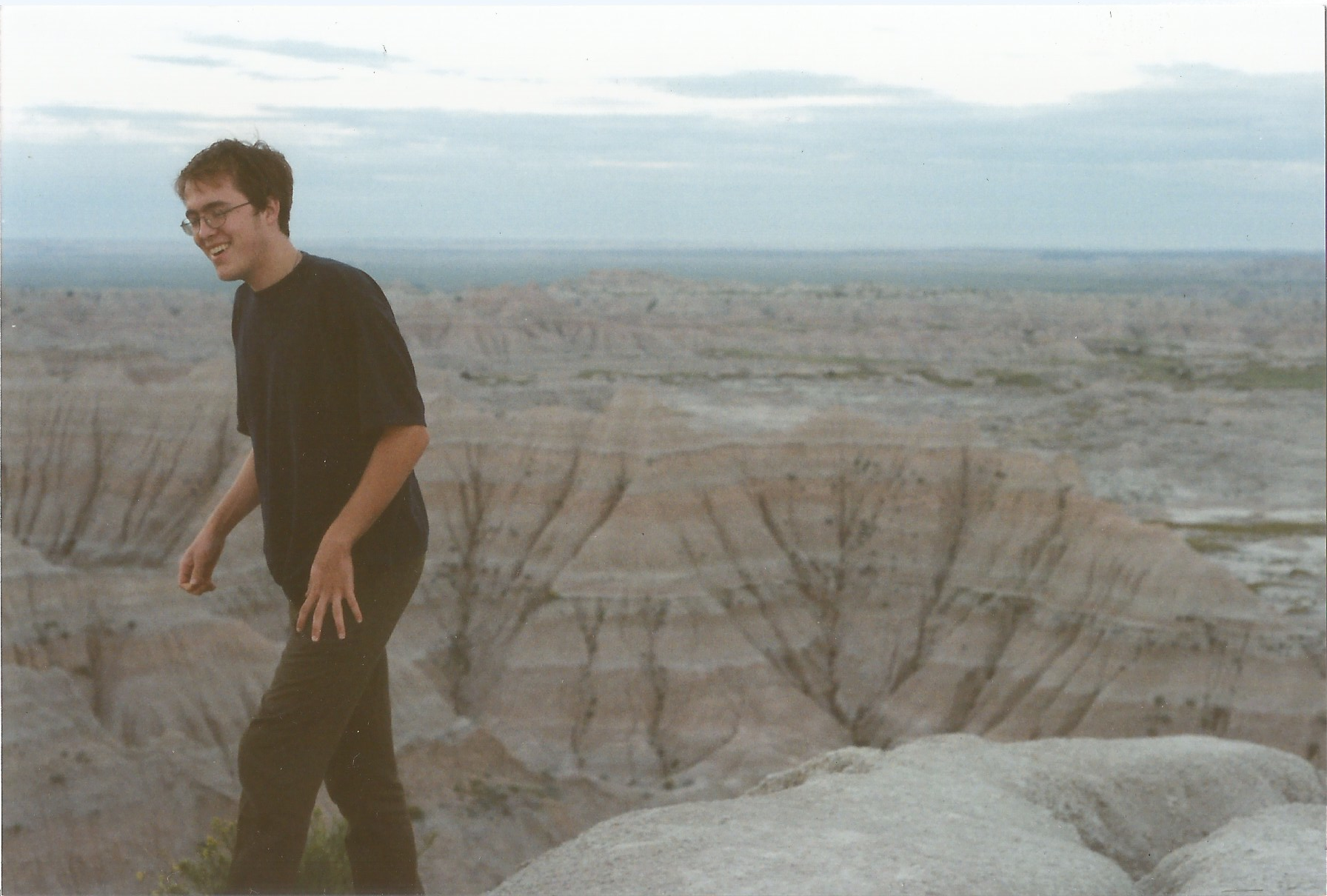
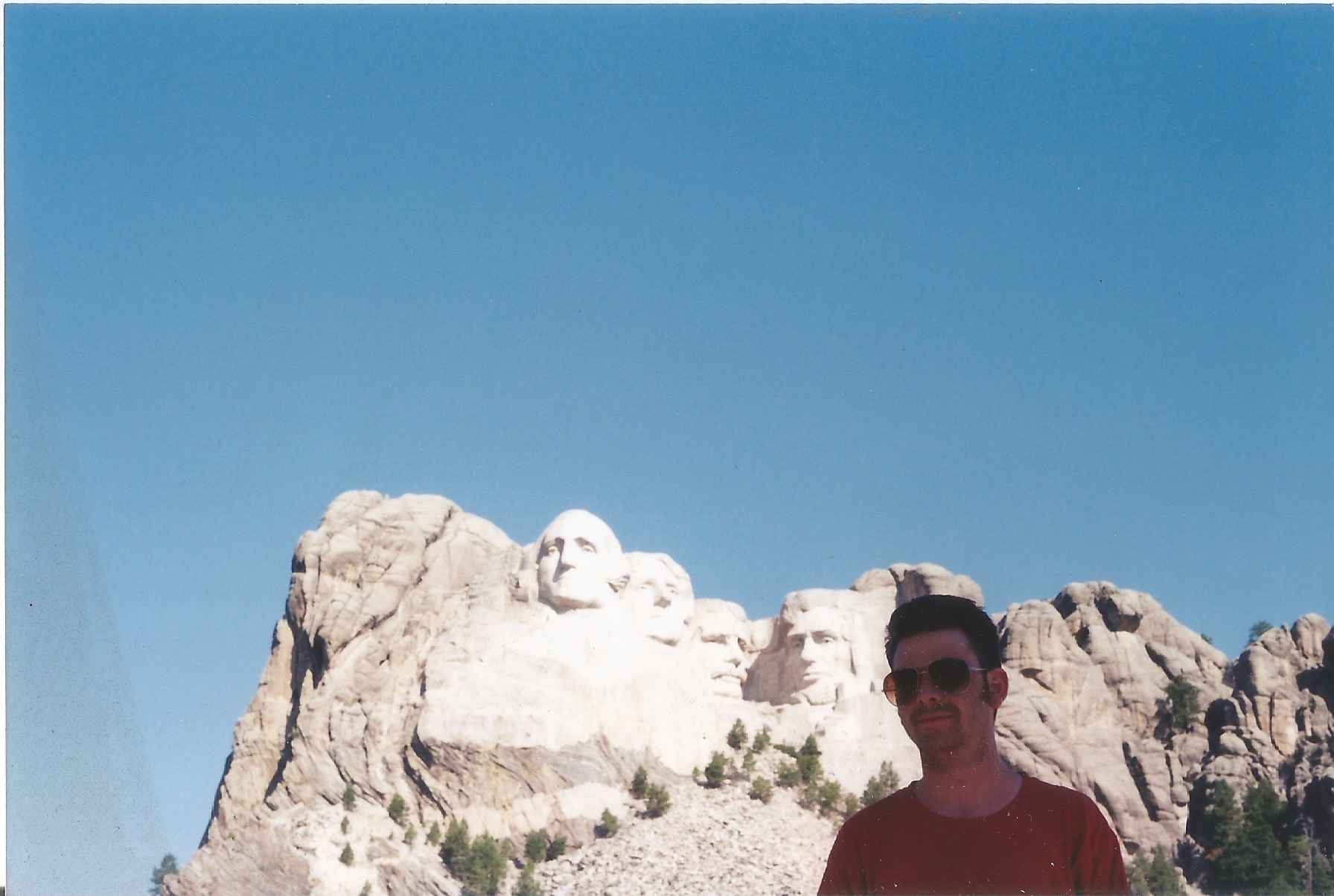
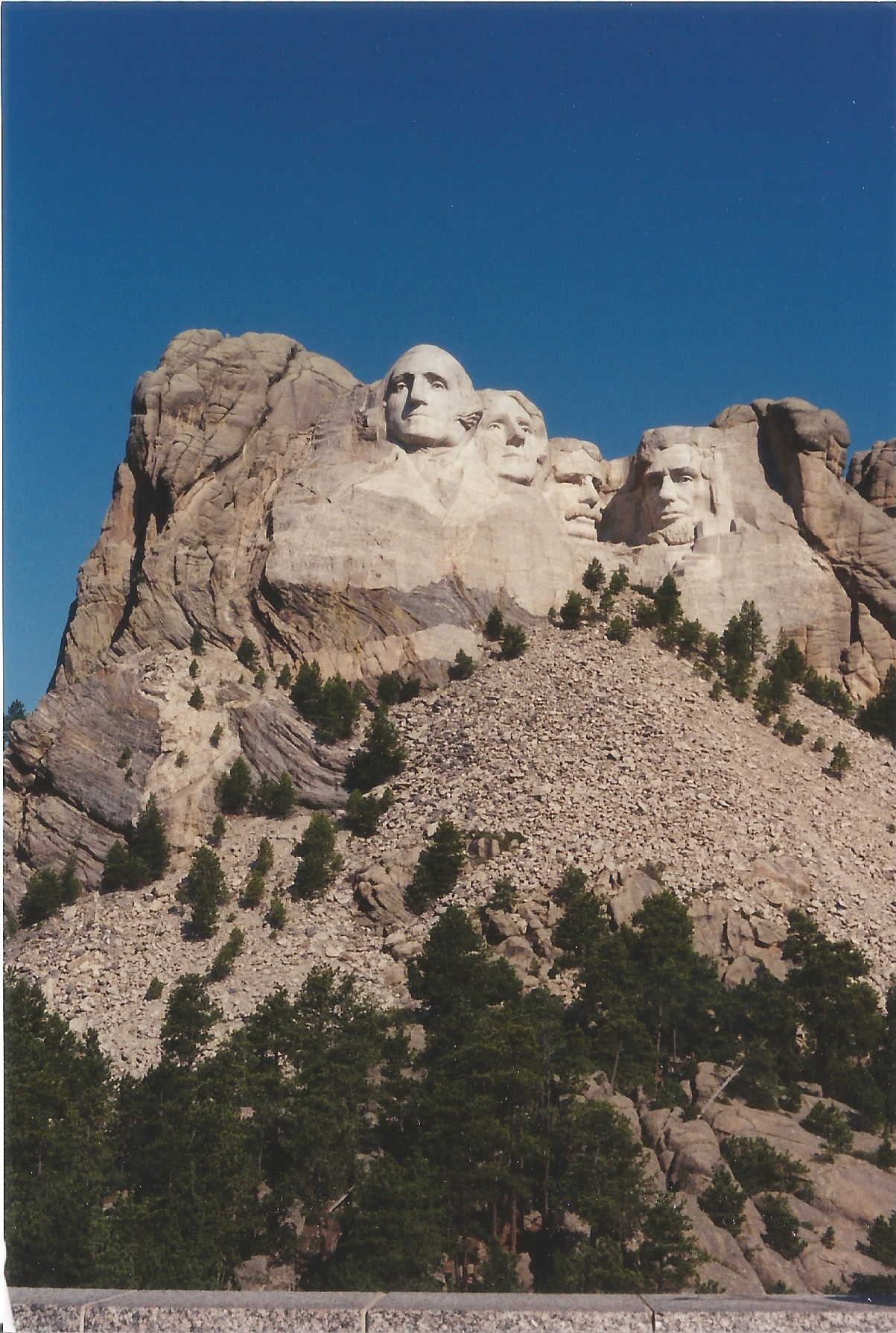
Although Seth’s sleep had been short, it was now my turn to rest. I woke up as we neared Mount Rushmore. We parked and walked to the viewing area. It was surprisingly underwhelming. Like the Corn Palace, it was smaller than expected. It also just looked exactly as you’d think it would and it was almost impossible to snap a photo that didn’t look like every other photo. Seth and I took turns posing for some obligatory gag photos before driving on.
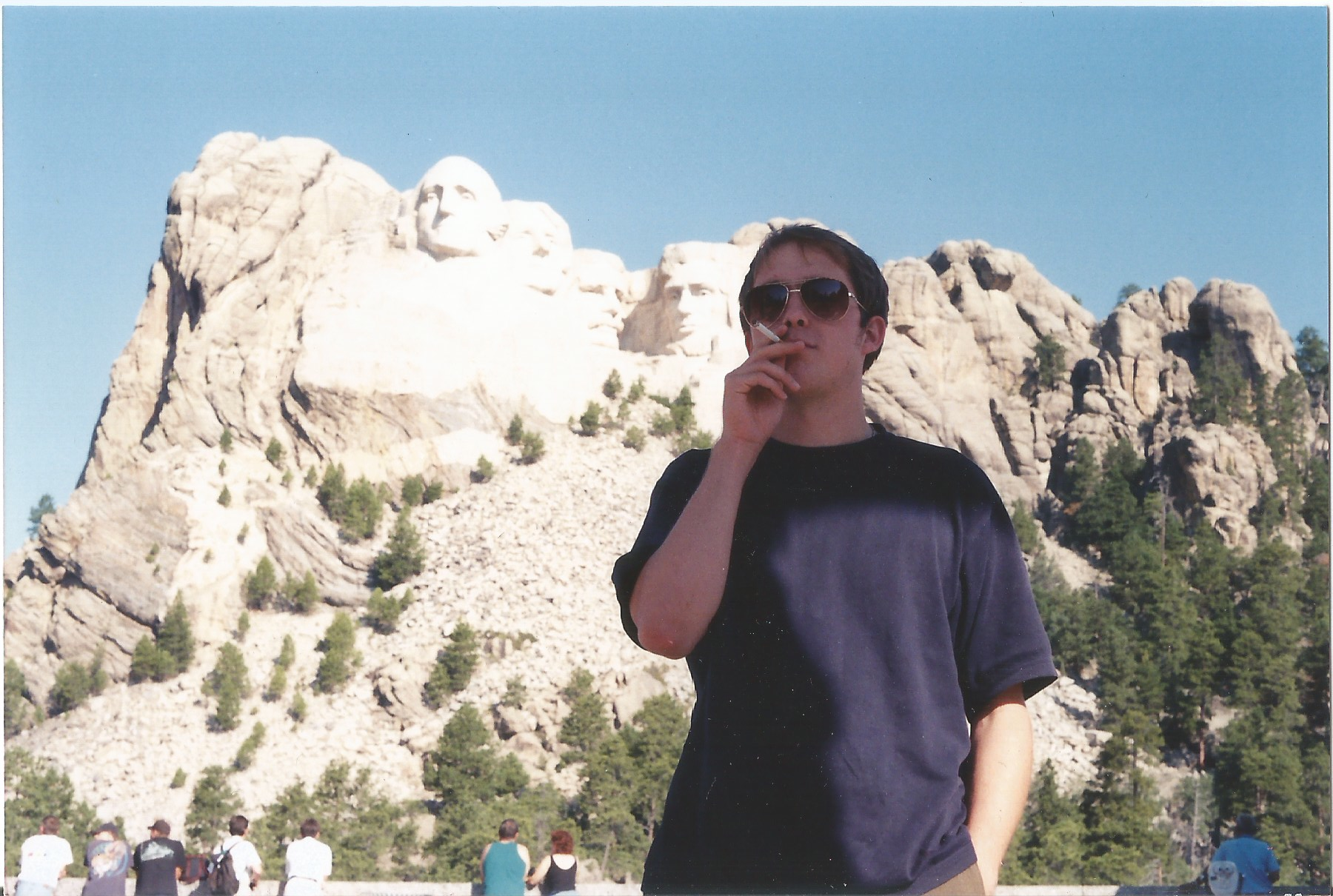
As we approached Sturgis, before I could see or hear the biker hordes, I could smell leather in the air. We crested a hill and there were bikers everywhere. I had to pee. The McDonald’s restroom was full of bikers. One, apparently unable to pee, punched a wall in apparent frustration. I was surprised to learn that it was only 10:30 in the morning. We decided to get breakfast.
Afterward, I tried to sleep some more as Seth drove but it was hot. We passed through the towns of Deadwood and Lead, both of which struck me as undeniably charming and worth spending time in — but not even charm could overcome the foul mood I found myself in thanks to a of lack of sleep, a lack of air conditioning, and a lack of bathing. I made a mental not to revisit them some day when I was better rested, groomed, and in better spirits. I still haven’t but I’m sure that they’re both still there. I probably should’ve at least taken pictures.
❦
WYOMING
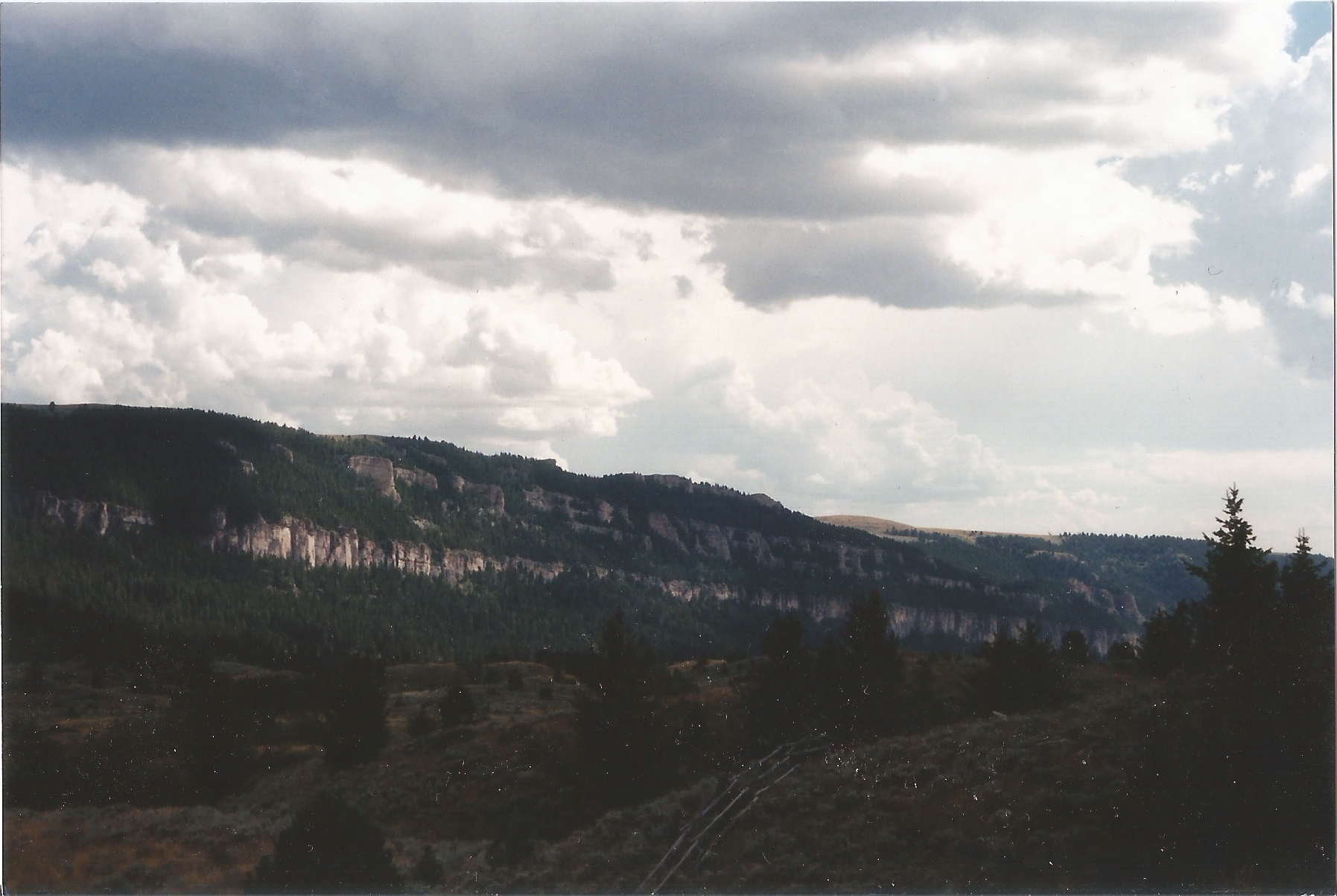
I woke up when Seth stopped in Moorcraft for gas. Seth and I debated whether or not it was worth it or not to add an extra hour to our trip with a visit to Devil’s Tower. Devil’s Tower, because it is unsullied by human hands — seemed more appealing to me than Mount Rushmore. It’s not that far from the freeway — nor is it exactly close. Seth was driving, though, and I was exhausted. We decided to drive on. The scenery, to my mind, was getting better everywhere, anyway. Wyoming was scrubby and wind-blown and the sky somehow seemed bigger. Everything also seemed to have a blue tint and looked somewhat like a day-for-night scene in an old Western. It was the sort of place that puts a fella in mind to listen to some Sons of the Pioneers. Get along, doggies.
I resumed driving duties and got us to Buffalo, where he lunched at a Pizza Hut. We then set a course for Yellowstone. There were two routes through the mountains available to us. We chose “safest, fastest.” I don’t remember what the alternative was. Maybe it was “more scenic.” That would be hard to imagine, though, because the route before us, through the Big Horn Mountains, took my breath away.
As we headed downhill out of the Big Horns, the Taurus began to shimmy and shake… and not in a good way. I pulled over to the side of the road. I did what probably everyone who knows nothing about cars does in that situation — I popped open the hood and stared dumbly at the engine like anyone who knows next-to-nothing about cars inevitably does. I closed the hood and moved to the trunk from which I retrieved the lug wrench. Perhaps the lug nuts on one of the tires was loose. As I tried to tighten one, it broke off. My brain then switched into survival mode. I sent Seth up the driveway of a ranch to see if we could borrow their phone whilst I waited at the car. After a brief wait, Seth returned, saying he hadn’t made it to the house it on account of dogs. We traded roles. I walked up the driveway. Pleasant and excited sheep dogs jumped and barked joyfully as I approached a ranch house.
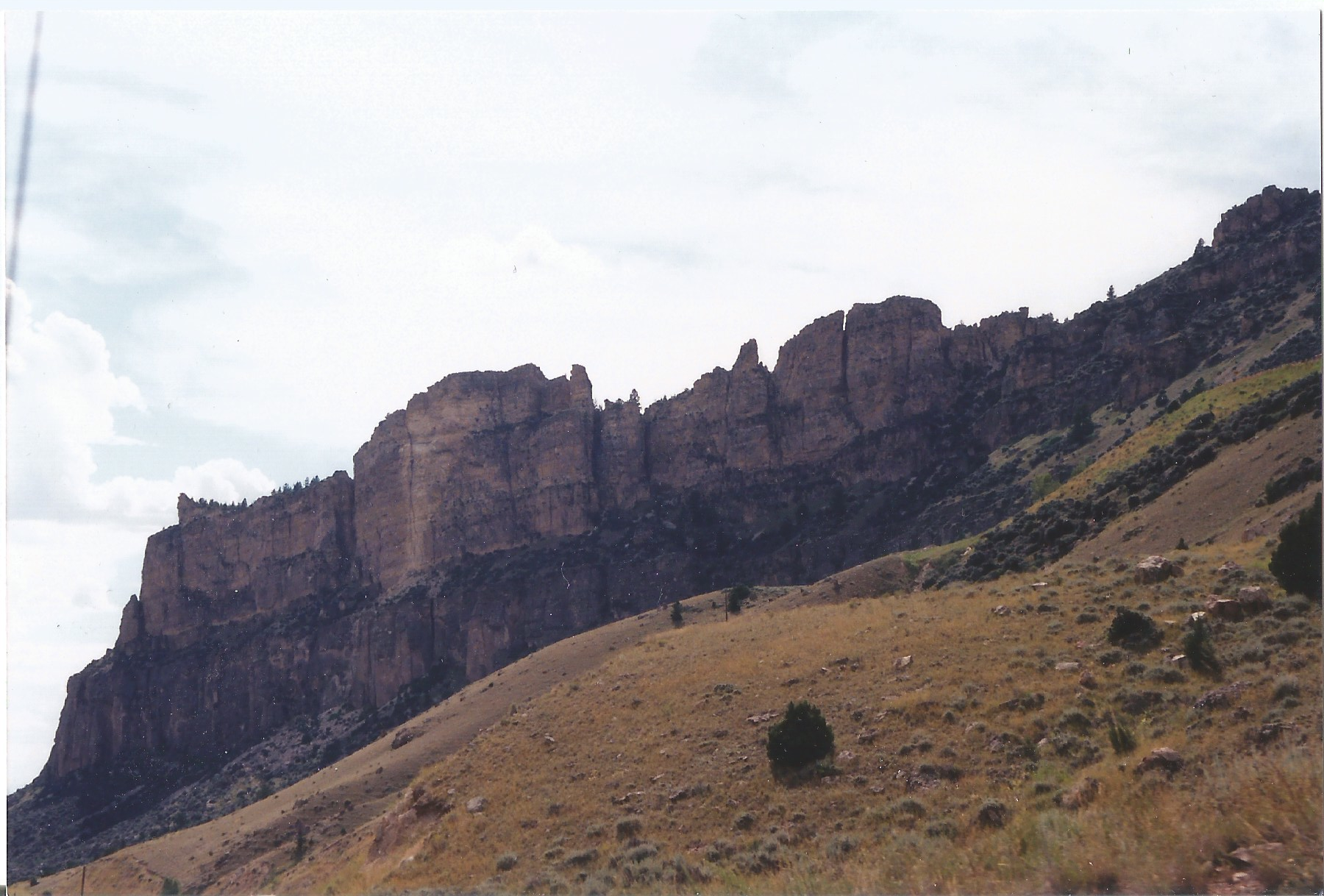
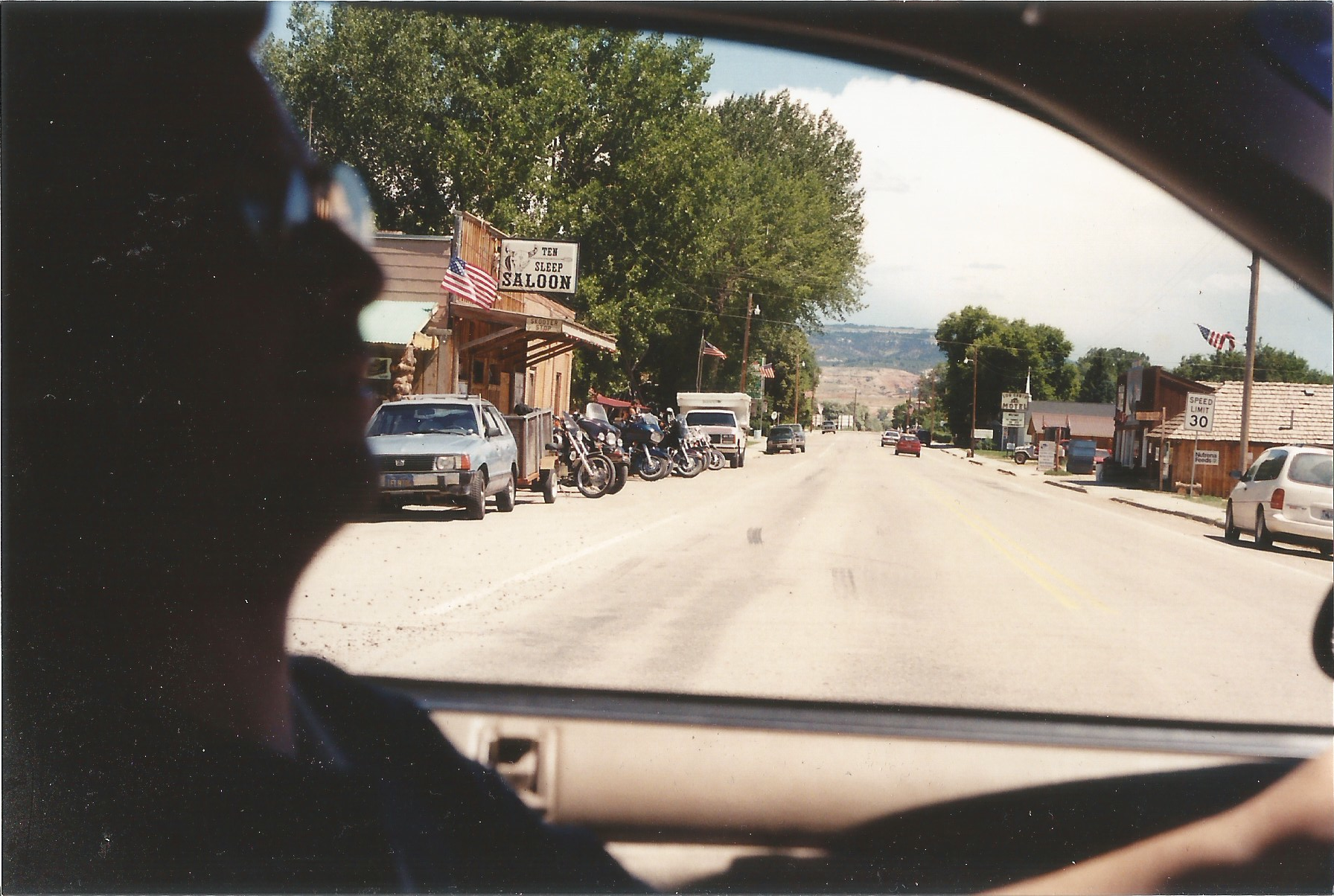
The ranchers welcomed me inside. I explained the situation. Without hesitation — or consulting a phone book — one of the ranchers called the mechanic. He wasn’t at the shop. It was a Sunday and a bit late in the day by this point. They invited me to stay for supper. They were making peach cobbler for desert and it smelled amazing. I told them that as much as I’d truly have loved to, my traveling companion didn’t do dogs and so we’d have to soldier on, cobbler-less. I trudged back down the driveway toward Seth and the Taurus and filled him in. We then walked a short distance down the highway toward a very small town called Ten Sleep — so known, supposedly, because it was, according to the country’s indigenous people, ten “sleeps” from anywhere else of note. The sign at the edge of informed us that the elevation was 4206 feet and the population about 323. One of us joked that we should take a piece of chalk and adjust it to 325.
We were grateful, after driving for more than thirteen hours, to finally find a vacant room at the Log Cabin. We put down our things, drew the curtains closed, and collapsed face down into our beds. I woke up to the sound of the room’s phone ringing and, as I came too, was unable to make sense of my surroundings. How long had that phone been ringing? Where was I? Who was I? I picked up the phone. The voice on the other end identified herself as Liz. Who was Liz? Reality slowly started to come back to me. Liz was Seth’s girlfriend. Seth must be the person passed out in the other bed. I woke Seth up and handed him the phone. He talked to Liz.
The light of the descending sun filtered through the curtains. It was still day time. Seth and I dragged ourselves down the street to the Ten Sleep Saloon. We grabbed a couple of spots at the bar and we ordered ourselves a couple of beers. It was just a lager but it hit me pretty hard. I sank into a state of deep relaxation. The bikers rolled into town and, moments later, into the bar. I looked around. The one next to me looked like Santa Claus. The graffiti on the walls seemed to have been made by livestock brands. Behind us was a horse. The horse seemed chill. Seth and I were chill. The bikers were rambunctious but jovial. I have since confirmed with Seth that he horse was real. “We weren’t on acid,” Seth said. Still, I had to check. It was almost certainly a very early night for us.
The next morning we went to the mechanic. He said that I’d “cooked the brakes.” Brake cooking is probably something most Iowa motorists know nothing about since, across most of the state, the only topography comes in the form of interstate highway overpasses. He scraped the cooked brake pads for effect. They sure looked cooked. Not that I’d ever seen any brake pads in their unbaked state. With the Taurus ready to roll, Seth and I headed to breakfast where I tackled another mountain, this time one made of undercooked hash browns. It tasted, rather strangely, like blood.
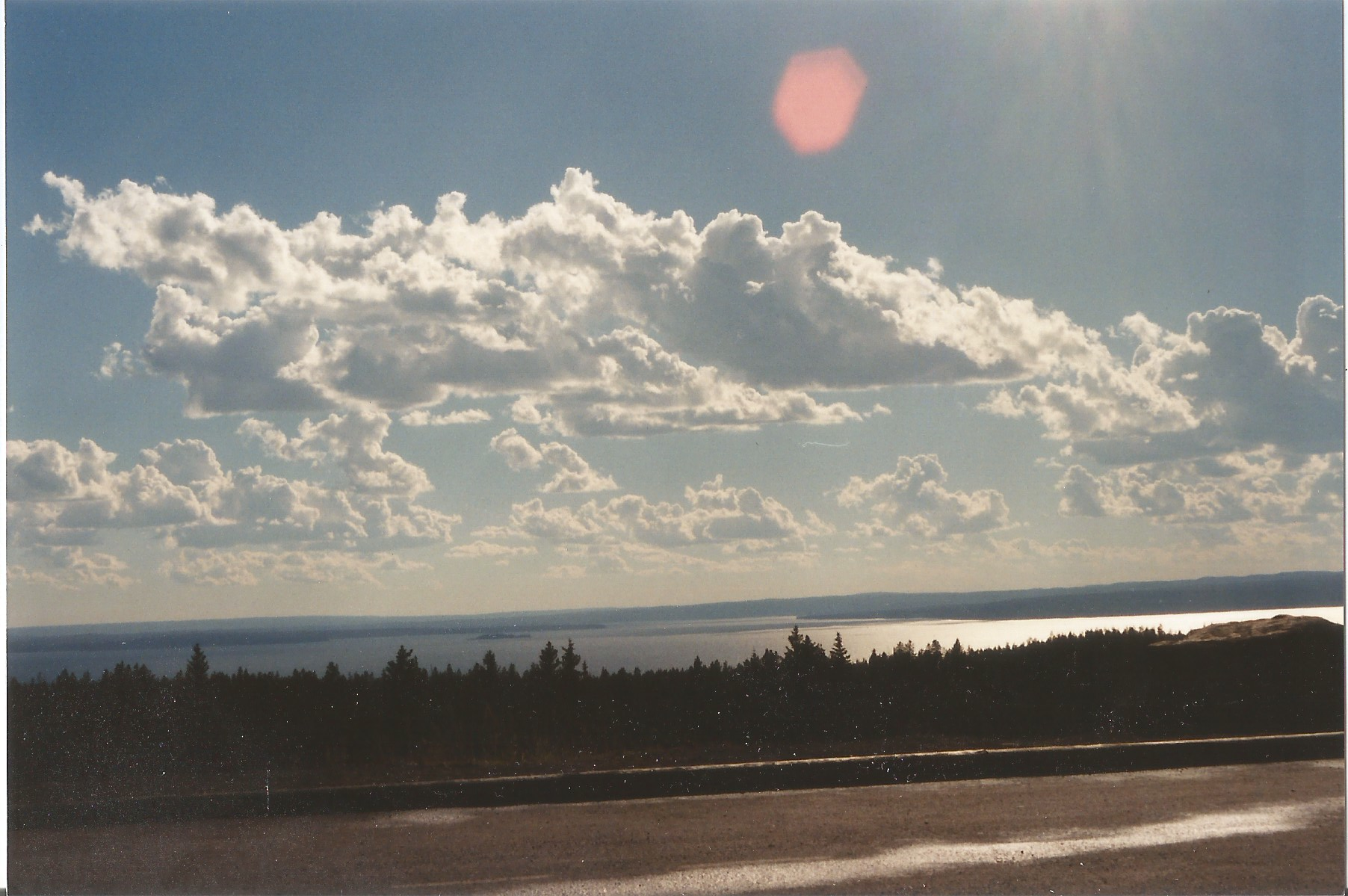
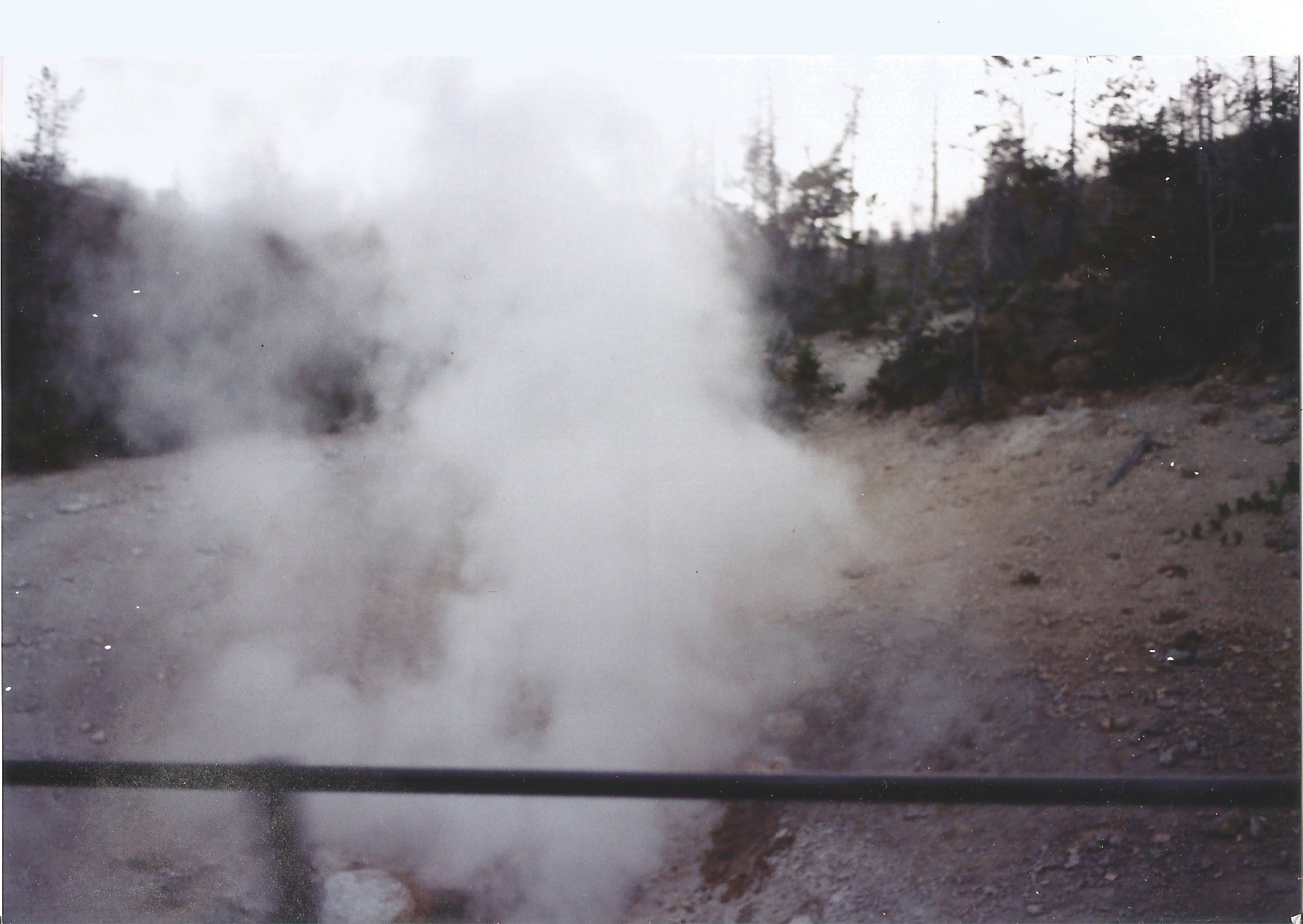
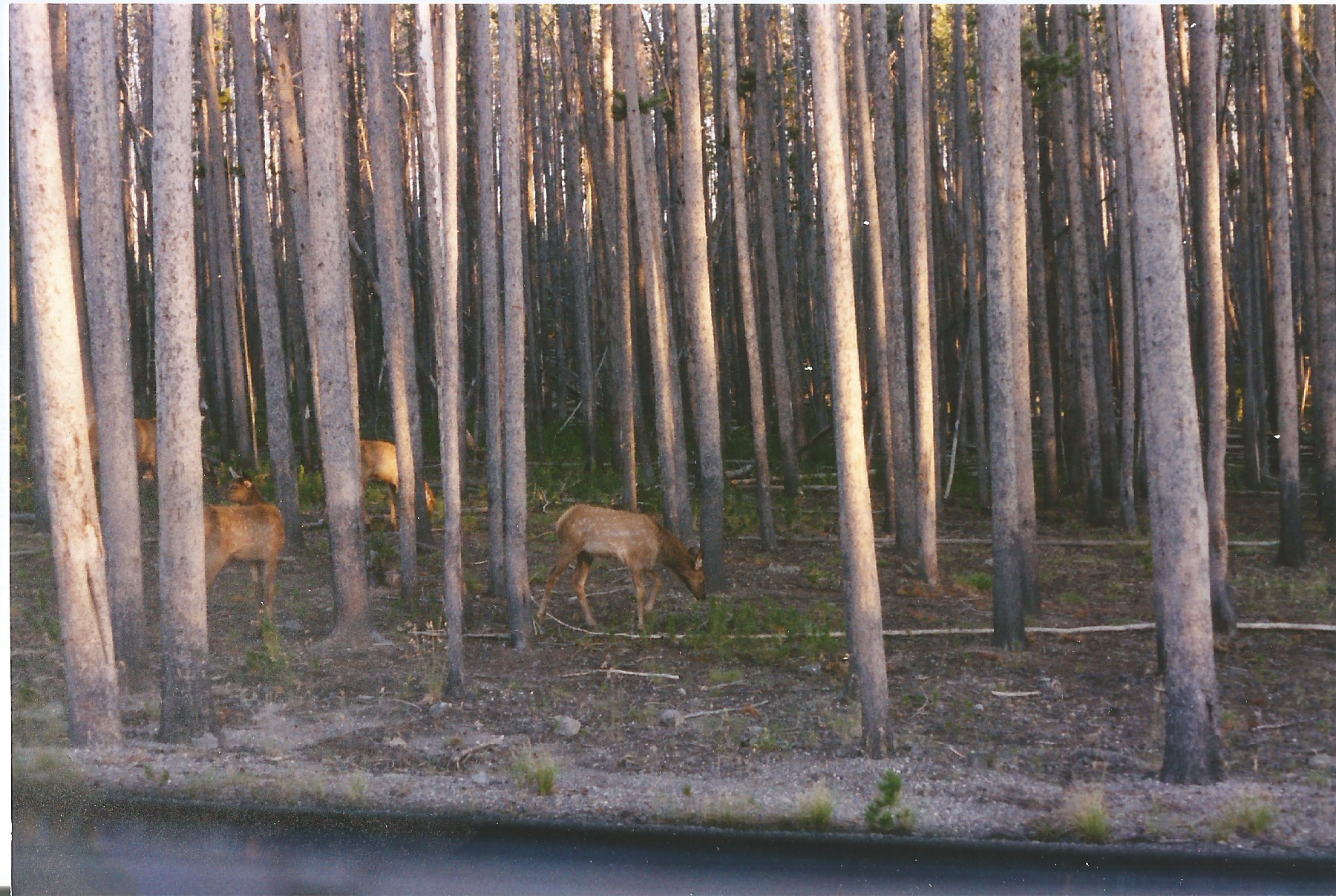
We drove on to Cody, where we stopped for sandwiches — I think at the Breadboard. After that, we headed back into the mountains — this time, the Absaroka Range. Yellowstone was every bit as beautiful as you’re led to believe. There’s a stunning array of vistas, wildlife, and views. We saw elk and bison and sulfur springs. Like good tourists, we visited Old Faithful. Imagine visiting Yellowstone and not.
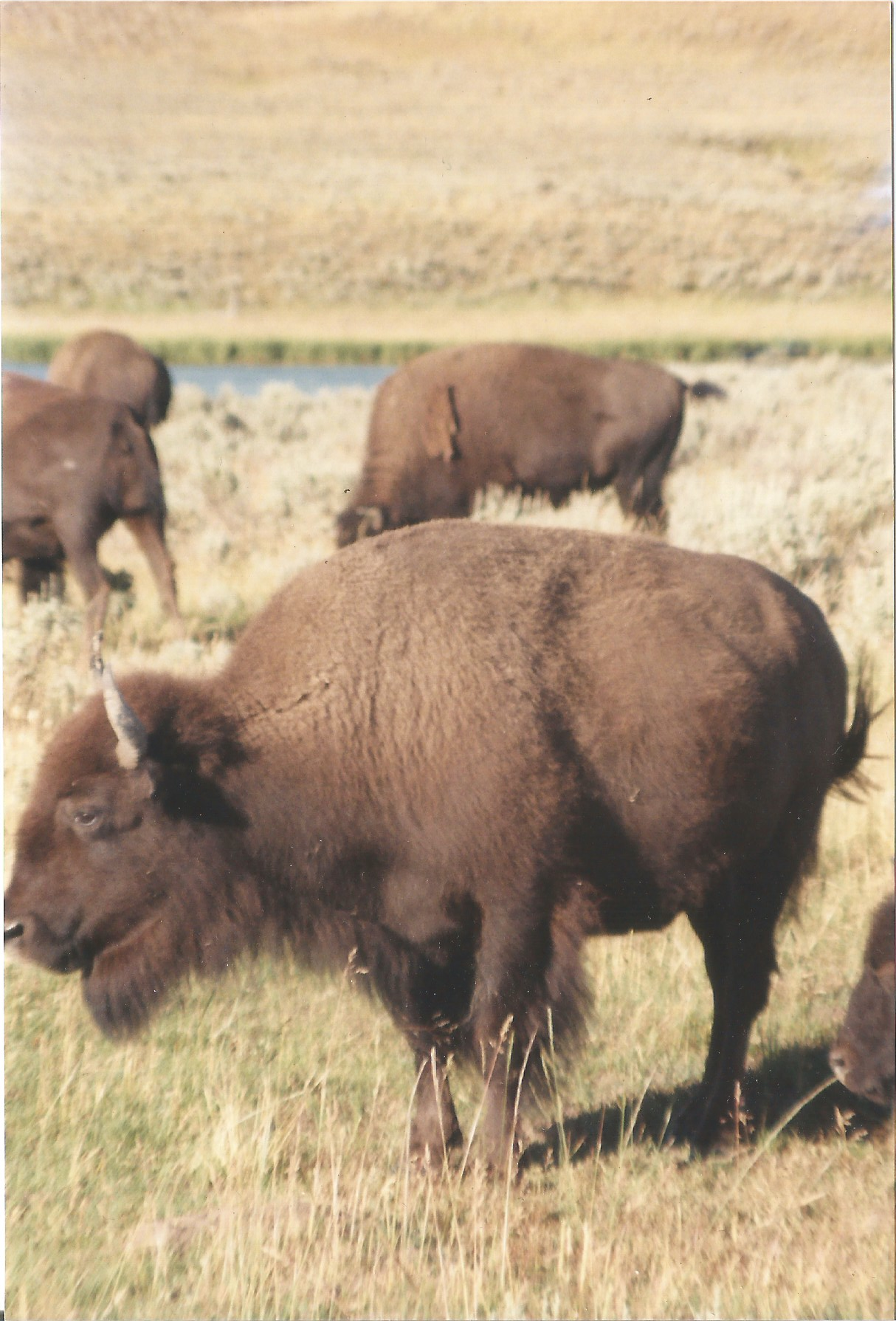
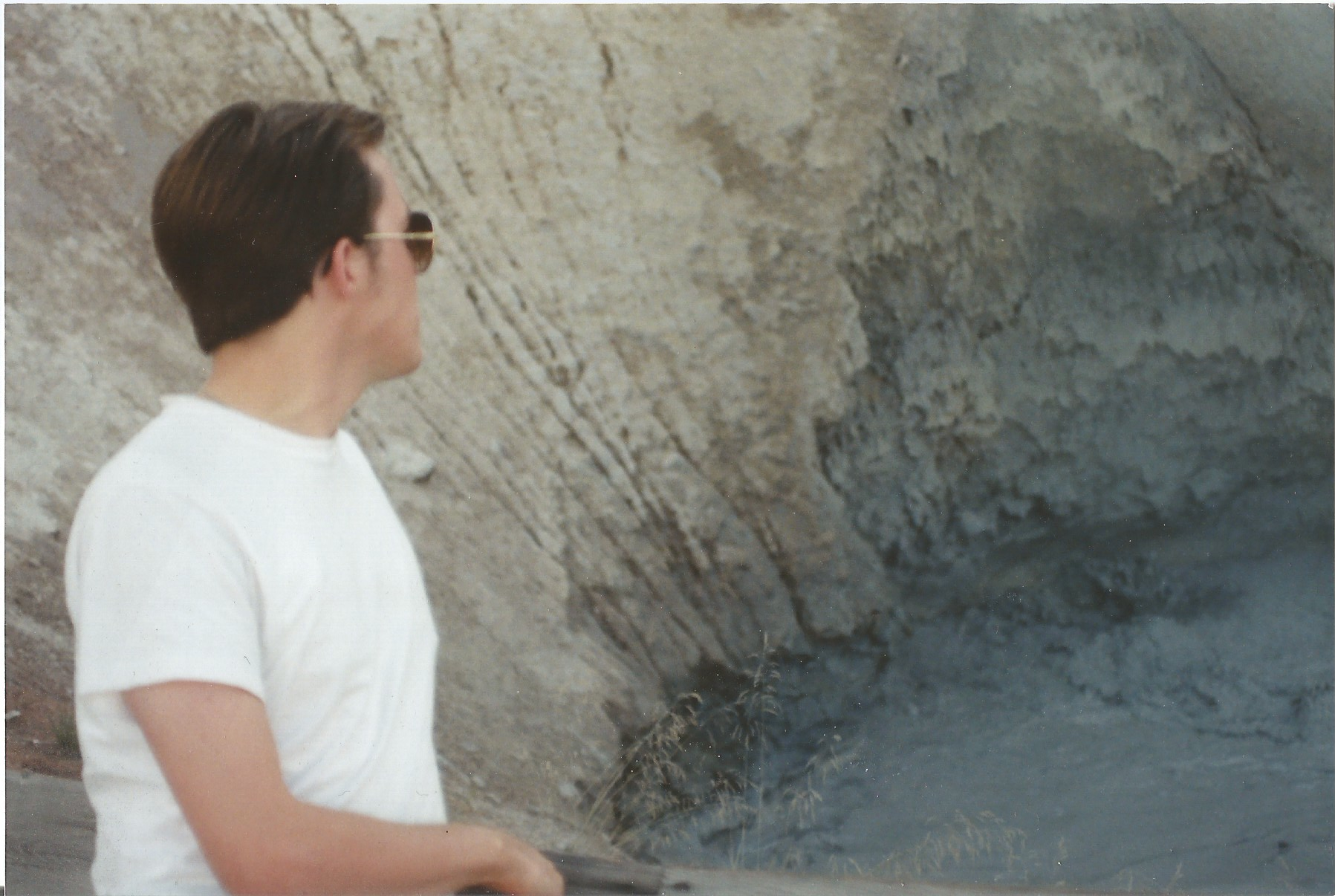
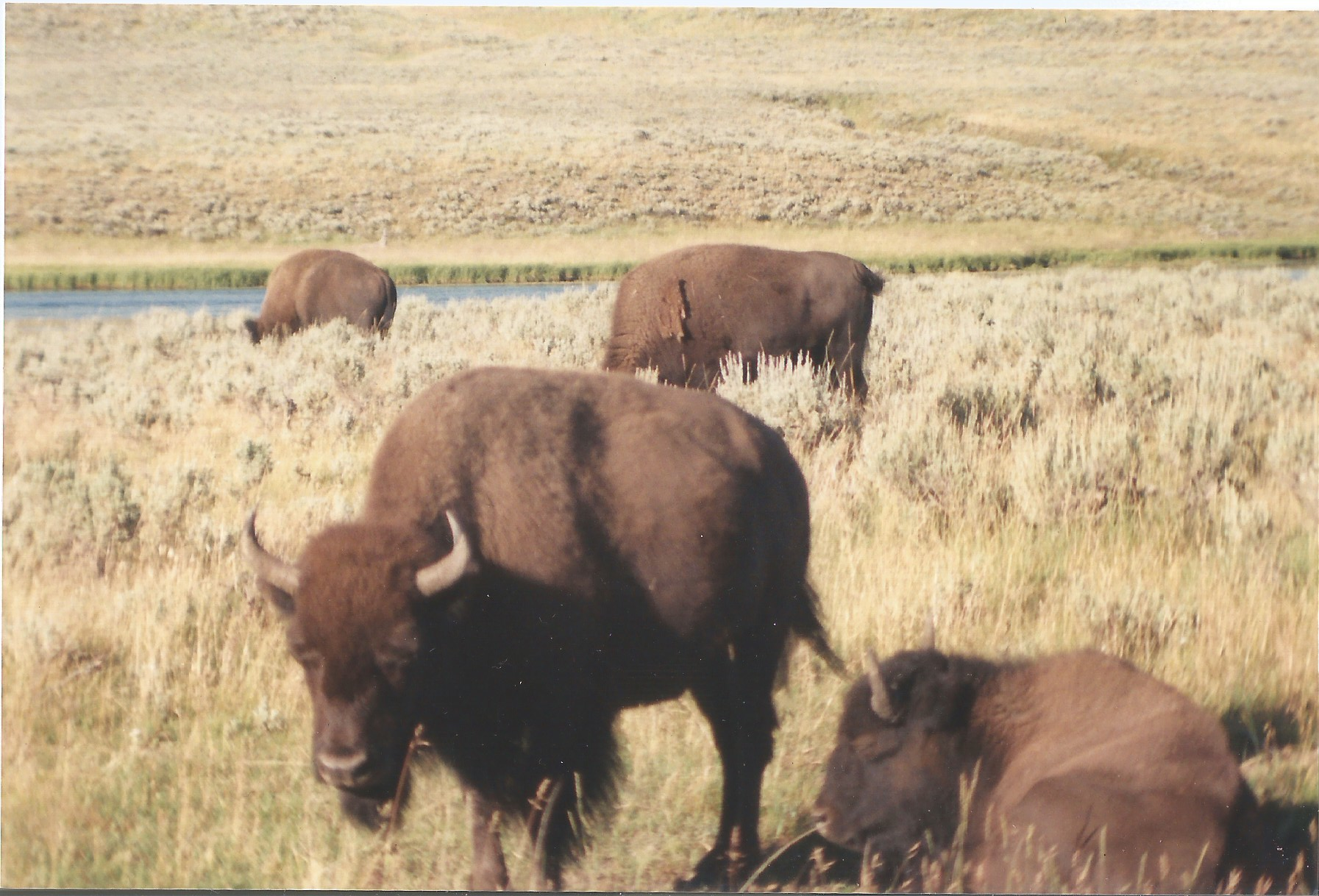
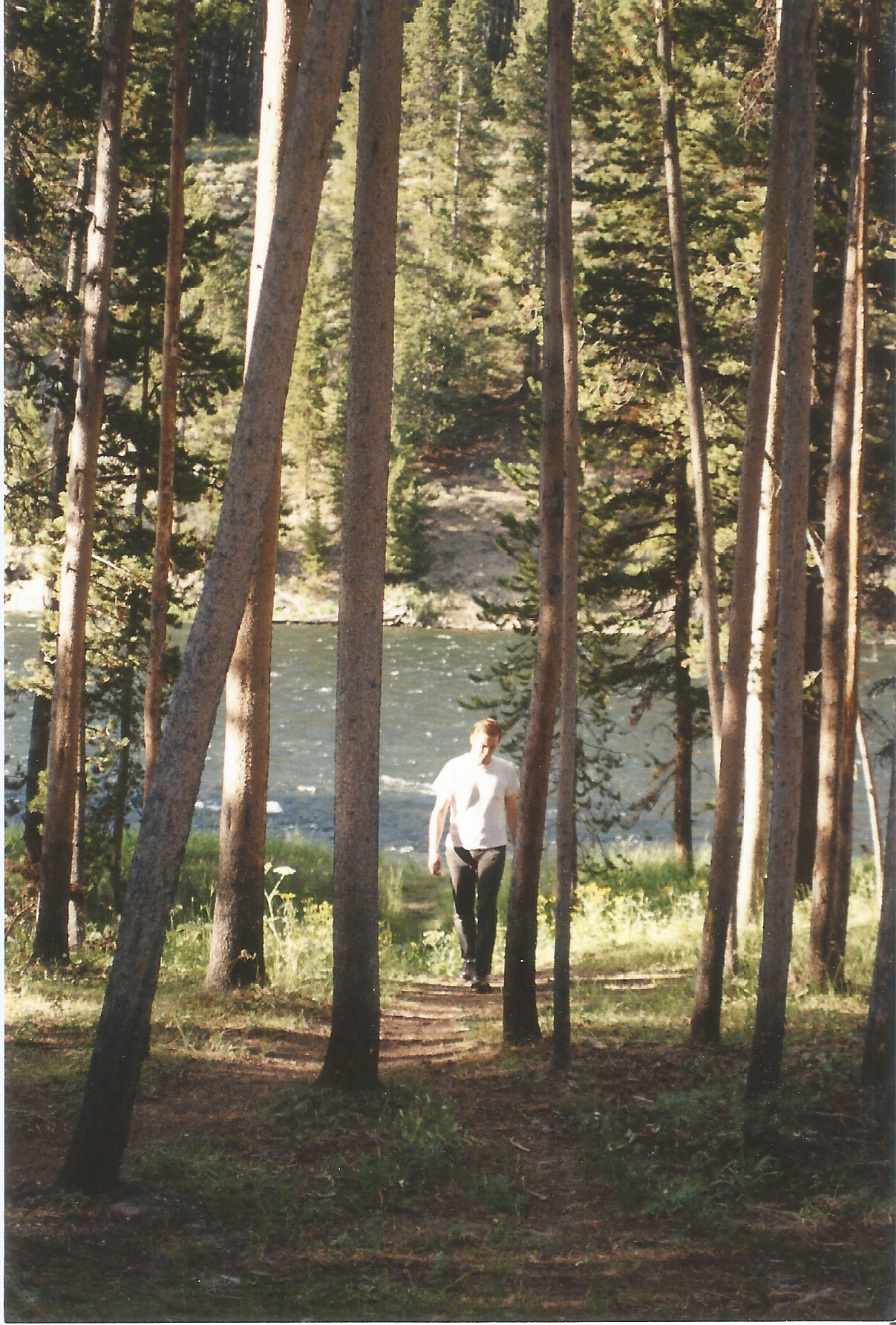
Heading south from Yellowstone, we came to Grand Teton National Park. To my mind, it’s just as stunning as the better known park to the north — although I suppose it lacks some of the dramatic geothermal features that make Yellowstone so popular with tourists but then, the relative calm is a plus. It’s also home to a lot of the same iconic animals that make Yellowstone popular, too, although our observations were limited to coyotes and a badger.
It was getting dark, though, and by the time we got to Jackson, night had fallen. We got a room at a suitable but unmemorable motel. The next morning, after we left, Seth realized that he’d left the pillow he’d brought with him in our room. If memory serves correctly, it was a fairly normal sort of down pillow that maybe had a pine green flannel pillowcase. We didn’t turn around for it. “I’m never going back to Jackson,” sang Stephin Merritt on “Lonely Highway.”
❦
UTAH
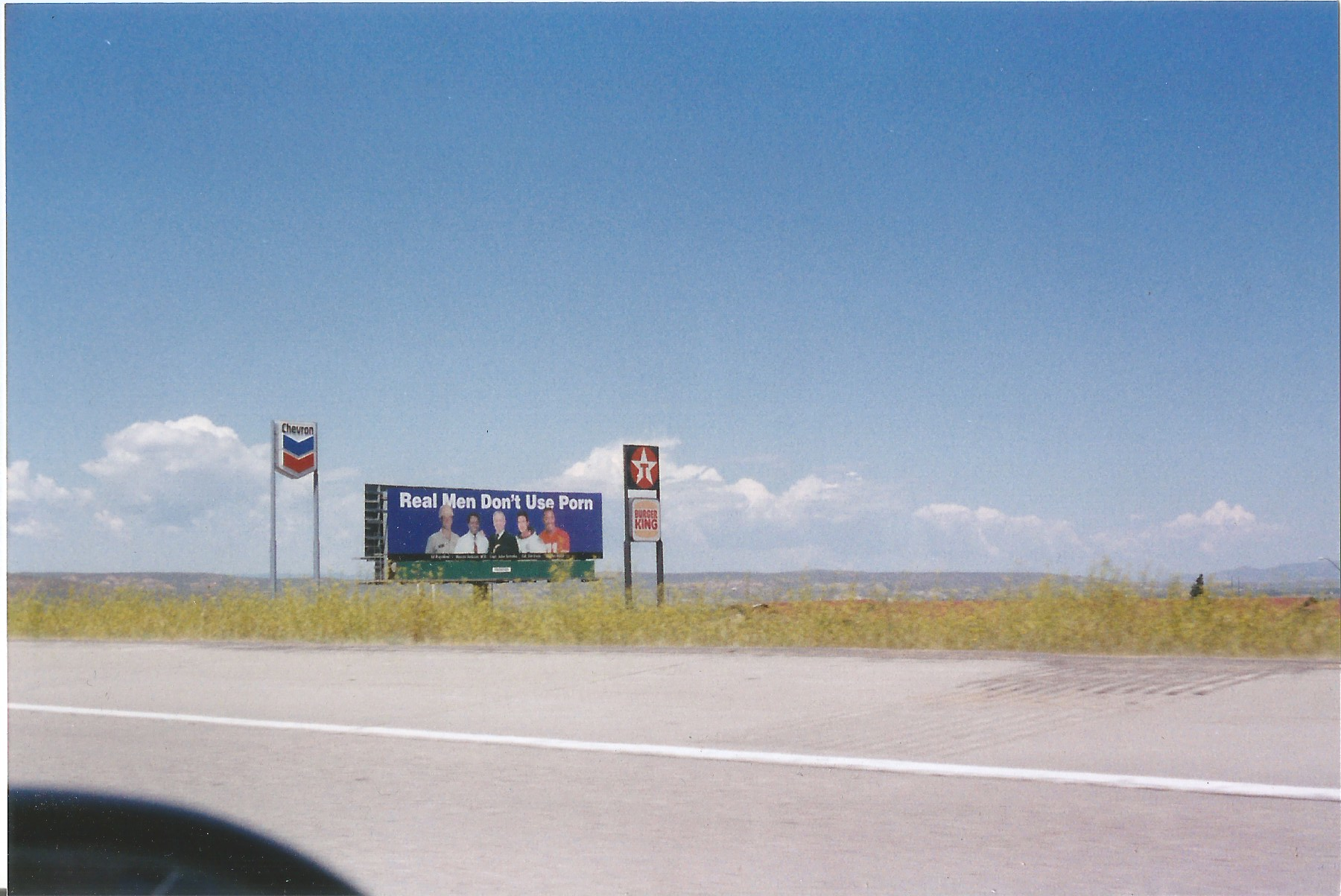
On our way out of Wyoming, we passed through Diamondville. In Utah, we grabbed a meal at the Polar King Drive-Inn, in Coalville. Diamonds to coal. Were we moving backwards? A billboard stating “Real men don’t use porn” confirmed that we were definitely in Utah.
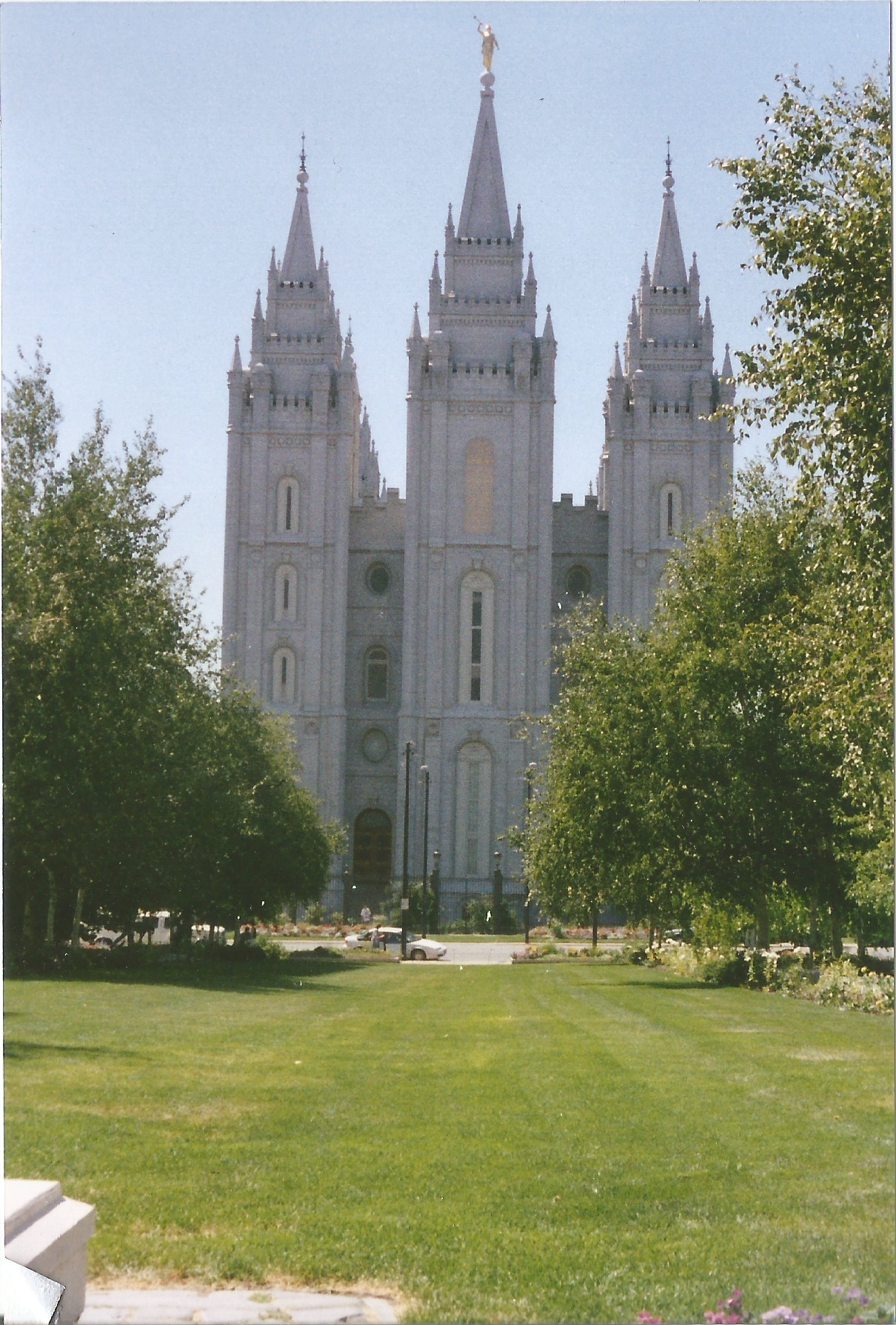
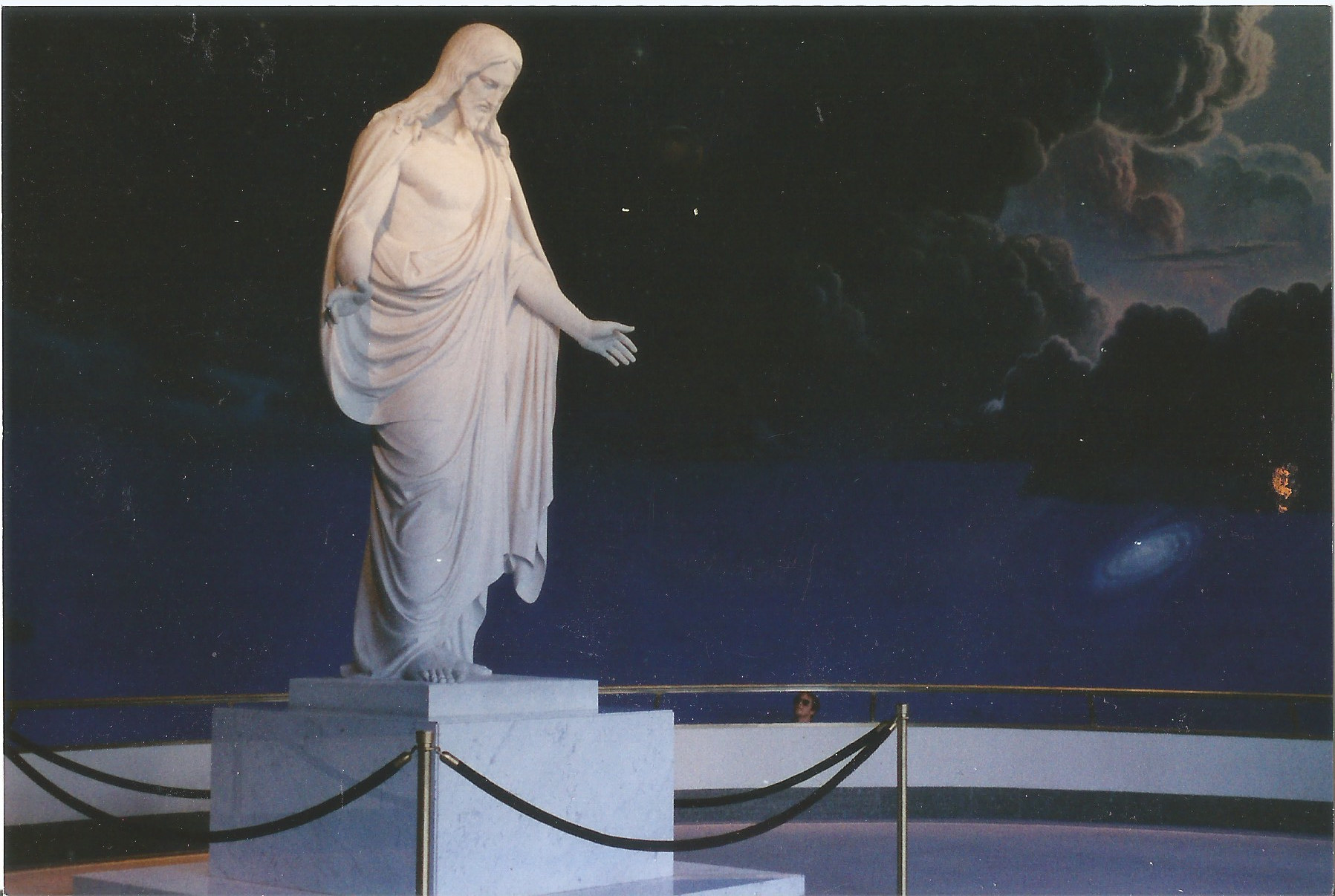
When we got to Salt Lake City, we parked the car and stretched our legs, once again. We walked quite a bit, actually, visiting several sites that non-Mormon heathens are allowed to. We took in a presentation about Jesus and I learned that, if I played my cards right, I’d get my own planet after the End Times. We went to a room with computers and looked at their genealogical database. Whenever I’d look up, there was inevitably another smiling girl who looked like a character from Little House on the Prairie seemingly keeping a watchful eye on us. It was very unnerving.
❦
LAS VEGAS
After we’d absorbed our lessons, we departed like good missionaries toward Las Vegas. From the city of Latter Day Saints to the city of all-day sinners. The part of Utah we passed through looked even more like Mars than the Badlands. As we got closer to Las Vegas, though, found a great radio station — KJUL, that brought us back to Earth. It played oldies from the 1960s, ’50s, and ’40s. While nowadays so-called Oldies stations play songs from the likes of Xzibit, White Town, and Third Eye Blind, for decades the Oldies format meant songs from the 1960s and ’50s. Before KJUL, I’d never heard a station playlist that crossed the galactic pop barrier between the ’50s and 40s. Obviously, pop music has been around since at least the dawn of recorded music in the 1880s and maybe since the era of sheet music and minstrel shows… but, for whatever reason, most Boomers had decided that it began in their childhoods. These were the kinds of Oldies one wants to hear one one’s first trip to Las Vegas. Perry Como, Blossom Dearie, Dean Martin, Tony Bennett, Wayne Newton — that sort of thing. These were the stars who I imagined performing at casinos with desert themes like Aladdin, Dunes, and El Morocco. Of course, all of those casinos were long ago reduced to rubble and the pleasing sounds of ring-a-ding-ding cocktail jazz and roulette wheels was long ago replaced with the incessant din of ring-a-ding-dinging slots.
Personally, I’ve never found gambling appealing. I think I lack the imagination or faith necessary to convince myself that the house doesn’t, in fact, always win. It was my first time in Las Vegas, though, so I thought it was important to participate as best as I was able. I played bit of blackjack here and there. Threw away a few dollars. on slots. We visited New York, New York, Caesars Palace, and the Mirage. Downtown was more appealing than the Strip, which felt like an amusement park with cigarette smoking and handbillers robotically slapping advertisements for escort services in their hands. There was an ashtray in the elevator, so I smoked a cigarette in the elevator. Seth and I ate dinner at a restaurant where there was cigarette smoke everywhere. It dawned on my that maybe smoking everywhere wasn’t such a great idea after all. Seth and I both quit smoking tobacco a long time ago. It’s weird how casual we were about it then.
At O’Sheas, I started to feel kind of bored. I knew that the drinks were free if you were gambling. Gambling was boring, though. I went to the bar and ordered a glass of wine. The bartender told me that their wine was not worth drinking. I ordered a Guinness instead. Seth and I got a room at the Flamingo. Hotel rooms are more fun than casinos, anyway. The next day, I fell asleep next to the hotel pool. As a result, Seth and I got a late start.
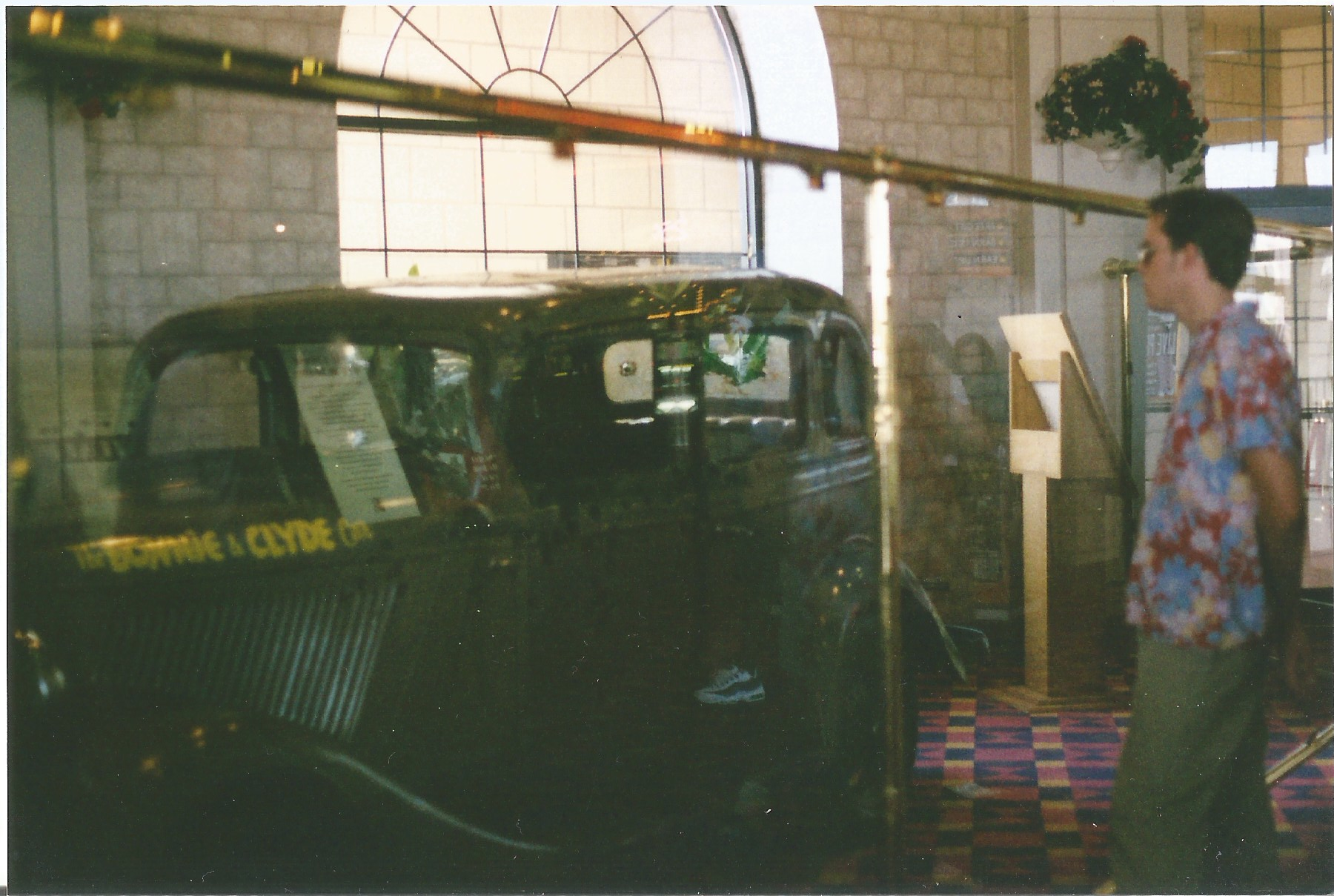
We stopped in Primm to look at the Bonnie & Clyde death car. Back in our own potential death car, the desert heat proved to be rather pleasant, actually.
I wondered how hot it was. Baker had the answer. There, the “world’s tallest thermometer” (actually just an electric sign that displays the temperature and looks like a giant thermometer) read “114.” “Well I’ll be damned,” I thought to myself, “dry heat!” All of those sweaty summers in Missouri where every complaint about the heat is met with a pedantic refrain of “it’s not the heat, it’s the humidity” — well they weren’t wrong, after all. They weren’t wrong about the humidity, I mean, but I would argue that it is wrong to respond to someone’s suffering with an obligatory “it’s not the heat, it’s the humidity.” They’re not helping anything.
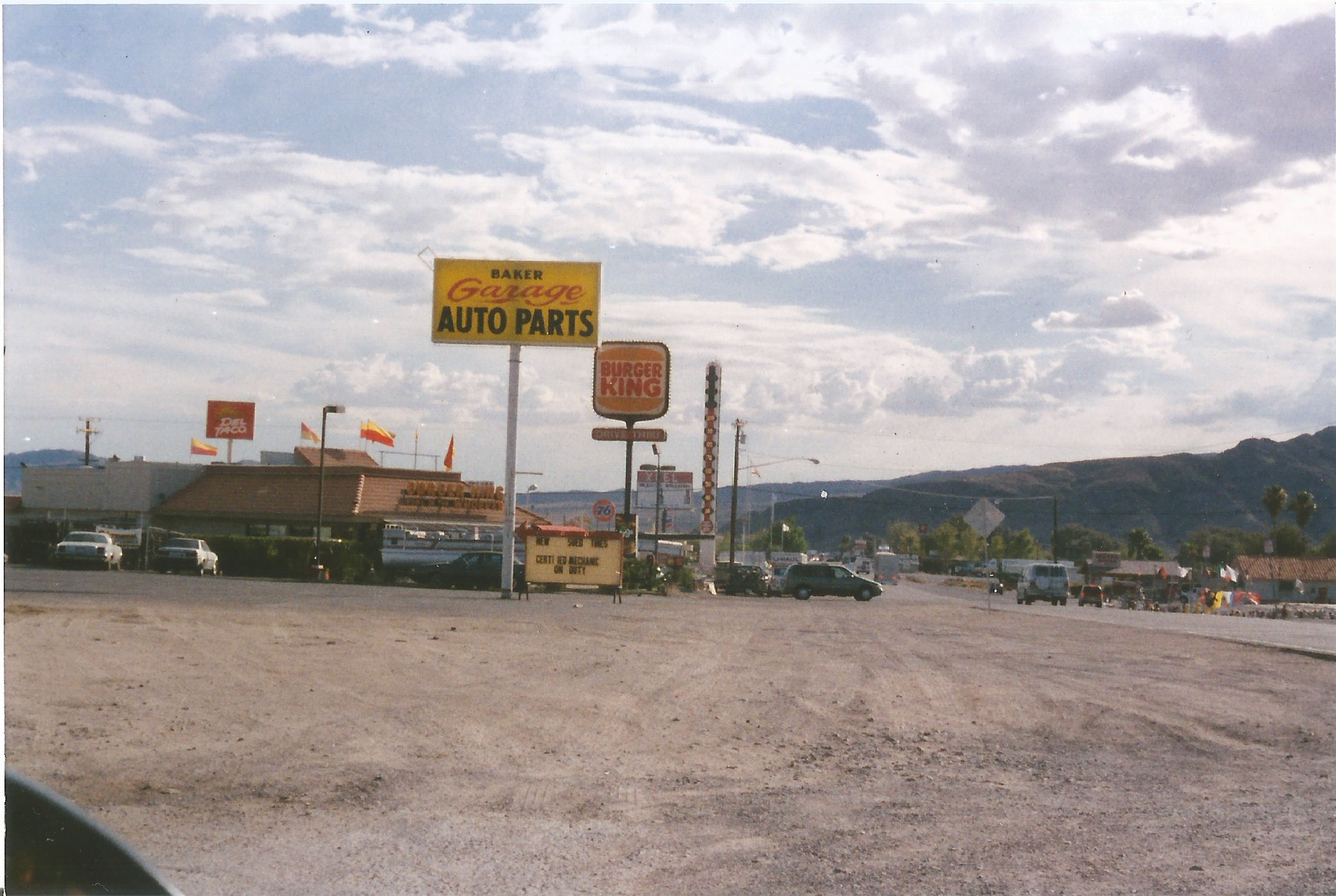
In Baker, Seth and I got lunch at the Mad Greek. I was a bit worried about vegetarian options. This was the 1990s — way before every backwoods gas station bragged of its “world famous vegan chili.” I’d once ordered a cheeseburger at a Mississippi McDonald’s — sans patty — and been chased out of town. Vegetarian — outside of Asian restaurants — usually meant some sad and unseasoned combination of alfalfa sprouts, tempeh, and shredded carrots. Back when I ate animal flesh, though, I’d loved gyros, and that’s all I knew of Greek cuisine. Falafels, therefore, proved to be a revelation. Things were looking up.
❦
METRO LOS ANGELES
After five days of driving, we finally got to Chino in the Inland Empire. I loved the sound of “Inland Empire” and assumed, quite incorrectly, that it was some recent coinage dreamt up by developers to sell people on the gloriousness of living on the suburban fringe of a metropolis. Chino felt very fringe. Seth’s mom stated with pride that she hadn’t been to Los Angeles in six years. Chino was sub-suburban, or, perhaps, sur-rural. In college, Seth had defended Chino against charges of its rural character. I’d never heard of it so I had no associations. It was hard, to ignore the bleating of sheep and smell of manure drifting over the wall in back.. And, further damaging Seth’s case was his sister, who shared that her Chino background had earned her a nickname, “Green Acres.”
We spent the remainder of the day in Chino. To someone raised with strict screen-time limits, their television seemed, literally, always to be on. I got sucked in, naturally. I marveled at how small-town and corny the local commercials and news were. There was an investigative report about which hotel had the best beds in which the journalist was accompanied by a Marilyn Monroe impersonator. There were people with professional wrestler names like Dallas Raines and Johnny Mountain. I was amazed by a program hosted by another man with a strange name but familiar dialect, Huell Howser.
There were also multiple channels in Spanish — not just Univision. There was an ad for a place I’d never heard of called El Pollo Loco. In it, comedian Paul Rodriguez talked to a chihuahua — an obvious dig at Taco Bell. That night, Seth and I drove to a video rental place and came back with Mr. Nice Guy — a Sammo Hung-directed film starring Jackie Chan.
The next day, I looked up El Pollo Loco. The closest one was in neighboring Chino Hills. I drove there ordered a BRC and a Smoky Black Bean Burrito. I filled containers at the salsa bar with pico de gallo, the house salsa, salsa roja, and the very runny avocado salsa. I sat and ate my meal in a spotless and otherwise empty dining room. All of the action seemed to be in the drive-thru. It feels strange to write these words but… this, I think, was the most “authentic” Mexican food I’d then had in my life — although my bar was admittedly low. The nominally “Mexican” restaurants I’d eaten at were either chains like Taco Tico or Taco John’s (which sold tater tots as “Mexi-nuggets”), or strawberry margarita joints like Carlos O’Kelly’s. I guess Pancheros was recognizably Mexican although I had nothing actually Mexican to compare it to.
Later that day, Seth drove us to Poo-Bah Record Shop in Pasadena. This was my first stop inside of Los Angeles County. A utility company was filming an infomercial/PSA there about a change in their name or something along those lines. Explaining the change were two music fans (hence the shooting location) dressed like Wayne and Garth from Saturday Night Live skit, Wayne’s World, but renamed (presumably for copyright purposes) “Duane” and “Mirth.” So this nine years-too-late pop culture reference was my first glimpse of the bright lights of Hollywood. But then again, Seth and I calling our roadtrip “Seth & Eric’s Airconditionless Adventure” was a nine-years-too-late pop culture reference to Bill & Ted.
I had heard of some places in Los Angeles County before arriving. Bel Air, Brentwood, Compton, East Los Angeles, Echo Park, El Segundo, Long Beach, Malibu, the Valley, Watts, and Pasadena, to name most. All that I knew of Pasadena was gleaned from the Jan & Dean song, “The Little Old Lady from Pasadena.” I can’t say that I had ever paid attention to the lyrics but I knew that Jan & Dean were a surf music duo and because of that, I surmised (again, incorrectly) that Pasadena must be a place where people surfed. I asked Seth if we could leave the car and just walk to the beach. He said that we could not. I was incredulous. It couldn’t be that far.
Our next destination was the Hollywood Walk of Fame. It smelled like hot urine but who but a cynic can one be unmoved by the site of names like Bill Cunningham, host of radio’s Meet the Boss?, written in terrazzo? Having lived in Los Angeles for 24 years, now, I personally would never consider taking visitors to the Walk of Fame — but maybe I would’ve if I’d grown up here and left after high school, like Seth. And I do often tell people to begin their trips to Los Angeles at Hollywood & Highland (which I just learned is now known as Ovation Hollywood). I tell them to do this not because it is a mall worth visiting but rather because it is where many visitors to Los Angeles already feel that they should go. And so –after the disappointment of having visited a run-of-the-mill mall with familiar and unloved shops like Footlocker, Hot Topic, and Walgreen’s — everything they experience afterward will unfailingly be a pleasant surprise.
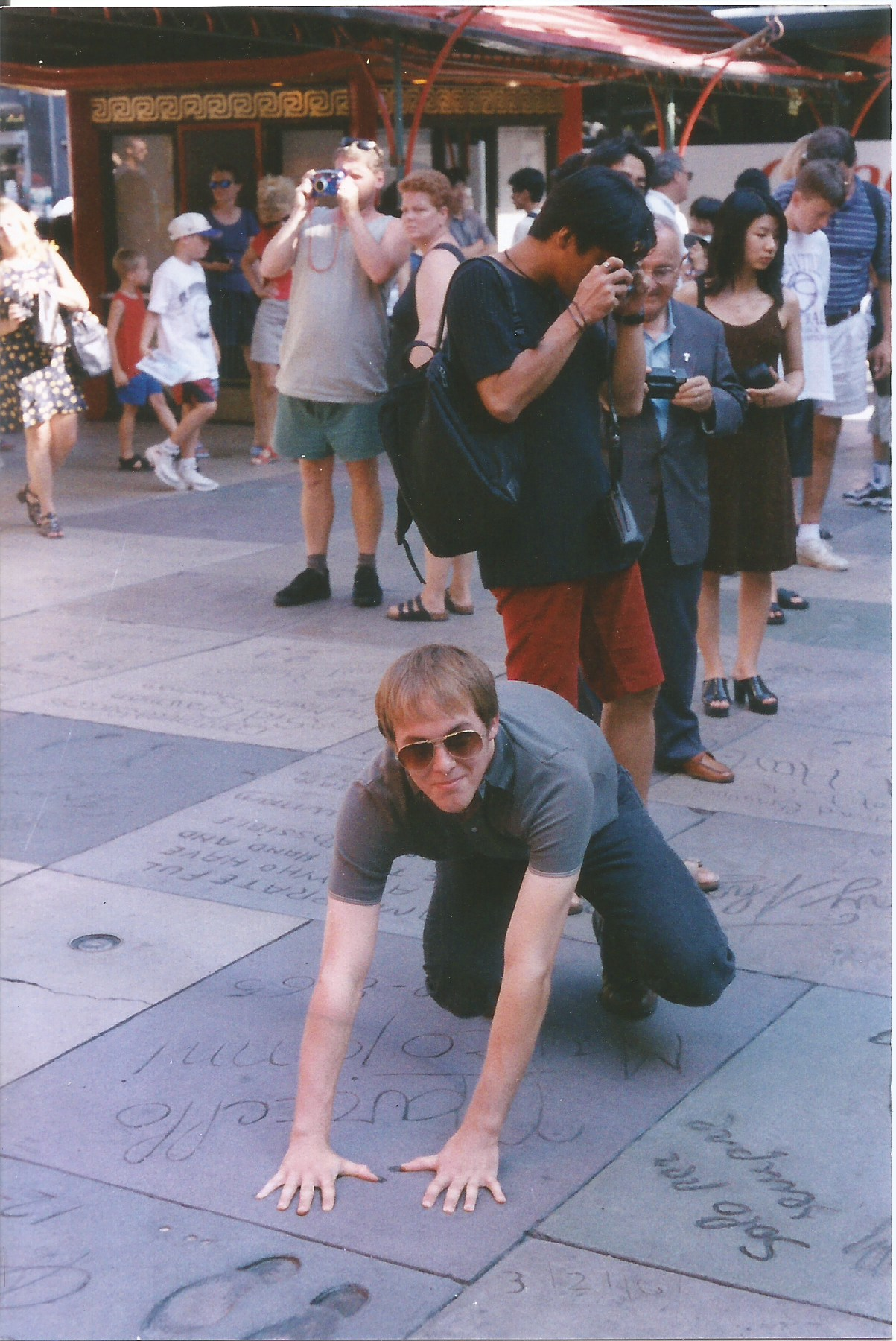
Our next stop was the Chinese Theatre — which is better than the Walk of Fame or The Ovation, because it is a beautiful cinema, designed by Meyer & Holler. Meyer & Holler also designed the beautiful Egyptian Theater — which we didn’t visit, I assume, because the main draw for most visitors isn’t Exotic Revival cinema architecture but hand prints, foot prints, and signatures made by slebs like Elmer C. Rhoden, Private Joe Brain, Rosa Grauman, or William F. “Bill” Hertz. I scoured the concrete and found a film star I liked and found Marcello Mastroianni. I duly placed my hands into his prints for an unflattering photo. I enquired about the Pig ‘n Whistle — because the name reminded me of the Wig & Pen. Seth assured me that it was nothing special.
Seth next drove us through Beverly Hills and Westwood, where I thought that I saw the Barbarian Brothers — David and Peter Paul — sitting in traffic. My first sleb sighting. I thought about how much it must cost to live in the Golden Mile and how isolating it must be, without anything within walking distance. An island of subruban highrises I got a bit depressed.
It was evening when we got to Seth’s dad in Redondo Beach. He and his wife worked at Mattel in El Segundo, a city I’d heard of because Q-Tip left his wallet there. Seth’s stepmom had a pewter Barbie — a reward with which she’d been presented for her many years of continuous employment at Mattel. We drank a couple of beers. I was 24 and it still felt weird to drink with peoples’ parents. I wanted so explore more. I told Seth’s dad that I’d heard that we shouldn’t go south of the 10 Freeway but here we were south of it. Seth’s dad cautioned us not to go east of the 405. I began drawing a mental map of the places I’d go on my own. Shortly after I moved to Los Angeles, I began volunteering at a community garden in Compton, where I never even got murdered once.
The next day, our friend, Christian, would show me the sites. He lived with Rebecca. They lived in Santa Monica’s Pico neighborhood. Getting there required driving across the width of the county from the Pomona Valley to the Westside. Passing through the San Gabriel Valley, I noticed signs in Chinese and mid-rises with names like Cathay Bank. I don’t remember having ever heard anything much about Los Angeles’s Asian population other than sa-i-gu/the ’92 riots. Why had I heard of “the Valley” but not the San Gabriel Valley, I wondered? I mean, if your metropolis was home to a vast valley full of Burmese, Filipinos, Chinese, Hongkongers, Indonesians, and Taiwanese; surely that would be well-known, right?
In Pico, Christian pointed to a spot on the sidewalk where someone had recently been murdered in a gang fight. Their apartment was situated on the disputed border between the Graveyard Gangster Crips and Varrio Santa Monica 17th Street. Right — so the Westside is safe but visiting South Los Angeles is a death sentence. Got it.
We ate at Rae’s, a diner that’s been around since 1958. We went to the Third Street Promenade. Christian also worked at Penny Lane. He introduced me to his co-worker, Nisha. We went to a record store in Venice. I asked about the dark shapes on the water. Christian said that they were islands and that “California Indians” had lived there. I asked what was there, today. He said there was a place called Avalon where people drove golf carts but that it was boring. Sounded amazing. to me. If you had a major island chain off of your coast, surely that, too, would be worth celebrating.
We had dinner at Toi on Sunset which was then only the second place I’d eaten Thai (after Coralville’s Saigon to Bangkok Vietnamese/Thai restaurant). I remember thinking that it was amazing. My hosts wanted to go to a club. There were so many clubs and so many nights listed in the back pages of the LA Weekly, it was overwhelming to me. They chose a club at El Rey. When Fatboy Slim’s “Praise You” dropped, most of the guys left the dance floor. I did not. Several of the girls, all of struck me as strikingly attractive, proceeded to tug me this way and that in an effort to get me to dance with them. This was not something I was accustomed to but I found it suited me. I realized, then, that I might want to live in Los Angeles.
The next couple of days blurred together as I crisscrossed the city. Back in the Pomona Valley, I saw Mask of Zorro at a multiplex. I was hard for me to take seriously a film in which the Mexican characters are all played by white, English-speaking Europeans: Spanish Antonio Banderas, Welsh Anthony Hopkins, and also Welsh (but faultless) Catherine Zeta-Jones. The director was a Kiwi. but then again, this is Hollywood — an expecting cultural sensitivity, historical accuracy, or sophistication is a bit like complaining about the quality of the Italian cuisine at Chuck E. Cheese. The audience was overwhelmingly Latino and they were demonstrably loving it, anyway.
We visited the Christian’s parents in Pomona. His mom was a tiny and spirited Comanche woman. His dad was a white Mexican who reminded me of Richard Dreyfus. He didn’t say much but his facial expressions changed to reflect the tenor of the conversation, dominated by Christian and his mom. We visited the Claremont Rhino where I bought a VHS of Nick Cave & the Bad Seeds’ The Videos.
Back on the Westside, we met up with Christian’s friend, Paloma, a teenager in a band called The Grown-Ups. We had coffee with Christian’s friend, Natasha, at Café Collage in Venice. Natasha referred to some razabillies as “rockasillies.” I thought they looked good. We rode the Metro Red Line, which I existed thanks to the film, Speed. There was no one else in the station or on the train, so I didn’t pay. We visited Chinatown and Little Tokyo. I’d heard of the former but not the latter. We visited the Grand Central Market and La Farmacia y Botánica Million Dollar on Broadway, then a thriving Latino shopping district. We went to Melrose, but I did’;t recognize the apartment from Melrose Place (which is actually in Los Feliz). At Aaardvark’s, I bought a white long sleeve mock-turtleneck with an RAF bulls eye and the message “Mods Rule.” A stranger asked me what Mods were.
As we drove down Fairfax, I smelled frankincense and myrrh. “What is this neighborhood?” I asked. “Little Ethiopia” Christian replied. I’d never heard of Little Ethiopia. The city wouldn’t get around to recognizing it as such until 2002. We later had drinks with Tasha and another friend, Lily — also a member of the Grown-Ups. We saw El Vez with his Lovely Elvettes. Christian was a rabid El Vez fan. I don’t remember what the venue was.
Crisscrossing the metropolis, I would spy a cluster of high-rises and ask, whether or not, it was Downtown. More often that not, it was not. It would be Century City, Glendale, Westlake, Westwood, &c. This seemed to amuse Seth, who also liked to quiz me about cardinal directions. I pointed to the tall buildings and signs stating “Koreatown.” “Why don’t we go there,” I asked. “There’s nothing there for us,” was the response.
KOREATOWN
I therefore went to Koreatown by myself. Not knowing where to start, I went to Koreatown Plaza. I observed girls holding hands with one another and found that strange. I knew next-to-nothing about Korean culture, then, and what experiences I had mostly went over my head. Hallyu would not crash on America’s shores for a few more years. Another year would pass before Shiri would be released — one of the first Korean films to enjoy something approaching a wide release in the US. Then, a critic on KPCC“S FilmWeek would admit, without embarrassment, that he hadn’t been able to follow the plot because everyone in it looked the same to him.
Back in the dorms, at Iowa City, I’d befriended a Korean but he had been adopted by a white family and he identified as white to the consternaiton of his black roommate, who did his best to awaken racial hostility by blasting Ice Cube’s “Black Korea” in their dorm room.. After I moved out of the dorms, I lived near — and did a lot of my shopping at — a Korean market, East-West Oriental Foods. I hadn’t known, though, that it was Korean. Nor did I know, until years later, that a smitten-Korean student had made a habit of grabbing a stool at Bo James, across from Every Bloomin’ Thing, and watching me deliver flowers, I suppose.
There weren’t a lot of vegetarian options in Koreatown Plaza’s International Food Court. I ate jjajangmyeon because I didn’t see any obvious bits of flesh. Years later, when I returned to that food court with a Korean friend and related to her this experience, she asked, with apparently real confusion, “Wait, so your first experience with Korean food was a Chinese dish?” I was confused by her confusion. How could I have known? I bought a taegeuk pendant at the gift store as a souvenir of my solo vacation within a vacation. It was clear to me that Koreatown was actually the most important neighborhood in Los Angeles.
FINAL IMPRESSIONS
My last night in Los Angeles was a Monday. My impressions of the city had disliked in ignorance had been radically challenged by actually exploring it. I came away with several lasting imressions.
Los Angeles is not, in fact, Florida — not even with all of the imported weevil-and-roof-rat incubators that even many locals and most tourists embrace as iconic. Los Angeles is not tropical nor even sub-tropical. It doesn’t rain everyday at lunchtime and it gets chilly at night. Neither is most of it a desert any more than is Mediterranean France, of which the climate and landscape reminded me more than a little. Why people would portray Los Angeles as a western suburb of Tampa, however, remains a mystery.
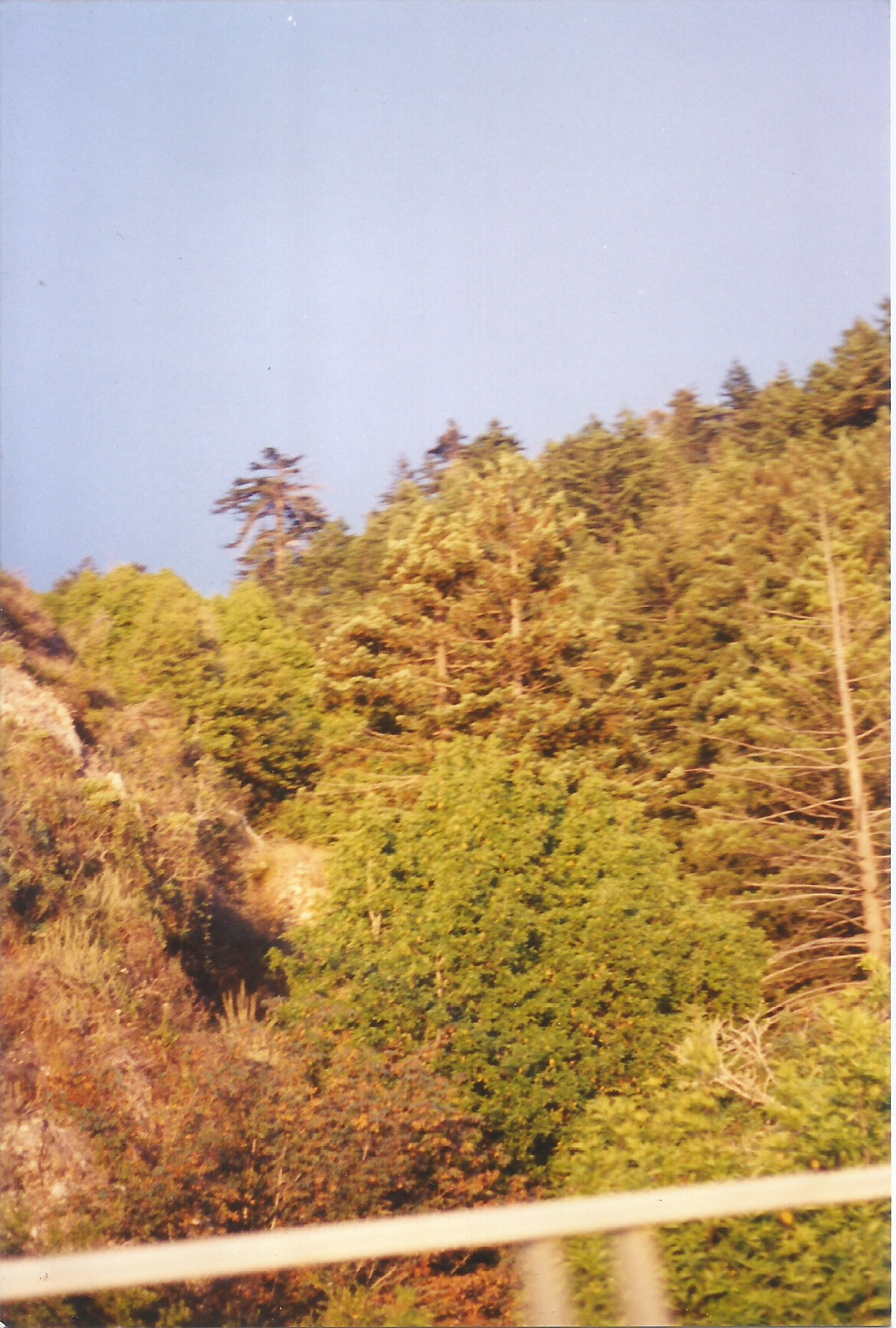
While I knew that there were “Hollywood Hills” and a “Valley” — I had no sense of just how truly mountainous Los Angeles is. There are mountain lions and bears living in the nations’ second-most populous city. People complain about Los Angeles’s skyline but that skyline, in every direction, is formed by skyscraper-dwarfing mountains. I was told, though, by someone that mountains don’t count. He, of course, neglected to say why, although it’s safe to assume that it was because he was from less mountainous city. Here, even the ocean is punctuated by the mostly submerged mountains that make up the Channel Islands. And yet almost no Angelenos seem to know that Los Angeles has the greatest elevation range of any city on Earth — from below sea level in Wilmington to 1,547 meters above sea level Mount Lukens. The city derided as horizontal is, in fact, also the planet’s most vertical.
Los Angeles was way more ethnically diverse than I had expected — but also differently so. Both black and white people are overrepresented in pop culture and media depictions of Los Angeles. On the other hand, while I had known that Los Angeles had a Latino minority, nothing I had seen had conveyed that Latinos are very nearly the majority. Los Angeles is home to the largest Mexican community outside of Mexico. One in three Angelenos is Mexican American — making it the most prevalent “ethnic” origin. I put ethnic in quotes because Mexico is, like most countries, a multi-ethnic society. There are more than twice as many Mexican Americans as there are Northern European Americans — the second most populous (and more broadly defined) “ethnic” group. One certainly doesn’t get that impression from films and television programs set in Los Angeles. It made sense, though, since the California borders Mexico and was for 37 years a pueblo in it.
I was even more surprised at how Asian — and how diverse the Asian population of the city — was. Of course, Los Angeles is on the Pacific Ocean, which essentially forms a vast maritime border with the countries of East and Southeast Asia. Why wouldn’t have a huge and diverse population — but then, and again, why wasn’t this reflected in pop culture? Why isn’t it more widely known that Los Angeles is home to the largest diasporic populations of Cambodians, Filipinos, Iranians, Koreans, Taiwanese, Thai, and Vietnamese on the planet — and the nation’s largest population of Burmese, Indonesians, and Mongolians. No other city on Earth comes close to being able to seriously claim its status as the world’s Pan-Asian Metropolis.
It is hard, once you’ve visited Los Angeles, to not get the impression that Los Angeles contains multitudes — and that it is either bad or uninterested in communicating this reality. Los Angeles is a city and a county and a metropolitan area. It’s home to dozens of ethnic enclaves, hundreds of municipalities, even more unincorporated communities, and thousands of neighborhoods. I fantasized about the possibility of living in one Los Angeles community and vacationing in another — and sending postcards home to my friends. “Wish you were here.”
Los Angeles is so deep, too. Here — and this isn’t true of every city — two people can easily lead fulfilling lives that never cross paths with one another. And it’s constantly changing — but while it’s not a museum city frozen in amber, it’s been continuously inhabited for more than 13,000 years (longer than, say, Ireland). It’s not, in other words a place without history any more than it is a place where no one walks or everyone works in “the industry.” It’s a hard place to wrap one’s head it and its hard to generalize about a city where a third of residents are natives, a third are transplants, and a third are either immigrants or refugees. I suspect that Los Angeles and L.A. are two different places. I prefer Los Angeles. Other people love L.A. That’s fine. They can have L.A., I’ll take Los Angeles.
❦
SAN FRANCISCO
After we left Los Angeles, Seth and I drove up to San Francisco (or S.F if your’e into the whole L.A. thing). It was a Tuesday. Another of Seth’s sisters lived there, I think, in the Castro. It was nighttime when we arrived so I didn’t see much. There was a homeless man sleeping in their foyer that we almost stepped on. Seth’s sister said that the residents of the building were on good terms with him. I don’t remember where we went that might but I wrote “Britpop Hell” in my journal. I was pretty sick of Britpop by 1995 but Seth and his sister, I think it’s fair to say, were not. My most vivid memory is of ending our night with a Mission Burrito. That I was down with. That and the downright chilly weather.
The next day, the 18th, Seth and his sister took me to Pier 39. I bought a painfully snug “on size fits all” mariner’s cap. I don’t remember exactly what happened next. I think Seth headed back to Chino — with his CD player. It would be just me and the radio for the rest of the trip.
I hugged the coast as much as I could, heading north.drove mostly along the coast. My grandfather had said that the route between San Francisco and Seattle was, in his estimation, the most beautiful in the country. Nothing I’ve seen before or since has led me to a different conclusion. The air in the redwood forest was wet and green. I drove
the Taurus through the trunk of one. I may’ve stopped in Eureka. I stopped at a Taco Bell in Crescent City.
My first trip to California was coming to an end.
❦
SEATTLE
With money running out and a lot of states between myself and Iowa, I ate less, took no photos, and covered more ground. I drove across Oregon, I think, without stopping. I got to Seattle and visited Pike Place. I walked around the ID for a bit. Night fell as I walked around Downtown. There were people screaming on the street. On the other side of a glass window, well-dressed people at dinner at a restaurant. I decided it was to move on.
❦
“TWIN PEAKS”
Today, people often refer to periods of just a few years ago as “before the internet” or “when the internet was in its infancy.” This is nonsense. The precursor to the internet, ARPANET, began operation in 1969. The birthday of the internet, though, is usually identified as 1983. That’s the year my family got a computer but I wasn’t on the internet until 1992. I’m not sure when the non-dorks got on board — maybe 2006 — but make no mistake, the internet already existed. That said, there was not nearly as much information on it in 1998 and although I knew that Twin Peaks had mostly been filmed in Snoqualmie, I don’t think anyone had yet mapped the filming locations. I knew, though, that the Salish Lodge was Twin Peaks’ Great Northern Hotel so I thought it was important to sleep there. I remember that the bed in my room was gigantic that it made me feel lonely. A bit of garmobozia for the road. After that night, I had very little left in my bank account — but it was worth it just to pass through such a spiritual place. I’ve since returned, mad ae map of filming locations, and visited a lot more of them.
❦
IDAHO AND MONTANA
I picked up the pace as I headed east. I was struck by the change in scenery once I got to eastern Washington. I got out of the car in Spokane to stretch my legs — and so that I could say that I’d been to Idaho. In Montana, there was a “basic rule” speed limit. There were signs at rest stops explaining that “yes there is a speed limit, Mario, it’s called ‘basic rule.’” It explained that basic rule meant that drivers could drive whatever speed they wanted as long as it was “reasonable and proper for conditions.” I assumed that “Mario” was a reference to Mario Andretti… but, in retrospect, maybe it was Nintendo’s Mario — or maybe both — although the former was known for driving quickly and I kind of doubt that state officials in Montana would want to draw comparisons between their roads and those in Super Mariokart. At night, the interstate speed limit would be 75 mph. I tore across the state as fast as an 1988 Ford Taurus could go — certainly faster than was “reasonable.” I didn’t make it across Montana before the sun set, though, and for a while, I could only pick up one station on the radio. It was a talk radio program. People called in to share their experiences with “black helicopters.” The host was angry about “Hillary Clinton and the healthcare conspiracy.” It was dark. I felt like I was losing my mind.
❦
SOUTH DAKOTA
I didn’t have enough money left to go through North Dakota. To this day, it’s the only states in the Lower 48 that’s west of the Mississippi, that I’ve still never even been through. I was back in South Dakota when the sun rose. I tried to sleep at a rest stop but the heat (and humidity) and the NoDoz made it impossible to sleep — even though I was exhausted. It’s also hard for me to imagine being comfortable enough to sleep in a parking lot with strangers wandering around. I gave up, opened my itchy eyes, and drove on. It took a second to recognize myself in the rearview mirror. My face was puffy and my skin had turned a troubling shade of lavender. I felt bad. I smelled bad.
❦
IOWA
When I got to Sioux City, just inside of Iowa, I reckoned that I had enough money left over that I could grab a bite at Taco Bell, even if it meant running out of gas. I was four and a half hours from home. I might run out of gas but the closer I got, the less stressful that prospect seemed. The “E” light had been on for a while when I rolled into Iowa City. It was late afternoon/early evening. I was back in my apartment. I hadn’t slept in 36 hours so I climbed into bed. With Seth and most of my friends gone, my last year in Iowa City would be an elegiac coda — but which I truly, if quietly cherished. Living in a college town after graduation felt strange but not in a bad way. It just felt like it was time to move on or turn into a townie. I read a lot and avoided people. Sometimes I’d climb a tree with a book so that no one would bother me. I favored liminal spaces like the ACT campus after hours. At least once I had a Ballardian picnic by myself on the landscaped island formed by a freeway exit. Usually, though, I hung out and read in bars and libraries, the WEEG Computing Center, Hall Mall, and the Ped Mall. I’d often ride my bike to Hickory Hill or walk to the then-undeveloped Peninsula where I’d pass hours reading, enjoying my surroundings, and drinking retsina. I know it’s frowned upon — at least in the US — maybe everywhere? — but I like drinking alone. I remember getting a pitcher of stout at the Deadwood and — when they gave me two glasses — giving one back. I was happy to sit in the big window, watching the world go by through the bar’s large window. When I think of it now, I think I was so content because it was the first time I’d ever lived anywhere and known, in advance, that I’d be leaving. It was the first time I’d had a chance to say goodbye to a place. I moved to Los Angeles in 1999 and I’ve been lived in the same place ever since.
Support Eric Brightwell on Patreon

Eric Brightwell is an adventurer, essayist, rambler, explorer, cartographer, and guerrilla gardener who is always seeking paid writing, speaking, traveling, and art opportunities. He is not interested in generating advertorials, cranking out clickbait, or laboring away in a listicle mill “for exposure.”
Brightwell has written for Angels Walk LA, Amoeblog, Boom: A Journal of California, diaCRITICS, Hey Freelancer!, Hidden Los Angeles, and KCET Departures. His art has been featured by the American Institute of Architects, the Architecture & Design Museum, the Craft Contemporary, Form Follows Function, the Los Angeles County Store, Sidewalking: Coming to Terms With Los Angeles, Skid Row Housing Trust, and the 1650 Gallery.
Brightwell has been featured as subject and/or guest in The Los Angeles Times, VICE, Huffington Post, Los Angeles Magazine, LAist, CurbedLA, Office Hours Live, Spectrum News, Eastsider LA, Boing Boing, Los Angeles, I’m Yours, Notebook on Cities and Culture, the Silver Lake History Collective, KCRW‘s Which Way, LA?, at Emerson College, and the University of Southern California.
Brightwell is currently writing a book about Los Angeles.
You can follow him on Ameba, Duolingo, Facebook, Goodreads, iNaturalist, Instagram, Mastodon, Medium, Mubi, the StoryGraph, TikTok, and Twitter.


 Eric Brightwell
