This post was born out of a shorter post originally written for the Silver Lake Neighborhood Council‘s “Ask Silver Lake” column.
‘Ask Silver Lake’ is dedicated to exploring the history and insights of our community. If you have questions or ideas you’d like us to consider, please drop a comment or send them to outreach@silverlakenc.org.
INTRODUCTION
If you’ve been by the old Satellite space at any time in the past couple of months, you’ve no doubt noticed that it’s currently surrounded by chain-link fence and plywood walls. According to the city’s Department of Planning, it is being remodeled and transformed back into a restaurant, which, curiously enough, is what it began when it first opened its doors, 72 years ago.
THE HAPPY HOLLOW
What last operated as Satellite began its life as the Happy Hollow, a restaurant which opened its doors for the first time on 1 June 1951. Its owner was a then 31-year-old transplant from Sioux City, Iowa named Anthony Chiponis. “Happy Hollow” is the name of a suburb of (and club in) Omaha, a city located downstream on the Missouri River from Sioux City. It’s also, though, the name a communities in various other states, including Alabama, Arkansas, Kentucky, and Missouri — states where a “hollow” suggests a somewhat secluded community in a small valley and — at least in the Upper South — is usually pronounced (and often spelled), “holler.”
Anyway, what inspired the name of the restaurant isn’t, as far as could determine, reported anywhere. Things undoubtedly got happier in the hollow in 1953, when it was granted a liquor license. Equally important in setting the mood for restaurant-goers’ dining pleasure was live organ accompaniment. In May 1959, Chiponis applied for. a permit to “conduct cafe entertainment.”
Chiponis had married Patricia Adams in 1933 and, a few years later, the couple had moved to Los Angeles where they lived in a house on 52nd Street in Chesterfield Square. There, they had two children — Richard and Jacqueline. Not long after establishing the Happy Hollow, however, the Chiponis clan relocated to Medford, Oregon, where Anthony Chiponis died in 1967.
The Happy Hollow’s next owner was Jim Mount, who must’ve taken over by September 1960. It was then that Harold A. Bridges and “James M. Mounts” were listed as having applied for a permit to “conduct cabaret entertainment”
I’m assuming — perhaps wrongly (and despite the spelling differences) — that this was James Donald Mount — a Portland native whose family had moved to Los Feliz when he was a teenager. After graduating from John Marshall High School, James D. Mount had served as a Marine in the Second World War and obtained a degree in architecture from USC around 1964.
That would fit with what little information I could find on the Jim Mount who took over the Happy Hollow, who was apparently a bit. of a traveler. Under his tutelage, Jim Mount’s Happy Hollow (as it was usually billed) featured dishes apparently inspired by travel. The eclectic menu featured Australian lobster tail, shish kebab with pilaf, Southern fried chicken, and steak. After a trip to France, a newsworthy newspaper article announced the addition o a mushroom Colbert sauce to the kitchen’s repertoire. If Jim Mount and James Donald Mount were indeed one-in-the-same, he passed away in 2013.
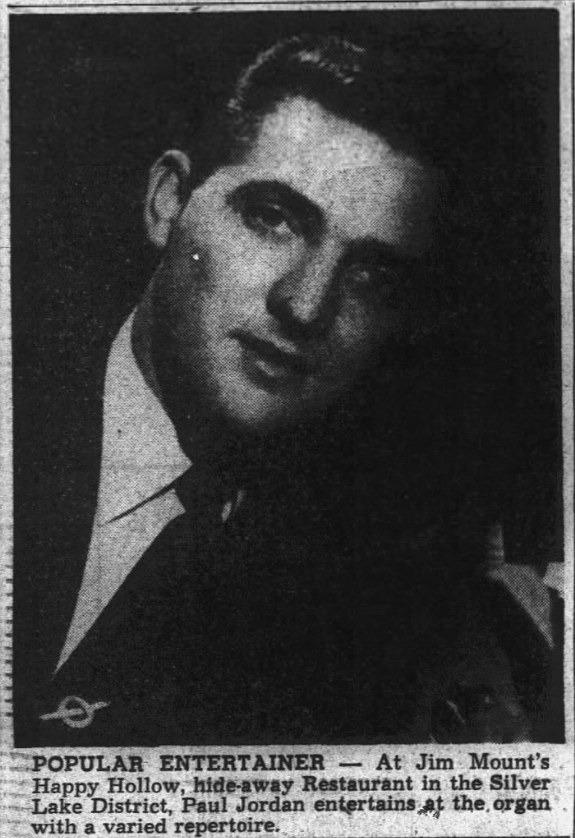
Blount also promoted the restaurant’s organist by name, one Paul Jordan. I’m unable to say, definitively, whether or not he was the venue’s original organist. There’s. a picture of Mr. Jordan from an ad for the Happy Hollow and there was an under-sung jazz pianist, composer, and arranger named Paul Jordan who performed in Artie Shaw‘s band and with Budd Freeman‘s band, the Chicagoans. The Paul Jordon Quartet and Paul Jordan Octet cut a couple of singles in. While there’s more than keyboardist named Paul Jordan, it seems likely that the Happy Hollow’s was the jazz pianist from Chicago.
THE RED CHIMNEY
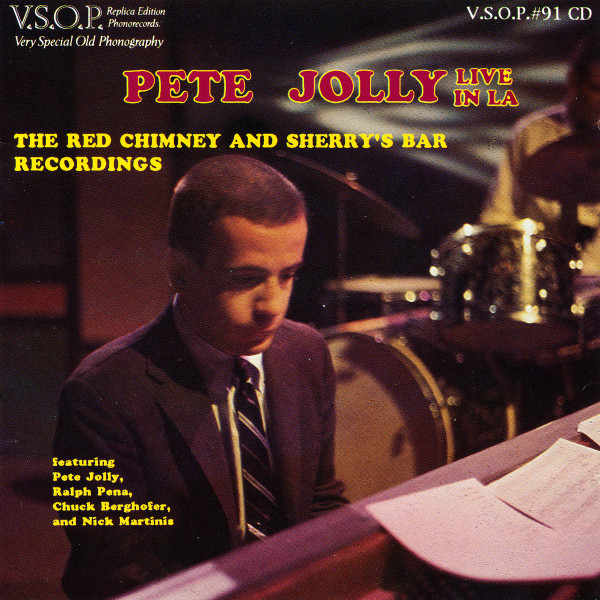
Around 1964, the Happy Hollow re-opened as the Red Chimney. Paul Jordan’s organ was replaced by the Pete Jolly Trio. Pete Jolly (né Peter A. Ceragioli, Jr.) was a pianist and accordionist whose composition, “Little Bird,” had been nominated for a Grammy in 1963. He formed his trio in 1964 with Nick Martinis on drums and, either Chuck Bergoger or Ralph Peña on bass. In 1965, the Pete Jolly Trio cut a live jazz record there in 1965 that also featured recordings from Sherry’s Bar. Sherry’s Bar — along with the Red Chimney and a North Hollywood venue called Donte’s — were all owned by John Ricella. The long, slow journey from restaurant to live music venue was underway.
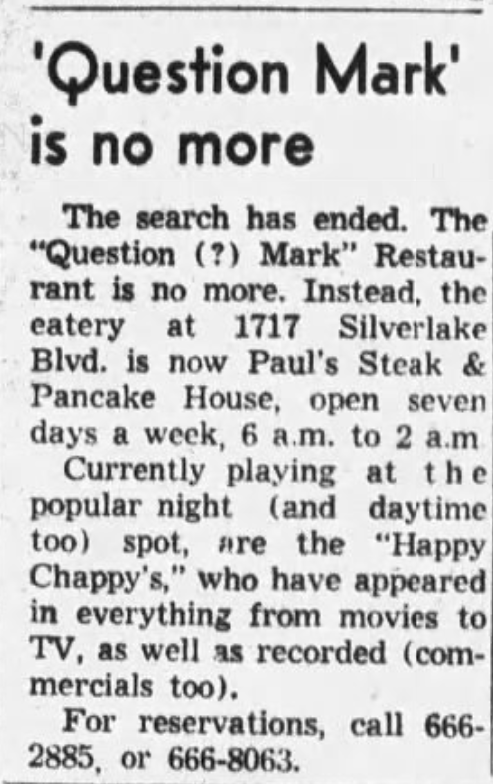
The Red Chimney was taken over by Harvey Boatwright and Paul Hadjes in late 1965. The duo were restaurateurs who co-owned a chain of pancake restaurants called Pancake Heaven. After a brief spell as the Question Mark — perhaps a reference to their temporary indecision about what to call it — the pancake barons re-christened it Paul’s Steak & Pancake House in February 1966.
It reverted to the Red Chimney, however, and around Augus 1967, Horst Wolfram bought the venue which began, then, to be marketed as a “European Nightclub.” Wolfram was an immigrant from Breslau and his concept of “European” seemed to have skewed pretty Germanic. Want ads for an “attractive cocktail waitress” mentioned that the ability to speak “either German or Swedish” was a plus. A group called the Grindelwald Ski Club met regularly at the Red Chimney until at least 1971.
THE DANCE ERA — VISIONS, CHIC, AND DREAMS OF L.A.

In the 1970s, disco ushered in dancing and dining seems to have moved to the back burner. Lessons for the “New York Hustle” were advertised. There were also “mirrored walls” and dance contests to entice disco dollies. A sale of kitchen equipment in 1977 perhaps indicated that the Red Chimney restaurant era was over.
The dancing continued into the 1980s, too. Backgammon, a game which over its long existence has experienced several distinct crazes, was mentioned in advertisements for the club — which change its name to Visions. If board games and disco weren’t enough — there was also billiard, popcorn, video games, and “Mexican hors d’oeuvres.”
By the summer of 1984, Visions had become Le Chic Discoteque & Video Dance Club — or “Le Chic” for those into the whole brevity thing. One weekends at Le Chic, dance tunes were spun by Glendale-based DJ, Paul Ambrose. Other entertainment in the era of Le Chic included the King Revue Girls — and “sexist miniskirt, lingerie, and bikini contests.”
In October 1986, Le Chic was reborn as Dreams of L.A. Judging by the wording on the sign, which stood above the space until recently, Dreams of L.A. at least initially offered “food & spirits.” Disco, however, was in the rearview mirror for most by then, and advertisements for Dreams of L.A. proclaimed, “If you dig the music of Power 106, you’ll love Dreams’ ‘new music mix’.” Magic 106 — an “upbeat adult contemporary” station — had rebranded itself “Power 106” in January 1986. The new name reflected a new format — “rhythmic contemporary” — or, for those not fluent in radio format jargon — synthfunk and freestyle groups like Club Nouveau, The Cover Girls, and Exposé.
It seems that it was at this time that speciality nights began to creep in to the club’s schedule. On Mondays, the club’s televisions were turned to Monday Night Football. Wednesdays were “ladies nights with salsa.” There were still dance revues and bikini contests, too. Tunes were spun by Dale Clark and Sexy DJ Claudette. By 1991, there were nights devoted to house, industrial, Motown, and “retro ‘80s.”
THE PAN ERA
Around 1993, Mitchell Frank and Nancy Whalen introduced live music with their influential live music night, Pan. Indie musicians including Babe the Blue Ox, Baby Lemonade, Burning Sofa No. 10, Congo Norvell, the Geraldine Fibbers, Guv’ner Crib, Lifter, Lutefisk, Mecolodiacs, Miniature, Mousetrap, Ms. 45, the Negro Problem, the Nels Cline trio, Palmetto, Polar Goldie Cates, Pop Defect, Silkworm, Slug, Spain, Sugarplastic, and That Dog all performed at Pan. There was a Syd Barrett tribute night, a “pansy night,” and on at least one occasion, a benefit to raise money to replace Michael Whitmore‘s stolen guitar. In an indication of the calm before the storm, a reporter for. the Los Angeles Times, in 1994, described Silver Lake as “a low-key locale on the hipster club spectrum.”
THE SPACELAND ERA
On 16 March 1995, Pan was reborn as Spaceland. Bands, again, were raising money for stolen gear — this time for the band, Lutefisk, who performed that night along with Beck, the Foo Fighters, and Possum Dixon. Jennifer Tefft, formerly of Boston‘s Jennifer Teft Band joined Frank in booking talent as Spaceland. Teft left Spaceland in 1999, though, and began booking for the Fold, which handled the Bootleg Theater in Filipinotown. Together, Spaceland, the Bootleg, and the Echo + Echoplex formed a real nexus of 300-ish capacity venues in Mideast Los Angeles and together, they helped establish the region’s reputation, for better or worse, as the center of Los Angeles hipsterdom to such a degree that whenever an indie band would play on the Westside‘s once-cool Sunset Strip, Angelenos would collectively wonder how they hadn’t gotten the memo.
I hadn’t gotten the memo, myself. I moved to Silver Lake in 1999, and I new nothing of its reputation. All that I knew of Echo Park was what I’d gleaned from the 1993 film, Mi Vida Loca. KLC and Mannie Fresh were the music-makers I listened to most. I was indifferent to the music of Beck and I only knew Elliot Smith as the guy who complained about the noise from my friends’ parties or who shoved my then-girlfriend out of his way as he stumbled out of a 7-Eleven. What little I’d seen of Los Angeles made me want to live in Boyle Heights. or Lincoln Heights, where I noticed the streets thronged with people on foot. But my only roommate with a job was a native an assured us that Silver Lake was where it was… at. And I came ’round on the neighborhood — although I never understood why spending twenty minutes looking for parking around Spaceland was better than just walking twenty minutes to the venue.
My roommate’s favorite night to go out was Mondays and on Mondays, Spaceland would feature bands with month-long residences. I can’t possibly remember all of the bands we saw on Mondays — or any other nights — but it’s not all a fog. I remember Acid Mothers Temple, the Antarcticans, the Autumns (who were being filmed for a documentary), the Clientele, the Dead 60s, Erase Errata, Gene, Kavee “Thai Elvis” Thongprecha, the Magnetic Fields, and Numbers — to name a few. My friend Lars and I once chatted up the ex-wife of Jesus Jones‘ Mike Edwards and then serenaded her with an a cappella renditions of “Info Freako.” Another time, Mark Gardener struck up a conversation with me. I didn’t recognize him until he mentioned he’d been in a band called Ride. “Oh wow, Ride meant a lot to me!” I said. “Ride meant a lot to me, too” he replied. When Amoeba Hollywood opened, we had our first Amoebapalooza at Spaceland. It was the best one, too, because people performed earnest original material instead of jokey covers that would later characterize those events. Of course, there was also the famous Smoquarium — a smoke-filled plexiglass box with a pinball machine, a cabinet video game, and strange booths that made it difficult not to eavesdrop. It was there that I stopped “Jenn with two ‘n’s” from lighting up and, presumably, getting kicked out for doing what, from the smell of it, people seemed to have done in there since the Happy Hollow days.
I think it was around that time that Horst Wolfram retired to Palm Desert and his son, Jeff, too over. Silver Lake and Spaceland’s reputation continued to grow. The Drones and Liam Finn, from Australia and New Zealand, respectively, recorded live albums there. Aaron Spelling produced a pilot for UPN called Silver Lake about a guy who works at Silver Lake’s second-most popular used record store… and can talk to dead people. UPN then tried (and failed) to create an OC-type show set in Silver Lake called Sex, Love, and Secrets. The club appeared in a Jim Carrey film, 2008’s Yes Man. In 2012, that hipster bible, Forbes Magazine, declared Silver Lake “America’s Hippest Hipster Neighborhood.
By the time of Forbes’s pronouncement, I reckon most “hipsters” had moved east — to the actual Eastside. Mitchell Frank, referred to by LA, I’m Yours as “Mr. Eastside Cool,” parted with the Silver Lake venue with his booking agency, Spaceland Presents, in 2010, in order to focus on the Echo/Echoplex. In 2019, Frank would go on to sell Spaceland Presents to Live Nation.
THE SATELLITE
Although there was still a sign proclaiming “Dreams of L.A.” above the venue, everyone had, by the time of Frank’s departure, taken to referring to the venue as Spaceland. The name was changed to the Satellite. Former Spaceland booker, Jennifer Teft, returned. The transition, I was told, was rocky. But the music continued. There were changes, too, At some point the stage moved to appease the fire marshal. The route to. the restrooms changed. The Smoquarium was drained and cleaned — and it dawned on everyone that smoking — especially inside — is pretty gross. I didn’t go as often — but probably because I’m older now, and rock shows are less appealing to me now. It wasn’t all rock, though. Gregg Turkington‘s Neil Hamburger persona remained a comedic fixture. And I remember enjoying performances by the Bats, the Clientele (again), Shonen Knife, and Sisu, that could reasonably be described as “rock.”
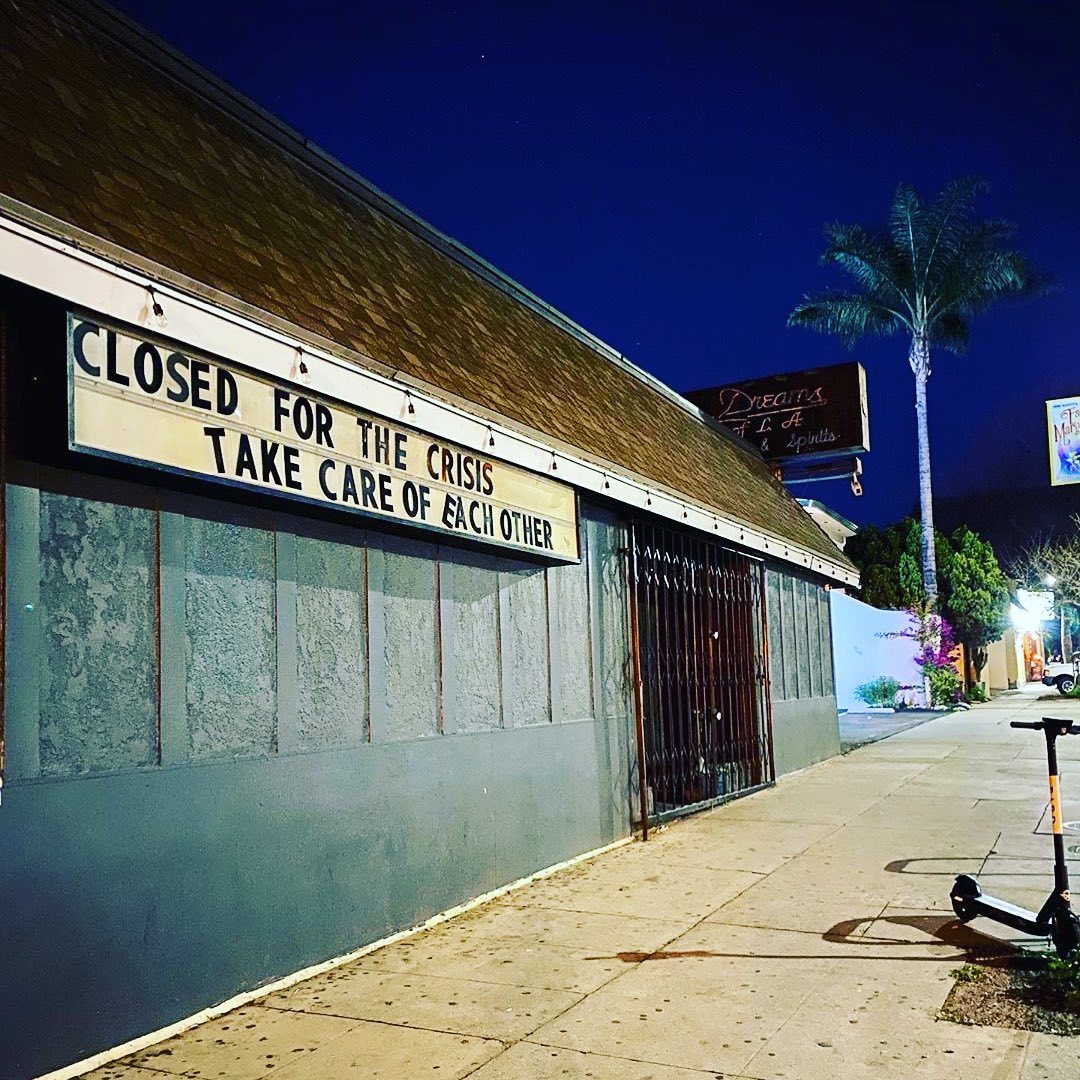
Everything changed again, of course, in 2020, when everything shut down during the COVID-19 Pandemic. Jeff Wofram announced that the venue would pivot back into a restaurant in order to stay afloat. Three years later, though, with the pandemic behind us, I think many of us in the neighborhood wondered what was next and when the venue would re-open. Then, the fences and plywood went up. The rusty old Dreams of L.A. sign — and part of the wall next to the parking lot — came down. I wish the restaurant luck… and time will tell what, if any, role music will play, be it in the form of indie bands, disco DJs, jazz trios, or live organ music for dining pleasure.
Support Eric Brightwell on Patreon

Eric Brightwell is an adventurer, essayist, rambler, explorer, cartographer, and guerrilla gardener who is always seeking paid writing, speaking, traveling, and art opportunities. He is not interested in generating advertorials, cranking out clickbait, or laboring away in a listicle mill “for exposure.”
Brightwell has written for Angels Walk LA, Amoeblog, Boom: A Journal of California, diaCRITICS, Hey Freelancer!, Hidden Los Angeles, and KCET Departures. His art has been featured by the American Institute of Architects, the Architecture & Design Museum, the Craft Contemporary, Form Follows Function, the Los Angeles County Store, Sidewalking: Coming to Terms With Los Angeles, Skid Row Housing Trust, and the 1650 Gallery.
Brightwell has been featured as subject and/or guest in The Los Angeles Times, VICE, Huffington Post, Los Angeles Magazine, LAist, CurbedLA, Office Hours Live, Spectrum News, Eastsider LA, Boing Boing, Los Angeles, I’m Yours, Notebook on Cities and Culture, the Silver Lake History Collective, KCRW‘s Which Way, LA?, at Emerson College, and the University of Southern California.
Brightwell is currently writing a book about Los Angeles.
You can follow him on Ameba, Duolingo, Facebook, Goodreads, iNaturalist, Instagram, Mastodon, Medium, Mubi, the StoryGraph, TikTok, and Twitter.


 Eric Brightwell
Thank you for this! My old band WACO played a Monday residency very early on in Spaceland’s reign, and it’s wonderful to read all about the pre-Horst iterations that I never knew about. One thing – let’s not forget Nancy Whalen, who was Mitchell Frank’s work partner in the Pan days. She was a great lover and promoter of local music.
LikeLiked by 1 person
Thank you for the information. I’m going to update the piece to reflect your additions.
LikeLike
hey eric! any updates on what’s going on with this space? i walked by the other day and it looked like construction had been abandoned.
LikeLike