If you ever walk, bicycle, or take public transit in Los Angeles, you’ve no doubt noticed those nearly ubiquitous tan or beige-colored signs with brown lettering, a City of Los Angeles seal, and text designating an intersection or section of road a “square.” If you’re a motorist, you may’ very well have missed them, because if you’ve convinced yourself that you must drive sometimes, you’ve no doubt convinced yourself that you might as well drive all the time and when you’re behind the wheel you’re more likely texting than paying attention to the nuances of the streetscape.
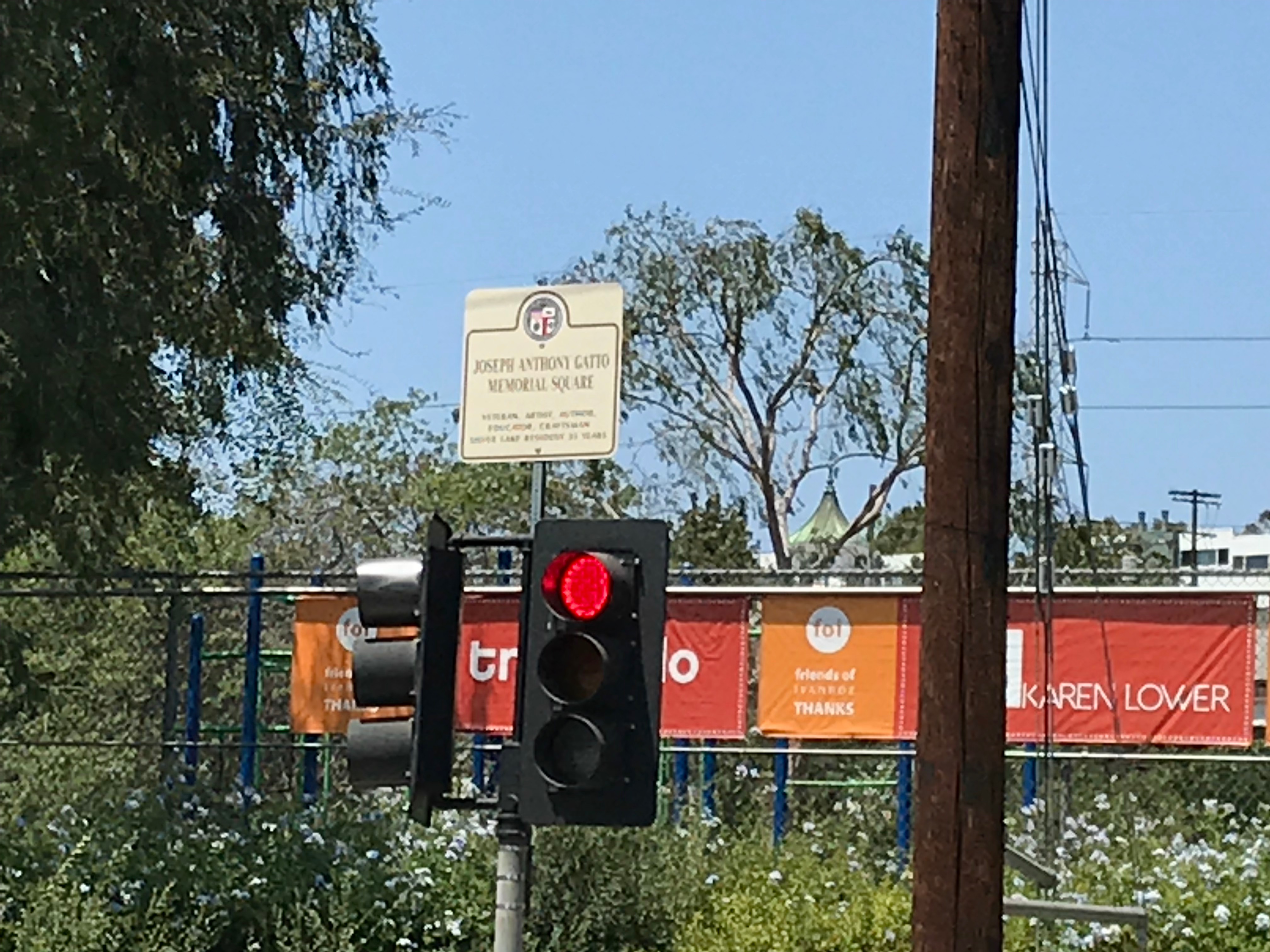
These signs usually but not always honor an individual. Many but not all are memorials. The process for their creation involves a city council member introducing a motion, the approval of the city council, and the installation of a sign by the Department of Transportation. They are almost never rejected. In fact, I’ve found only one incidence of that happening — with the proposed David Geffen Square — proposed in 2016, met with protests, and quietly left to expire in 2918. All of this is recorded by the Los Angeles City Clerk and yet, despite my best (if admittedly meager) efforts, I’ve thus far been unsuccessful in locating or verifying the existence of any sort of master list of these “squares.” I have, though, attempted to map them. I’m sure that I’ve left off a good many; When I wondered which one I’d use in the image for this piece, I walked 100 meters from my door and spied one that until forgotten about. If I’d walked another 100 meters, I’d probably have spied another. Obviously, I’d love to add any omissions of which I’m sure there are many. Just leave a comment.
Although once uncommon, since about 2000, they’ve begun to spring up like mushrooms after the rain. Although they often honor noteworthy individuals and police killed in the line of duty, I’m not entirely sure exactly what purpose, if any, they’re meant to serve. Take the case of Fletcher Square in the Glassell Park neighborhood. Fletcher Square is the pleasant-sounding name for a particularly unpleasant intersection flanked by fast-food chains, automobile maintenance businesses, and parking lots. If designating it “Fletcher Square” was an attempt to create some sense of space, I can’t help but think that it’s been no more successful in doing so than bestowing the name “Premier Plaza,” on of the “square’s” strip malls. I’ve never heard anyone refer to “Fletcher Square” in conversation and I reckon no one would know what I was talking about if I mentioned it in conversation. A search online turned up listings for a nearby Goodwill but that’s about it… and even with its new name, it’s still an unpleasant intersection that most go out of their way to avoid, not visit.
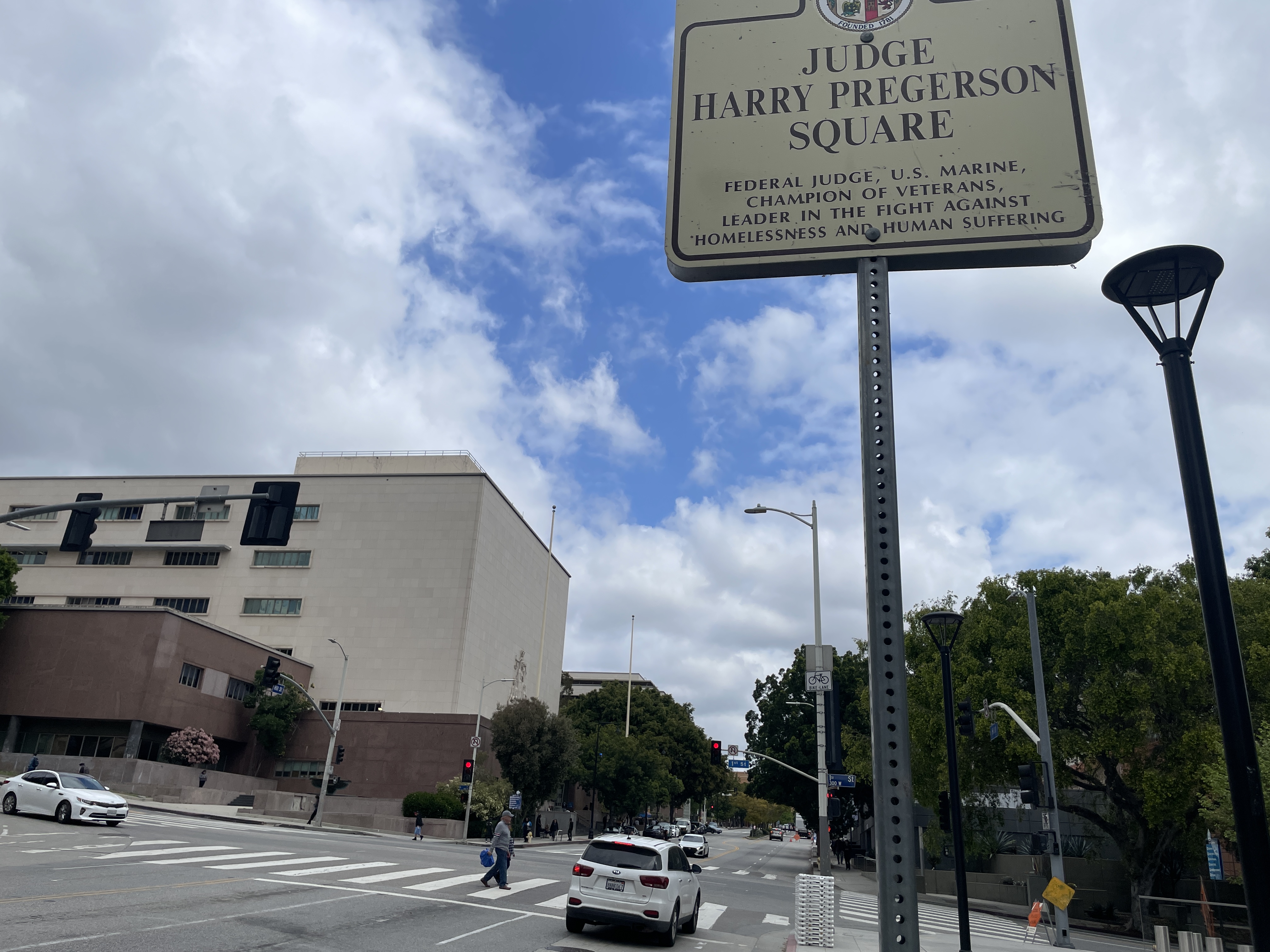
As a Los Angeles Square, it’s no more and no less successful than most. On the other side of the looking glass, a “square” refers to a planned public space that usually hosts various public events. They’re variously known as city squares, market squares, public squares, town squares, urban squares, piazzas, plazas, and town greens. Some of the best known include Beijing’s Tiananmen Square, Moscow’s Red Square, Cairo’s Tahrir Square, and Berlin’s Alexanderplatz. Some of my favorites that I’ve spent time in include Taipei’s Liberty Square, Seoul’s Gwanghwamun Plaza, and Mexico City’s Zócalo. All such squares are used for a variety of purposes, such as hosting public gatherings, markets, musical concerts, and political rallies. They also provide space for equally important passive activities including rest, relaxation, and reflection.
All have another thing in common — they are off limits to automobiles. Los Angeles’s squares, too, started out that way. When the Pueblo de Los Ángeles was founded in 1781, at its center was a square – the aptly named Plaza de Los Ángeles. The course of the Los Angeles River changed during the flood of 1815 and the “plaza nueva” was designated at the present-day site of Los Angeles Plaza Park in 1818. The second public square, La Plaza Abaja, was designated by Mayor José Cristóbal Aguilar in 1866. In 1918, it was renamed Pershing Square in honor of Missourian John Joseph “Black Jack” Pershing. Before then it had been known by several names including St. Vincent’s Park, 6th Street, and at the time of its designation as Pershing Square, Central Park — all of which suggest its status as the traditional public space it remains today — even with its current regrettable 1993 postmodern makeover.
It was followed by the dedication of Morin Memorial Square in 1968 at the eastern edge of Boyle Heights. Fletcher Bowron Square was created in 1974 in an effort to revitalize downtown. The Stanton & Stockwell-designed retail complex known as the Los Angeles Mall, opened below street level. Atop the partially subterranean mall is a small park and Joseph Young‘s equally loathed and loved Triforium sculpture. The square which contains them all was named after Los Angles’s 35th mayor. It’s hard to imagine anyone who thinks fondly of the sunken mall (unwelcoming and perpetually seemingly half-dead) or of the “square” which is only popular with the apparently homeless — but it does somewhat resemble a traditional square.
The same cannot be said for the third of Los Angeles’s squares, Edgar F. Magnin Square, so designated in honor of Wilshire Boulevard Temple’s then-rabbi. The “square” in this case was simply a block of busy Wilshire Boulevard in front of his congregation’s synagogue. Neither at the time of its 1980 dedication, nor in the intervening 38 years, has anyone seen fit to install bollards and chains, benches, or bicycle racks to impede automobiles from driving through this square. There are no fountains, clocks, statues, or trees in it. It is not a square, therefore, in any sense of the word.
The definition of “square” thus rendered meaningless, city council members have over the years proven much more eager to declare that car-plagued intersections are squares than they are to create actual pedestrian amenities. After all, won’t somebody please think of the cars? Making my map of Los Angeles Squares, however, I found myself daydreaming about what this city would be like of the blocks surrounding all of them were handed back to people. A man can dream.
FURTHER READING
“Some City Squares Bring Lives, and History, Full Circle” by Héctor Tobar
“Los Angeles Squares” from Traveling Far and Near
“It’s Hip to be Square” by Michael Darling

Eric Brightwell is an adventurer, essayist, rambler, explorer, cartographer, and guerrilla gardener who is always seeking paid writing, speaking, traveling, and art opportunities. He is not interested in generating advertorials, cranking out clickbait, or laboring away in a listicle mill “for exposure.”
Brightwell has written for Angels Walk LA, Amoeblog, Boom: A Journal of California, diaCRITICS, Hidden Los Angeles, and KCET Departures. His art has been featured by the American Institute of Architects, the Architecture & Design Museum, the Craft Contemporary, Form Follows Function, Los Angeles County Store, the book Sidewalking, Skid Row Housing Trust, and 1650 Gallery. Brightwell has been featured as subject in The Los Angeles Times, Huffington Post, Los Angeles Magazine, LAist, CurbedLA, Eastsider LA, Boing Boing, Los Angeles, I’m Yours, and on Notebook on Cities and Culture. He has been a guest speaker on KCRW‘s Which Way, LA?, at Emerson College, and the University of Southern California.
Brightwell is currently writing a book about Los Angeles and you can follow him on Ameba, Duolingo, Facebook, Goodreads, Instagram, Mubi, and Twitter.



 Eric Brightwell
Leon “Ted” Garr Square, at Vermont & Gage
https://lasentinel.net/leon-garr-honored-with-leon-garr-square.html
LikeLiked by 1 person
Great article! Los Angeles so special when experienced beyond the typical tourist routes seeing the city through expert eyes makes all the difference.
Exploring Los Angeles and California is a dream for many Brazilians, but the reality is that the city can be challenging without proper guidance. Long distances, heavy traffic, strict parking rules, and attractions spread across multiple regions often cause visitors to waste time, money, and miss incredible experiences.
That’s why I highly recommend a Guia Brasileiro em Los Angeles. Services like Descubra Califa, led by an experienced Brazilian guide who truly knows Los Angeles, help travelers enjoy the city in a smarter, safer, and more practical way making sure every minute in LA is fully worth it.
LikeLike