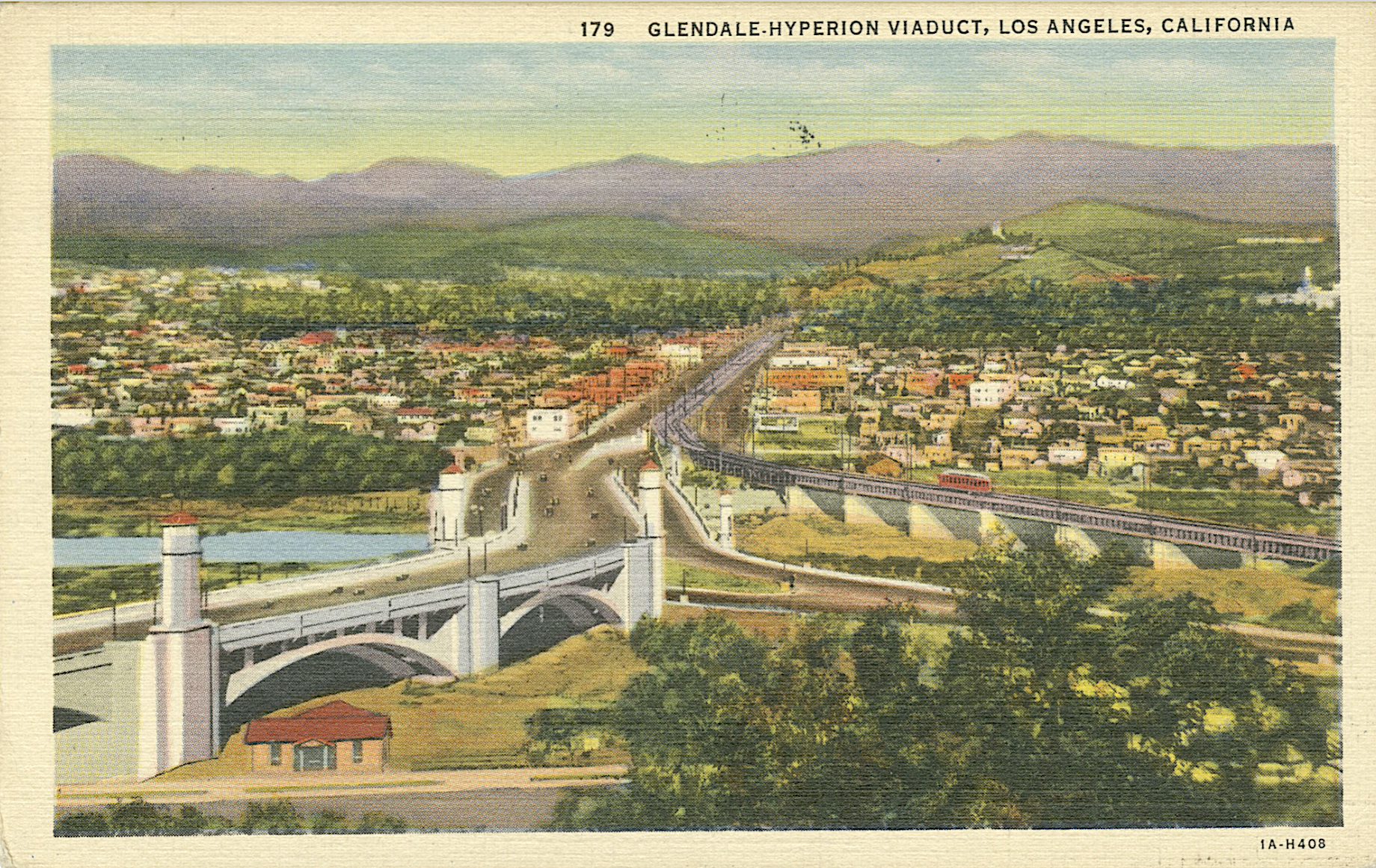
The iconic Victory Memorial Bridge (Glendale-Hyperion Viaduct), connecting Los Feliz and Silver Lake on the Los Angeles River’s west bank with Atwater on the east, has for years been beset by long-standing structural and maintenance challenges. For years, too, its muddled traffic configuration has made it as much of a barrier between neighborhoods as a connection. After years of delays, all that is finally set to change.
This month’s “Ask Silver Lake,” is a look at that bridge — both its history and what’s in store. We’ll also direct our attention to the community’s other bridges — present and past. Ask Silver Lake” is dedicated to exploring the history and insights of our community. If you have questions or ideas you’d like us to consider, please drop a comment or send them to outreach@silverlakenc.org.
The $208 million bridge renovation, spearheaded by the Los Angeles Bureau of Engineering, aims to make transiting this century-old structure both safer and more equitable by retrofitting it to withstand earthquakes and by providing better connections for pedestrians, cyclists, Metro users, and motorists. The contractor, Alameda-based Stacy Witbeck. was selected for the project in late 2025. Work on the project began in February 2026.
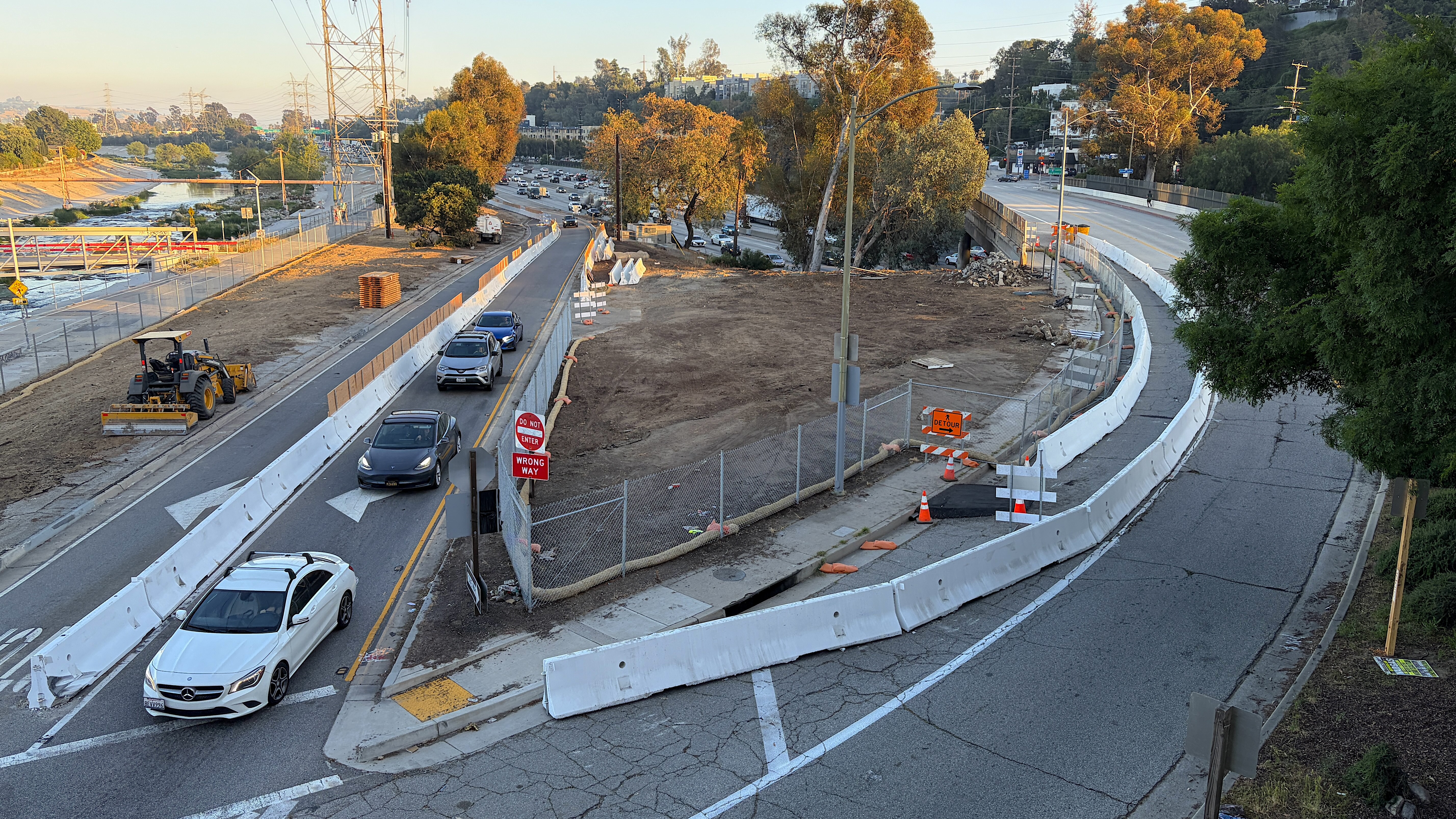
A key logistical fix of the project involves realigning the I-5 Freeway northbound off-ramp so that cars will be able to turn directly southwest toward Silver Lake, thus eliminating the snaking “U-turn” many motorists currently make in Atwater at Glenhurst Avenue. Renovations will also include reparations and restorations of historic aesthetic features – as well as the creation of environmental upgrades, namely the addition of bicycle lanes and a bioremediation basin designed to filter water entering the river.
The first bridge here was a wooden one built in 1904 for streetcars by L.C. Brand & Associates for Brand’s Los Angeles & Glendale Railway (LA&G). The LA&G’s green streetcars first crossed the bridge on 6 April of that year, connecting the downtowns of Glendale and Los Angeles via the historic communities of Tropico, Ivanhoe, and Edendale. Around 1910, a wooden bridge was constructed next to the train bridge, primarily for the use of pedestrians, cyclists, horse-drawn carts, buggies, and carriages.
The Los Angeles County Flood Control District was created in 1915. The then-new agency recommended to Angelenos that they replace these wooden structures with bridges made of sturdier stuff. Angeleno voters, however, roundly rejected their recommendation. In 1927, a flood completely obliterated both bridges and community members reconsidered and thus, plans were made for the construction of steel and concrete viaduct.
The new bridge, like all bridges of the era, was designed by Engineer of Bridges and Structures, Merrill Butler. In the Victory Memorial’s case, it was designed in collaboration with City Engineer, John Charles Shaw. Butler was inspired by the City Beautiful movement, a philosophy that had arisen in the 1890s and whose adherents believed that beautiful environmental design could positively impact social behavior of city dwellers. Butler was born in Gouverneur, New York in 1891. When still a youth, he moved to Southern California where he graduated from Los Angeles Polytechnic High School before embarking upon a career in civil engineering. In 1924, Butler was appointed as the Bridge and Viaduct Engineer for the City of Los Angeles. Amongst his most celebrated bridges were the Ninth Street Viaduct (1925), Seventh Street Viaduct (1927), First Street Bridge (1929), Fourth Street Viaduct (1931), and the now-demolished Sixth Street Viaduct (1932). Butler retired in 1961. He died in 1963.
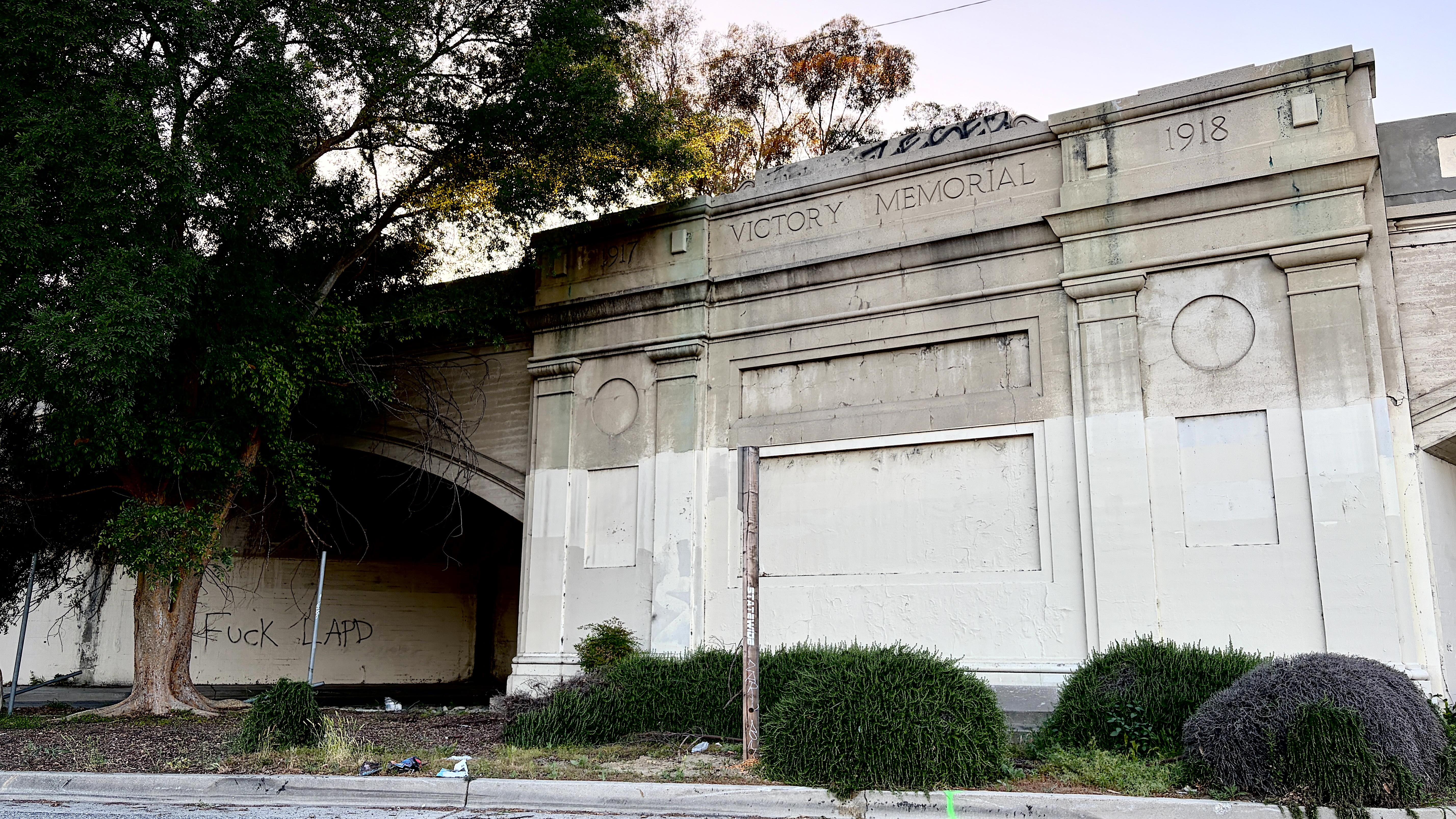
Each of Butler’s bridges spanning the Los Angeles River was designed with unique aesthetic touches. The Glendale-Hyperion complex has a closed-spandrel concrete deck design with thirteen sweeping arches as well as large hexagonal posts. Construction of the Victory Memorial Bridge, by the North Pacific Construction Company, began on 27 March 1927, utilizing 27,000 cubic meters of concrete and 2,700 metric tons of steel at a cost of $2 million (roughly $37.5 million in 2026). The bridge was supposed to open on Memorial Day 1928, which is why it was named Victory Memorial Bridge. When that year’s Memorial Day came and went with construction still incomplete, the Glendale Historical Society suggested re-naming it after Catalan explorer Joan Crespí. The Glendalians were rebuffed, however, and after construction was completed in February 1929, the bridge was dedicated as “Victory Memorial Bridge” on Memorial Day of 1930.
A major flood struck on 1 January 1934. Woody Guthrie memorialized the tragedy with a song, “Los Angeles New Year’s Flood.” The new bridge was undamaged – but the deadly floods destroyed roughly 400 homes and 100 human lives. As a result the US Army Corps of Engineers channelized most of the Los Angeles River (as well as nearly every other waterway in the region), encasing them in concrete.
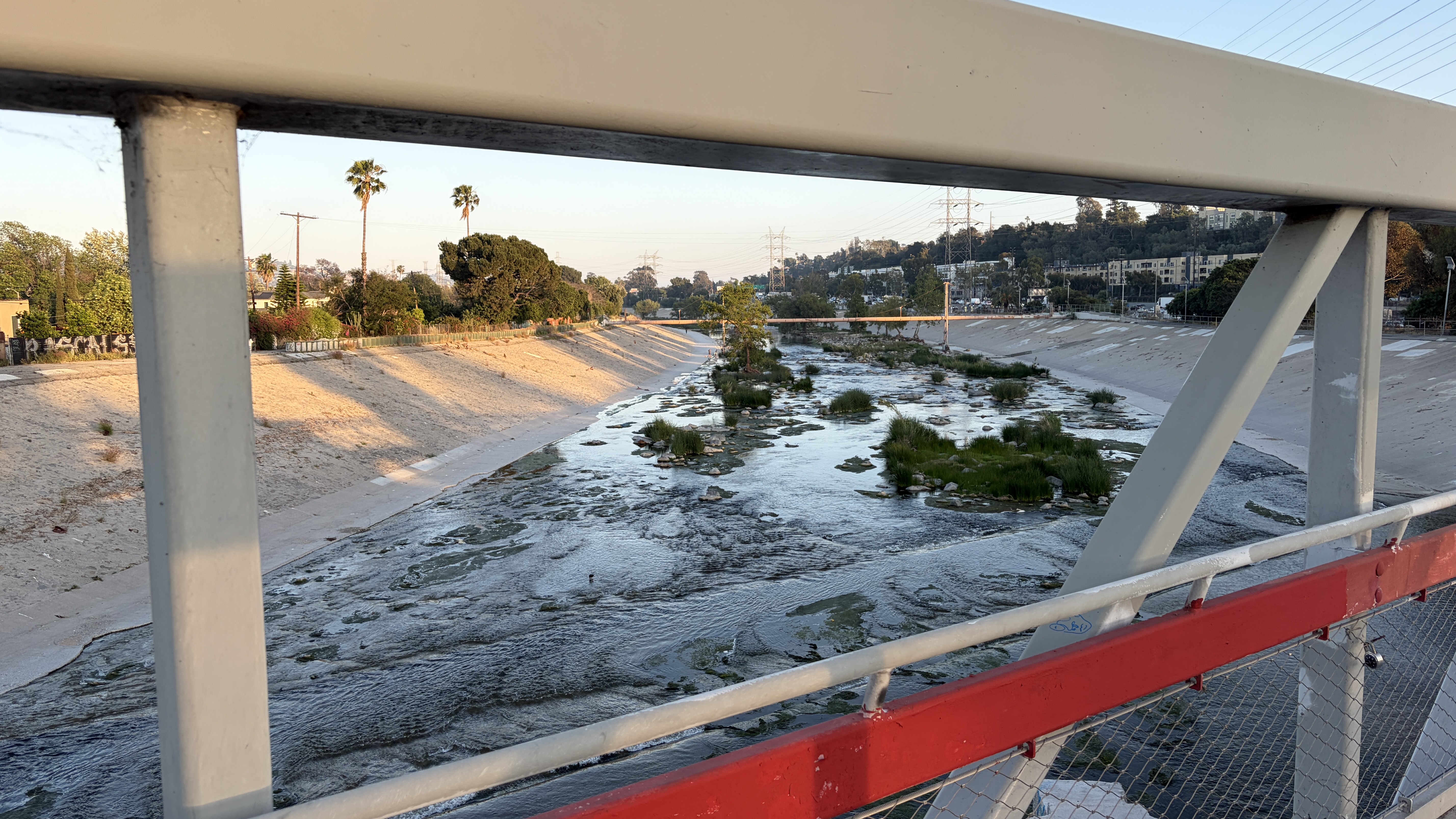
The section of the Los Angeles River here, the “Glendale Narrows,” resisted complete channelization. High water levels and subterranean springs made paving the bottom of the channel impossible. As a result, this “soft-bottomed” section teems with life. Whereas most of the channelized river is characterized, for most of the year, by a narrow, algae-coated concrete channel; the wide Glendale Narrows teem with alders, American coots, arroyo willows, black-crowned night herons, California sycamores, damselflies, double-crested cormorants, floating primrose-willows, great egrets, green sunfish, killdeer, king snakes, mallards, raccoons, red swamp crayfish, red-winged blackbirds, snowy egrets, western fence lizards, and all sorts of other flora, fauna, and fungi.
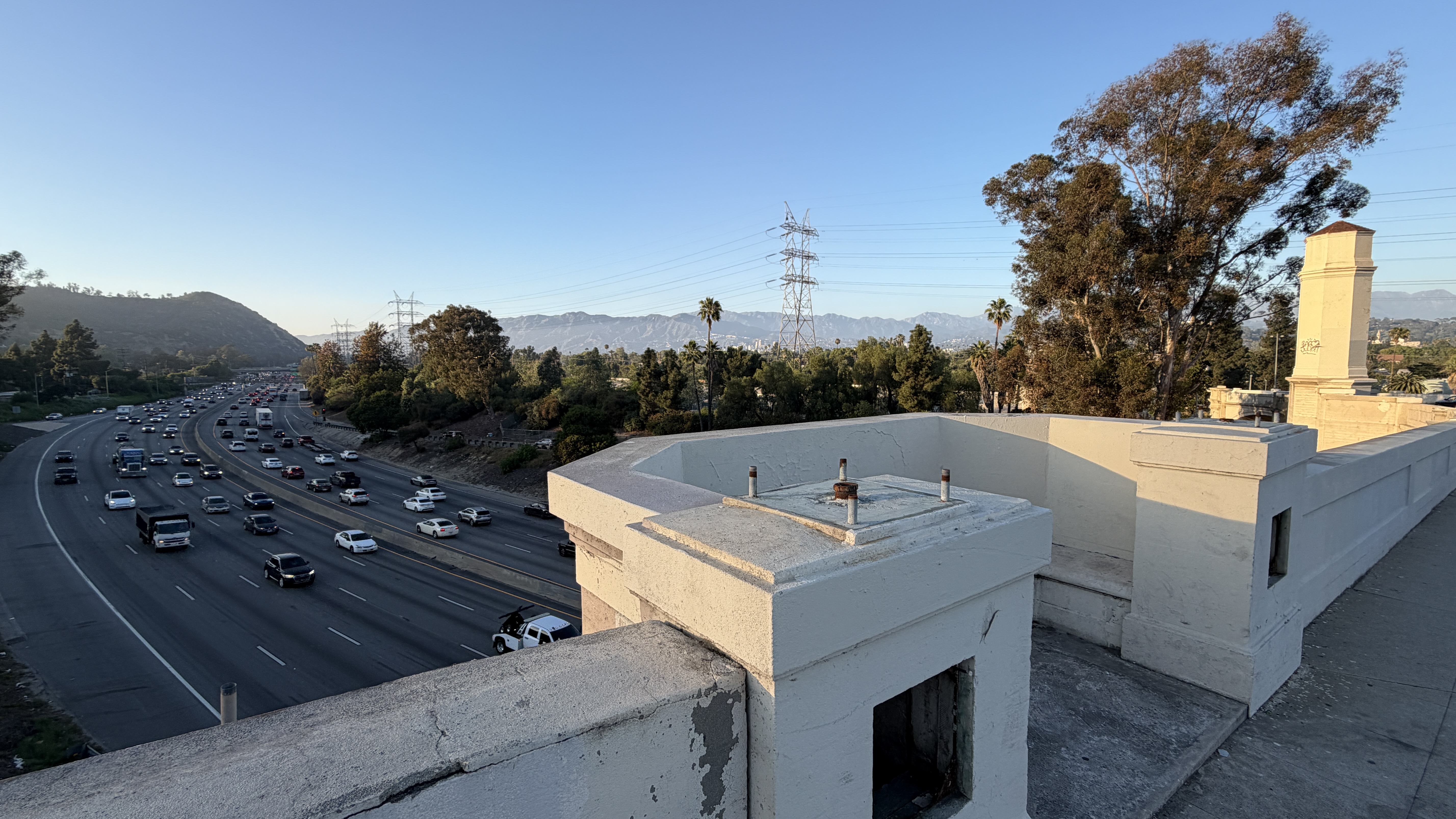
The edenic Narrows, which succesfully resisted channelization, proved to be no match for the Master Plan of Metropolitan Los Angeles Freeways, adopted by the city in 1947. The Golden State Freeway would carve through the neighborhood, cutting off Silver Lake and Griffith Park from the river. The disastrous floods of the 1930s had made some 3,700 Angelenos into refugees. Construction of interstate freeways through Los Angeles, though, would ultimately displace close to 250,000. After this section was completed, in 1962, users of the bridge’s “refuge bays” would be treated not to an aerial vista of a green, riparian glen but to the soothing sights, sounds, and smells of freeway traffic.
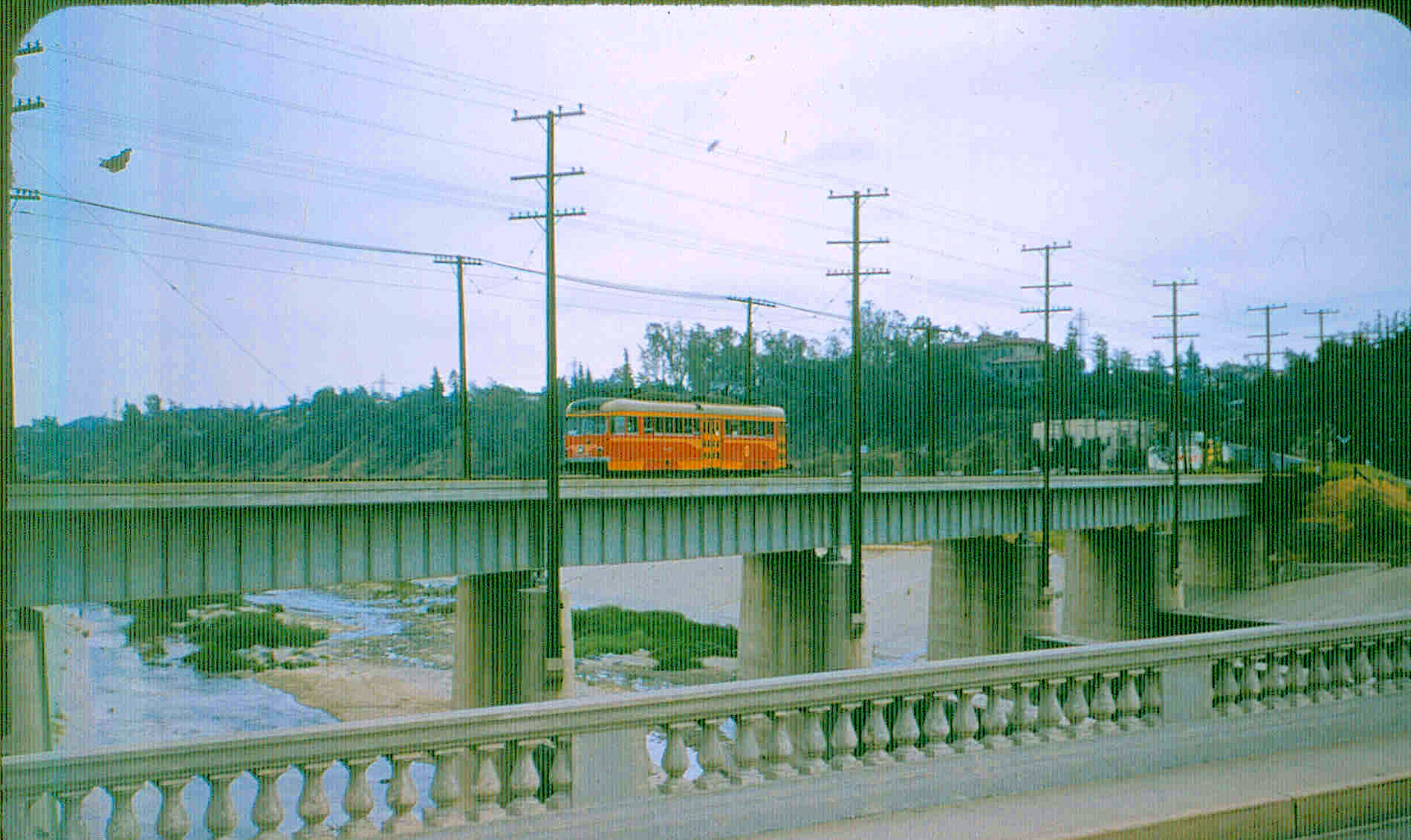
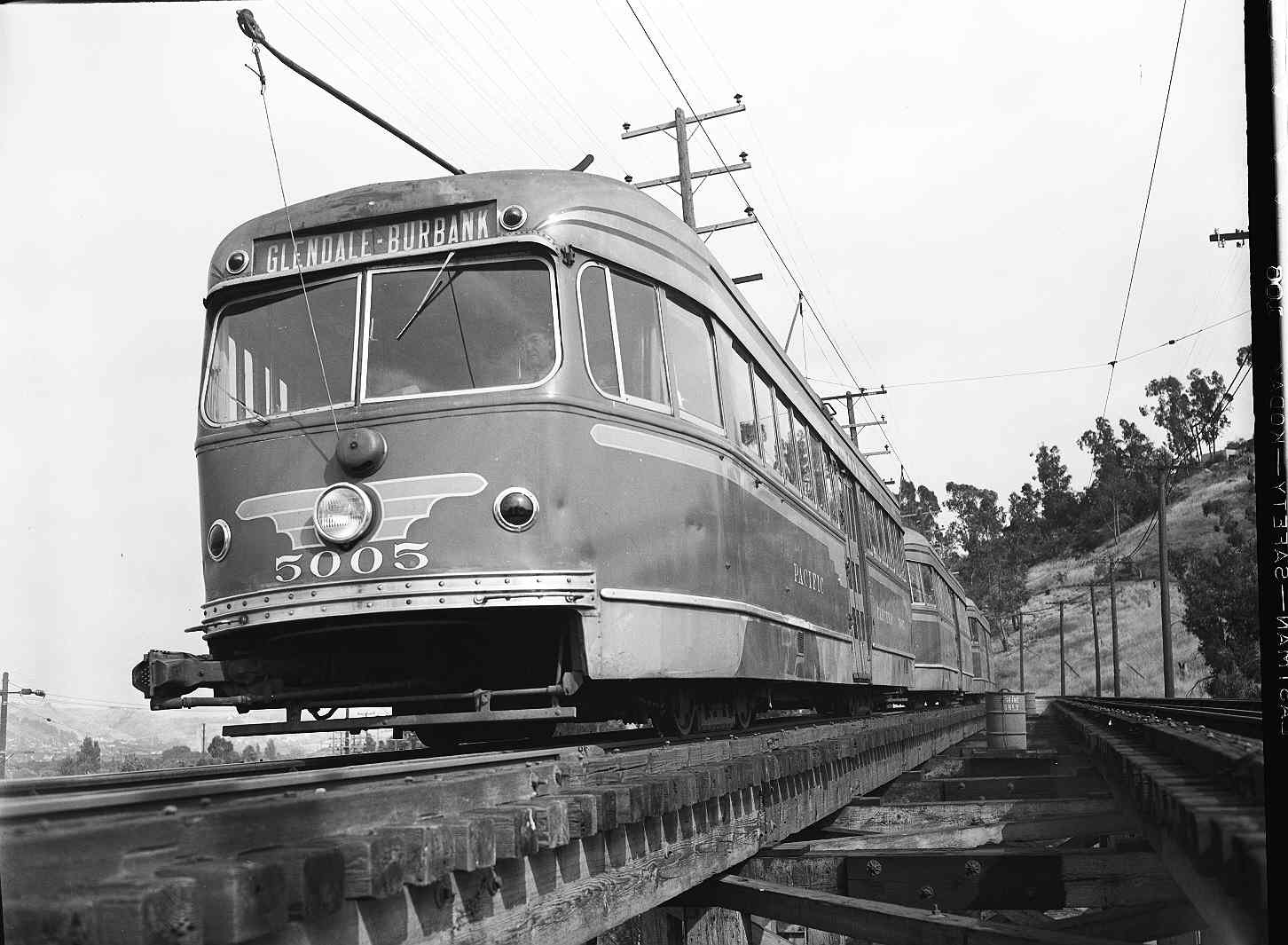
The train bridge, next to the Victory Memorial Bridge, was abandoned on 19 June 1955. At that time, the operator of the trains, Metropolitan Coach Lines, replaced the trains with buses, launching the still-extant 92 Route the day the last train of the Glendale-Burbank Line crossed the river. The 92’s route included the Victory Memorial Bridge and in order to accommodate the increased motor vehicle traffic, the sidewalks were narrowed in spots. The bridge was designated Los Angeles Historic-Cultural Monument (LAHCM) No. 164 on 20 October 1976. In 2012, a small-scale replica of the Victory Memorial Bridge opened at Disney California Adventure, the Orange County theme park that opened in 2001. There, it replaced a replica of another iconic bridge – San Francisco’s Golden Gate.
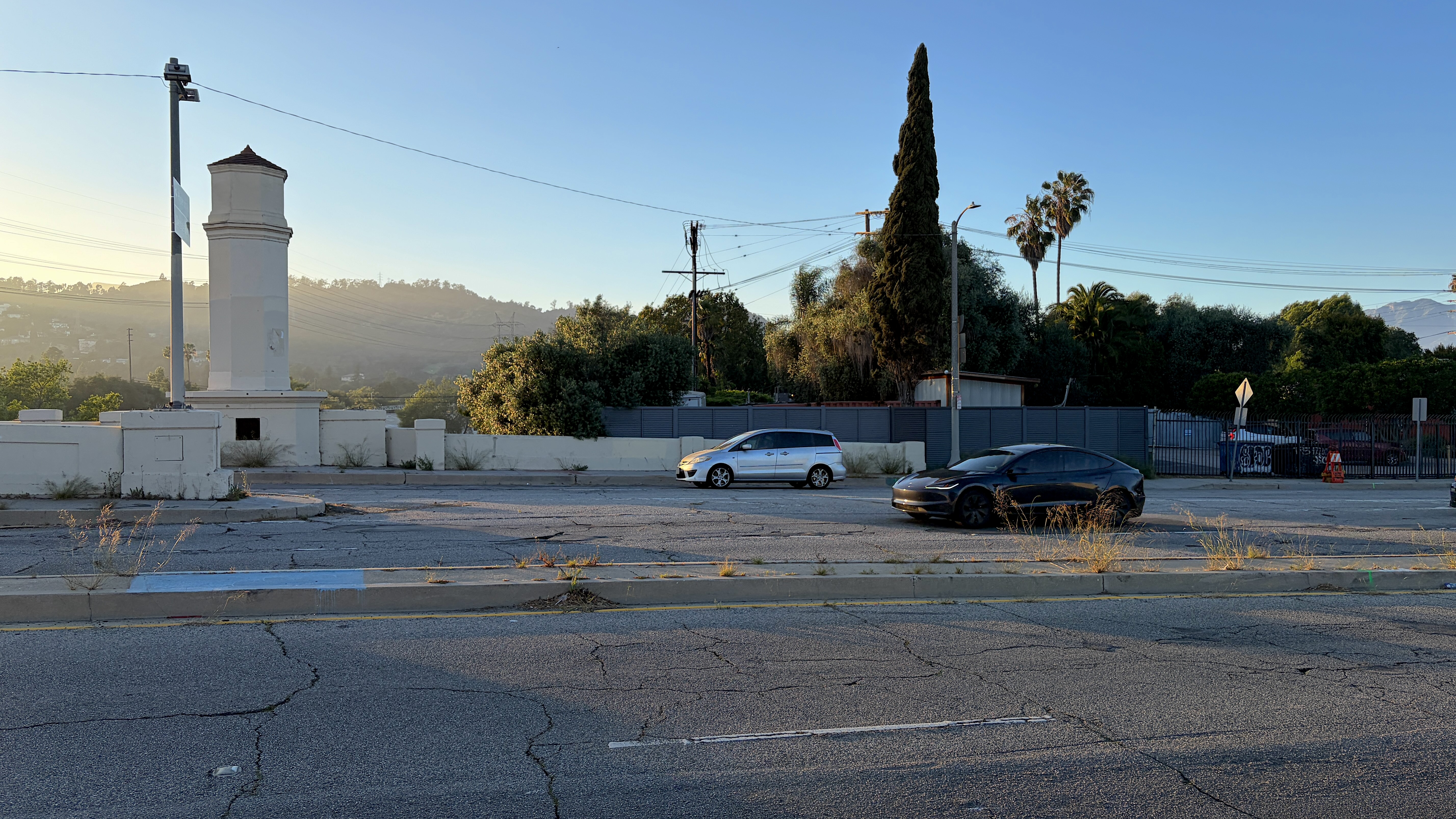
The seeds of the bridge’s renovation began in 1994, when increased federal funding became available for seismic retrofits. Formal proposals emerged in 2009 and were followed by years of disagreements. Outgoing CD 4 Councilmember Tom LaBonge and Councilmember CD 13 Mitch O’Farrell both advocated for Option 1, a design that preserved four lanes for cars and created two bicycle lanes – but which confined pedestrians to a single sidewalk. Pedestrian advocates, like Los Angeles Walks, pushed for Option 3, which called for two sidewalks and bicycle lanes – but which reduced general traffic lanes from four to three. To pedestrian advocates, O’Farrell pointed to the Red Car Multi-Use Bridge, describing it as the “first-ever uninterrupted walking route” between Atwater and Silver Lake – although, to this day, actually accessing it from anywhere within Silver Lake (other than the bike trail) requires scurrying across an off-ramp and crawling through a hole in the chainlink fence (provided one can find one). Incoming CD4 Councilmember-elect David Ryu (2015-2020), supported Option 3 – but wouldn’t take office until 1 July. With three weeks left in their term, City Council hurriedly and unanimously voted for Option 1. The issue, it would seem, was settled – but changes would soon come to the bridge that the community was united against.
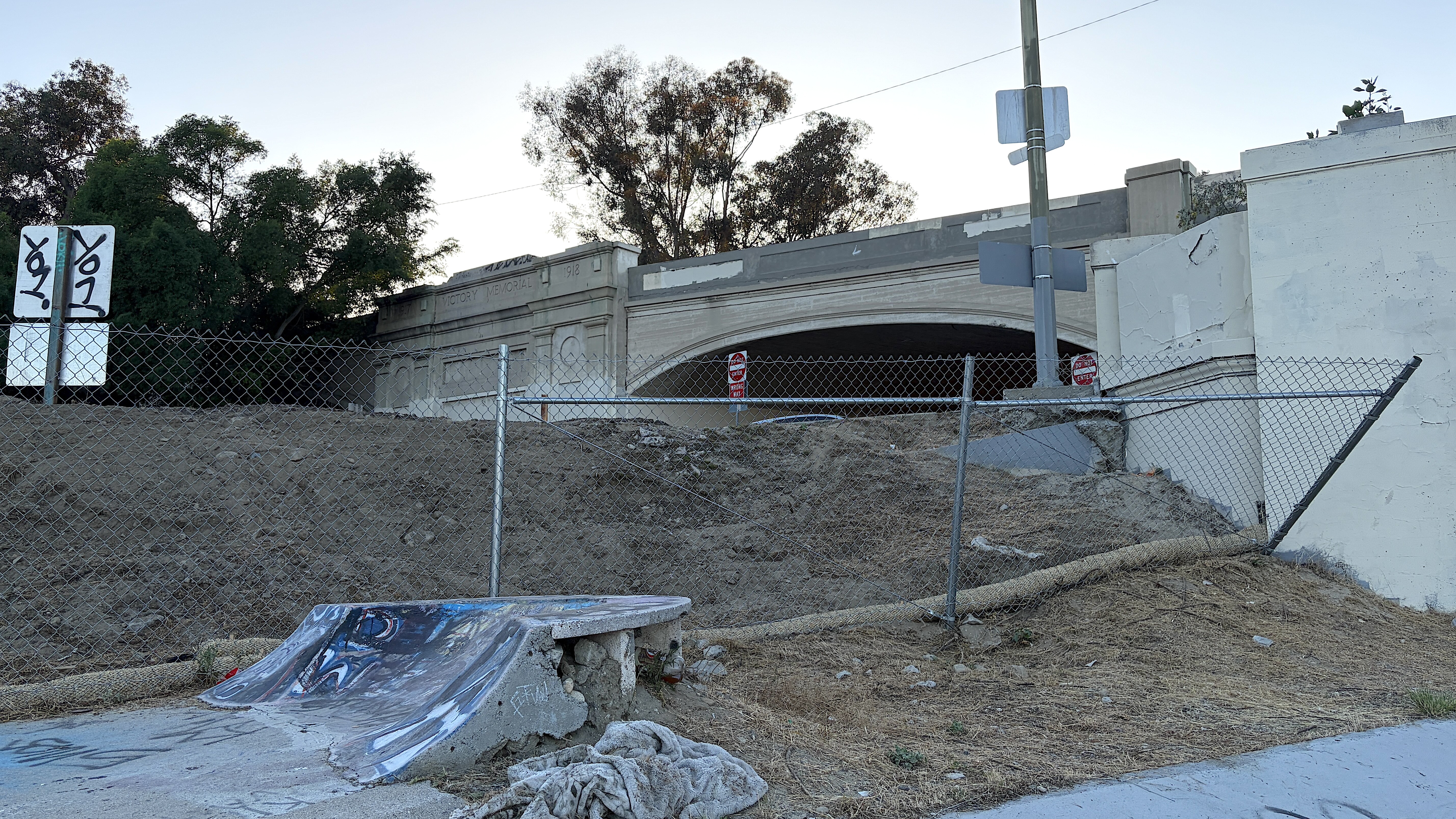
Back in 2013, brazen thieves stole a nearly four-meter-tall bronze lamppost. Eight years passed without incident — or arrest. Then, beginning in September 2021, 22 of the lampposts were stolen over the course of just three and a half months. In the first week of 2022, the remaining eighteen were placed into storage for safekeeping. In January 2024, Los Angeles Police Department formed the Heavy Metal Task Force to meaningfully address the growing number of copper and bronze thieves. Additionally, Assembly Bill 476 was introduced and passed making possession of recognizable infrastructure without documentation illegal. None of the lampposts were recovered, though, and the Heavy Metal Task Force was quietly disbanded in July 2025. When work on the bridge is complete, however, there will be replica bronze lampposts, protected by “fortified infrastructure” and security sensors. And — although they will resemble the historic lampposts — their lights will utilize more environmentally-friendly LED technology.
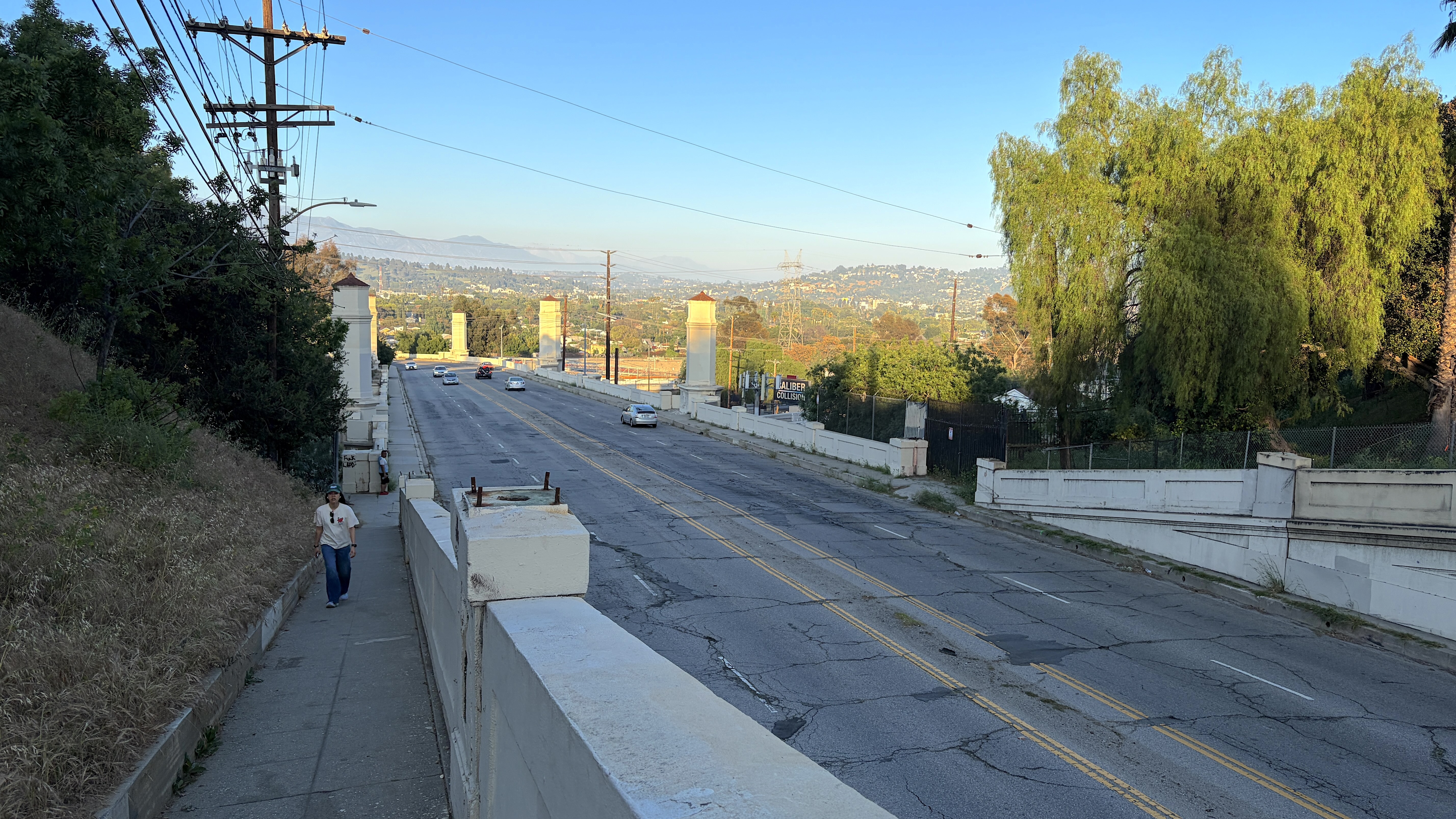
OTHER BRIDGES OF THE GLENDALE-HYPERION COMPLEX
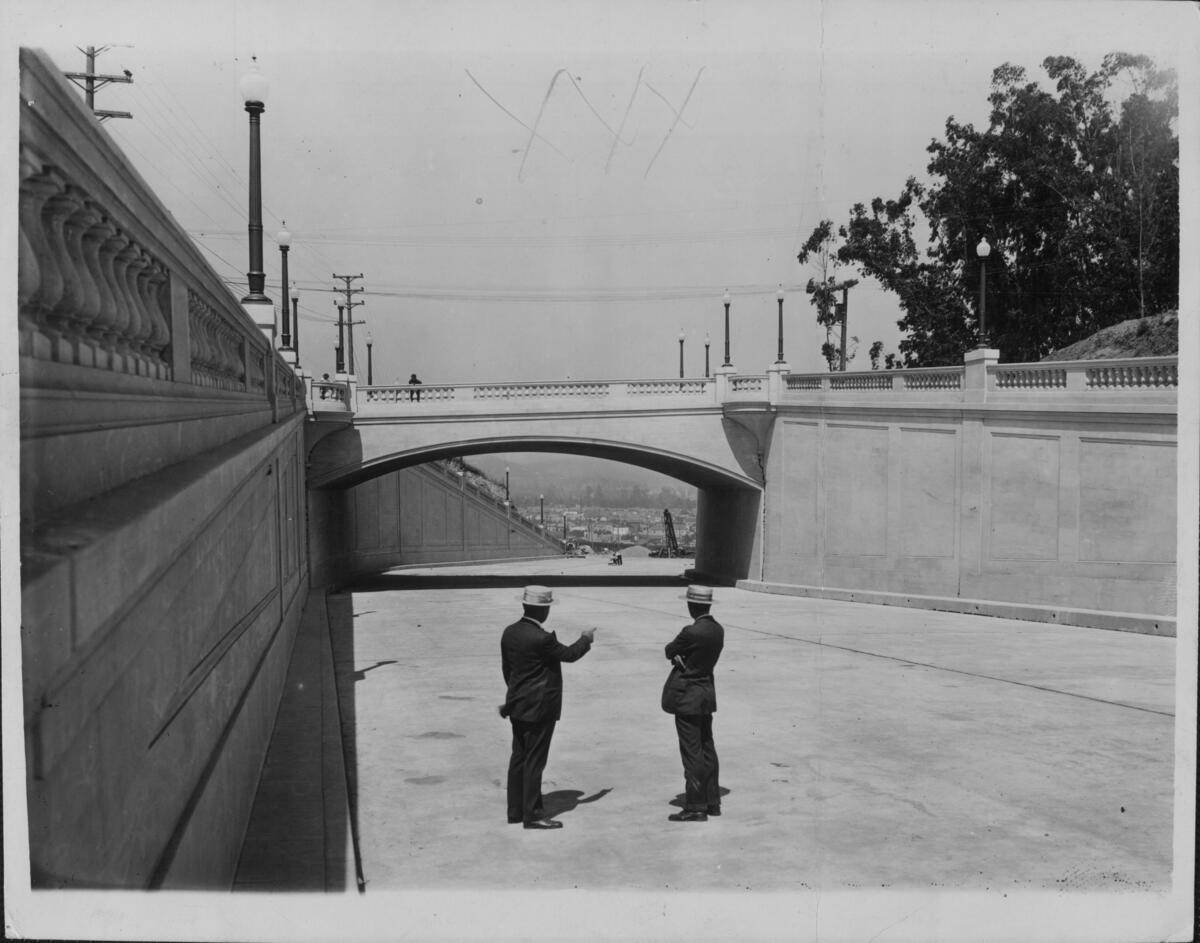
During its renovation, scheduled to take five to six years, the bridge will never be fully closed and, with all eyes on the bridge for the forseeable future, I thought it might be nice to turn our gaze to appreciate the community’s other bridges – starting with two bridges that are technically part of the Glendale-Hyperion complex. The Waverly Drive Overcrossing (Structure Number: 53C1179) is the name of the bridge that spans Hyperion Avenue and connects Silver Lake and Los Feliz. It was completed in 1928.
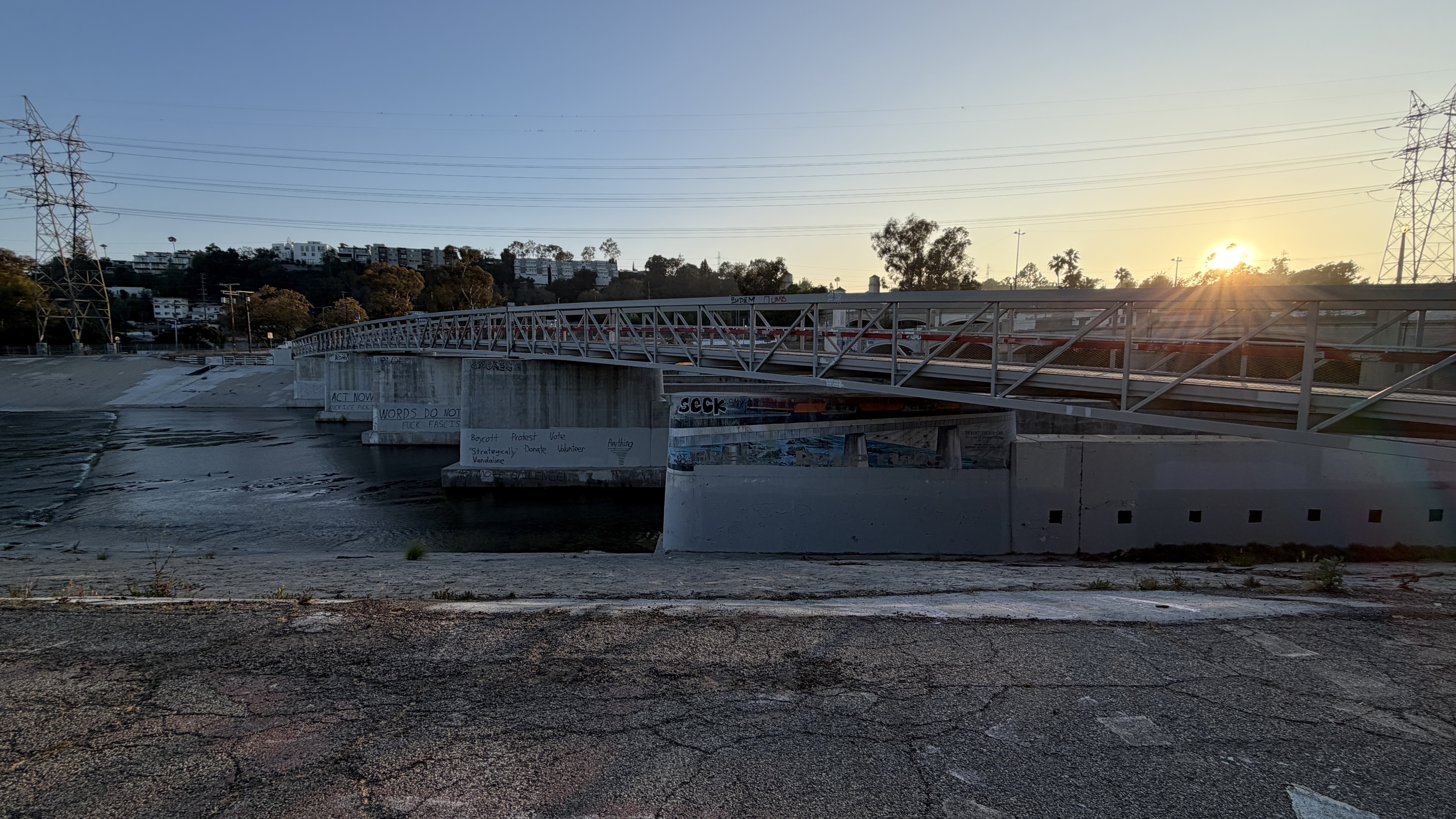
There’s also the aformentioned Red Car Bridge (Structure:53C1884), that incorporates the concrete industrial-functional pylons of the former train bridge, built in 1929, for PE’s red cars. On the Silver Lake side, Los Angeles River Bicycle Path opened here in 2000. In 2004, (with assistance from Roxanne Salazar and Tom Hinds), Rafael Escamilla painted a mural on one of the pylons titled Revisit the Red Car, only a fragment of which survives today. Red Car Park opened on the Atwater side the same year. The pedestrian/cyclist bridge opened atop the old pylons in 2020.
THE FLETCHER VIADUCT
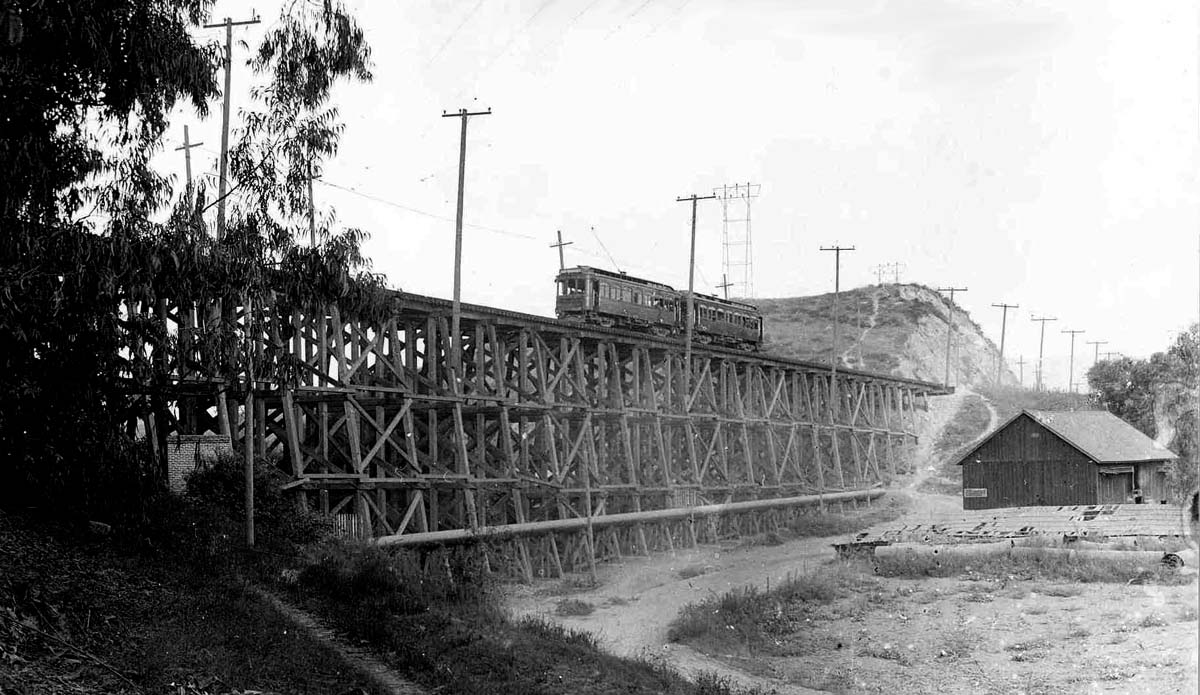
The Fletcher Viaduct, like the train trestle over the river, was built in 1904 for Leslie Brand’s railway. In 1906, the green cars were replaced with the red cars of Henry E. Huntington’s Pacific Electric Railway (PE), after his agency took over operations. The original wooden viaduct was replaced with a taller, steel structure in 1928. It continued to be used by trains of the Glendale-Burbank Line (as the line came to be known after it was extended to Burbank) until 19 June 1955. It was demolished by the Cleveland Wrecking Company on 1 August 1959, leaving just the trestle footings that came to be nicknamed “Silverlake’s Stonehenge” and which were designated (as the Pacific Electric Ethel Viaduct Footings) Historic-Cultural Monument No. 770 on 24 March 2004.
FLETCHER DRIVE BRIDGE
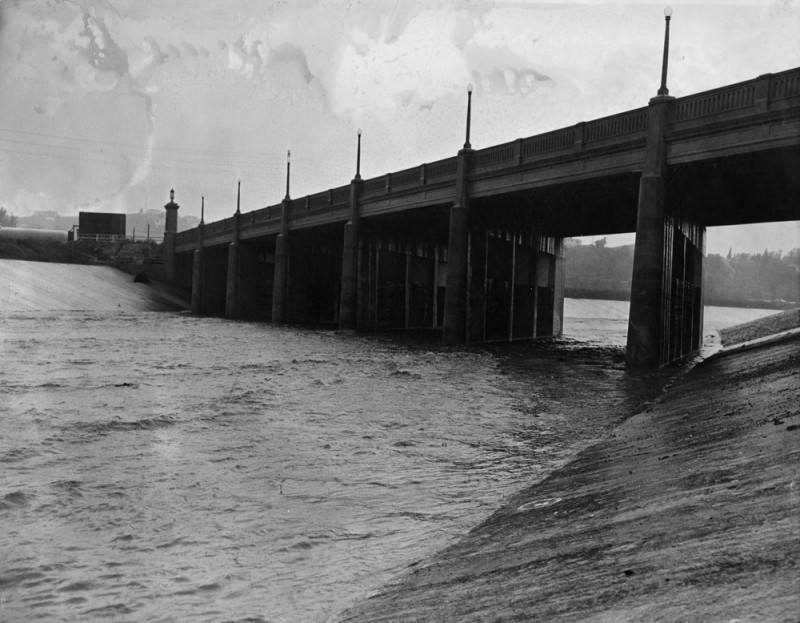
Construction of the Neo-Classical/Beaux Arts-style Fletcher Drive Bridge (Structure 53C0185) began in 1927. Built by the Lance-Cannon Engineering Company, construction was completed in 1928. It is made of reinforced concrete and features pylons designed to resemble articulated masonry, marbelite columns, and decorative brass lanterns. It connects Silver Lake and Elysian Valley (Frogtown), on the west bank, with Atwater on the east. It was designated HCM No. 322 in 1987.
SUNSET BOULEVARD OVERPASS AT MYRA
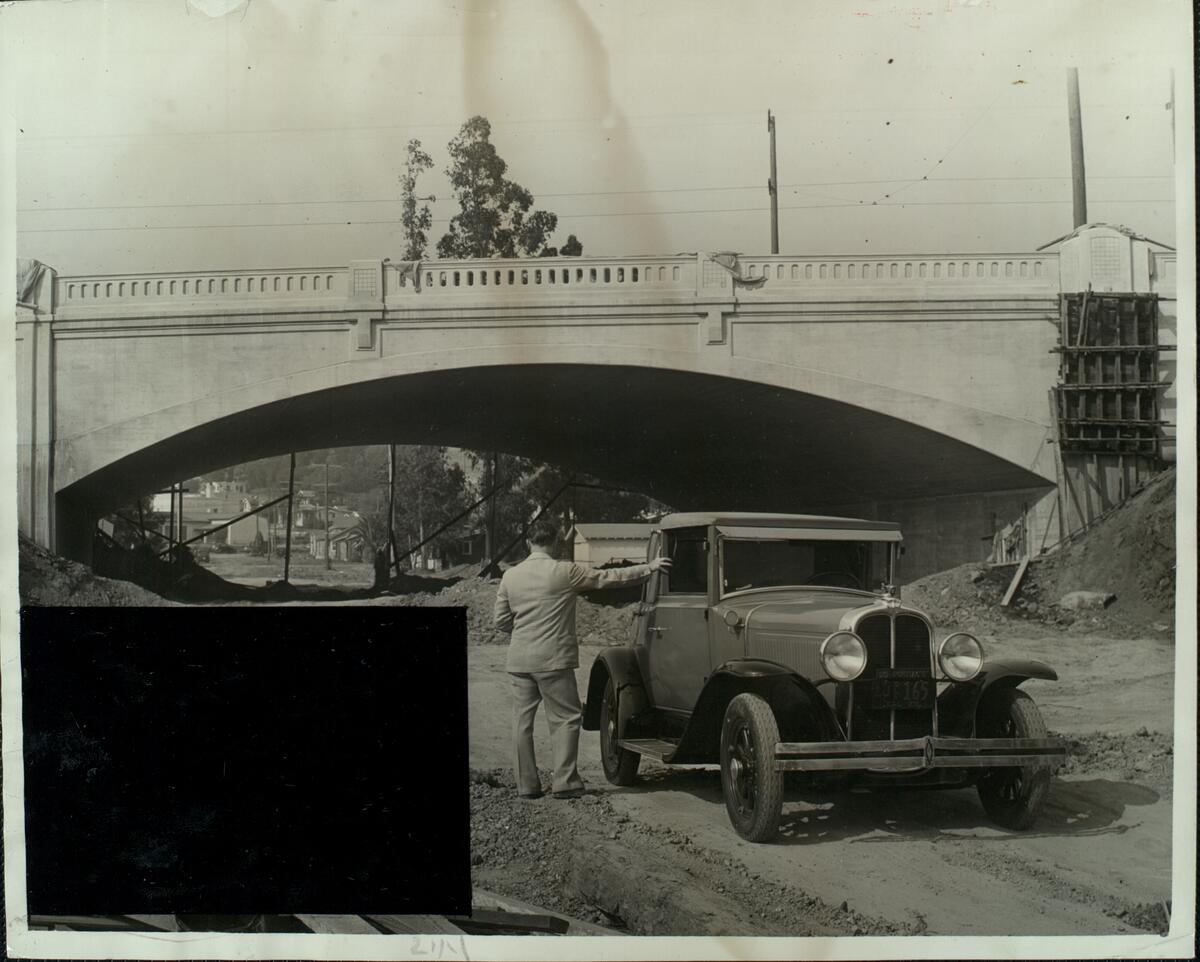
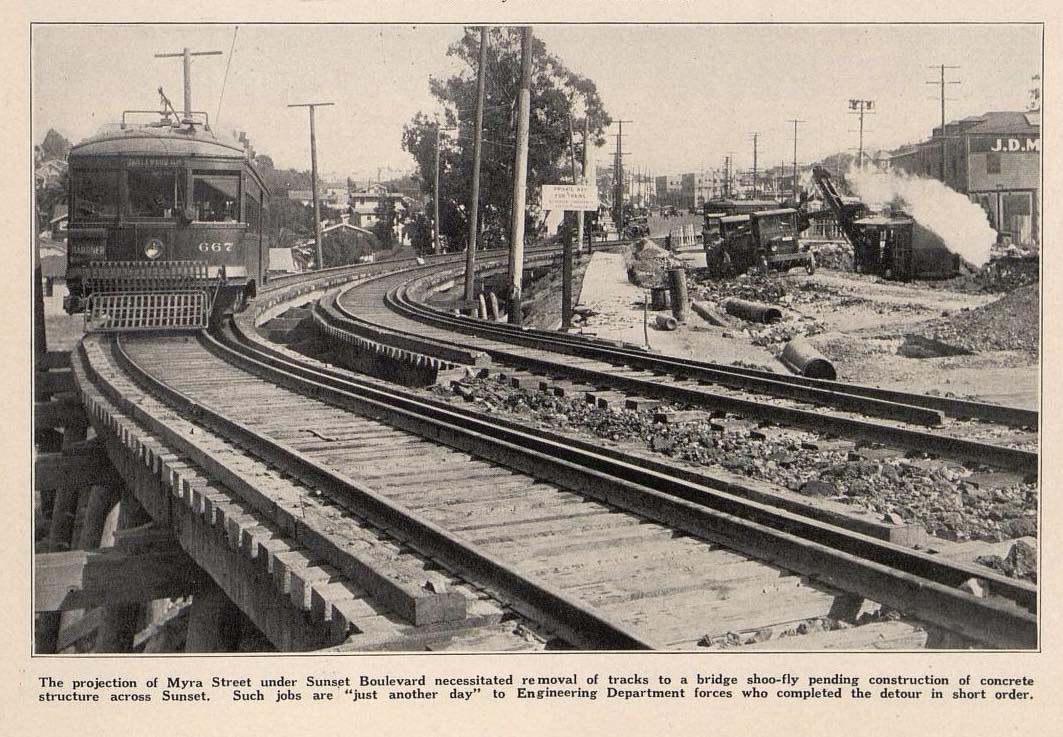
Construction of the Butler-designed Industrial Beaux-Arts/Neo-Classical-style Sunset Boulevard Overpass at Myra (Structure: 53C1425) began in 1928 and was completed in 1929. Before its construction, trains there traveled at-grade, down and up the ravine carved by the Arroyo de la Sacatela (the same stream over which the Shakespeare Bridge was built in 1926). In order to continue rail service, uninterrupted, a wooden “shoo-fly” detour was built around the path of the bridge as it was constructed. The arroyo, meanwhile, was channelized and buried as part of the Sacatela Storm Drain Project No. 3. Then, in 1929, Myra Avenue was extended along the route of the entombed stream.
For many years, Sacatela and Myra formed the recognized border between Silver Lake and East Hollywood. The Los Angeles Department of Transportation’s familiar blue neighborhood signs were posted atop the bridge, announcing Silver Lake and Hollywood. In 2008, Brandt Marshall, Guia Avesani, Louie Metz, and Rob Malone painted a mural titled Gateway on the bridge, below. The Silver Lake Neighborhood Council, however, annexed the section of East Hollywood bounded by Myra, Fountain Avenue, and Hoover Street in 2009. The neighborhood signs came down, the mural was buried beneath tags and cover-ups, and the semi-official border of the neighborhood was moved northwest from Myra Avenue to the corner of Hoover Street and Fountain Avenue — the northwest corner of the city from 1781 until 1909.
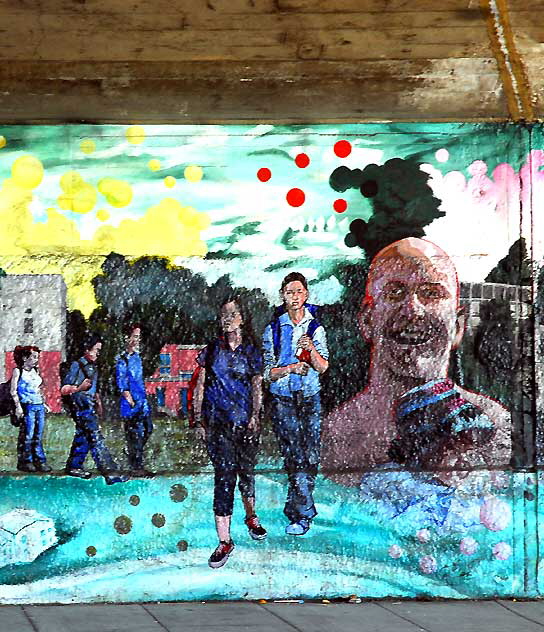
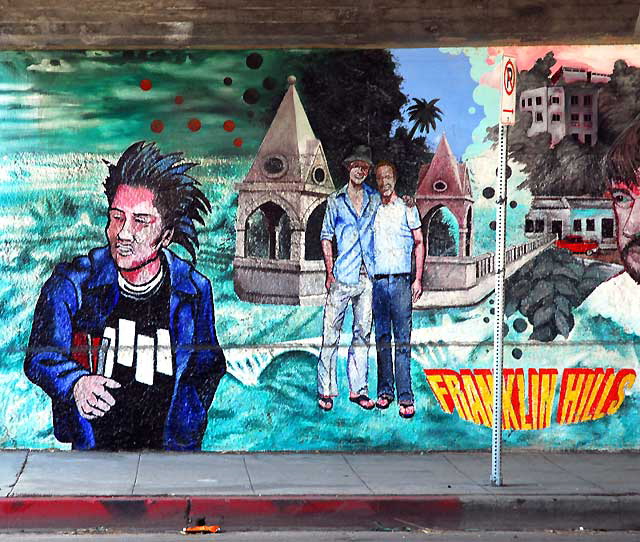
Details of Gateway, from the website, Just Above Sunset
SUNSET BOULEVARD BRIDGE AT SILVER LAKE BOULEVARD
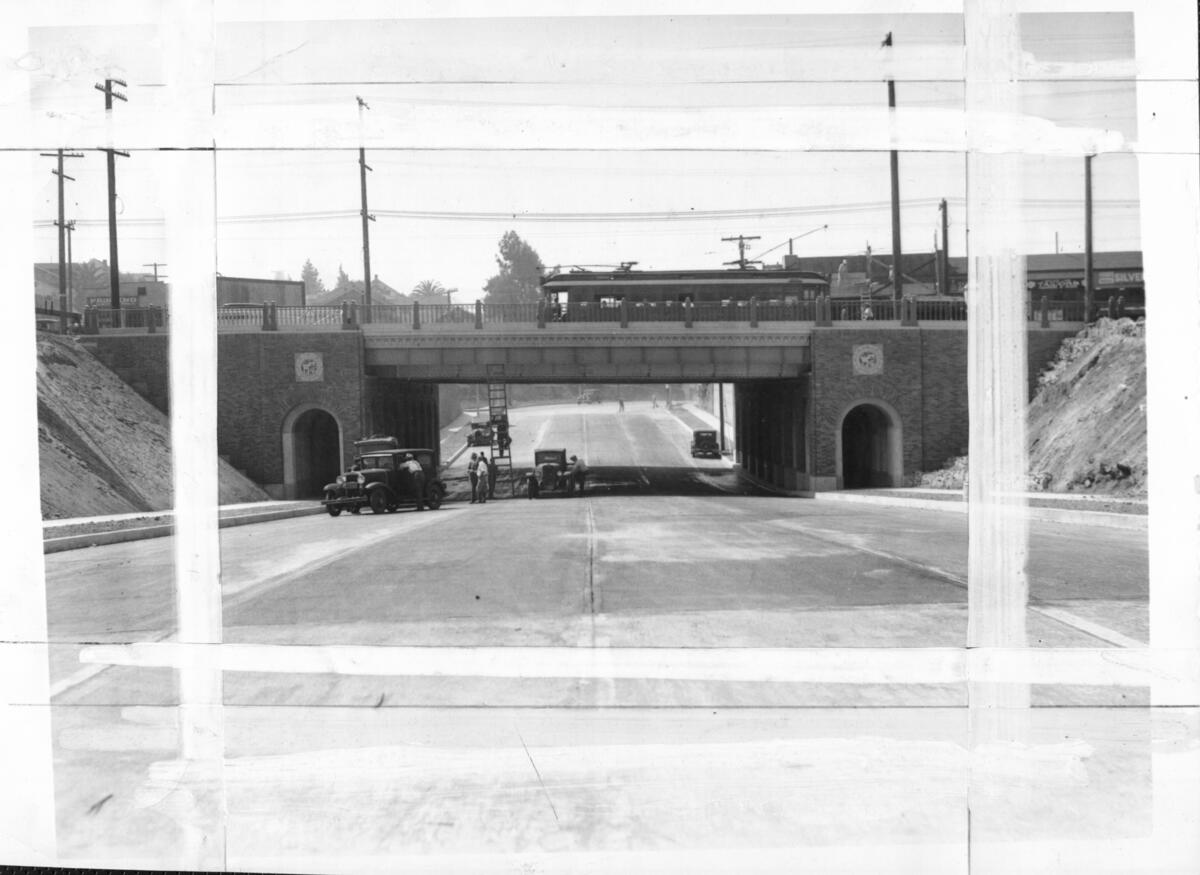
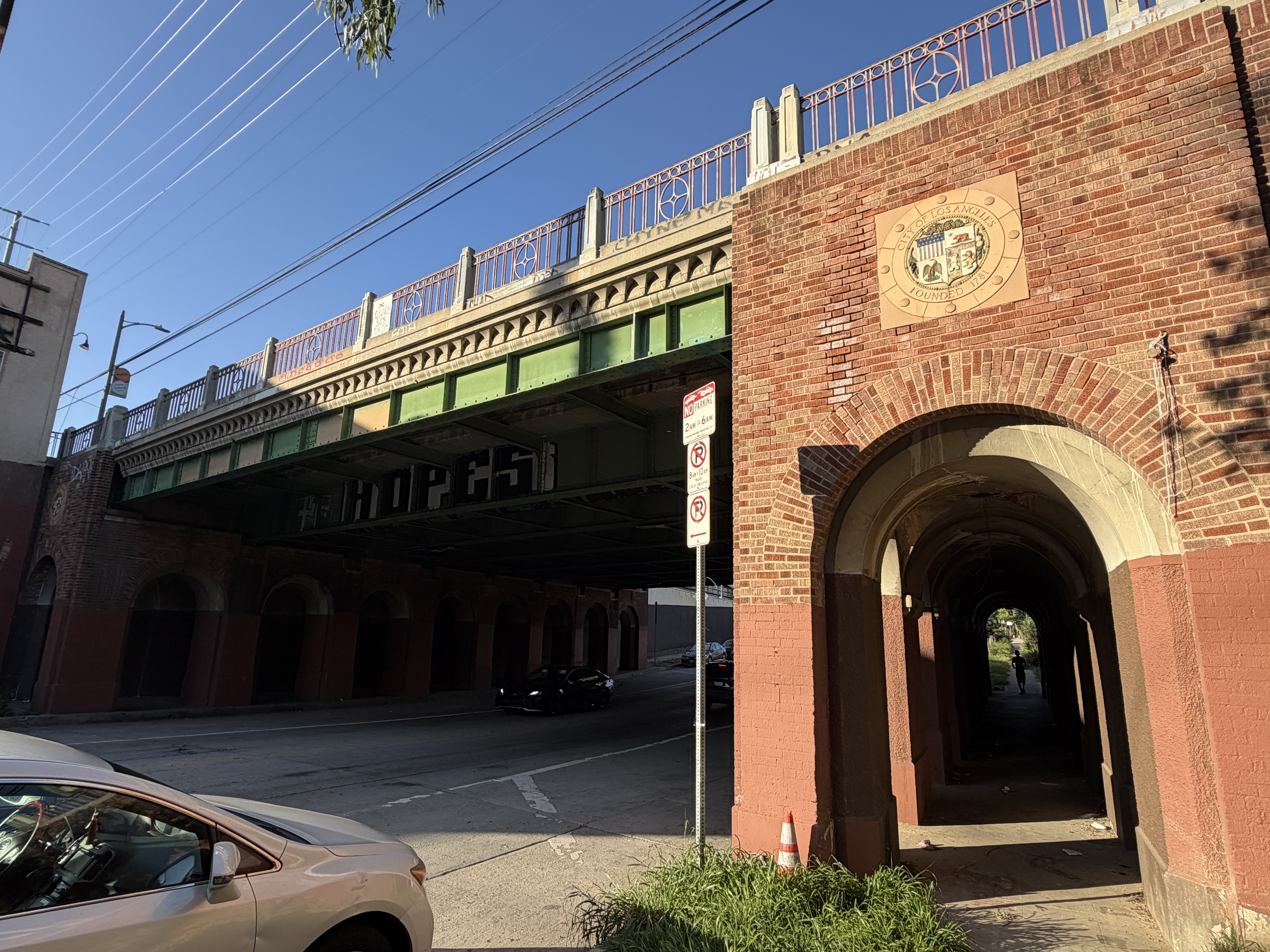
Sunset Boulevard Bridge At Silver Lake Boulevard (Structure: 53C0020) spans an unnamed stream that was channelized in 1934. After it was relocated to a storm train, Silver Lake Boulevard was extended atop it to Temple Street, then utilized by the Los Angeles Railway‘s A Line. Construction of the brick, Romanesque Revival-style bridge was begun under the tenure of City Engineer Shaw’s successor, Joseph John Jessup. By the time the bridge opened on 20 September 1934, Jessup had been succeeded by Lloyd Aldrich. Although still one of the most charming bridges in Silver Lake,, the arcaded pedestrian walkways were originally illuminated by ornamental lights. The bridge was designated LAHCM No. 236 on 5 November 1982.
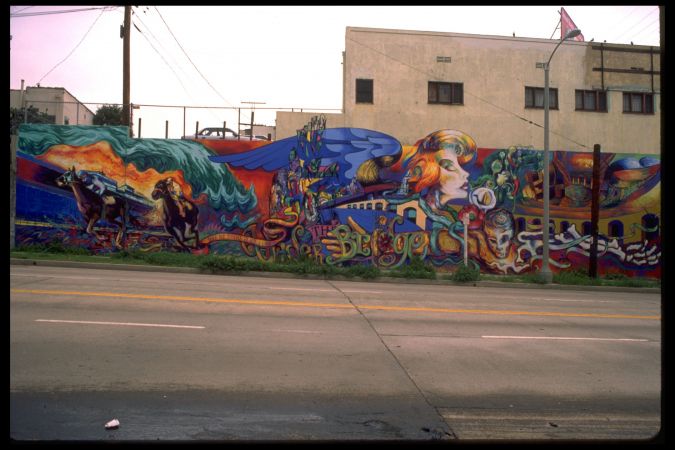
The nearby West Olive Substation was built in 1905 by the Los Angeles Pacific Railroad (LAP) to power streetcars along Sunset. The last streetcars ended service along Sunset in 1954 and the tracks were paved over. Since 1998, the old substation has been home to Epitaph Records. In 1994, Ernesto de la Loza painted a mural there, titled Under the Bridge. The artwork was sponsored by the Lucky Nun Gallery (owned by Johnette Napolitano of Concrete Blonde) and Red Hot Chili Peppers. The mural, however, was long ago buried beneath placas and city cover-ups.
THE FREEWAY BRIDGES
Silver Lake is largely hemmed in by freeways – the Golden State (5), the Glendale (2), and the Hollywood (101). All of them include numerous bridges in their design. That said, few without a taste for the bleak likely find charm in any of them. Suffice to say, Butler had no hand in their design and their engineers, if aware of the City Beautiful Movement, were unencumbered by its tenants. They are bridges, however, and so they are worthy of consideration here. Besides, despite or because of their single-minded commitment to function, maybe we can admire their Ballardian qualities.
THE 101 BRIDGES
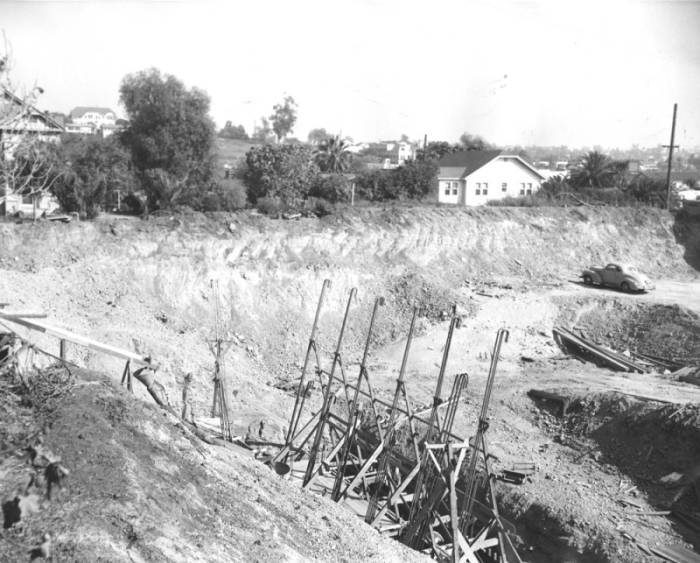
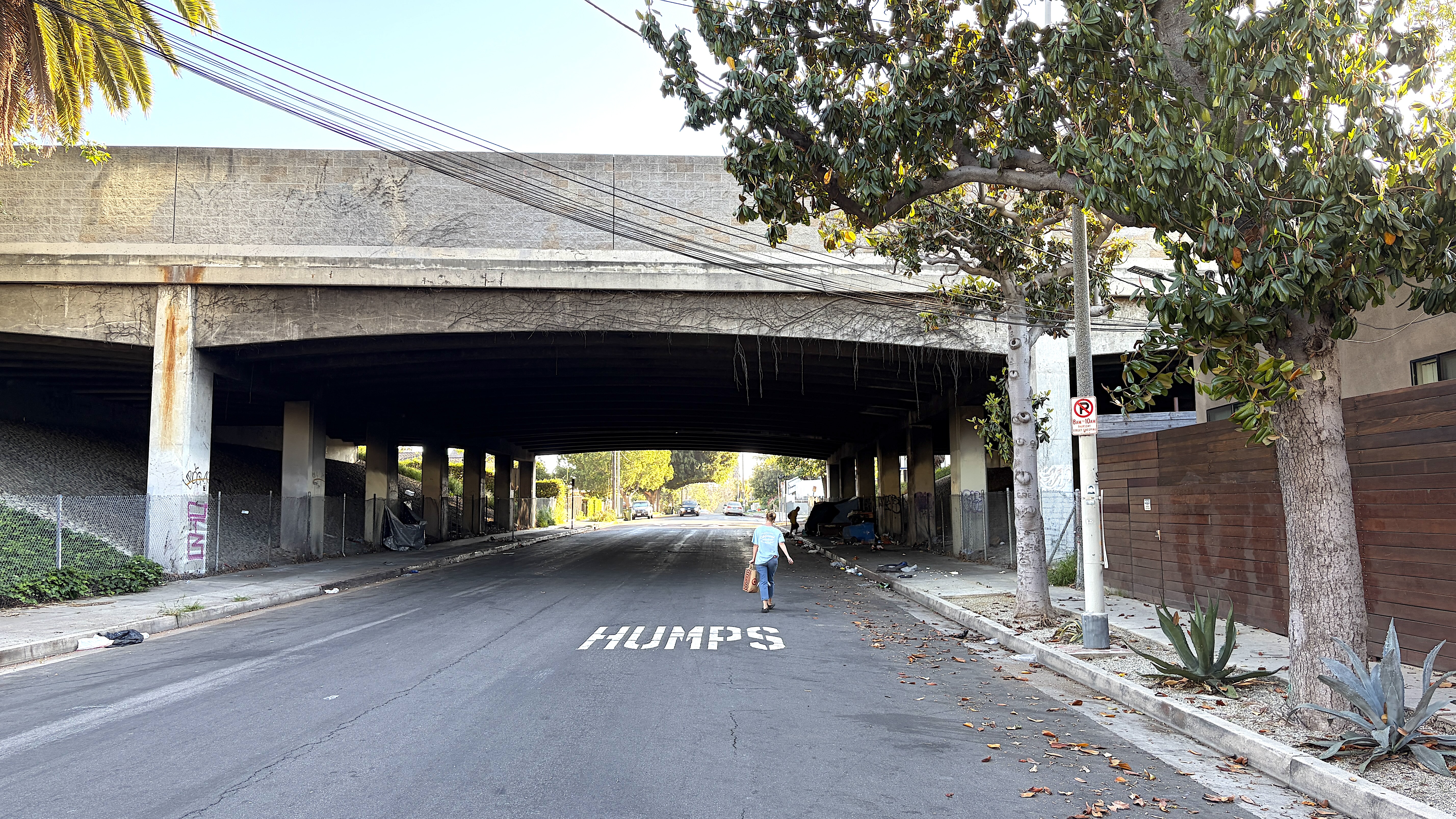
Within Silver Lake, there are six overcrosses along the 101, built when this section was known as the Hollywood Parkway. It was renamed the Hollywood Freeway in 1954. The overpass at Benton Way (53 0614) was built in 1947. The underpass at Silver Lake Boulevard (53 0613) was built in 1948. The underpasses at Hoover (53 0635), Vendome (53 0631), and Coronado streets (53 0632) were all built in 1950. All are concrete continuous box beam/girder structures. Arcade fencing and boulders embedded in concrete were installed at most (and at considerable cost) around 2019 to make life under them for anyone unfortunate enough to live there completely insufferable. Their hostile landscape, however, has not deterred the residents of an encampment of unhoused Angelenos who’ve lived at the Silver Lake Boulevard Overpass for roughly seven years.
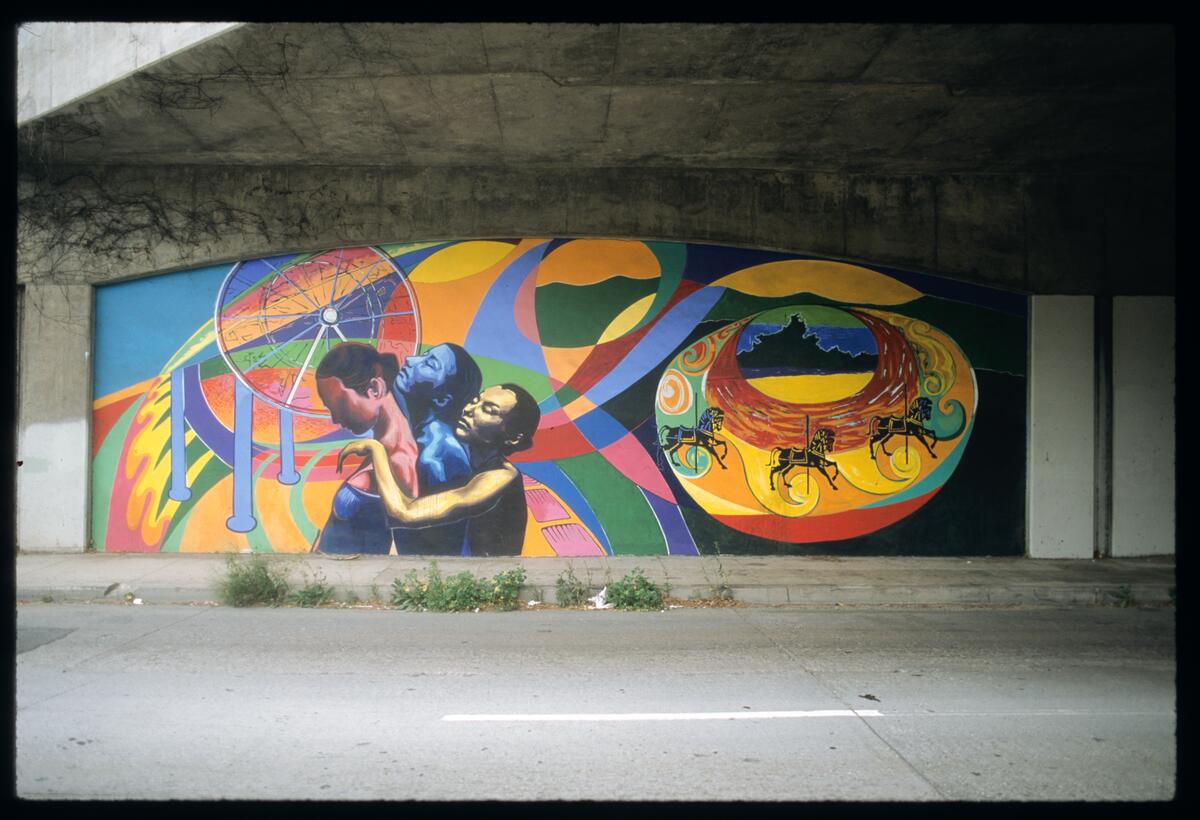
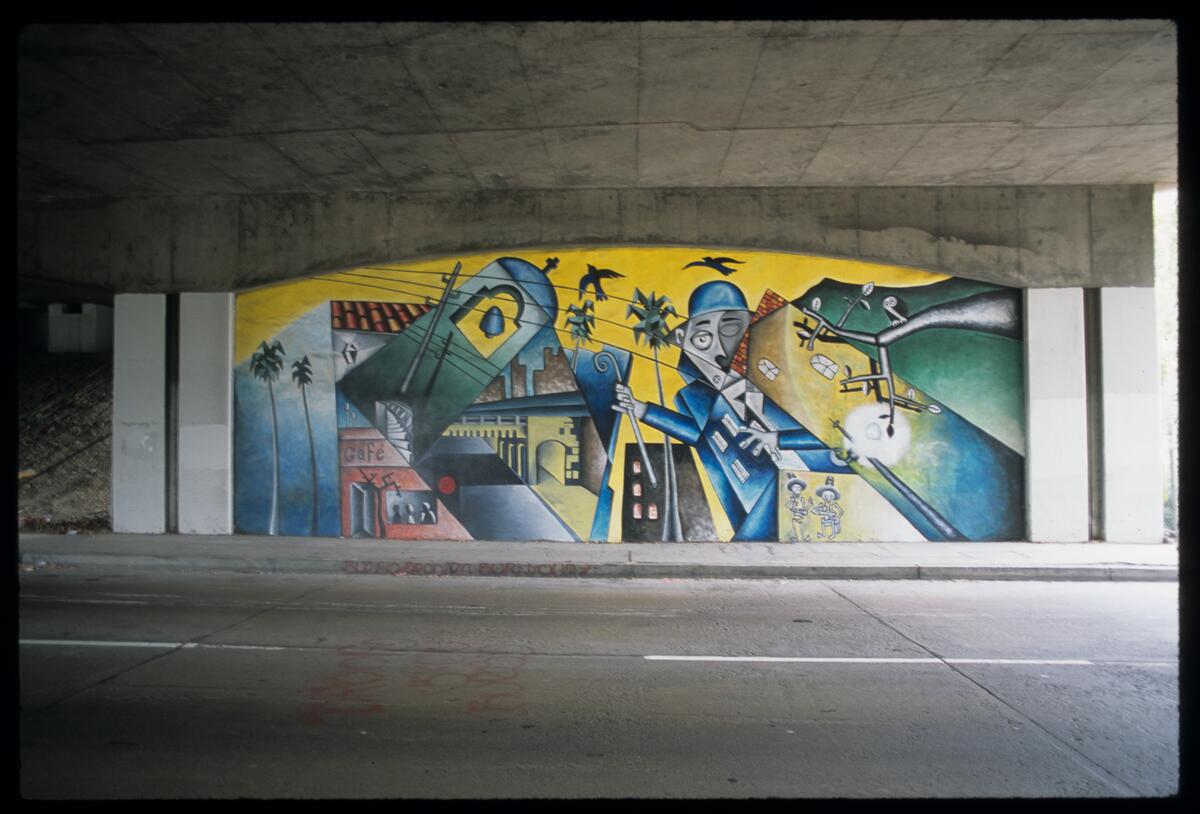
Murals under the 101/Sunset Overpass (Image: Robin J. Dunitz, University of Southern California. Libraries)
All were these bridges were built by the California Division of Highways (reorganized into the California Department of Transportation (Caltrans) in 1973). Those built in 1950 were subcontracted to N.M. Ball Sons. Of these freeway bridges, the underpass at Silver Lake Boulevard is the most notable. In 1997, the Silver Lake Improvement Association, Silver Lake Residents Association, and Silver Lake Chamber of Commerce partnered together to create Gateway to Silver Lake 2000 (GSL 2000). They landscaped the former asphalt median and areas next to the offramp with river rocks, jacarandas, foxtail agaves, and other plants.
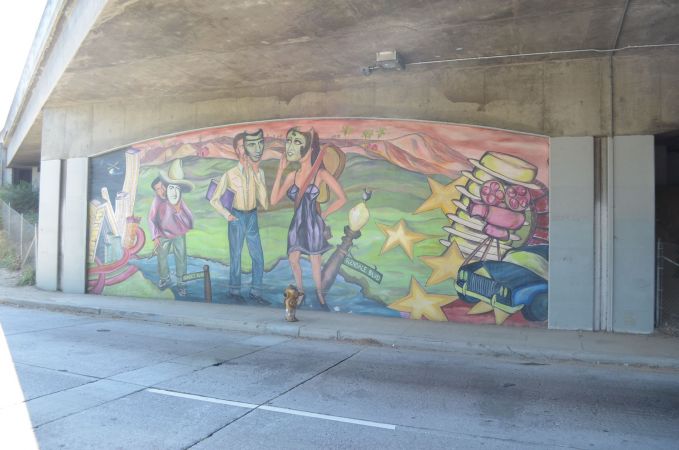
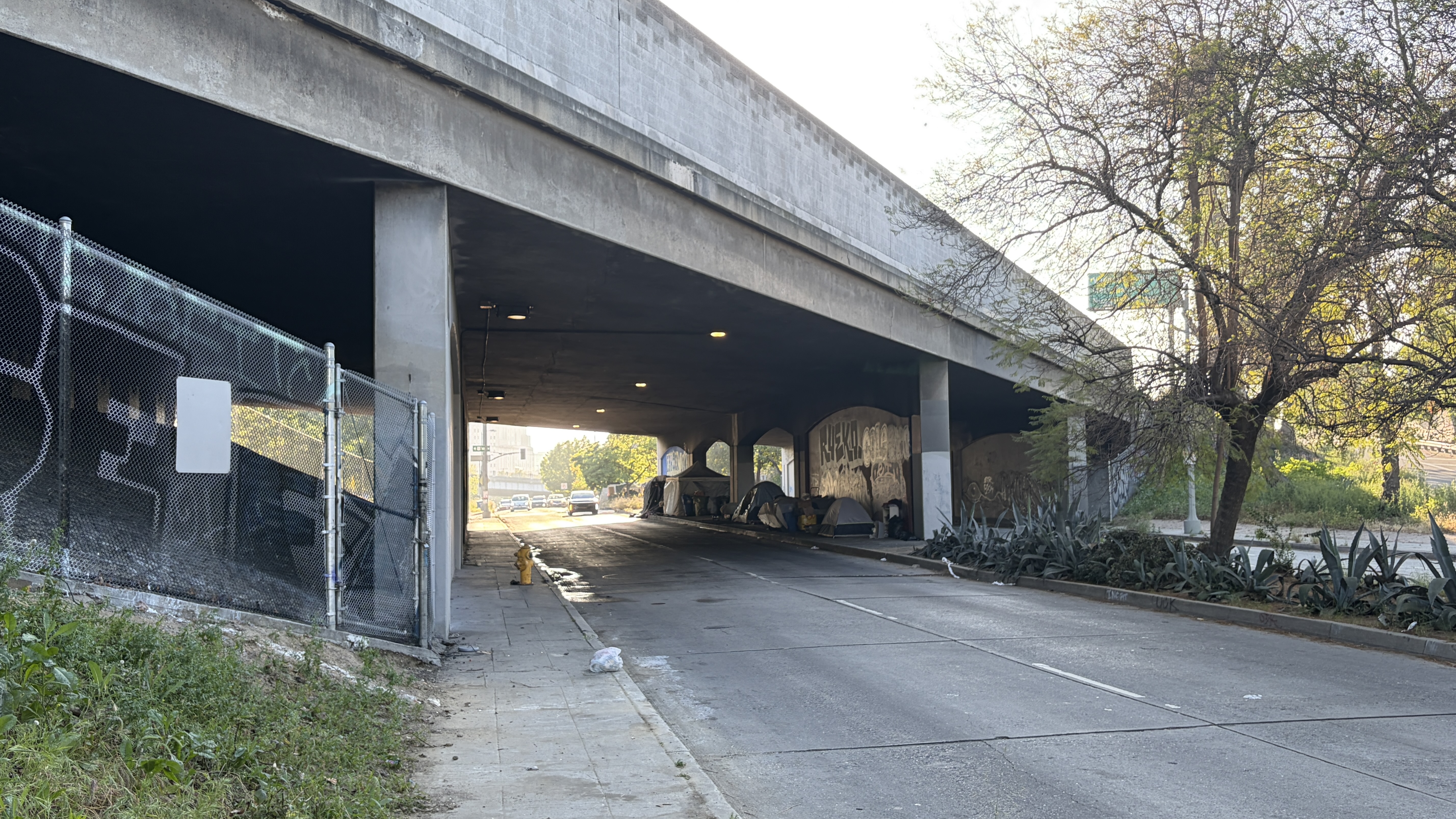
A mural, Ghosts of Silverlake, was painted by Annie Sperling-Cesano. However, all of the murals were defaced by both tags and CalTrans cover-ups. Despite the efforts of numerous volunteer “trash clubs” and the SLIA, its median is nearly always partially buried beneath trash and its pedestrian paths are unusable.
The 2/5 BRIDGES
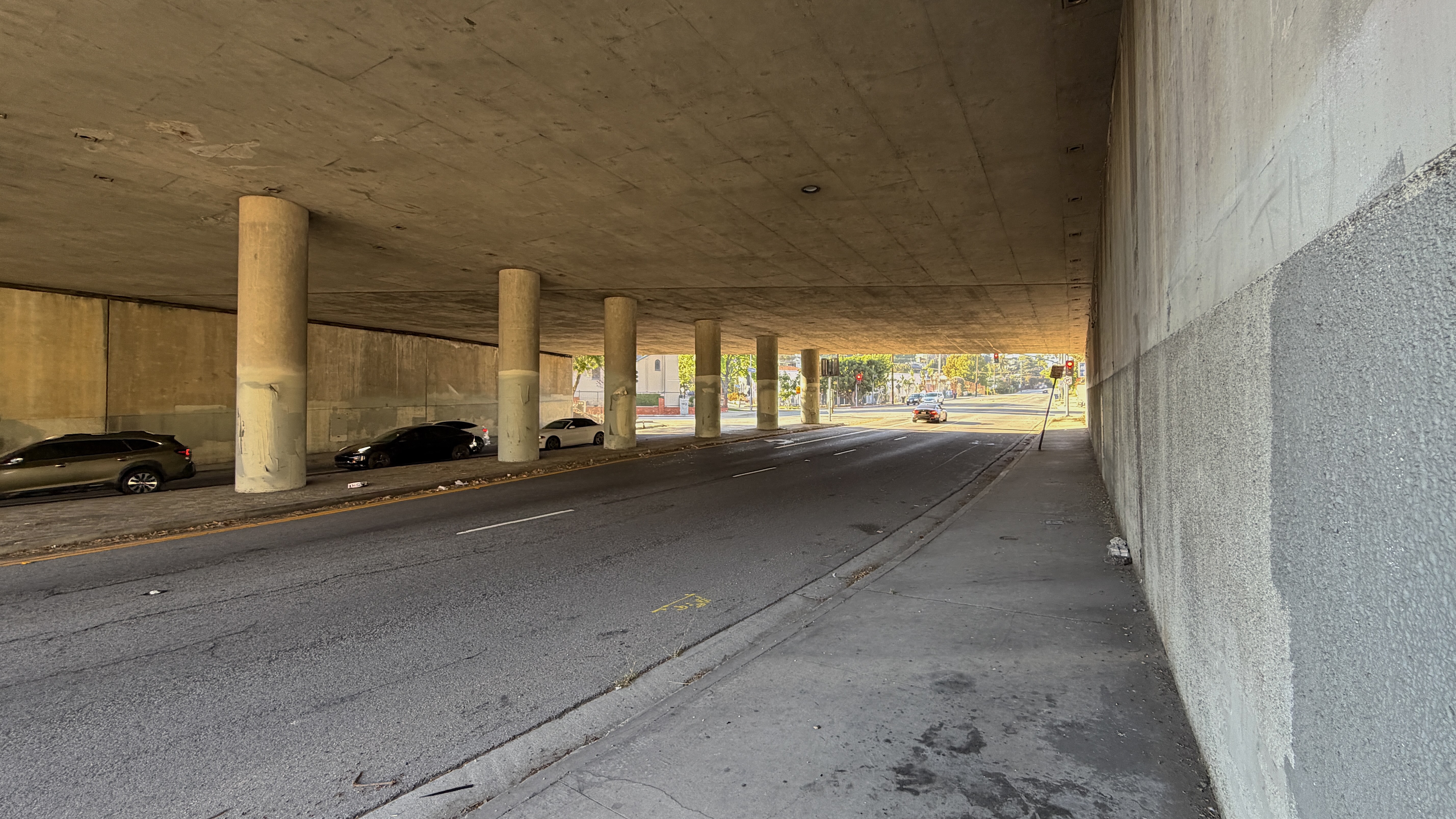
The California Division of Highways built the freeway passes of the 5 and 2 freeways, as well. The 5 Underpass at Fletcher Drive (53 1084) was built in 1961. So, too, was the Glendale-Golden State Interchange – a soaring structure compsed of several “bridges.” The 2 terminates between Echo Park and Silver Lake, after crossing over Glendale Boulevard Overpass (53 1485) near the old Edendale Library. That overpass was constructed in 1962 and dumps freeway traffic onto Glendale Boulevard. In 2015, Christopher Hawthorne proposed turning the freeway stub into a linear park — something like Paris‘s Coulée Verte René-Dumont or Seoul‘s Seoullo 7017. For visionary ideas like that, a new position was created for Hawthorne — Chief Design Officer for the City of Los Angeles. Hawthorne’s tenure ended in 2022, however, and the idea, like the position, was dropped.
CONCLUSION
Work on the Victory Memorial Bridge is scheduled to be completed in or before 2031. No word on when, or if, any of the community’s other bridges will ever be restored with graffiti abatement or the return of ornamental lighting. Nor, as of March 2026, has Disney has made any official announcements about plans to remodel or replace the theme park replica of the Victory Memorial Bridge.
Support Eric Brightwell on Patreon

Eric Brightwell is an adventurer, essayist, rambler, explorer, cartographer, and guerrilla gardener who is always open to paid writing, speaking, traveling, and art opportunities. He is not interested in generating advertorials, cranking out clickbait, or laboring away in a listicle mill “for exposure.”
Brightwell has written for Angels Walk LA, Amoeblog, Boom: A Journal of California, diaCRITICS, Hey Freelancer!, Hidden Los Angeles, and KCET Departures. His art has been featured by the American Institute of Architects, the Architecture & Design Museum, the Craft Contemporary, Form Follows Function, the Los Angeles County Store, Sidewalking: Coming to Terms With Los Angeles, Skid Row Housing Trust, the 1650 Gallery, and Abundant Housing LA.
Brightwell has been featured as subject and/or guest in The Los Angeles Times, VICE, Huffington Post, Los Angeles Magazine, LAist, CurbedLA, LA Times 404, Marketplace, Office Hours Live, L.A. Untangled, Spectrum News, Eastsider LA, Boing Boing, Los Angeles, I’m Yours, Notebook on Cities and Culture, the Silver Lake History Collective, KCRW‘s Which Way, LA?, All Valley Everything, Hear in LA, KPCC‘s How to LA, at Emerson College, and at the University of Southern California. He is the co-host of the podcast, Nobody Drives in LA.
Brightwell has written a haiku-inspired guidebook, Los Angeles Neighborhoods — From Academy Hill to Zamperini Field and All Points Between; and a self-guided walking tour of Silver Lake covering architecture, history, and culture, titled Silver Lake Walks. If you’re an interested literary agent or publisher, please out. You may also follow on Bluesky, Duolingo, Facebook, Goodreads, iNaturalist, Instagram, Letterboxd, Medium, Mubi, Substack, Threads, and TikTok.


 Eric Brightwell