A reminder, if needed, that the internet isn’t all bad.
Two months ago, on the LosAngeles subreddit, user suprunkn0wn asked:
“What’s that one spot in L.A. that you missed where it used to be? The new Amoeba is cool, but the most typical L.A. shit is the fact it’s under apartments and that will always piss me off. I will always miss the OG location, miss seeing it on the corner.“
I’m not sure what’s bad about mixed use buildings with housing components. When I’ve been fortunate enough to visit cities where such an arrangements are common, I have always enjoyed them. It’s nice to have the option of descending from one’s quarters to a market, cafe, or other shop without having to leave one’s building. When I first moved to Los Angeles, I was drawn, for that very reason, to the dream of living in Chinatown — one of the only neighborhoods where mixed residential-commercial is “typical.”
Keeping these views to myself, however, I only commented:
“Behind the neon sign above the front door was a secret cannabis smoking lounge called the Paisley Room. You could only access it via a small hatch at the back of a VHS storage closet. I wonder what happened to all of the furnishings (some inflatable) that we lugged in there.”
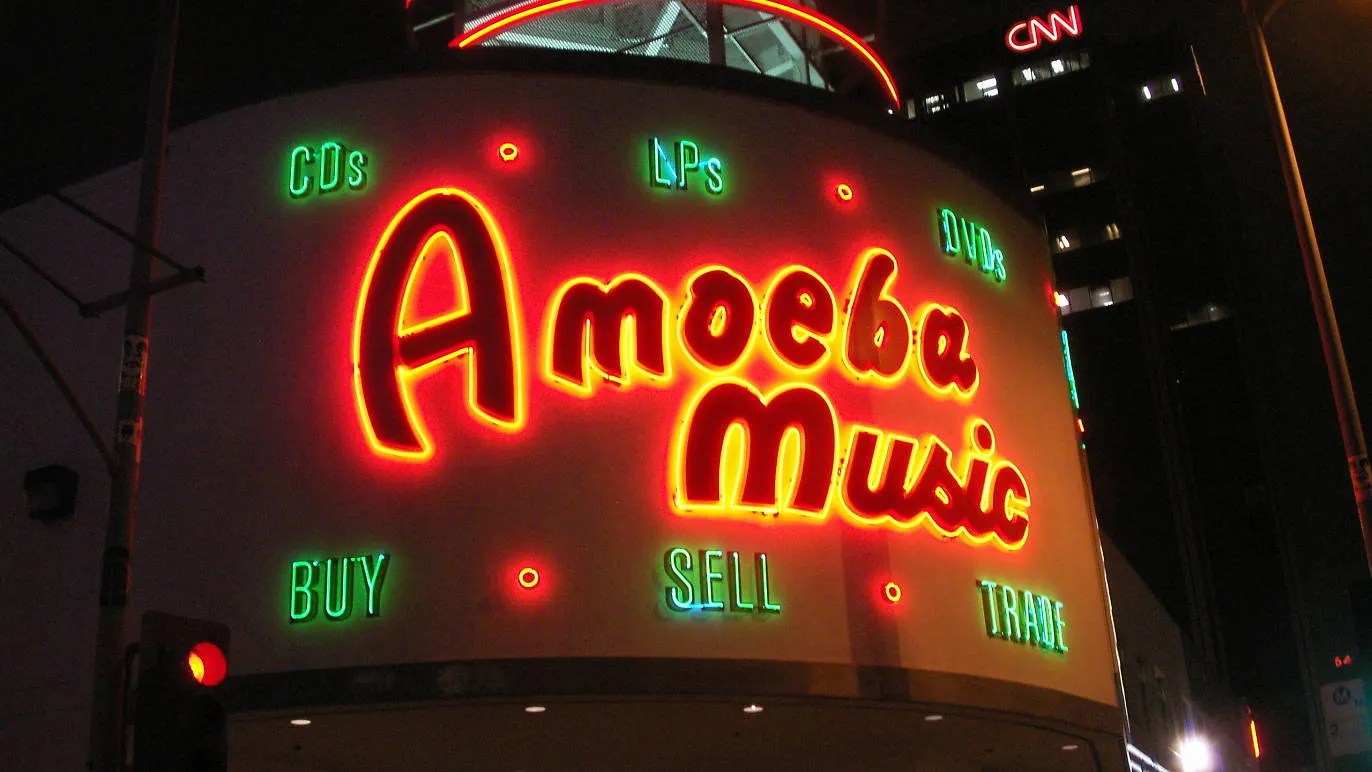
As luck would have it, a couple of days later I found myself in the “new” Amoeba location for only my second time. I ran into an old co-worker, Chris, and he mentioned having read an interesting comment on Reddit. He wondered whether or not I knew anything about it. It seemed doubtful that he intended to press charges so I filled him in. He, in turn, sent me a couple of photos and video taken of the space shortly before Amoeba vacated the building. I promised I’d write a piece about it. So here you are.
Cast your mind back to the year 2001 — the year we (or at least, astronaut Dave) were supposed to have “made contact” with the Star Child. Instead, however, 2001 is best remembered today for being the year that a group of mostly Saudi terrorists led by the Saudi Osama bin Laden carried out attacks on the US which resulted int an invasion and twenty year occupation of… Afghanistan. 24 years later and questions about their involvement never satisfactorily addressed, we’re still way tight with the House of Saud whilst Afghanistan is now the least democratic regime on Earth. Mission accomplished.
2001 was also the year that All Your Base Are Belong to Us blew up the internet. iTunes made its debut but most people still purchased music recorded and stored on aluminum and plastic compact discs. Some of my favorites from that year were Pulp‘s We Love Life, So Solid Crew‘s They Don’t Know, and Turk‘s Young & Thuggin’. Had the ArcLight Cinema yet opened its flagship location next to Amoeba, it might’ve screened Hou Hsiao-Hsien‘s Millennium Mambo, Kiyoshi Kurosawa‘s Pulse, Peter Jackson‘s The Fellowship of the Ring, or Tsai Ming-liang‘s What Time Is It There? The ArcLight would open a year later, though, after I started working at Amoeba after returning from a Thanksgiving roadtrip to Chicago on which my friend and I only got as far as Vancouver. We were taking the scenic route.
David Oved and Fred Leeds had purchased a lot next to the Cinerama Dome in Central Hollywood for $2 million in 1999. They demolished the existing structures and began construction of a large building that was intended to house Freestyle Photo & Imaging Supplies. Freestyle never moved in, though, and it was taken over by Amoeba before construction was entirely complete.
There were lots of interesting spaces in the mostly-completed building that most members of the public would never see. Various offices, a break room, a locker room with showers, and all sorts of nooks and crannies. Some were transformed into spaces like the green room and “the Dungeon.” Poking around the cavernous industrial space felt a bit like exploring the Death Star. At the back of a small room with a transparent mirror that would become the VHS overstock closet was a metal hatch in the wall. I opened it with a coin and crawled through. Luckily, it proved not the be the building’s dianoga-infested trash compactor.
Inside the hatch was a light switch. I flipped it open and found myself in a secret room. It was empty and plain but I felt a bit like Mary Lennox discovering the Secret Garden. The floor was plywood but seemed sufficient to support my then-lighter weight. The room had a strange shape and wrapped around the side of the building, giving it something of the form a paisley… which felt appropriate because my first thought was that this would be an excellent place in which to smoke cannabis. I christened it the Paisley Lounge. I unscrewed the lightbulb overhead so that if anyone else discovered the room, they would find only darkness.
Later, I would bring a lamp from my apartment, Pendersleigh. I would then enter the darkened room and find my way to the lamp, which provided it with better ambiance. There was some light, though, as light made its way up through seams in the floors and walls, along with muffled voices, into the hidden space. Given sufficient time for one’s eyes to adjust, tiny shafts and points pierced the darkness providing it the effect of a stuffy planetarium.
Now, nearly everyone’s imagination is awakened by secret passages and hidden rooms. If you think everyone at a record store owned by Bay Area hippies is cool with weed, you’re mistaken. A–, who worked in soundtracks, once asked our baffled manager what course of action she should after she thought she’d detected the smell of “marijuana smoke.” To access this secret space, one had to pass A–‘s work station. At the back of it was a transparent mirror. That way, at least, I could climb out of the lounge into the darkened VHS closet and look through the mirror until the coast was clear. If I could muster a scowl and push a handtruck with a look of purpose on my serious face, I figured, no one would be the wiser.
I couldn’t wait to share my discovery, though. I chose a co-worker on the mezzanine who wore tie dyed T-shirts and looked like the kind of guy who was handy with a hacky sack named J–. He, was, of course, excited by the discovery, and out of an abundance of caution, we squeezed into the tail of the paisley to smoke a bowl. I think it was J–‘s idea that to stuff a cardboard paper towel roll with fabric softener sheets and exhale into that — so that no one would smell the strong and unmistakable, skunky scent that is magically cancelled out by the aroma of Snuggles’s Blue Sparkle Aroma. I had never tried that trick before. I haven’t tried it since.
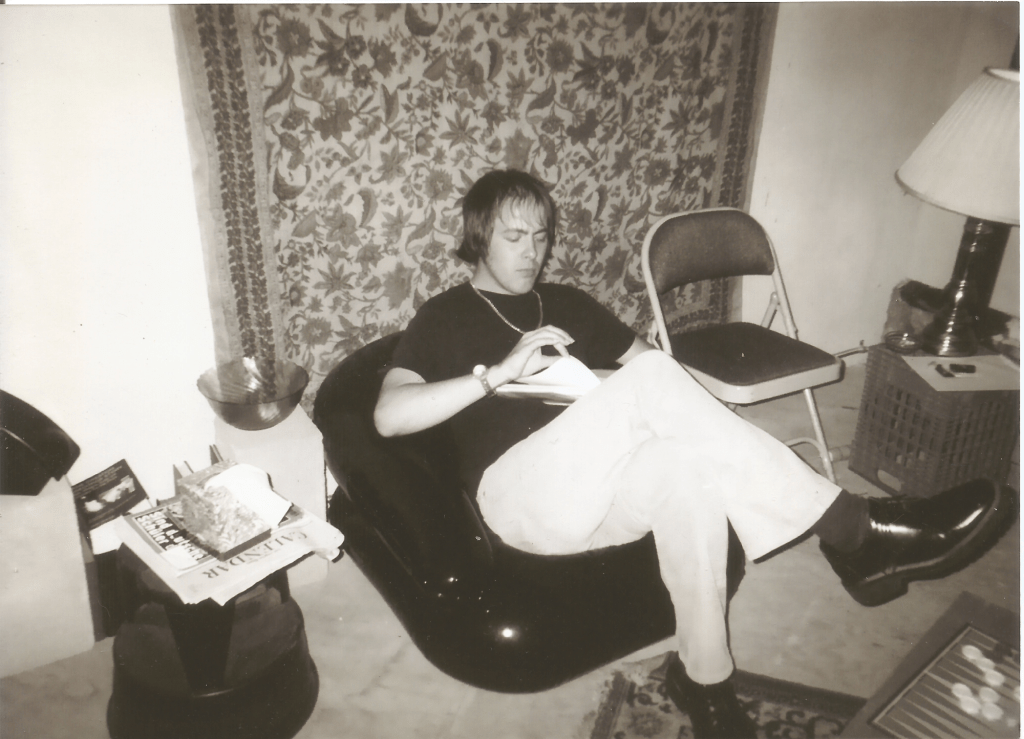
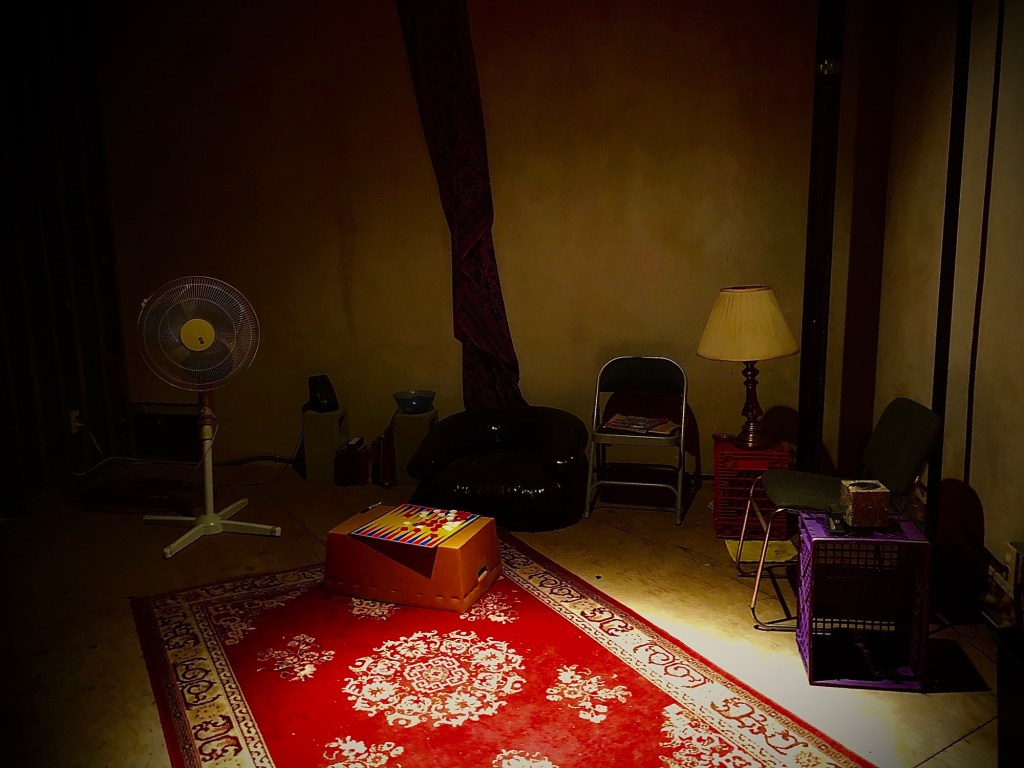
J– and I agreed that we would show other people the Paisley Lounge eventually. It would be the secret hideout of a secret order. I named it the Clandestine Order of Illuminated Gentlemen — or “COIG” for short. We came up with a secret gesture that we would employ when the time was right to retreat to the lounge for a smoke session. If you think I’m going to share it here, you’re mistaken. I believe that it was J– who brought a tapestry to hang on the wall of the lounge. He, or a subsequent member, also brought an inflatable chair, which we (perhaps me) inflated once safely inside. I donated a rug, a fan, and a digital clock. We commandeered a few folding chairs and milk crates. There was an ashtray or two, of course.
In a music store of Ameoba’s high school-like size, cliques would naturally form fairly quickly. But as we hadn’t yet opened, early associations seemed mostly to be based upon places of former employment rather than shared interests. There were, for example, many people from Amoeba Berkeley, Amoeba San Francisco, Aron’s, Penny Lane, Tower, and Virgin. I’m not the type to make friends quickly. J–, though, had already befriended a “used buyer,” named T–. T– also wore tie dye T-shirts. J– showed T– the lounge.
I was worried that knowlege of the Paisley Lounge’s existence was spreading too quickly. I wasn’t so much worried about accidentally burning down the store with our lighters or for getting in trouble for being stoned. After all, I’d already gone to the roof on the invatation of one of the owners to join him in “sparking a fat one.” I didn’t think, however, that anyone with any level of responsibility — no matter how “down” they might be — would shrug off employees gathering inside of a half-finished attack space to smoke bowls. I worried that I’d be fired before we even opened the store.
From that point on, new COIG members would have to be vouched for by a particular member — like we were a stoney mafia family. New members would require unanimous approval, too. Both J– and T– wanted to initiate another employee, P–. I agreed, and we all gathered for a session inside the Paisley Lounge. Eventually, we’d started heading over to the Out of the Closet at Gower Gulch where we would buy items like a backgammon/checkers board and books with which to create a small library. I seem to recall we bought a book by Mark Twain that bore his signature. We chose to believe that it was authentic.
One day, after T– and P– returned from the Paisley Lounge to the buy counter, another buyer, C–, looked into their blood shot eyes and asked one of the the COIG members where he’d gone to puff. He told her that it was a secret. She then told another member that the first member had told her about the secret spot and that she now wanted to see it for herself. So, duped, they showed her. The “illuminated gentlemen” became “illuminated gentlepersons.”
Although it was I who had discovered this magical space and only, thus far, shown it to one other person — there were now five of us smoking together inside the sign. As we sat there, trying and failing to “keep it down,” the hatch popped open to my horror and in popped the head of another mezzanine employee, B–. You could tell that he was both angry and hurt — because, he assured us, he was cool and therefore miffed that we had kept it, thus far, a secret from him. After we closed the store that night, all of the COIG members took B– out for a night of free drinks and apologies at the NoBar, near his North Hollywood residence. I assured him that we’d have told him eventually but that we were understandably worried about how fast it was blowing up.
After that scare, my visits were more judicious and less frequent. There were other places to smoke where doing so was less likely to cost us our jobs. Now and then I’d pop into the lounge by myself or, on rare occasions, with a partner. It think it was another mezzanine employee, and not a full COIG member (N– or a different B–) who snapped a couple of mock-serious photos of me reading This Beautiful and the Damned so that I could develop a roll of film mostly snapped at the abandoned zoo in Griffith Park for my 30th.
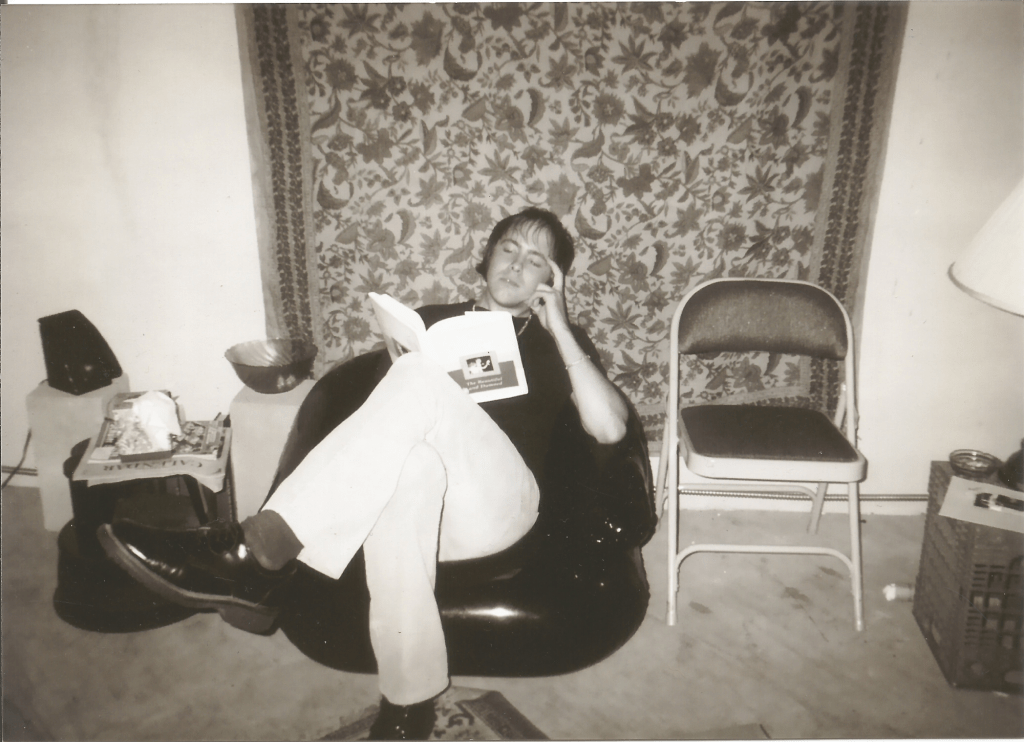
One day, I arrived at work and felt sick to my stomach — a different sort of sickness that was typical after a lunch break at the nearby Chinatown Express, El Pollo Loco, or Hollywood’s sketchiest Jack in the Box. This sickness was from nerves, not food contamination. Part of the neon Amoeba sign was out. I hadn’t considered the possibility that someone might actually have to go into the lounge, say, to fix or replace the neon — you know, for actual work. Whether a manager or repair person screwed in a new ceiling light or brought a flashlight, it would be hard for them not to draw certain conclusions upon finding an apparent opium den. Maybe they’d keep it to themselves. There was nothing, as far as I knew except heresy, to connect me to the lounge.
I didn’t hear anything after that. Gradually, the members of COIG all drifted apart. Like the writer in the elegiac monologue at the end of Stand By Me intoned, “It happens sometimes. Friends come in and out of your life, like busboys in a restaurant.” All of the COIG members left Amoeba at some point. I quit smoking in 2008. I stopped working at the store in 2009. Years later, I ran into someone at Cinefamily who got hired on the mezzanine after or around the time that I’d left. I asked her if she or any of her co-workers knew about the secret space at the back of the VHS closet. She said that they did and that they referred to it as “Narnia.”
The original building was sold in 2015 but Amoeba continued to lease it in the years that followed. Then, in 2018, it was announced that the new owner would demolish the building and replace it with one of those mixed use commercial- residential towers that vex Redditors like suprunkn0wn. On 27 April 27 2020, the original location closed during the COVID pandemic. Chris and a camera person documented the existence of the Paisley Lounge for posterity before moving out. It looks like the tapestry has fallen and the lamp shade appears to have mysteriously vanished. Imagine better lighting and you can still get the idea. Have you got it yet?
On 31 July 2021, the building was taken over by Immersive Van Gogh. That Instagrammable installation ended its run on my 49th birthday in 2023. The tower was never built. The old Amoeba building sits vacant, now, and is for lease. As far as I know, the Paisley Lounge is still there.
Support Eric Brightwell on Patreon

Eric Brightwell is an adventurer, essayist, rambler, explorer, cartographer, and guerrilla gardener who is always seeking paid writing, speaking, traveling, and art opportunities. He is not interested in generating advertorials, cranking out clickbait, or laboring away in a listicle mill “for exposure.”
Brightwell has written for Angels Walk LA, Amoeblog, Boom: A Journal of California, diaCRITICS, Hey Freelancer!, Hidden Los Angeles, and KCET Departures. His art has been featured by the American Institute of Architects, the Architecture & Design Museum, the Craft Contemporary, Form Follows Function, the Los Angeles County Store, Sidewalking: Coming to Terms With Los Angeles, Skid Row Housing Trust, the 1650 Gallery, and Abundant Housing LA.
Brightwell has been featured as subject and/or guest in The Los Angeles Times, VICE, Huffington Post, Los Angeles Magazine, LAist, CurbedLA, Office Hours Live, L.A. Untangled, Spectrum News, Eastsider LA, Boing Boing, Los Angeles, I’m Yours, Notebook on Cities and Culture, the Silver Lake History Collective, KCRW‘s Which Way, LA?, All Valley Everything, Hear in LA, KPCC‘s How to LA, at Emerson College, and at the University of Southern California.
Brightwell is currently writing a book about Los Angeles.
You can follow him on Ameba, Duolingo, Facebook, Goodreads, iNaturalist, Instagram, Letterboxd, Mastodon, Medium, Mubi, the StoryGraph, Threads, TikTok, and Twitter.


 Eric Brightwell
Hi Eric–I haven’t checked in NDinLA lately and your story of the Clandestine Order showed up on my e-mail. I only visited the old Amoeba location once, and have yet to visit the new site. For various reasons, my travel radius is severely limited these days, although I know the new Amoeba is just a short walk from the Vine St. Metro station. Right now I’m just trying to get my existing collection of CDs sorted out. My interest in recorded music goes back to the 78-RPM era, and my first day job was as a teen-age part time sales clerk at the local music store in Monrovia in 1957-58. That was my only paid employment in the music industry, although in recent years I’ve been an honorary roadie for a now inactive local band.
Keep those yarns a-spinnin’!
Bob Davis
San Gabriel Valley native
LikeLike
I was trying to remember when I first encountered your writings–I remember commenting on your use of the SI (Metric system) for distances and that one of your photos showed an orange cat. Do you still have the cat, and is he getting close to “senior kitizen” (my younger daughter’s term) status? Out in our neck of the woods, Metro is getting ready to activate the “A” line extension to Pomona, and they appear to have the $$$$ to carry on as far as Montclair.
Hope you are doing well, and if you have a book in the works, I would like to buy one when it comes out.
Bob Davis
LikeLike
I still have the cat. Alan is ten now. I’m currently in the process of trying to find a publisher. Take care!
LikeLike