INTRODUCTION
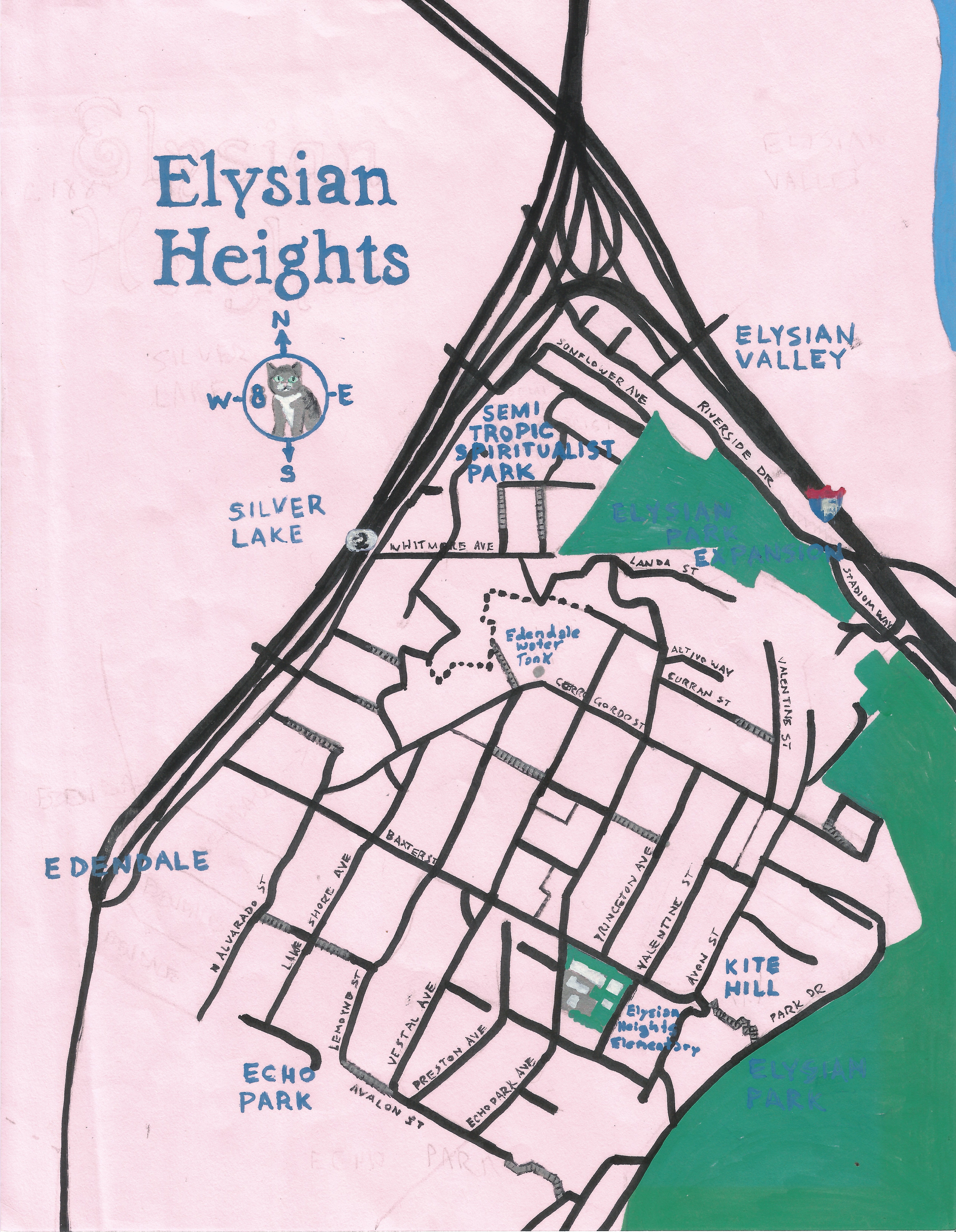
The other day, the Los Angeles Public Library posted a short clip of me talking about my map of the Elysian Heights neighborhood — crafted from interview footage shot for episode three of the library’s series, L.A. Untangled. After it was released, my friend, Jiyoung Park, commented on Twitter, “I wanna know more about the Semi-Tropic Spiritualists!” That, I thought, might be a good idea for a Spooky Season-themed post.
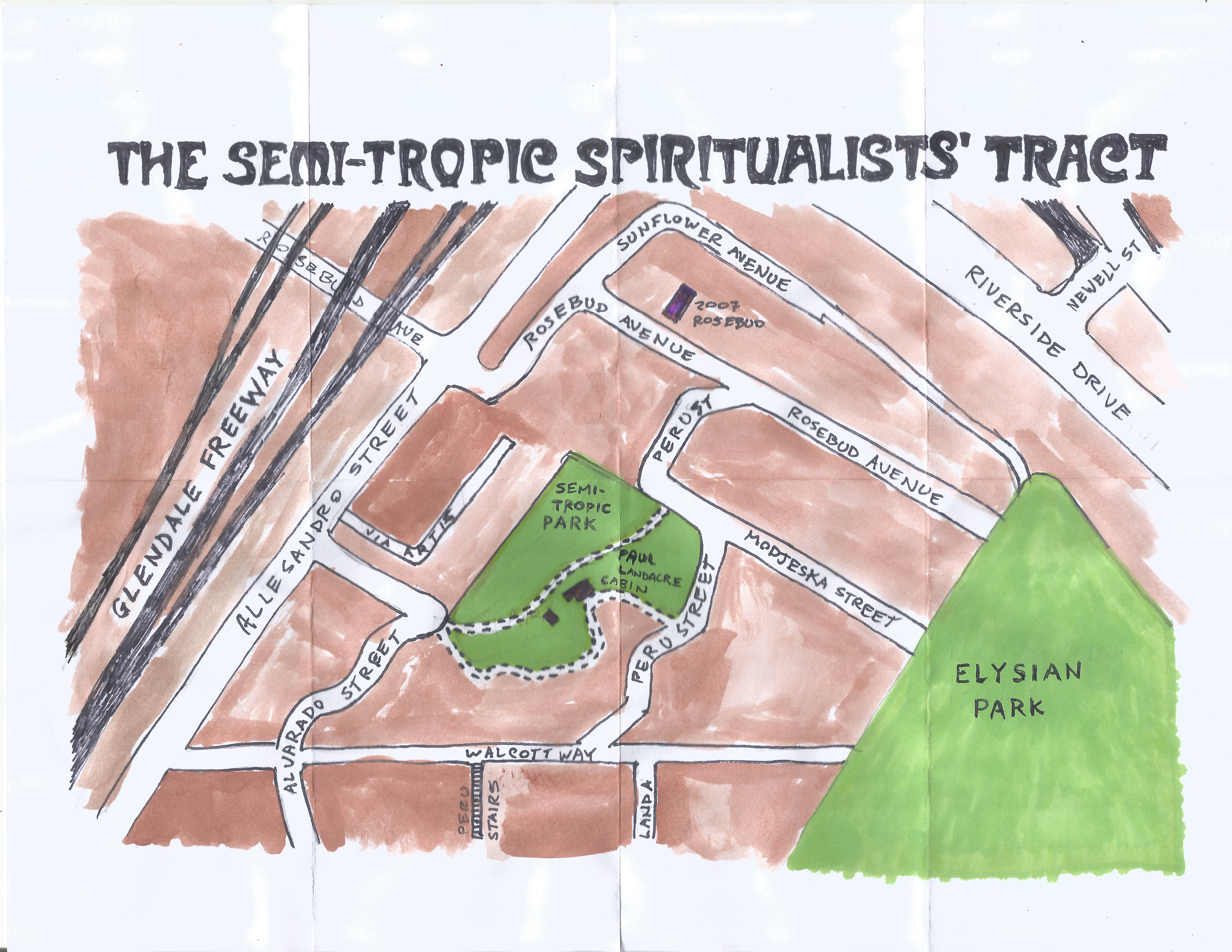
I don’t remember exactly when I first became aware of the Semi-Tropic Spiritualists but I do know it followed my having seen the Semi-Tropic Spiritualists’ Tract on an online map and wondering what that was all about. I was stuck, of course, by the evocative but slightly odd name. I also remember that another friend, Lee Conger, who lived nearby in Silver Lake Heights, had heard of Semi-Tropic Spiritualists. I also find Spiritualism and the Occult, in general, interesting. I actually just finished the Spiritualist-informed Turn of the Screw a couple of days ago.
Los Angeles has been referred to as the “the Capital of Car Culture,” “the Gang Capital of America,” and “the Entertainment Capital of the World.” I could quibble with all of those but instead I’ll just suggest that it’s also, surely, “the Cult Capital of the US and maybe, the Cosmos.” That said, before writing this essay, I’d come across little information about the Semi-Tropic Spiritualists in the years since first hearing of them. Now seemed like a good time to dig deeper. Obon passed not long ago, Pitru Paksha is upon us, and Samhain, Halloween, Calan Gaeaf, and Día de los Muertos are all just around the corner. The nights, now longer than the days, are getting longer. The Darker Half is almost here!
SPIRITUALISM
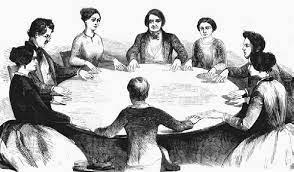
Spiritualism was a social movement and religion that arose in the 1840s — and it remained incredibly popular until the 1930 or so. Central to Spiritualism’s core is the belief that once people die, their spirit lives on in the afterlife (or spirit world) where they remain interested in the affairs of the living and who can be contacted by spirit mediums during séances. Spiritualism was essentially born on 31 March 1848, when sisters Kate and Margaret Fox, of Hydesville, New York, claimed to have made contact with the spirit of a peddler named Charles B. “Mr. Splitfoot” Rosna, who’d supposedly been murdered by a previous inhabitant of the house, John Bell. He purportedly communicated with the two by making rapping noises. In 1888, the sisters said that it had all been a hoax, revealing how they made the noises by cracking their joints.
Later, they recanted but, by then, Spiritualism had had a life of its own for ages. They weren’t the leaders of Spiritualism, though, which was fairly decentralized. According to a New York Times article from November 1897, there were then eight million followers of Spiritualism in the US then. That would make about ten percent of Americans Spiritualists. By comparison — the combined population of all practicing and self-identified Jews, Buddhists, Mormons, and Muslims in 2023 only adds up to about six percent of the US’s population.
There was no unifying Spiritualist holy book or structure although there were larger organizations. The National Spiritualist Association was formed in 1893. The “Declaration of Principles” was adopted by many in 1899. Spiritualists were generally middle and upper class white Americans and socially very progressive for their time. Spiritualists were opposed to slavery. Spiritualists advocated for women’s suffrage. Many were Socialists. Many came from Quaker backgrounds and, not surprisingly, most were Pacifists. Some also believed in free love.
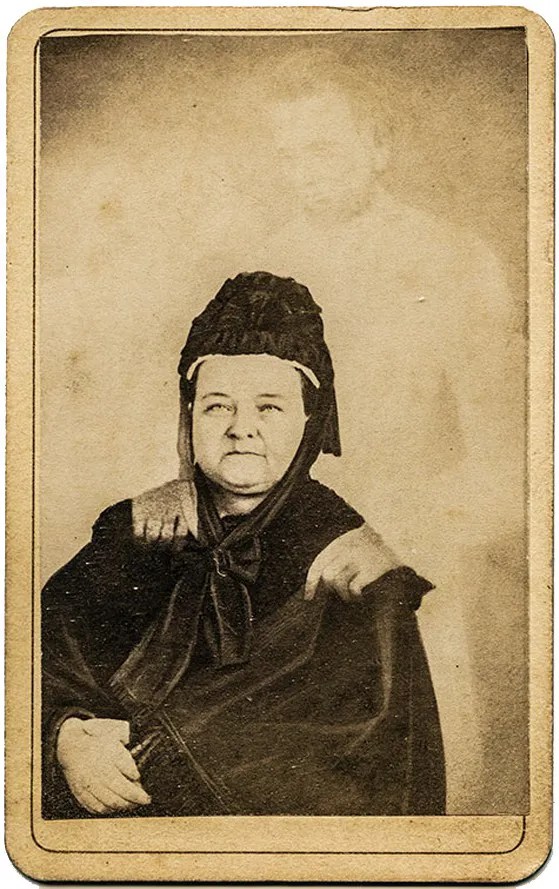
As with any movement, Spiritualism almost certainly included within its ranks both true believers and those willing to exploit them. There were people who made a profitable living as frauds — as well as those who profited from exposing them. For some, I also suspect, Spiritualism provided a respectable cover for Progressive causes. As the popularity of the movement grew, though, so did the taste for showmanship.
One of the earliest features of séance was table-turning, in which the table would tilt in a manner that spelled out messages. Soon, mediums began incorporating spirit slates — small chalkboards on which spirits wrote messages without human intervention. The Ouija Board was patented by businessman Elijah Bond in 1890. Ohio-based medium, Jonathan Koons, introduced spirit trumpets, invented by his son, Nahum, to amplify the voices of spirits. Audiences paid to see public demonstrations of automatic writing, clairvoyance, hypnotizing, and “message reading” — in which a Spiritualist would use their powers to answer questions received in sealed envelopes. I suppose it’s not that different from paying the offering — even if it sounds a bit less like a morning at church service than an evening at the Magic Castle.
One of the most famous adherents of Spiritualism was first lady Mary Todd Lincoln. She used at least four different mediums in an effort to contact her and Abraham’s son, Willie, who died in 1862 of a “bilious fever,” when only eleven years old. One of the mediums, “Lord” Charles J. Colchester, warned that Abraham was in grave danger. Of course, this may’ve had less to do with his supernatural ability than his friendship with an unhinged actor named John Wilkes Booth. Another famous adherent of Spiritualism was author Arthur Conan Doyle, creator of Sherlock Holmes. Spiritualism’s greatest opponent, though, was Doyle’s friend — magician Harry Houdini — who embarked on a campaign to expose the fraudulent methods of mediums in the 1920s. Ten years after he died, though, his widow, Bess, was still attempting to contact his spirit in front of audiences.
THE SEMI-TROPIC SPIRITUALISTS — IN THE BEGINNING
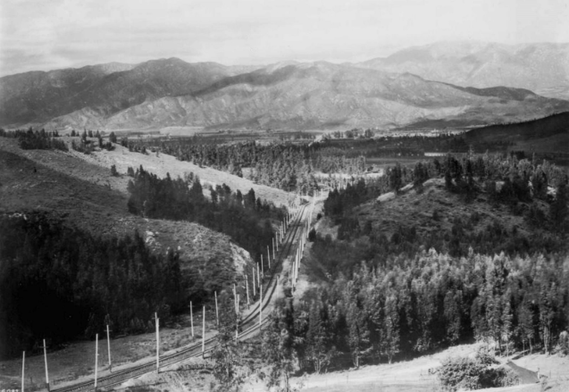
The Semi-Tropic Spiritualist Association was incorporated on 22 July 1905. They were one of many local Spiritualist organizations. There was also the First Spiritualist Mission, the People’s Spiritualist Church, and the Society of Spiritual Progression, to name just a few. There were other, similar new religions, too, like the Theosophical Society, the Society of Eternal Progression, the Be Happy Association, the Mazdaznan Society, the Truthseekers’ Society, the Vedanta Society, and the Church of Humanity. The founding directors of the Semi-Tropic Spiritualists were A. Anderson, A. J. Spink, P. A. B. Kennedy (likely Phillip Andrew Brownlee Kennedy), S. D. Dye, and Nettie Howell. The stated purpose of their association was “to acquire, operate and maintain permanent camp grounds in the County of Los Angeles.” Meetings at the campground would “be devoted to the maintenance and spreading of the religion of Modern Spiritualism, its philosophy and its phenomena.” In addition to the expected séances and medium readings — midnight dances were deemed essential in routing the spirits.
SEMI-TROPIC VIBEZ
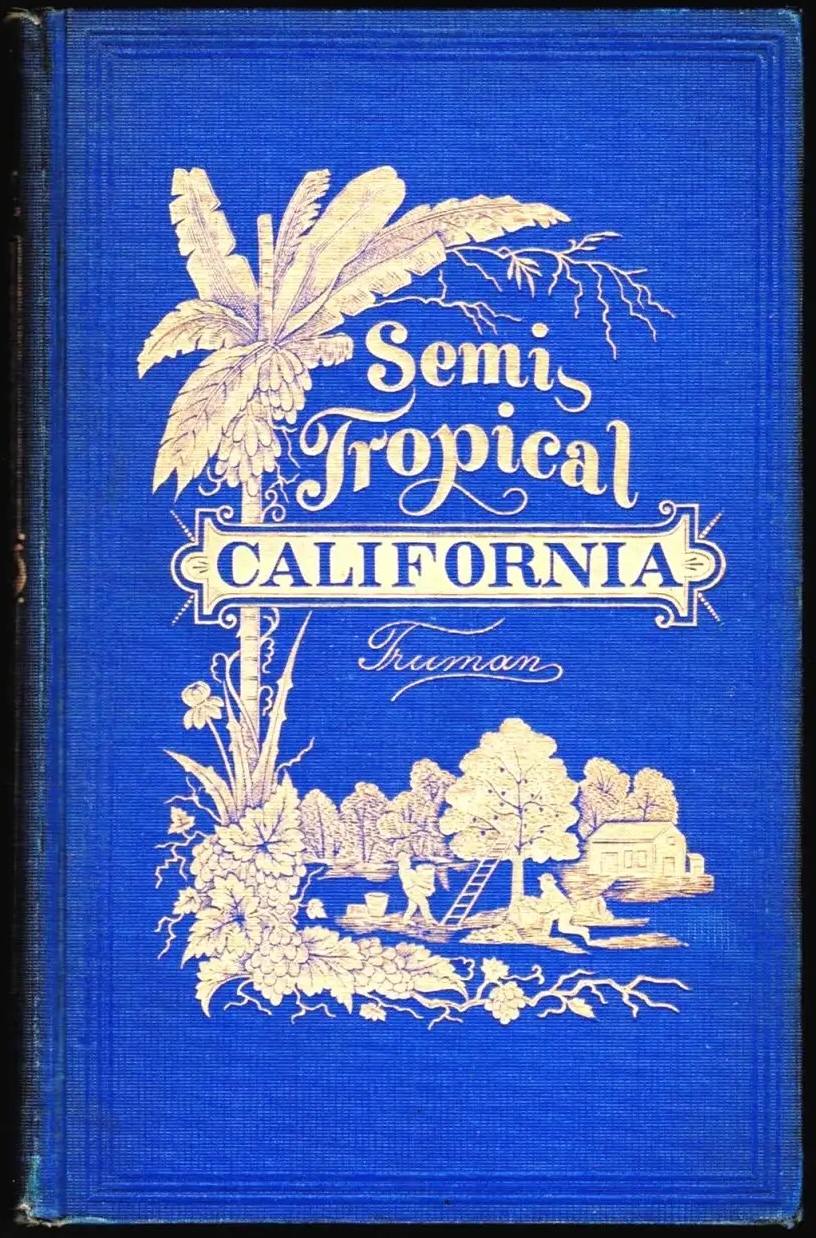
The term, “semi-tropic” probably sounds a bit bizarre to most modern Angelenos — most of whom either wrongly believe that Los Angeles is a desert or rightly know that it’s a mostly semi-arid place. Almost no one mischaracterizes it as semi-tropical. Setting aside the fact that “Semi-Arid Spiritualists” doesn’t sound like the name of a very appealing group, Los Angeles in the late 19th century was overrun with transplants from the Upper Midwest and Northeast who’d probably never experienced a semi-arid climate. For them, I imagine, the unfamiliar chaparral scrublands were recognizably something other than tropical or desert even if they couldn’t exactly say just what. The climate of the Gulf Coast is sub-tropical — and a place where palm trees thrive. There were palms, too, in Los Angeles — although not as many as there are now. Usage of the term “Semi-Tropic” was common back then and peaked, in print at least, in the 1870s and ’80s. It was still in fairly large usage in the 1900s.
THE SEMI-TROPIC SPIRITUALISTS’ TRACT
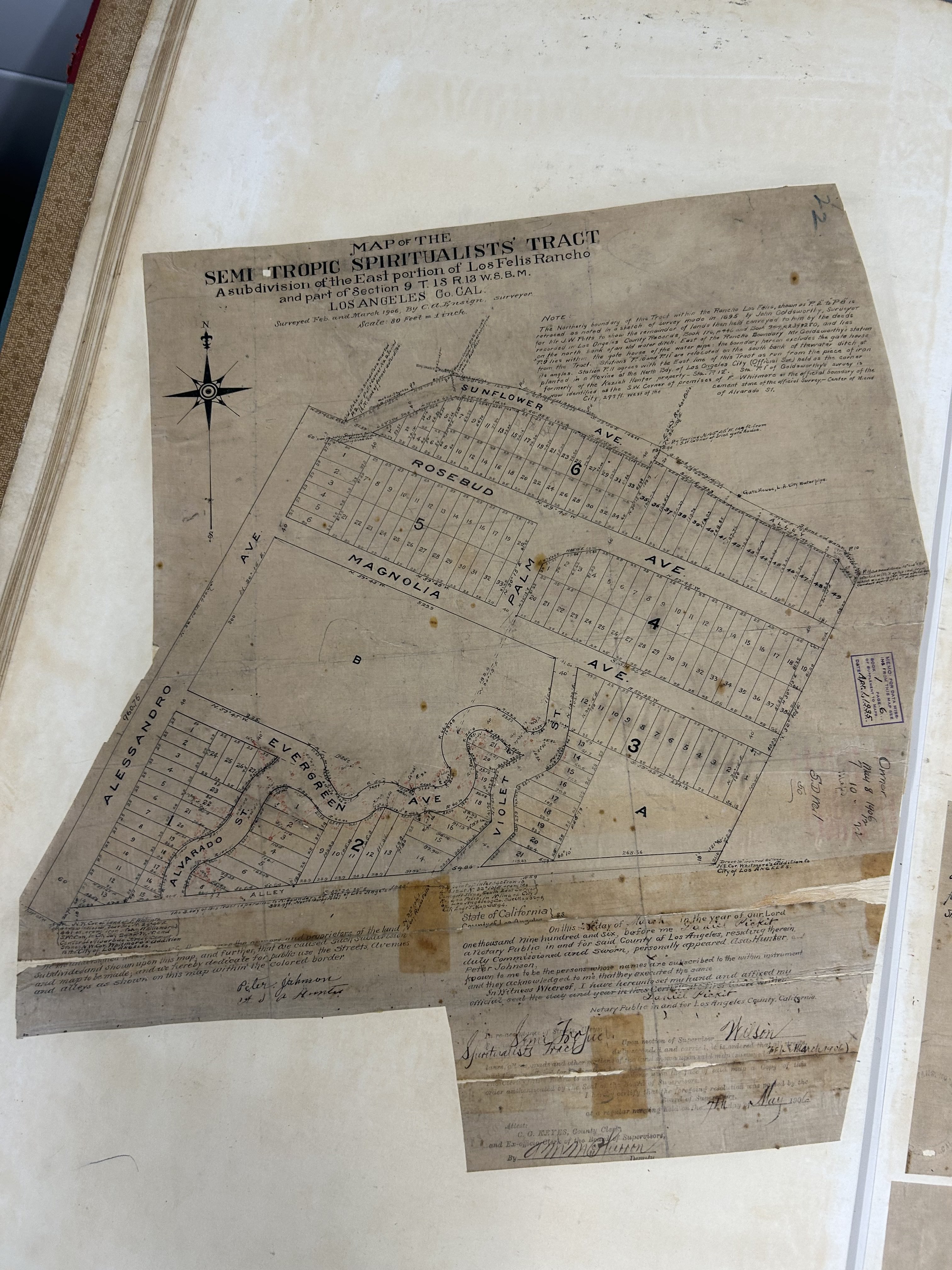
On 19 September 1905, the Semi-Tropic Spiritualists bought land just north of the city limits in the Elysian Hills above Edendale — which would soon emerge as the capital of West Coast filmmaking. To the west was the Ivanhoe subdivision. To the north was the sparsely populated Elysian Valley. Directly south of the Semi-Tropic Spiritualist Tract was another campground, this one belonging to the Fellowship of New Thought — a group that practiced “right thinking” (a mix of Christian Science, Hinduism, and Idealism). There’s still an unpaved road/trail there called Fellowship Parkway.
The county recorded the establishment of the Semi-Tropic Spiritualists’ Tract in 1906. The Spiritualists’ sales agent, Peter Johnson, began selling lots on the tract to members who pitched tents and later, had cottages constructed. In July 1906, Johnson sold a tract to C. A. Notte. In November, a lot was sold to M. A. McHatton in November. In the middle of the tract was a larger lot known as Semi-Tropical Park, where the Spiritualists then planned to build shared structures. At least as early as July, the Semi-Tropic Spiritualists were hosting concerts, picnics, and guest speakers at the Semi-Tropic Spiritualists’ Tract. One of the first was a medium, Dr. Adah S. Harmon Patterson.
THE DYNAMITE SCARE
1907 seems to have begun quietly enough for Lots were sold to the Semi-Tropic Spiritualists. In January, the Los Angeles Financier announced that the Semi-Tropic Spiritualists were going to form a bank. More lots were purchased, that summer, by Ingebrickt Didrickson, P. W. Gertz, L. Ward, Freda Geltzer (a medium), and J. A. Dandridge.
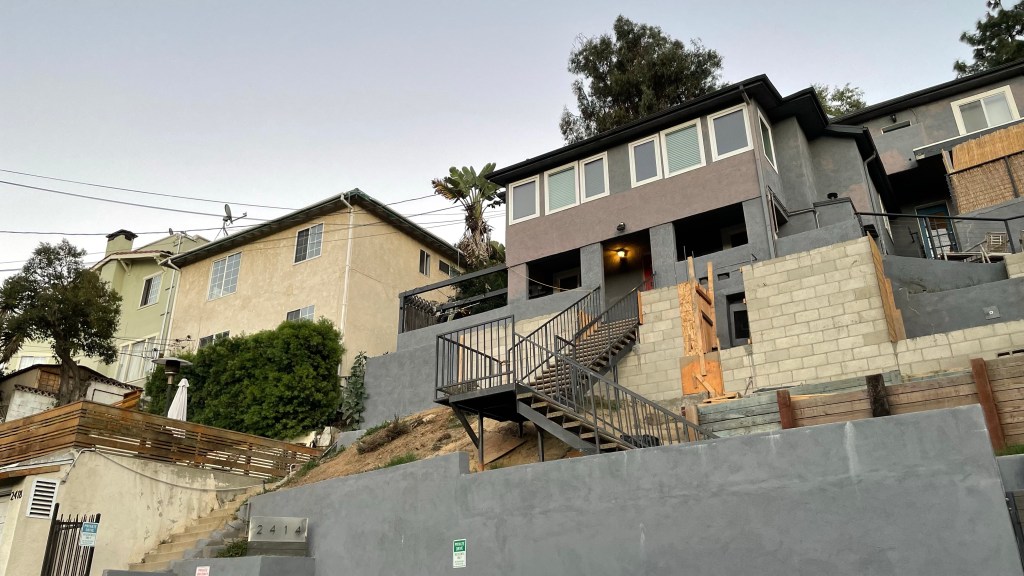
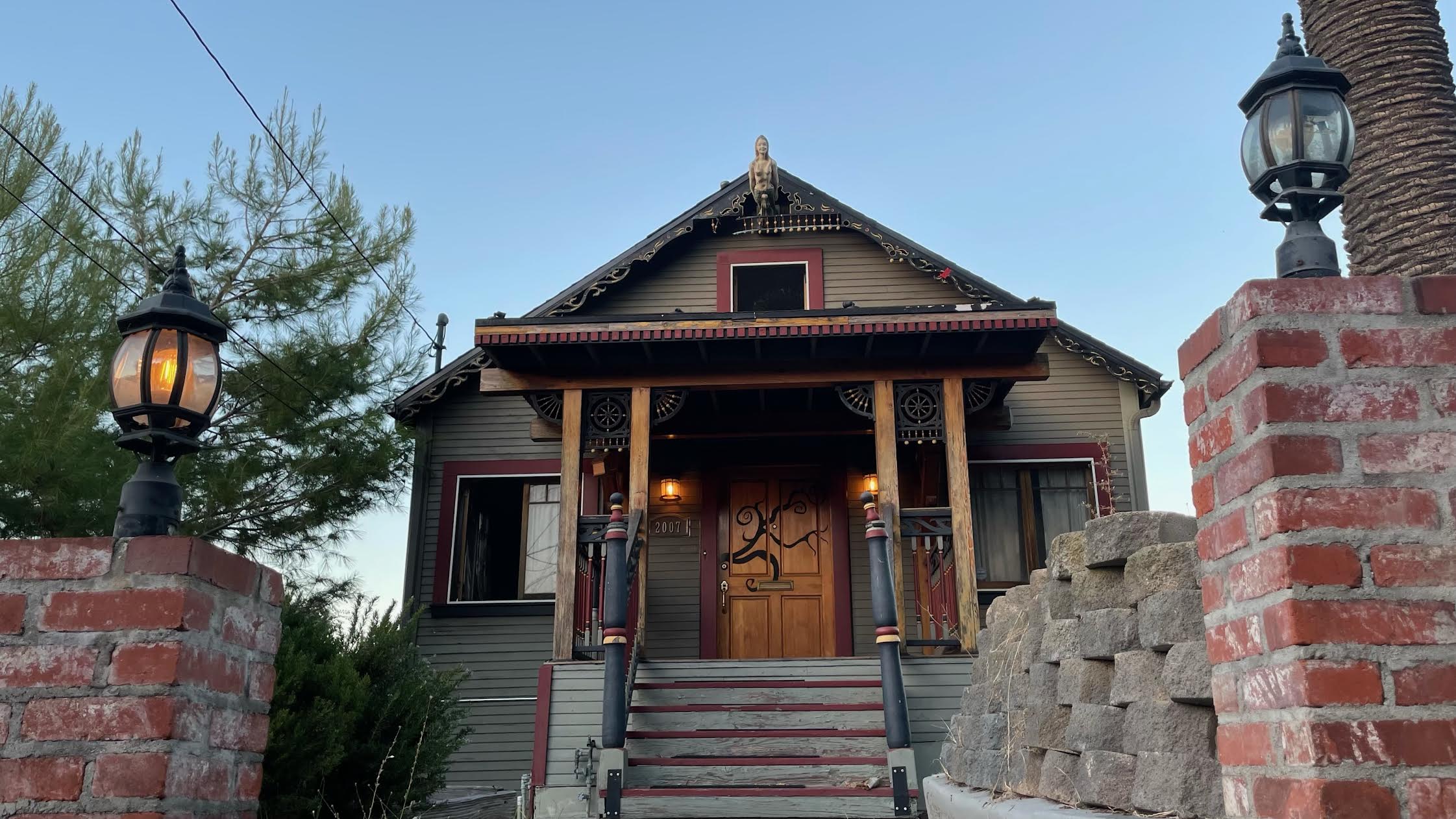
At least two of the houses built on the tract that year still stand — one at 2007 Rosebud Avenue and 2414 North Alvarado Street. The house at 2418 North Alvarado Street was built the following year, 1908. The Alvarado homes have been so substantially altered that, at least from the street, they look pretty much like any 1960s stucco box and nothing like they would’ve looked in the 1900s. 2007 Rosebud, though, is stunning — and even pleasingly spooky.
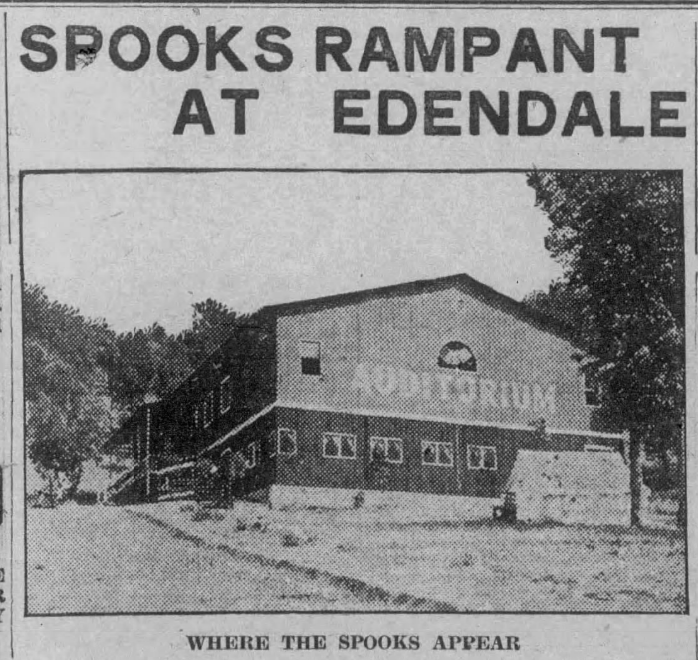
The Semi-Tropic Spiritualists’ year ended on shakier ground, although it could’ve been, all things considered, much shakier. On 9 December, The Los Angeles Times reported that 25 pounds of dynamite, purchased by the Spiritualists to clear tree stumps from their campground, had gone missing. The article noted that, by then, the campground had “an auditorium, meeting house, and several small tents on its camp ground in the heart of Edendale.” According to the last Spiritualist to have seen the dynamite, John Thorne, the dynamite had first been “safely” stored inside a pile of hay in a small barn. A neighbor named John North, having observed the arrival of the explosive with “fear and trembling,” fled from Edendale that day — as, apparently, did several others. A complaint was filed with District Attorney Fredericks, who ordered the dynamite moved to a safer spot. Thorne agreed to move it and dismissed their concerns, reportedly describing it as no more “harmful than a Dutch cheese.” Thorne’s apparent idea of a safe spot to store dynamite was underneath his mattress. From there, though, it seemingly vanished into thin air. I couldn’t find any accounts of it ever resurfacing, exploding, or having been absconded with by a ghost.
SEMI-TROPICAL PARK
By 1908, the Semi-Tropic Spiritualists’ Tract’s common area was usually referred to as Semi-Tropic Park. Johnson continued to sell the surrounding lots. C. Marks and Lucy A. Shaw were recorded as having purchased lots that April. It was also that April that the Semi-Tropic Spiritualist Association sued Johnson, though, alleging that he owed them $318 ($10,612 in 2023 dollars). He counter-sued for $290 ($9,678 in 2023 dollars). The disagreement, predictably, arose over profits from sales of the lots as well as whose names were on the deeds. It was described as a “friendly” suit to settle accounts. I don’t know if “friendly suit” is legalese but afterward, Johnson was, not surprisingly, no longer retained by the Semi-Tropic Spiritualists. Didrickson, who’d bought her tract the previous year, sold their lot to Elizabeth E. Hinsdale that April. The following month, a lot was purchased by P. A. B. Kennedy, one of the Semi-Tropic Spiritualists Association’s founding directors — and soon to be accused of leading the Spiritualists astray.
RESORT OF ROWDIES
In May, Los Angeles County passed an ordinance requiring “spiritualists, clairvoyants, mediums and palmists” pay a fee of $30 per month ($1,001 in 2023 dollars) for a license. Semi-Tropic Spiritualists Ernest C. Johnson and Spink argued that their group should be exempted — as they’d by then spent a considerable amount of money already on purchasing the tract, improving it with a water system, and building a pavilion there. They also argued that they were planning a large concession and that, furthermore, as a religion, they should be exempted from taxes just like Christian churches.
Opposing the Semi-Tropic Spiritualists were Hartley Shaw, E. E. Campbell, and Robert T. Hale. Shaw was a Chief Deputy District Attorney and argued, on behalf of the Board of Supervisors, that granting an exemption to the Semi-Tropic Spiritualists would be arbitrary. Campbell, a member of the California State Spiritualist Association, said that the Semi-Tropic Spiritualists were not affiliated with their movement and, what’s more, if they weren’t licensed, fake mediums might exploit the exemptions granted the Semi-Tropic Spiritualists to defraud the public at Semi-Tropic Park — thus besmirching the reputation of legitimate Spiritualists.
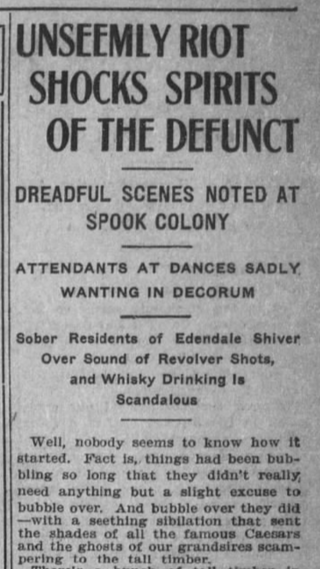
The most damning opposition, though, came from Hale. Hale was a member of both the state and National Spiritualists’ associations. He was also president of the Anti-Fakirs’ Association; and he alleged that the Semi-Tropic Park was a frequent site of disorder, where the Semi-Tropic Spiritualists regularly rented out their auditorium to anyone who’d pay. Hale also claimed that, at Semi-Tropic Park, young girls were served liquor and danced until midnight and that it was, effectively, a “resort of rowdies.” On one instance, when Hale was exiting the dance hall, he claimed that he’d even been shot at three times. The Semi-Tropic Spiritualists denied all charges and the Board of Supervisors granted the exemption. Unfortunately for them, though, the battle was far from over.
THE DEPUTY WITH THE THORN IN HIS SIDE
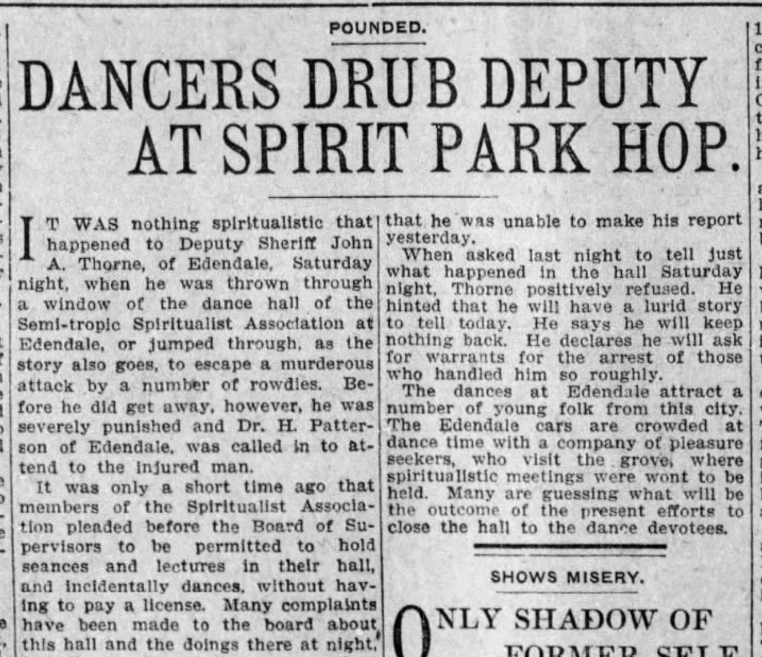
On 18 July, Deputy Sheriff John A. Thorne of Edendale entered Semi-Tropic Hall and encountered there a whiskey drinking crowd that was “becoming boisterous.” Five, young, “irate dancers,” upon seeing an officer of the law, proceeded to attack him. According to an account provided by The Los Angeles Times, “he was kicked in the stomach, his eye was blacked, and his nose received several ugly punches.” At that point, Thorne was either thrown through a window — or jumped through it to escape the abusive dancers — all of whom were charged as “John Does.” Interestingly, I strongly suspect that Deputy John A. Thorne of Edendale was the same John Thorne who’d managed to lose 25 pounds of dynamite. How many Semi-Tropic Spiritualist affiliated John Thornes could there have been in Edendale — and it seems as though a split had formed between factions of Spiritualists. Thorne’s injuries were treated by Mr. William Patterson and Dr. Adah S. Harmon Patterson, both of whom had been members of the Semi-Tropic Spiritualists Dr. Patterson was a physician and by then, president of the State Spiritualists’ Association — the same organization that had opposed the Semi-Tropic Spiritualists being exempted from paying fees for practicing Spiritualism because the loophole might then be exploited by frauds. It sounds a bit like a conspiracy.
Dr. Patterson claimed that the Semi-Tropic Spiritualists had been led astray by P. A. B. Kennedy, who’d supervised the dance, and L. Ward, who’d acted as floor manager. The two, she claimed, would admit anyone for the price of 25 cents, including whiskey-drunk hoodlums who took Pacific Electric Railway’s Edendale-Glendale Line to the park — and disembarked there “whooping and yelling” and “firing revolvers.” Someone testified that they’d counted ten gun shots in one night. Another testified that obviously drunk attendees had been admitted and then proceeded to dance “Bowery style.” In response, a meeting of stockholders was scheduled for August, at which it was expected, a new board of trustees would assume control who would not tolerate liquor, whooping, yelling, or Bowery dancing.
THE SOUL TREAT
Whether or not a new regime assumed control, the Semi-Tropic Spiritualists do seem to have turned a corner by 1909. It seems that P. A. B. Kennedy may have left the picture — although his fate isn’t absoluley certain. It’s hard to know for sure, but it seems unlikely in a town of a few hundred thousand that there would be more than one resident with the initials P. A. B. Kennedy. What is known, however, is that a Delaware-born Civil War veteran named Phillip Andrew Brownlee Kennedy married a woman named Maud Bell Hoyt in 1891. They moved to Los Angeles and bought a lot in the Menlo Park Tract of West Adams in 1902. That P. A. B. Kennedy died on 22 November 1912 at the age of 67. His wife was murdered at her home in Lincoln Heights by a man named Percy Tugwell in 1914.
Back at the park, though, Mrs. L. E. Cook was a featured speaker in July. Other meetings included addresses from Colonel John L. Dryden, W. C. Bowmen, William Bethel, Mrs. Cork, Miss Ines, W. F. Peck, Mrs. Ruel, and Jerick. “Tests” were conducted by Mrs. Boice-Reed and Gertrudge Partridge. Another still extant home was built at 2414 North Alvarado Street. New grounds and buildings were dedicated at 2:30 pm on 18 April with “splendid speakers and mediums” featured. Thomas C. Saunders built a still-extant but abandoned cabin there at 2006 El Moran Street. Today it’s known as the Paul Landacre cabin. More on that in a bit.
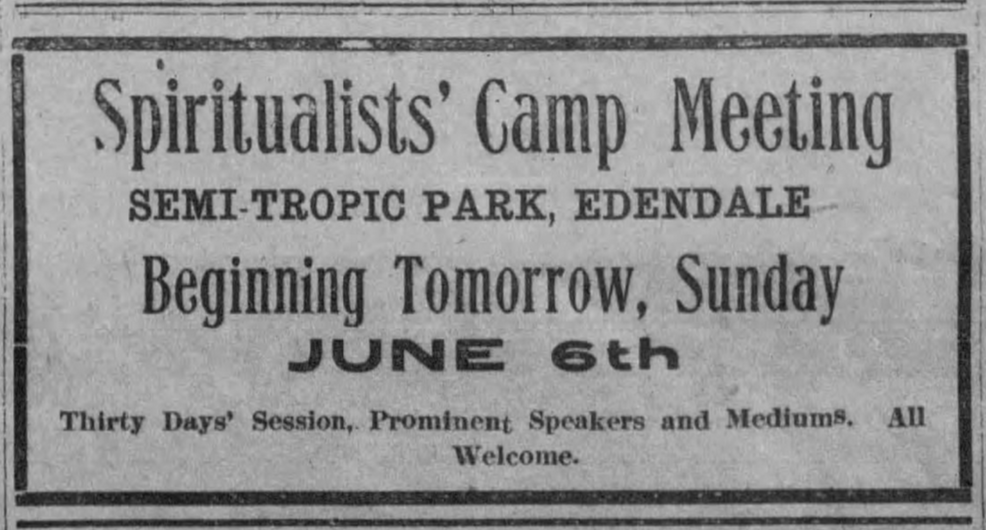
A big announcement was made that a “30 days’ soul treat” would take place at Semi-Tropic Park from 6 June until 6 July. Admission would cost ten cents; a séance, fifteen. Adelaide Brooks would perform music. Featured speakers would include Reverend George B. Warne (president of National Spiritualists’ Association), Reverend George Brooks of Milwakuee, message reader John D. Slater (nicknamed “the Millionaire Medium”), Reverend and Socialist Mary C. Vlasek of the Progressive Society of Spiritual Truth Seekers, Reverend T. Grimshaw of St. Louis, and Professor L. Madison Norris of Washington, DC.
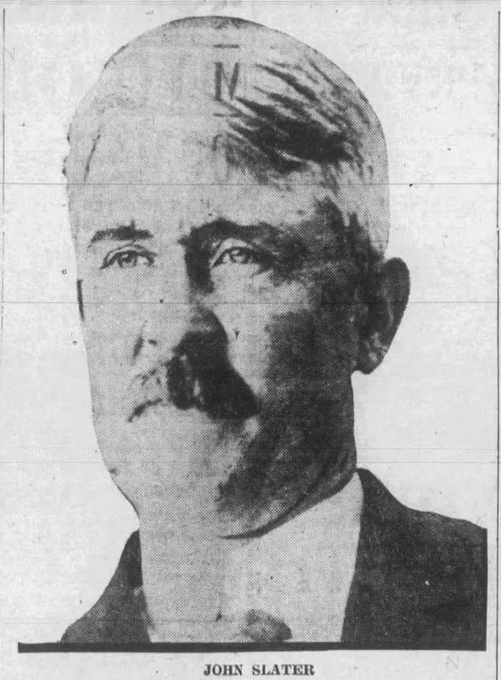
Whenever Spiritualism was covered by The Los Angeles Herald, the tone was nearly always so jokey that it’s difficult to tell what’s fact and what’s an outright joke. One reporter attended an event during the thirty-day-long event and claimed that there were indeed rappings of the sort ghosts often used to communicate with the living — but that upon investigation, the noises proved to be coming from a couple of men playing a game of cribbage at the back of the auditorium. The same account claimed that Slater was downcast because there were “few spooks were in evidence” but that he could be heard muttering that he didn’t care because attendees had already paid their admission fee. The journalist also reported that Slater claimed he could identify “anyone’s name, age, nationality, place of birth and color of socks.” In another edition, a reporter at The Los Angeles Herald wrote that Slater identified a ghost named E. S. Jones, who was “standing behind the woman with the double chin.” “Everyone jumped,” the writer noted. That was the day of the raid.
THE RAID
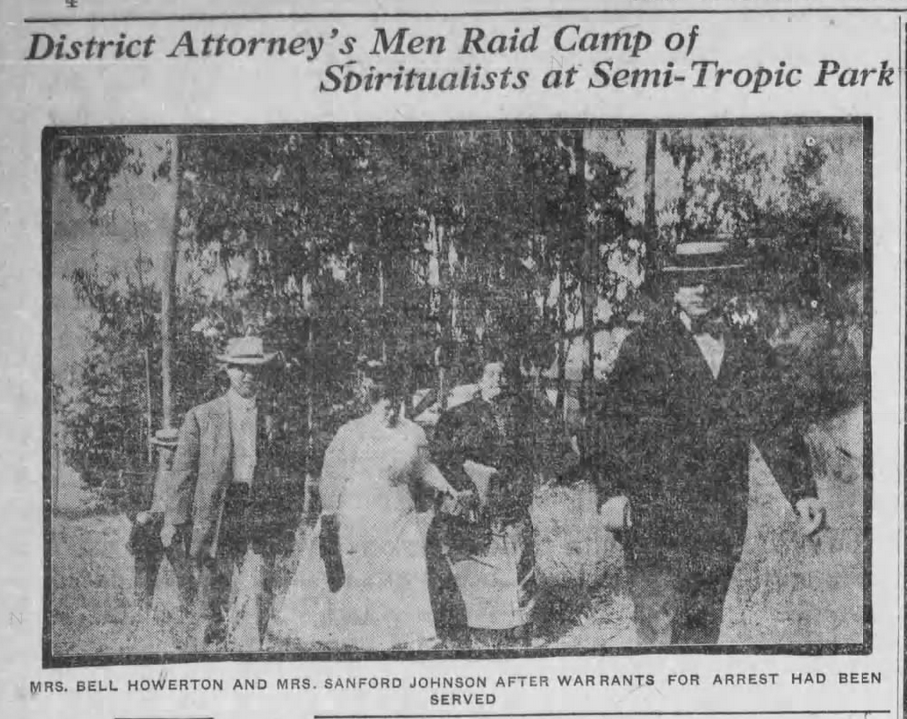
On 19 June, the District Attorney’s office raided the camp. Mediums Belle Howerton, John Slater, Professor Norris, Nettie Howell, Mrs. Sanford Johnson (a psychic), and “Mother” Mary E. Weeks-Wright were all charged with practicing Spiritualism without licenses. Weeks-Wright, then 81, claimed to be the oldest medium alive and to have attended one of Abraham Lincoln’s sittings. She was not made to appear in court. Nettie Howell, by then, managed Semi-Tropic Park as well as Burbank and Howell halls. Howell was also, by 1909, the treasurer of the State Spiritualists’ Association. Justice R. A. Ling dismissed the charges against all.
On 23 June, the Semi-Tropic Spiritualists gathered to decide how best to respond and what steps to take next. Meanwhile, the month-long retreat continued, with 30 June featuring William Capp of San Bernardino (whose lecture was “The Mission and Message of Modern Spiritualism”), William Green, Mrs. Nicholas Cobb, Miss Freda Geltzer, and Mrs. S. A. Steele of Pittsburg. After the event finally ended, other events continued to take place at the park. John A. Morris gave a talk called, “Human Life.” Mrs. Read read messages in August. A November meeting featured Dr. Adah Harmon Patterson, who seems to have returned to the fold, as well as Emily Kratz, Freda Geltzer, and soloist, Marie Brandes.
ANNEXATION AND THE END OF THE SEMI-TROPIC SPIRITUALISTS
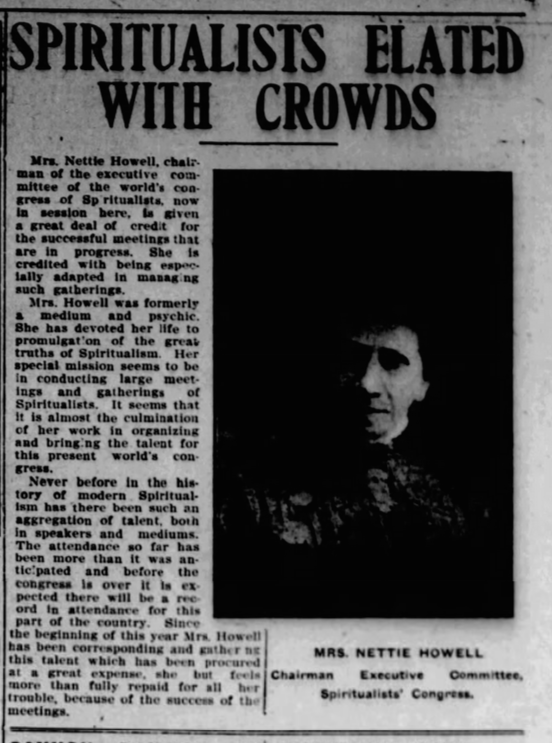
What ultimately seems to have done in the Semi-Tropic Spiritualists was not the harassment of cops and anti-fakirs but something more mundane — the annexation of their tract by Los Angeles on 28 February 1910. The Semi-Tropic Spiritualist Association lobbied the Los Angeles City Council to have a road on their tract paved that August. One of the last mentions of the Semi-Tropic Spiritualists having an event at Semi-Tropic Park followed in October. That month they had a picnic with coffee, lemonade, conferences, speeches, music, lectures and a “good time generally.”
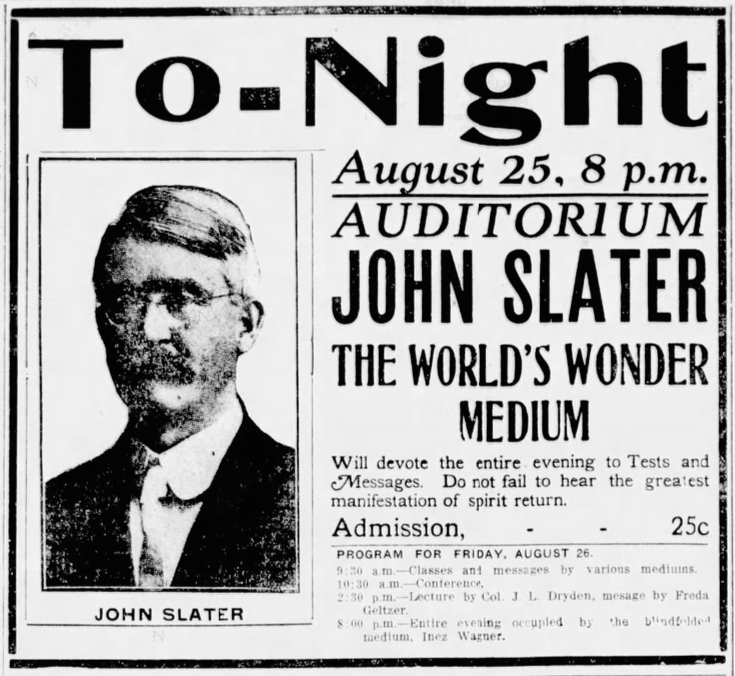
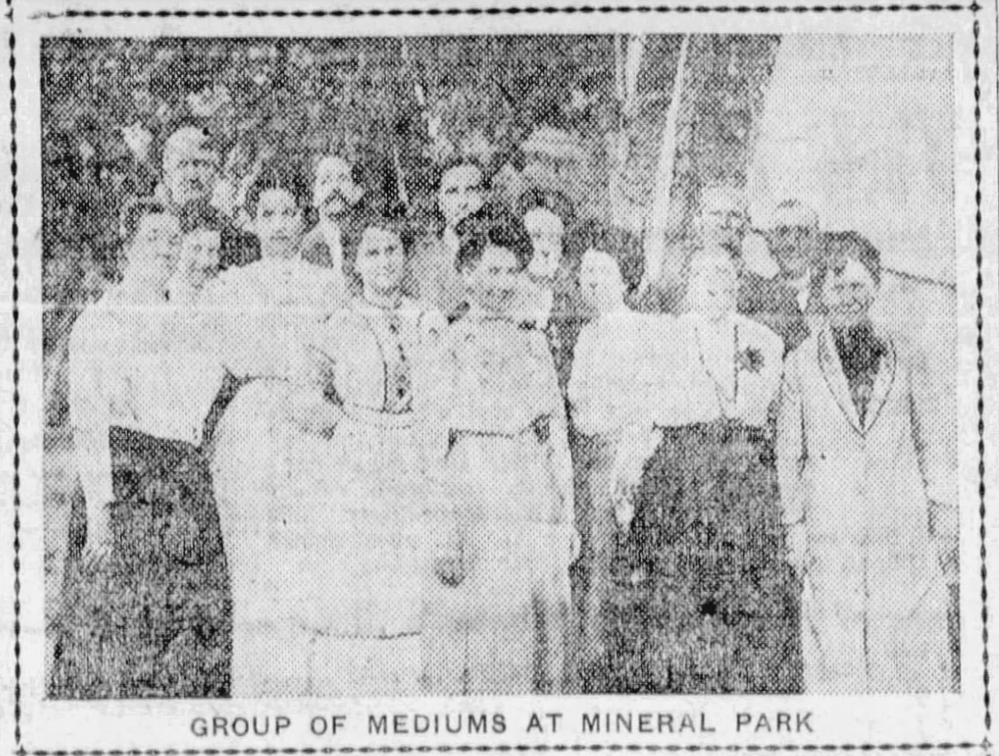
Semi-Tropic Park would continue to host events — albeit not ones organized any longer, specifically, by the Semi-Tropic Spiritualists. Increasingly, the spirits of the dead would soon be joined by something much more frightening – Socialists. That November, all Spiritualists, Socialists and “liberal thinkers” were invited to a free event to hear a communication about the future economic revelation as communicated through a revelation called “Oahope.” The Independent Spiritualists met there for a lecture from Dr. M. A. Schutz of Long Beach with message reading from L. Madison Morris. At the same time, former Semi-Tropic Spiritualists like Nettie Howell and Adah Patterson continued to practice Spiritualism elsewhere. Howell joined John Slater at the the third annual congress of Spiritualists in Long Beach. Many of the former Semi-Tropic Spiritualists appear to have decamped to Mineral Park in South Pasadena between the Ostrich Farm and Arroyo Seco, where they continued, it seems, to hold the sorts of Spiritualist events that they’d formerly held at Semi-Tropic Park. Howell, though, had by then become a “chairman” of the People’s Spiritualist Church.
SEMI-TROPIC PARK WITHOUT THE SEMI-TROPIC SPIRITUALISTS
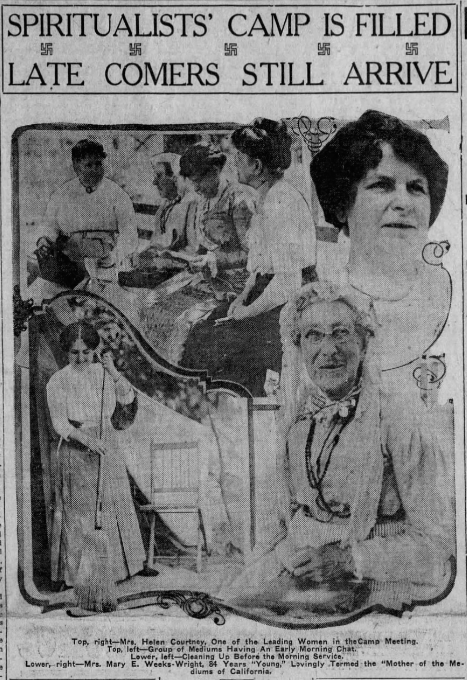
Even though the Semi-Tropic Spiritualists were gone, Semi-Tropic Park continued to host events for a few years. In 1911, Claude Riddle and Stanley Wilson spoke at Socialist meetings there. The case of Semi-Tropic Spiritualists Association v. Peter Johnson was finally, it seems, settled in favor of the Semi-Tropic Spiritualists, in 1912. In May of that year, a name change ordinance was passed that renamed several of the tracts streets, probably because those street names were already in use elsewhere in Los Angeles. Thus, Magnolia Avenue became Modjeska Street, Violet Street became Peru Street, and Evergreen Avenue became Elmore Street. In 1917, Elmore was renamed Elmoran Street.
That June, another ordinance was proposed to, in the words of The Los Angeles Municipal News, “put clairvoyants, astrologers and other seers out of business.” It didn’t pass.
Semi-Tropic Park hosted the People’s Spiritualist Church, the Grace English Lutheran Church, and the Spiritualist Relief Association, which featured Adah S. Harmon Patterson, Dr. N. F. Hazeldine, and Attorney J. C. F. Craig as speakers. Reportedly, 1,000 people were in attendance. A Socialist picnic attracted 1,200 attendees. The most exciting event, though, has to have been the Newsies’ Ball which was thrown and attended by “newsboys and their best girls.” “Famous” newsboys in attendance included “Eggs, Toddy, Waddy, Skeets, Jockey Page, Slats Lee, Cock-Eyed Pat and hundreds of others” according to the Los Angeles Evening Press. Bush’s Ragtime Band provided the music. Attendees danced the Bunny Hug and the Texas Tommy. There were no reports of Bowery dancing.
The ladies auxiliary of the orthodox Jewish Congregation Poalai Zedeck met at the park in 1914. In 1917, 500 girls were invited to the park to audition for film work by Edendale’s West Coast Studio. One last mention of the Semi-Tropic Spiritualist Association is a filing of “non-responsibility of ownership” of Semi-Tropic Park. A few Socialist meetings took place in 1918. The gray and joyless Socialists of Los Angeles County met there for dancing, sports, refreshments. There were addresses by several Socialist politicians including Henry H. Roser, (a candidate for governor), James H. Ryckman (a candidate for Congress’s 10th District), Chaim Shapiro (a candidate for Superior Judge), and Grace Silver Henry (a candidate for Congress’s for 9th District).
LATER YEARS
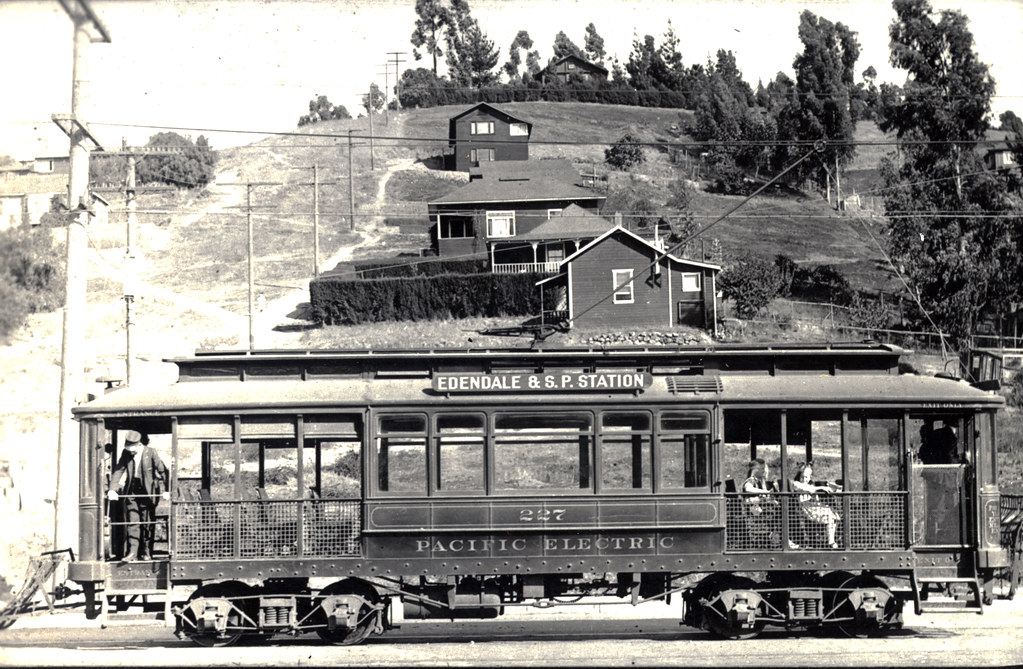
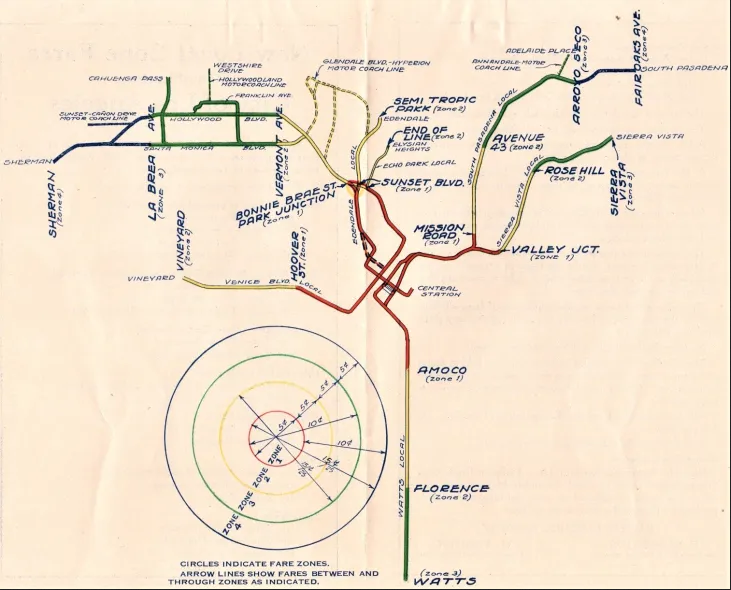
There are still occasional mentions made of former Semi-Tropic Spiritualists into the 1930s. Freda Geltzer was still a practicing medium at least as late as 1918. Mary E. Weeks-Wright’s 91st birthday was covered in newspapers in 1920. The last mention I could find of Semi-Tropic Park was from 1928, when it still appeared in several home listings. It may’ve been abandoned around that time. Nettie Howell died in 1935. So, too, did John Slater — at his home in San Francisco. Pacific Electric stopped operating its Edendale Line to Semi-Tropic Park in 1940. Construction of the 2 Freeway in 1957 obliterated much of Edendale — and certainly rendered what remained decidedly less edenic.
PAUL LANDACRE
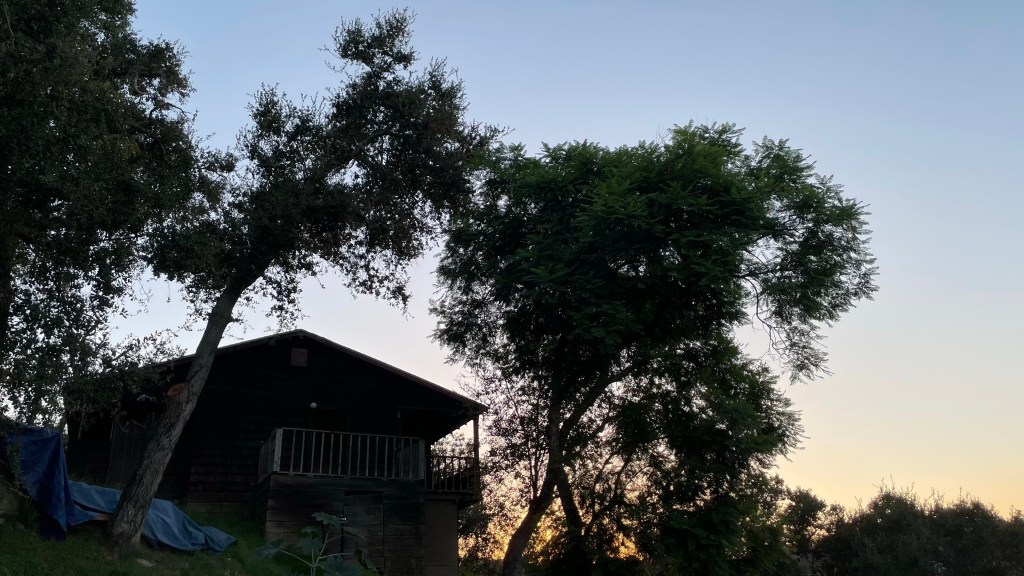
Woodblock artist, Paul Landacre, bought one of the Semi-Tropic Spiritualist Association’s cabins in 1932. According to the site, Pasadena Adjacent, the Landacres were “were card-carrying members of the Semi Tropic Spiritualists Association.” I have my doubts, though, since they didn’t buy the home for 22 years after the Semi-Tropic Spiritualists had left — and Paul would’ve been sixteen years old, at the oldest, when the Semi-Tropic Park Spiritualists ceased to be. There’s also the issue of Pauling having lived in Ohio during the entirety of the Spiritualists’ existence. There’s a bit of an exaggeration on Landacre’s Wikipedia entry too. Their “modest home was perched near the top of an impossibly steep and winding Peru Street.” Either the hill has shrunk or it’s not, actually, impossibly steep — since I went up there on my bicycle last night to take pictures. Maybe, though, I was aided by unseen preternatural forces.
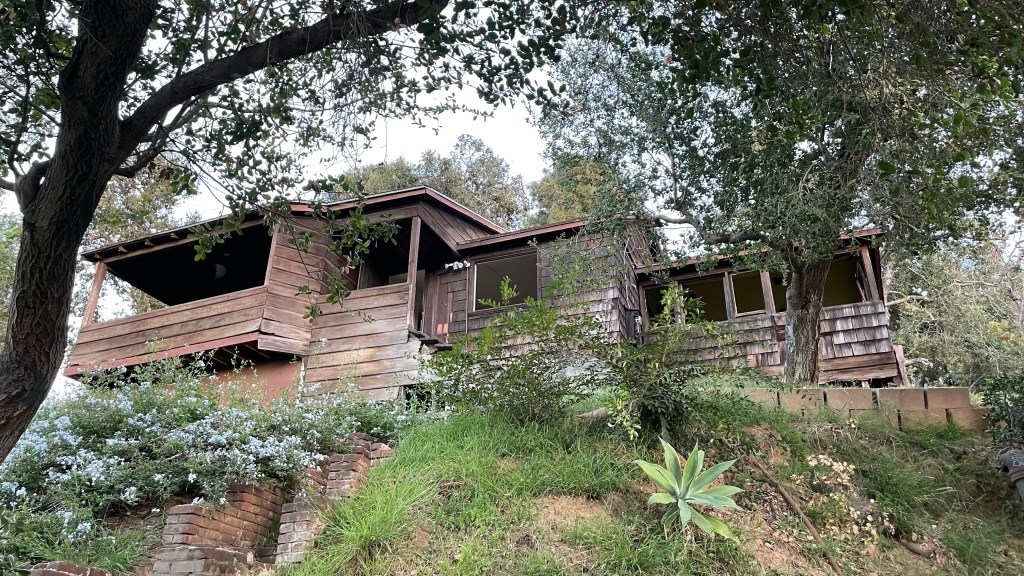
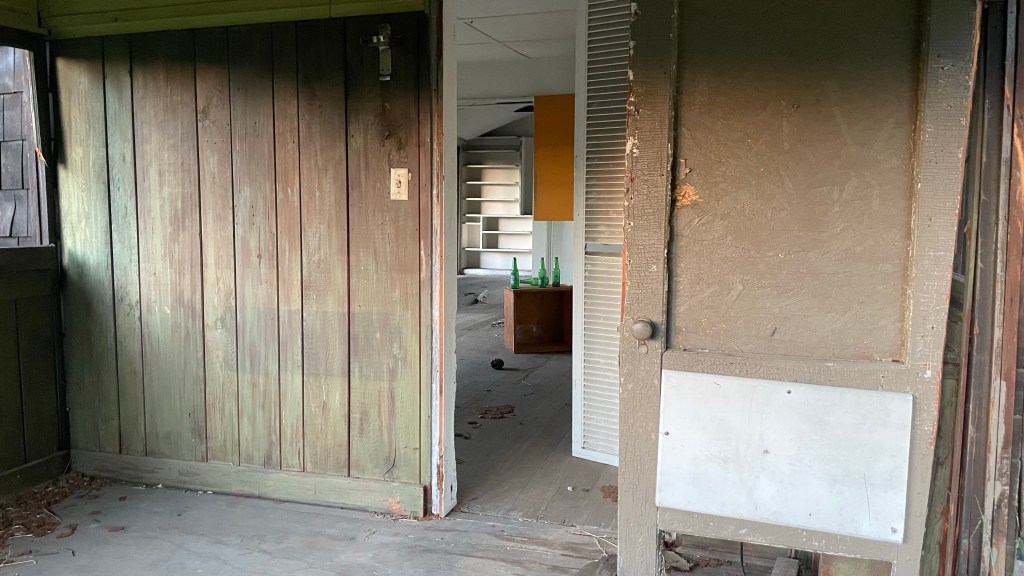
The cabin was declared Los Angeles Historic-Cultural Monument No. 839 but it seems that no one is taking care of it, at all. I counted one intact window when I explored and the floor had rotted away to such an extent that I would strongly advise the curious against entering. And for God’s sake, whatever you do, do not take anything you find there like the tweed-wearing protagonists of M. R. James stories! That said, someone — or something — is drinking Heinekens in there.
Landacre’s wife, Margaret McCreery, died of cancer in 1963. In May of that year, a heartbroken Paul filled his home with gas from his stove on 19 May 1963. An explosion left him with extensive burns. He died from his injuries two weeks later, on 3 June.
DEVELOPMENT OF SEMI-TROPIC PARK
The park, like the cabin, seems to have been neglected for many years. There was a planned development in the 1970s that went nowhere. In the 1990s, I believe, it was fenced off. Then, in January 2007, then-City Councilman Eric Garcetti’s staff hosted a community meeting with an Orange County developer and residents of the neighborhoods to inform them about the planned development, the Semi-Tropic Spiritualists’ Tract Garden Lots.
After the meeting, the developer began felling mature black walnuts, eucalyptus, oaks, queen palms, stone pines, and other trees. A court challenge led by Cindy Ortiz was lost in 2009 when the City Council’s Planning and Land Use Management Committee denied their appeal. The initial developer backed out. Another developer, Planet Home Living, bought the tract in 2011 and renamed it Echo Park 15 @ Allesandro. They partnered with Van Daele Development and, by 2012, when the fifteen-home development was completed, it had been renamed Via Artis (something like “Art Road” in Latin).
The development seems to have awakened an at least passing interest in the Semi-Tropic Spiritualists — or at least their evocative name. Wife-and-husband artists Astri Swensdrud and Quinn Gomez-Heitzeberg began making performance art as the Semi-Tropic Spiritualists in 2012. In 2018, they published the Semi-Tropic Spiritualist Guidebook. In 2015, Daniel W. Finley and Eren Magri opened a cafe/bar (in the Pacific Electric Tract) called the Semi-Tropic, which they described as having a “forest seance vibe.”
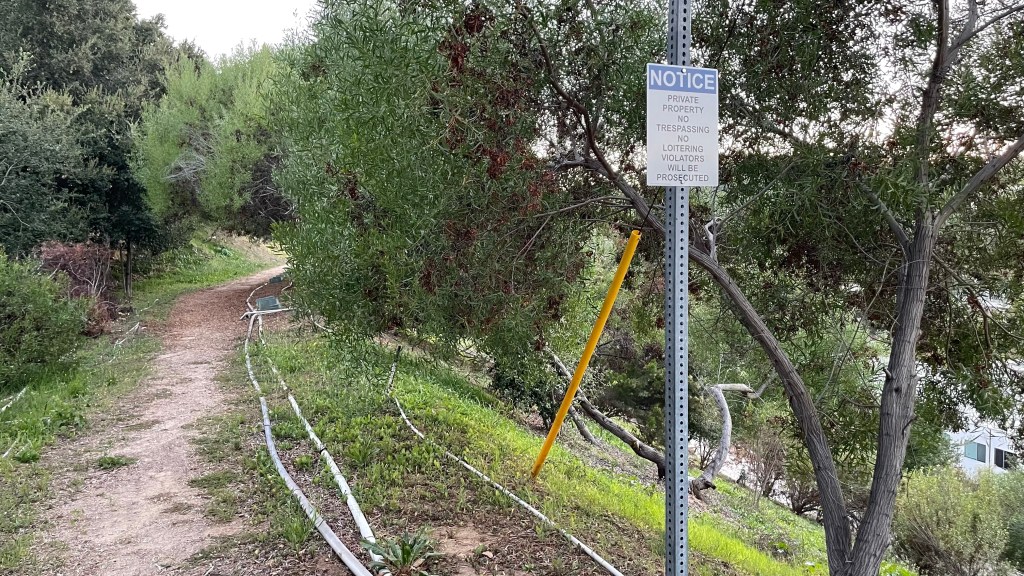
I have friends who live in Via Artis. I wonder if they ever hear any rappings on Halloween or any other night. During my visit to what remains of Semi-Tropic Park, I walked down unpaved El Moran Street and then, a trail through what’s left of Semi-Tropic Park. There were “No Trespassing” signs but I ignored them — just like the mourning doves that took flight as I approached. There were signs that other humans had been there relatively recently — an old chair… a rusty grill. Looking below, I could see the roofs of the Artis Project. Uphill, I could see the spooky Landacre Cabin. I was reminded of the Bates Motel, which was made creepier by its juxtaposition with the Victorian Bates Home looming over it from the hilltop above. The sun was setting. I don’t believe in ghosts but — just to be safe — I didn’t ride directly home. Maybe you should pay a visit. Do be respectful, though, and tell ‘em E. S. Jones sent ya!
FURTHER READING
Paul Landacre’s Aventures in Edendale by Pasadena Adjacent (2012)
The Nature Boys of Edendale: The Spiritualists, the Colburn Institute, the Landacres, and the Destruction of Urban Forests by the Asphalt Island (2017)
Take It On Faith From Point A to Point B with a Pacific Electric Railway Pamphlet With A Spiritualism Connection, April 1928 by homesteadmuseum Posted (2020)
Support Eric Brightwell on Patreon

Eric Brightwell is an adventurer, essayist, rambler, explorer, cartographer, and guerrilla gardener who is always seeking paid writing, speaking, traveling, and art opportunities. He is not interested in generating advertorials, cranking out clickbait, or laboring away in a listicle mill “for exposure.”
Brightwell has written for Angels Walk LA, Amoeblog, Boom: A Journal of California, diaCRITICS, Hey Freelancer!, Hidden Los Angeles, and KCET Departures. His art has been featured by the American Institute of Architects, the Architecture & Design Museum, the Craft Contemporary, Form Follows Function, the Los Angeles County Store, Sidewalking: Coming to Terms With Los Angeles, Skid Row Housing Trust, and the 1650 Gallery.
Brightwell has been featured as subject and/or guest in The Los Angeles Times, VICE, Huffington Post, Los Angeles Magazine, LAist, CurbedLA, Office Hours Live, L.A. Untangled, Spectrum News, Eastsider LA, Boing Boing, Los Angeles, I’m Yours, Notebook on Cities and Culture, the Silver Lake History Collective, KCRW‘s Which Way, LA?, at Emerson College, and the University of Southern California.
Brightwell is currently writing a book about Los Angeles.
You can follow him on Ameba, Duolingo, Facebook, Goodreads, iNaturalist, Instagram, Letterboxd, Mastodon, Medium, Mubi, the StoryGraph, Threads, TikTok, and Twitter.


Fantabulous depth of thought. Thanks, Eric.
LikeLiked by 1 person
Many of the houses are original from the tract, but as you said, stuccoed and redone. The one I’m living in was built in 1910. The Landacre house was up for sale a few years back, and it appeared to have sold to some one…either way they unboarded all the windows and left the doors open. The owner seems to be intentionally destroying the place. Tangentially, the undriveable part of Landa St. is worth walking down as well, very interesting and old neighborhood. I heard lots of Hells Angels lived there, and the insides of their cabins were painted black.
LikeLiked by 1 person