A reservoir is constructed in Silver Lake. After decades of service, the city determines that the water in it isn’t fit to drink and that reservoir is obsolete. It is decommissioned. The city decides to turn it into a park. Not everyone is happy with this plan. Sound familiar? Perhaps, then, you already know the history of the Bellevue Reservoir. Feel free to read on if you need a refresher.
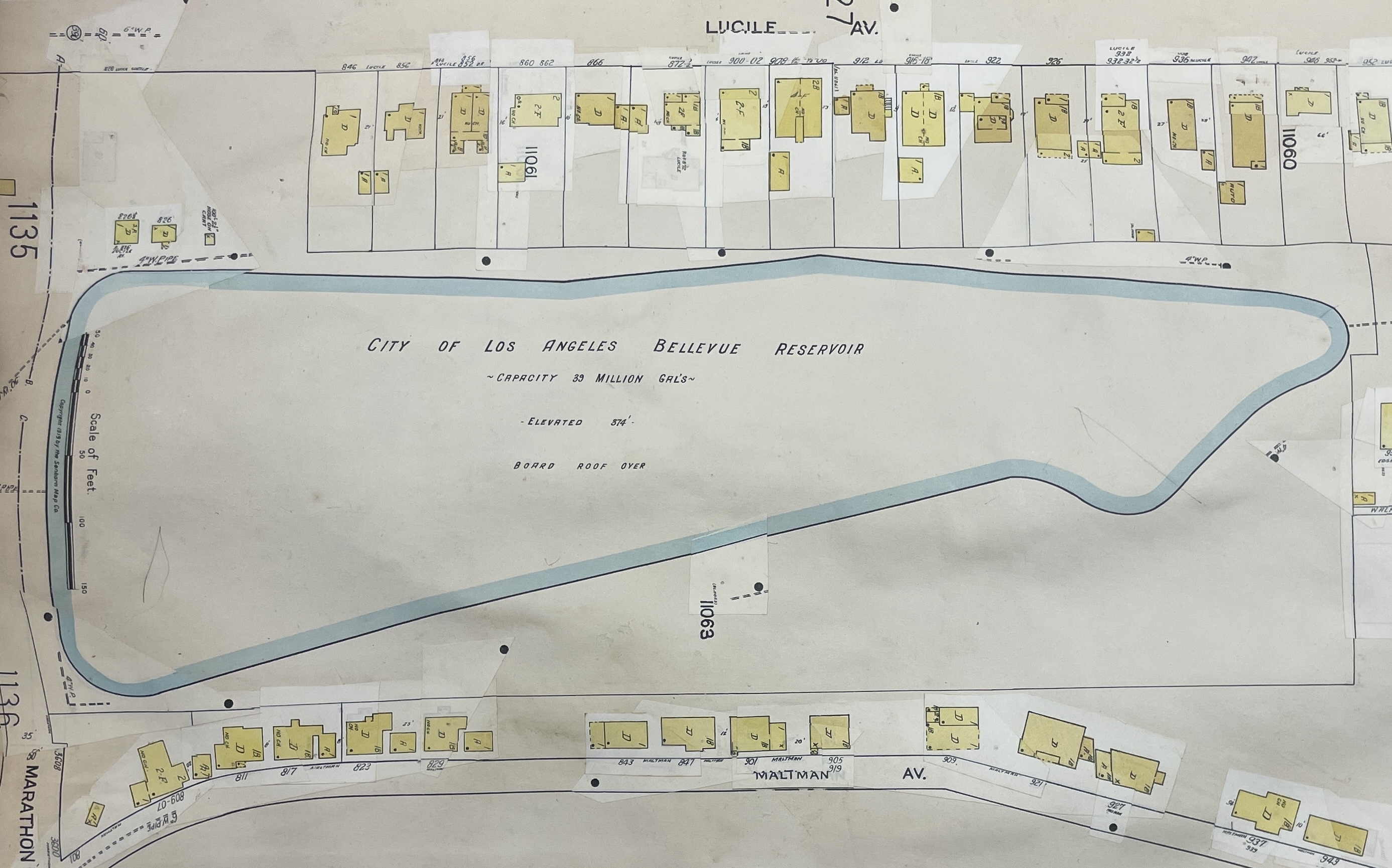

In 1895, the Crystal Springs Land and Water Company built a reservoir in a ravine in the Dayton Heights area called the Bellevue Reservoir. The water that filled the Bellevue Reservoir came from Crystal Springs. Near the intersection of Hyperion and Riverside, a brick conduit spurred off from the Crystal Springs conduit, tunneled beneath the Ivanhoe Hills, and then flowed into the reservoir.


Water arrived via a brick conduit that branched off of the Crystal Springs conduit near the intersection of Hyperion and Riverside and then tunneled beneath the Ivanhoe Hills. The reservoir was forty feet deep and had a capacity of about 41,000,000 million gallons (roughly comparable to the Ivanhoe Reservoir’s 46,000,000 capacity and 33 foot depth). Treated water flowed out of the reservoir through a 48” main that ran beneath to the intersection of Hoover Street to 7th, where it joined a larger water main. By 1897, the Bellevue Reservoir provided almost half the city’s water supply.
A piece in the Los Angeles Evening Post-Record described the new reservoir as “a poet’s paradise.” What sort of poet, writer doesn’t say. Perhaps a French Decadent. It seems that, from the start, the reservoir had its critics. There were the algae blooms… and the odor. The City of Los Angeles took over in 1899 and, in 1902, the Los Angeles Water Department was formed to oversee operations. People continued to complain of the stench. A wooden roof was constructed around 1904. It was replaced with a new roof in 1907.

By then, the city had begun construction of two larger reservoirs nearby, the Ivanhoe in 1905 and the Silver Lake in 1906. By 1912, people were referring to the surrounding neighborhood as Silver Lake. Not to be outshone, the smell of the Bellevue Reservoir impelled the Water Works Laboratory Director, Carl Wilson, to introduce an ordinance in 1924 to prohibit the keeping of chickens and other fowl within 100 feet of any reservoir. A new roof was installed in 1928. The Bellevue Reservoir continued to provide water, despite its problems, until 1955.


At that point, the city decided to turn the decommissioned reservoir into a park. It would not be the first such reservoir-to-park conversion. Back in 1892, Reservoir No. 4 had been transformed into Echo Lake — the centerpiece of the city’s beloved Echo Park. The city announced its intention to fill the empty reservoir with street sweepings for the next six years. Once full, it would become a park. There were protests. A reported 250 Silver Lakers voiced concerns about noise, danger to children, and increased traffic that the reservoir-to-park conversion might create. The cost was not inconsiderable, either. Proposition B was passed — which directed the city to spend $39,000,000 ($520,563,114 in 2023 dollars) on the construction of eighteen city parks — including one at Bellevue. In 1955, the Los Angeles Department of Water and Power transferred the property to the Department of Public Works, who built the Bellevue Recreation center next to the decommissioned reservoir. On 1 May 1959, operation of the recreation center and park was transferred to the Department of Recreation and Parks.
Ever since its creation, 64 years ago, Bellevue Park has been the largest park in Silver Lake — more than twice the size of the Silver Lake Recreation Center and larger than the combined area of the Silver Lake Meadow, Tommy Lasorda Field of Dreams, and Tesla Pocket Park — Silver Lake’s only other parks, at present. It has baseball diamonds, basketball courts, grills, a gymnasium, a jogging path, a nursery school, a playground, and a stage. It hosts after school programs, cultural programs, cheerleading, fitness classes, flag football, Frisbee, futsal, volleyball… and on occasion, the odd Silver Lake Neighborhood Council event.
Support Eric Brightwell on Patreon

Eric Brightwell is an adventurer, essayist, rambler, explorer, cartographer, and guerrilla gardener who is always seeking paid writing, speaking, traveling, and art opportunities. He is not interested in generating advertorials, cranking out clickbait, or laboring away in a listicle mill “for exposure.”
Brightwell has written for Angels Walk LA, Amoeblog, Boom: A Journal of California, diaCRITICS, Hey Freelancer!, Hidden Los Angeles, and KCET Departures. His art has been featured by the American Institute of Architects, the Architecture & Design Museum, the Craft Contemporary, Form Follows Function, the Los Angeles County Store, Sidewalking: Coming to Terms With Los Angeles, Skid Row Housing Trust, the 1650 Gallery, and Abundant Housing LA.
Brightwell has been featured as subject and/or guest in The Los Angeles Times, VICE, Huffington Post, Los Angeles Magazine, LAist, CurbedLA, Office Hours Live, L.A. Untangled, Spectrum News, Eastsider LA, Boing Boing, Los Angeles, I’m Yours, Notebook on Cities and Culture, the Silver Lake History Collective, KCRW‘s Which Way, LA?, All Valley Everything, Hear in LA, KPCC‘s How to LA, at Emerson College, and at the University of Southern California. He is the co-host of the podcast, Nobody Drives in LA.
Brightwell has written a haiku-inspired guidebook, Los Angeles Neighborhoods — From Academy Hill to Zamperini Field and All Points Between, that he hopes to have published. If you’re a literary agent or publisher, please contact him.
You can follow him on Ameba, Duolingo, Facebook, Goodreads, iNaturalist, Instagram, Letterboxd, Mastodon, Medium, Mubi, the StoryGraph, Threads, TikTok, and Twitter.


 Eric Brightwell
Thanks for your article about Bellevue Reservoir, Eric! I have vivid memories of playing down there in 1956. It was partly filled by trash, with long boards that we made into giant teeter-totters. A sump pond at the north end harbored huge iridescent dragonflies. It was ringed by 4 times the present trees, which seemed to poke a patch of clear blue sky in LA’s smog layer. I used discarded wood to build a treehouse 15′ from the top of a swaying pine, in view of my Maltman home, worrying my parents. Got to add a page with pix to my own website, someday.
Mike Jittlov
LikeLiked by 1 person