

In the 2000s, Amoeba Music enlisted an army of writers and data entry people to work on an ambitious website that was meant to be a sort of combination of Allmusic, Apple Music, Discogs, Wikipedia, and more. Despite investing a tremendous amount of time, labor and money, the site, as envisioned, never got off the ground. In 2020 — without so much as a head’s up — the plug was pulled. Not only did all of the work of those who toiled in “the Dungeon” quietly die; the musician biographies we wrote were mothballed, Movies We Like vanished, and the celebrated Amoeblog was wiped from the website. Luckily, the Wayback Machine has preserved most of it, allowing me to retrieve my work and post it here, with minimal editing, because I think so some of what we did there was worth more than just a wage.
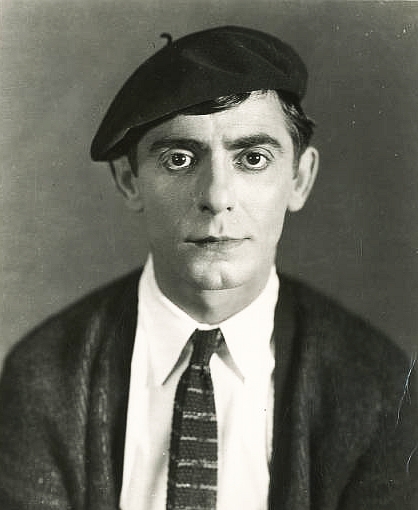
Eddie “Banjo Eyes” Cantor, was an American comedian, dancer, actor, singer, songwriter, and music video pioneer. During his heyday, the outspokenly progressive entertainer was both hugely controversial and popular. Today, he’s a prime example of the superstar who becomes virtually unknown over the decades following their death.
Cantor was born Isidore Itzkowitz on 31 January 1892 in Manhattan‘s Lower East Side. His parents, Meta and Mecel, were Jewish immigrants from Russia. Edward’s mother died in childbirth when he was just one year old. When he was two, his father died of pneumonia. At that point, the young boy was taken in by his grandmother, Esther Kanrowitz.
Whilst attending Surprise Lake Camp in Cold Spring, New York, he was mistakenly listed under his grandmother’s name, which was then shortened to “Kanter.” He began singing and juggling on street corners and soon moved to talent contests. In 1903, he met his future wife, Ida Tobias, who reportedly convinced him that “Eddie” was a better showbiz name than “Izzy.” Still in his early teens, he began working both as a waiter and singer at Carey Walsh‘s Coney Island saloon, where he was accompanied on piano by a young Jimmy Durante. Cantor made to move to Vaudeville and was a billed name by 1907, using the spelling, “Eddie Cantor.”

Whilst in Los Angeles, Cantor was spotted by composer Earl Carroll, who signed him to his show, Canary Cottage. In Gus Edwards’s Kid Kaberet, in 1912, he was the only performer under twenty and debuted his blackface character, Jefferson. The following year he appeared in his first film, Widow at the Races. In 1914, he married Ida. In 1915, she gave birth to Marjorie who was followed by Natalie in 1916.
After getting the attention of Florenz Ziegfeld, Cantor came to New York City to appear on Broadway in the producer’s Midnight Frolic. After Ziegfeld Follies of 1917, Cantor became one of the most popper stars of Broadway and he cut, “That’s the Kind of Baby For Me” on Victor. Ziegfeld Follies of 1918 followed, for which he co-wrote “Broadway’s Not a Bad Place After All” with Harry Ruby. For the 1919 follies, he was the lyricist for “(Oh! She’s the) Last Rose of Summer.” He and Ida had their third daughter, Edna. For his role in the strike by the Actors Equity Association that forced the closure of Broadway theaters, he was fired by Ziegfeld in 1920.
For the next two years, Cantor recorded for Emerson Records, including the hits “Margie,” “Palesteena,” and “Snoops, The Lawyer.” He also starred in two productions of Ziegfled’s rivals, the Schuberts. In 1921, the Cantors had another daughter, Marilyn. That year he signed an exclusive contract with Columbia Records. On 3 February 1922, Cantor turned to radio, singing on the Westinghouse Electric and Manufacturing Company network’s program, Make it Snappy. Kid Boots (1923) opened on 31 December 1923 at the Earl Carroll Theatre and then moved to the Selwyn Theatre for a total of 489 performances. To promote it, Cantor appeared in an early form of music video, for DeForest Phonofilm‘s sound-on-film, “A Few Moments with Eddie Cantor, Star of ‘Kid Boots’.”

With his tail between his legs, Ziegfeld re-hired the mega star. He starred in his first full-length film, the cinematic adaptaion of Kid Boots (1926). He starred in The Ziegfeld Follies of 1927. That year he also acted in another film, Special Delivery (1927), and he and Ida had another daughter, Janet. The short film, That Party in Person (1928), followed and another revue, Whoopee!, opened on Broadway at the New Amsterdam Theatre on December 4, 1928 and closed on 23 November 1929 after 407 performances.
The stock market crash of 1929 left the previously multi-millionaire Cantor in deep debt. He responded by diversifying his talents. A best-selling line of autobiographic books and cartoons, including Caught Short! A Saga of Wailing Wall Street, 1929 A.C. (After Crash) and Yoo Hoo Prosperity helped restore his fortunes. The short film, A Ziegfeld Midnight Frolic (1929) and Glorifying the American Girl (1929) were followed by him signing a contract with Samuel Goldwyn. The filmed version of Whoopee! (1930) established Cantor as a movie star and restored him to riches.
For the remainder of the decade, Cantor was one of the biggest stars of radio and Hollywood. His appearance on Rudy Vallée‘s The Fleischmann’s Yeast Hour on 5 February 1931 led to a four-week tryout with NBC‘s The Chase and Sanborn Hour as a replacement for Maurice Chevalier. He was a success, becoming, as a result, the highest paid figure in radio. He appeared in the films. Palmy Days (1931) and Eddie Cantor at the Palace (1931), Talking Screen Snapshots (1932), The Kid from Spain (1932), and Roman Scandals (1933) followed. That year, he became the second president of the Screen Actors’ Guild, serving until 1935.
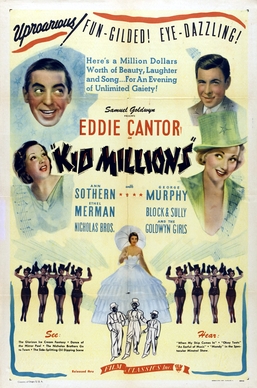
More films followed: Kid Millions (1934), The Hollywood Gad-About (1934), and Strike Me Pink (1936). By this point Cantor was so popular that he was merchandising products including Cantor Cards and his Tell It to the Judge board game, for Parker Brothers. In 1937, he acted in Ali Baba Goes to Town (1937). In 1939, he again courted controversy head on when, at the 1939 New York World’s Fair, Cantor publicly denounced Father Charles Coughlin, a then-prominent Catholic priest who used his weekly radio program to attack Jews and Franklin Roosevelt — and to praise Adolf Hitler and Benito Mussolini. As a result of his controversial criticism of a popular bigot, he was dropped by his sponsor, Camel cigarettes.
Despite the controversy, Cantor’s career continued to move forward in the 1940s. He appeared in the film, Forty Little Mothers (1940). He was the only living person ever to be depicted as a balloon in theMacy’s Thanksgiving Day Parade. He hosted his own NBC radio show, Time to Smile. Despite sharing its title with Cantor’s nickname, Banjo Eyes (1941) was a musical based on the play Three Men on a Horse by John Cecil Holm and George Abbott. It was followed by Thank Your Lucky Stars (1943) and Hollywood Canteen (1944). Show Business (1944) was self-produced, somewhat autobiographical, and RKO‘s biggest hit of the year. In 1946, Cantor’s first radio show ended and he went on to host The Pabst Blue Ribbon Show through 1949. American Creed (1946) and Nellie Bly (1946) were followed by his last starring role in a film, If You Knew Susie (1949). That year he hosted the radio game show, The $64 Question.
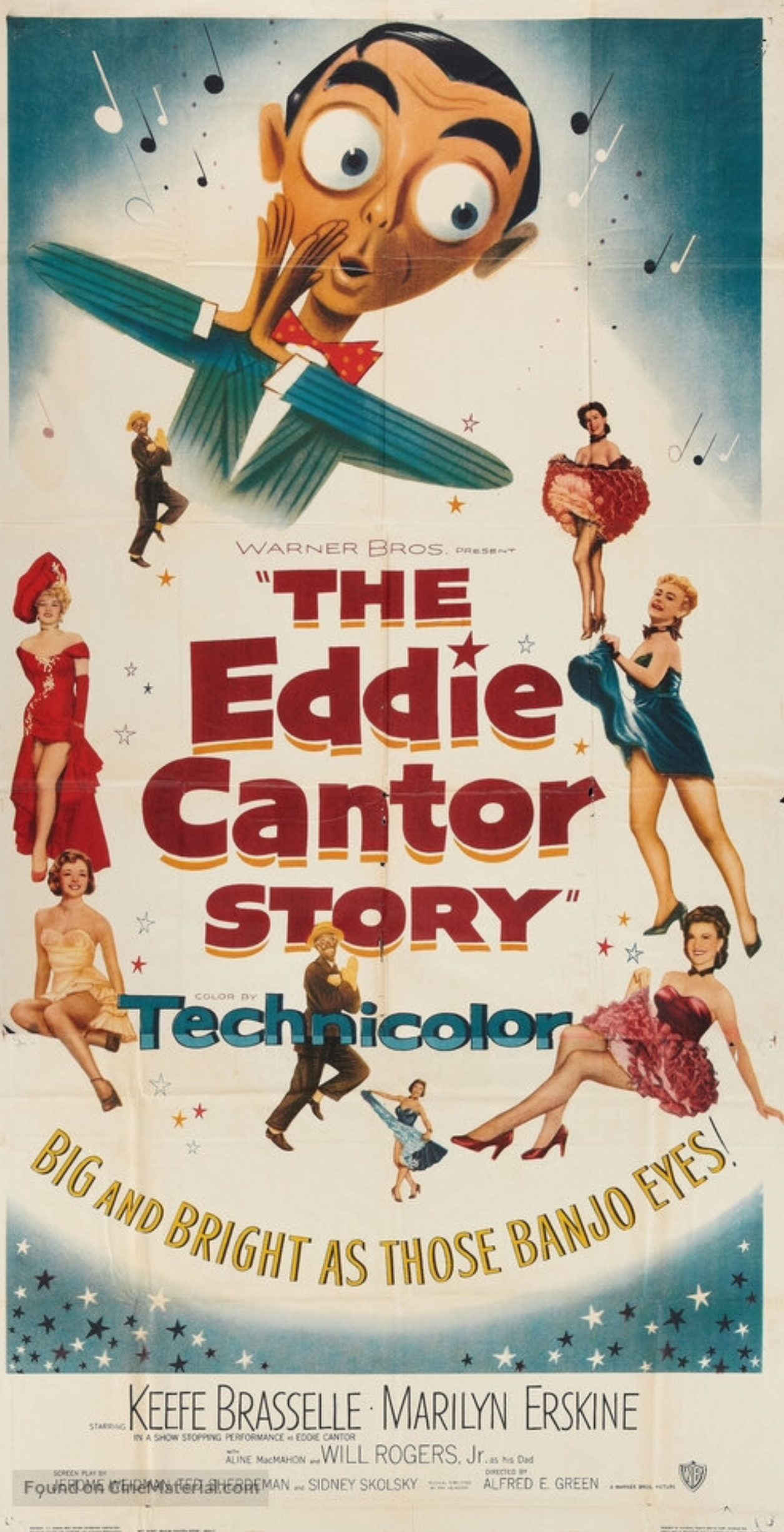
The 1950s marked a shift in Cantor’s focus to television and a slowing of his output. He was an alternating host on The Colgate Comedy Hour, where he recounted his career, sang many of his hits, and introduced guests. It was later released on DVD as Eddie Cantor in Person. In 1952 he appeared in The Story of Will Rogers (1952) and also began hosting a weekly program for Philip Morris, rivals to his old bosses at Camel.
Cantor suffered a heart attack in September 1952. The following year, hoping to replicate the success of The Jolson Story, Warner Bros. filmed The Eddie Cantor Story. In his memoir, All My Best Friends, George Burns observed that Warner Bros. had created a miracle by producing a movie that “made Eddie Cantor’s life boring.” By 1954, Cantor was too ill to continue hosting his television show and made his final Colgate appearance in May. In 1959, his eldest daughter, Marjorie, died of cancer. Another heart attack led to his permanent retirement. Ida died in August 1962. Two years later, on Eddie Cantor suffered another heart attack and died, aged 72, 10 October 1964 in Beverly Hills. He is buried in Hillside Memorial Park Cemetery in Culver City. His autobiographies, My Life is in Your Hands (co-written with David Freedman) and Take My Life (co-written with Jane Kesner Ardmore) were both republished in 2000.
Support Eric Brightwell on Patreon

Eric Brightwell is an adventurer, essayist, rambler, explorer, cartographer, and guerrilla gardener who is always open to paid writing, speaking, traveling, and art opportunities. He is not interested in generating advertorials, cranking out clickbait, or laboring away in a listicle mill “for exposure.”
Brightwell has written for Angels Walk LA, Amoeblog, Boom: A Journal of California, diaCRITICS, Hey Freelancer!, Hidden Los Angeles, and KCET Departures. His art has been featured by the American Institute of Architects, the Architecture & Design Museum, the Craft Contemporary, Form Follows Function, the Los Angeles County Store, Sidewalking: Coming to Terms With Los Angeles, Skid Row Housing Trust, the 1650 Gallery, and Abundant Housing LA.
Brightwell has been featured as subject and/or guest in The Los Angeles Times, VICE, Huffington Post, Los Angeles Magazine, LAist, CurbedLA, LA Times 404, Marketplace, Office Hours Live, L.A. Untangled, Spectrum News, Eastsider LA, Boing Boing, Los Angeles, I’m Yours, Notebook on Cities and Culture, the Silver Lake History Collective, KCRW‘s Which Way, LA?, All Valley Everything, Hear in LA, KPCC‘s How to LA, at Emerson College, and at the University of Southern California. He is the co-host of the podcast, Nobody Drives in LA.
Brightwell has written a haiku-inspired guidebook, Los Angeles Neighborhoods — From Academy Hill to Zamperini Field and All Points Between; and a self-guided walking tour of Silver Lake covering architecture, history, and culture, titled Silver Lake Walks. If you’re an interested literary agent or publisher, please out. You may also follow on Bluesky, Duolingo, Facebook, Goodreads, iNaturalist, Instagram, Letterboxd, Medium, Mubi, Substack, Threads, and TikTok.


 Eric Brightwell
Dear Eric,
I’m interested in using the San Gabriel valley image for our Stanford University Urban Studies website. A student wrote their thesis on the Asian enclave in San Gabriel Valley. We will offer a credit line.
Let me know what you think. Thank you!
Patricia Jacobus pjacobus@stanford.edu
LikeLike