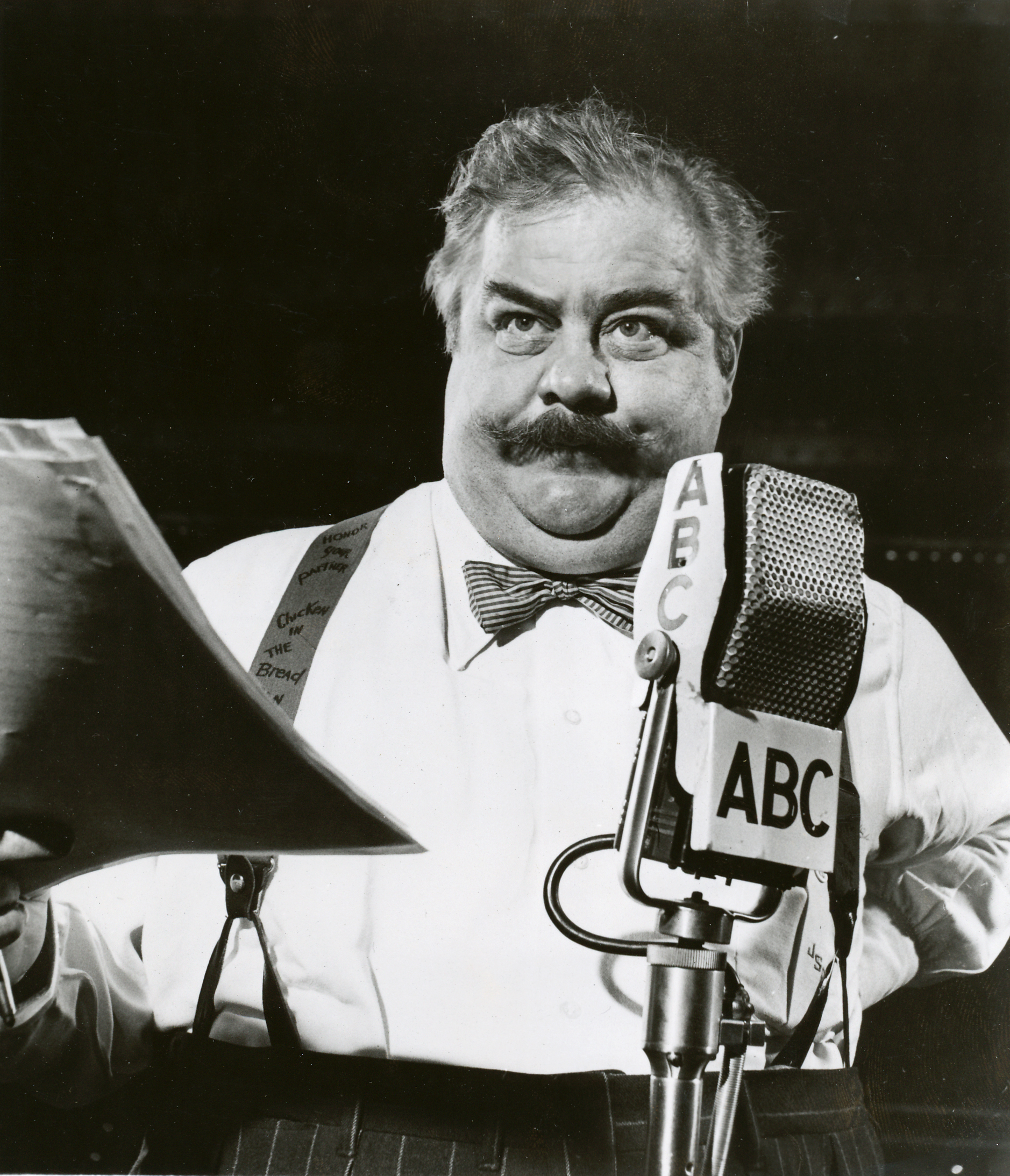
The Fat Man was a popular radio detective drama that debuted on this date (21 January) in 1946. It starred J. Scott Smart as the titular detective who, although best known as “the Fat Man,” was actually named Brad Runyon. His deep, resonant, rich, and slightly theatrical voice was occasionally described as “fruity,” which fit the character of the gourmand Smart was both in and out of character.
Although inevitably credited to hard-boiled detective novelist Dashiell Hammett, The Fat Man was pretty much wholly developed by radio (and later, television) producer Emanuel “Mannie” Rosenberg (known professionally as “E. J. Rosenberg”) — who also produced The Adventures of Nero Wolfe (1950–1951).
Although marketed as “Dashiell Hammett’s The Fat Man” and marketed as “Dashiell Hammett’s most exciting character,” the writer’s actual contributions were fairly limited. In 1933, Hammett had published his novel, The Thin Man, which had spawned a successful film franchise. “The Fat Man,” was the title of Chapter 11 of Hammett’s novel, The Maltese Falcon — where it refers to the antagonist, named Casper Gutman. Hammett’s biggest contribution, though, was the use of his name. In 1949, he told a writer from The Martha’s Vineyard Gazette:
“My sole duty in regard to these programs is to look in the mail for a check once a week. I don’t even listen to them. If I did, I’d complain about how they were being handled, and then I’d fall into the trap of being asked to come down and help. I don’t want to have anything to do with the radio. It’s a dizzy world — makes the movies seem highly intellectual.”
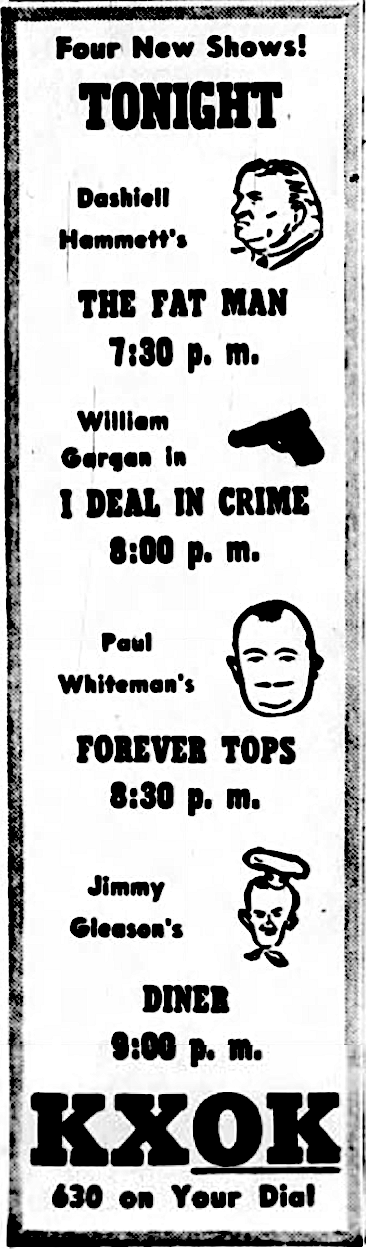
If radio existed to make the movies seem highly intellectual, television did the same for radio — and despite Hammett’s dismissal, the writing on The Fat Man was often sharp and funny. The series’ main writer was Richard Ellington, creator of his own series of detective novels about a Manhattan-based private eye named Steve Drake. Other scripts were written by Lawrence Klee and Robert Sloane. The series was directed by Clark Andrews. The Fat Man was produced by and broadcast from WJZ in New York City. It was carried by the American Broadcasting Company (ABC), who presented it as part of a block of programming which also included I Deal in Crime, Forever Tops, and Jimmy Gleason’s Diner.
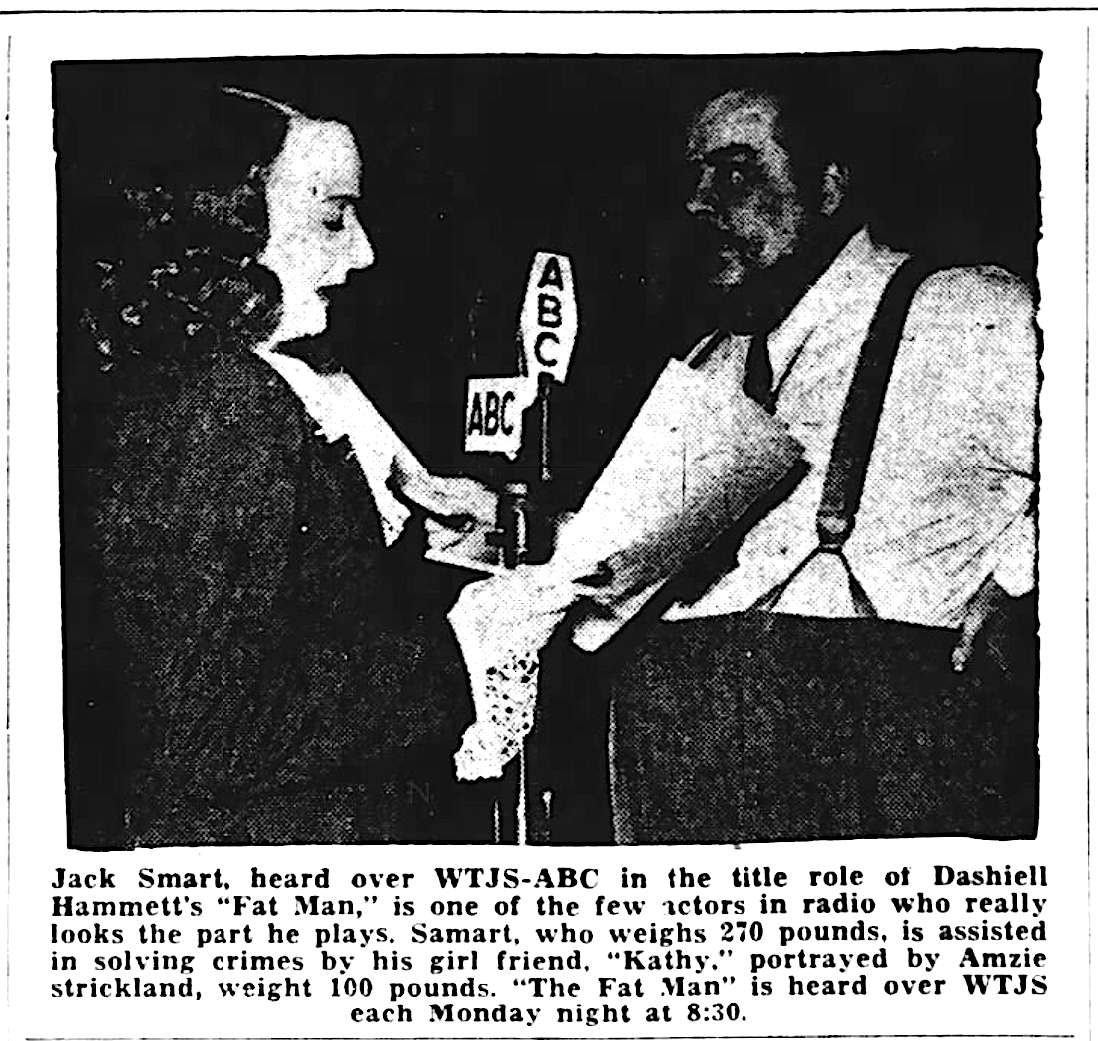
Runyon’s character enjoyed large meals and the program was sponsored by Norwich Pharmaceutical Company, the makers of Pepto-Bismol. Each episode began with the detective entering a drugstore and weighing himself — announced by the sonic signature of a penny dropping. The announcer would say: “Weight: 237 [or 241] pounds. Fortune: Danger. Who is it? The Fat Man!” In real life, Smart topped the scale around 270 pounds (122 kilograms).
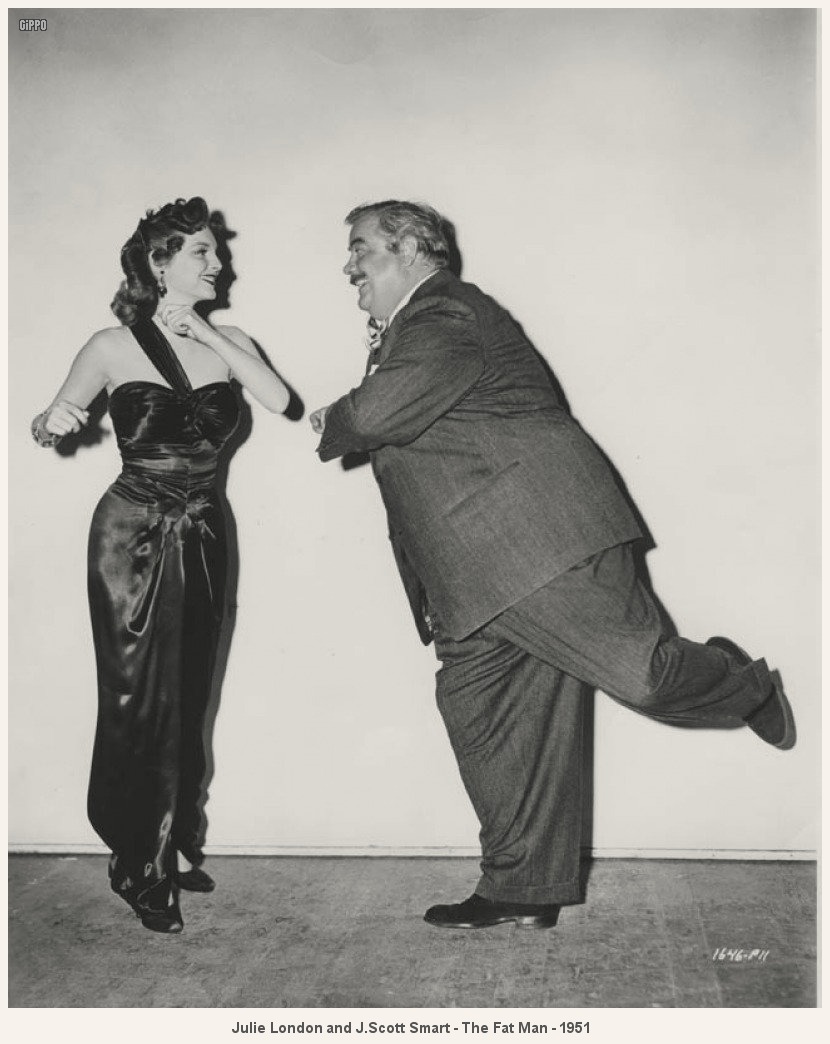
Smart was born John Kenley Tener Smart in Philadelphia in 1902. Despite his stature, he was a dancer who won at least one Charleston competition and performed with Hedda Hopper and Julie London. He began acting in a Buffalo stock company in 1925. His Broadway credits include Separate Rooms (1939) and A Bell for Adano (1944).
Smart married Alice Coy Wright on 23 July 1931. They celebrated at least three wedding anniversaries but divorced at some point before he re-married Mary-Leigh Call in 1951. Despite his relationships, a profile in Radio Life described him as a “reclusive, extremely shy and even lonely man. In the 1930s, he acted in many radio series, including The March of Time, The Fred Allen Show, Whispering Tables, and Theatre Guild.
The program’s score was written by Bernard Green and performed by his eleven piece orchestra. Sound effects were created by Ed Blaney. The program’s announcers were Charles Irving and Gene Kirby. Rounding out the cast were Amzie Strickland as the Fat Man’s girlfriend, Cathy Evans; Betty Garde; Dan Ocko; Ed Begley as Sgt. O’Hara; Linda Watkins;Mary Patton as Lila North; Nell Harrison as the Fat Man’s mother; Paul Stewart; Robert Dryden; Rolly Bester; and Vicki Vola.
The Fat Man was popular and in 1950, master huckster/filmmaker, William Castle, directed a low budget cinematic adaptation written by Harry Essex and Leonard Lee. It starred Smart in the title role alongside Clinton Sundberg, Jayne Meadows, his former dance partner Julie London, Parley Baer, and a young Rock Hudson. Filming was concluded in August 1950. The film had its premiere in Buffalo on 9 May 1951, followed by its New York City opening on 24 May 1951. There was no mention of Hammett, however, because he was under an investigation for his Leftist political leanings.
On 9 July 1951, Hammett refused to provide information regarding the contributors to a bail fund for the Civil Rights Congress (CRC), of which he was a trustee. He was found to be in contempt of court and sent to the Federal House of Detention in New York City. He was then transferred to West Virginia before ending his sentence at the Federal Correctional Institution in Ashland, Kentucky on 9 December 1951.
Although popular, the radio program was tarred by its association with Hammett, Norwich withdrew its sponsorship and the program became a sustainer for its last season. The American Chicle Company (makers of Chiclets, Clorets, and Dentyne) withdrew its sponsorship in September. The Fat Man ended its run on 26 September 1951. On 26 March 1953, Hammett would appear before the Senate Permanent Subcommittee on Investigations where he was questioned by Senator Joseph McCarthy and counsel (and Donald Trump mentor) Roy Cohn. Hammett invoked the Fifth Amendment and avoided another prison sentence but was blacklisted by Hollywood. Hammett became a hermit and died on 10 January 1961 of lung cancer.
Unfortunately, there was little incentive for ABC or the sponsor to preserve or syndicate the master recordings and although at least 271 episodes are known to have been made, only ten are in circulation today. Luckily, however, the Fat Man enjoyed something of a second career in Australia. Due to strict currency regulations and high import costs, it was often more economical for Australian production companies to purchase American scripts and record them locally with Australian actors than to import the original recordings. Thus The Fat Man — as well as Lux Radio Theatre (1939–1964), When a Girl Marries (1946–1965), Superman (1949–1954), Dr. Paul (1949–1970), Lady in Distress (1950), Night Beat (1950–1952), Dossier on Dumetrius (1951), Dragnet (1952–early 1960s), Portia Faces Life (1952–1970), The Inner Sanctum (1952–1958), Mr. and Mrs. North (1952), Philip Marlowe Investigates (1953), Mystery is My Hobby (1954), Life Can Be Beautiful (1954), The Guiding Light (1959) — all were remade in Australia.
The Australian adaptation of The Fat Man debuted on the Australian Broadcasting Commission (The ABC), starring Lloyd Berrell, debuted on 9 September 1954. It ran for 52 episodes, concluding in late 1955 and was later picked up for syndication by Artansa. Of those, 36 are in circulation. Surviving episodes of The Fat Man can be listened to on the Internet Radio Archive.
After The Fat Man‘s cancellation, Smart largely retired from acting (he appeared in a 1955 production of Waiting for Godot). He and his wife moved to the Perkins Cove area, of Ogunquit, Maine, where he turned his interest to collage, painting, and sculpture. The couple lived in a fisherman’s shack. He died of cancer on 15 January 1960. After his death, his widow toured Europe for nine months with her life partner, a teacher named Beverly Hallam. In 1970, the couple purchased additional land in York where, in 1971, they built a duplex. In 1988, they co-founded an artists’ colony there, the Surf Point Foundation.
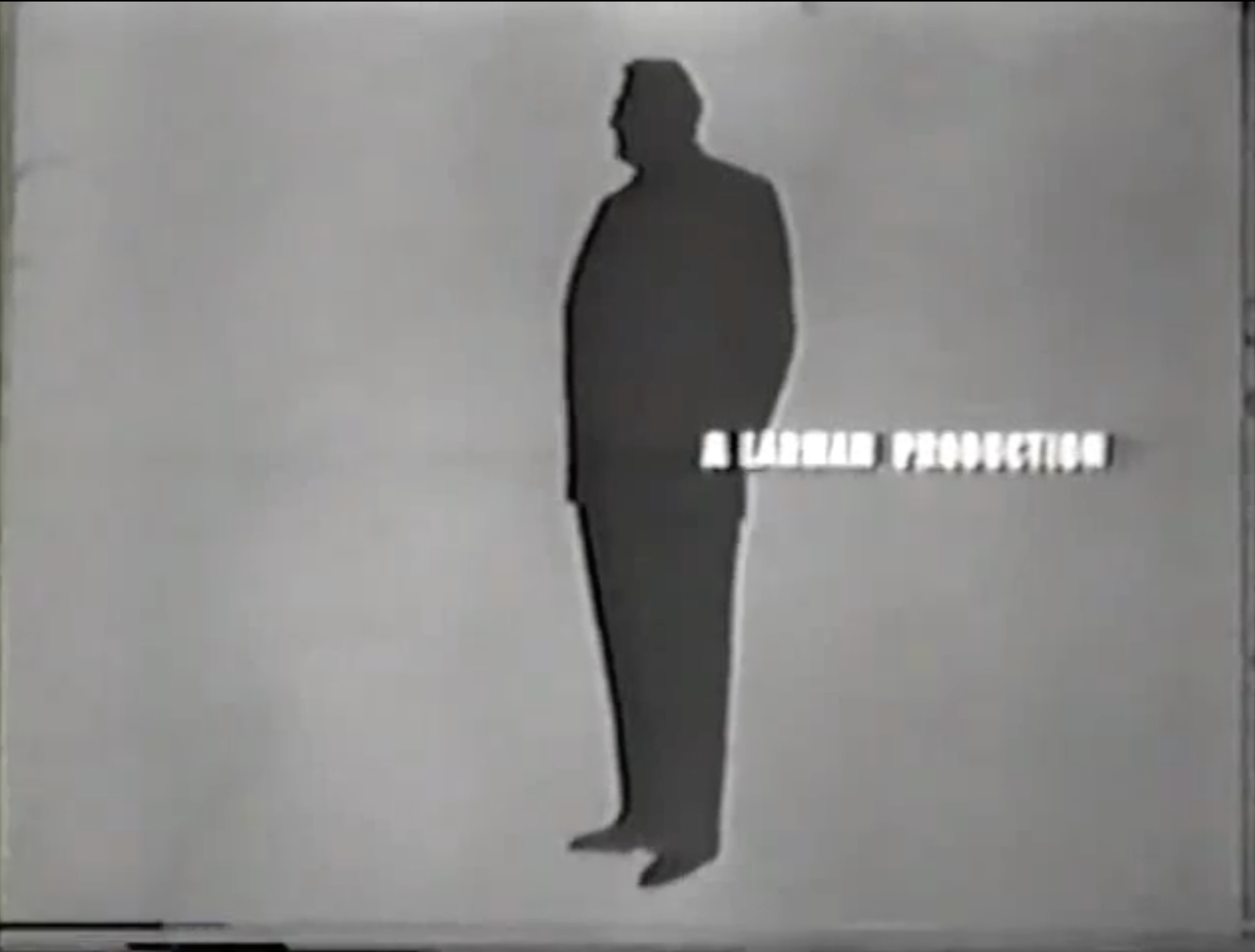
In the early 1950s, E.J. Rosenberg was involved in a major six-film deal with the Italian film group I.F.E., providing financing for Hollywood-star-driven productions. In 1958, Rosenberg produced 22 episodes of the television sitcom. The People’s Choice. In 1959, he returned to the Fat Man with a teleplay written by Ben Roberts and Ivan Goff and starring Robert Middleton in the role of the title character — renamed Lucius Crane. The pilot, titled The Fat Man: The Thirty-Two Friends of Gina Lardelli, wasn’t picked up for production. In 1993, he married actress Irene Vernon and remained with her until his death in 1997.
Support Eric Brightwell on Patreon

Eric Brightwell is an adventurer, essayist, rambler, explorer, cartographer, and guerrilla gardener who is always open to paid writing, speaking, traveling, and art opportunities. He is not interested in generating advertorials, cranking out clickbait, or laboring away in a listicle mill “for exposure.”
Brightwell has written for Angels Walk LA, Amoeblog, Boom: A Journal of California, diaCRITICS, Hey Freelancer!, Hidden Los Angeles, and KCET Departures. His art has been featured by the American Institute of Architects, the Architecture & Design Museum, the Craft Contemporary, Form Follows Function, the Los Angeles County Store, Sidewalking: Coming to Terms With Los Angeles, Skid Row Housing Trust, the 1650 Gallery, and Abundant Housing LA.
Brightwell has been featured as subject and/or guest in The Los Angeles Times, VICE, Huffington Post, Los Angeles Magazine, LAist, CurbedLA, LA Times 404, Marketplace, Office Hours Live, L.A. Untangled, Spectrum News, Eastsider LA, Boing Boing, Los Angeles, I’m Yours, Notebook on Cities and Culture, the Silver Lake History Collective, KCRW‘s Which Way, LA?, All Valley Everything, Hear in LA, KPCC‘s How to LA, at Emerson College, and at the University of Southern California. He is the co-host of the podcast, Nobody Drives in LA.
Brightwell has written a haiku-inspired guidebook, Los Angeles Neighborhoods — From Academy Hill to Zamperini Field and All Points Between; and a self-guided walking tour of Silver Lake covering architecture, history, and culture, titled Silver Lake Walks. If you’re an interested literary agent or publisher, please out. You may also follow on Bluesky, Duolingo, Facebook, Goodreads, iNaturalist, Instagram, Letterboxd, Medium, Mubi, Substack, Threads, and TikTok.

Share


 Eric Brightwell