In the 2000s, Amoeba Music enlisted an army of writers and data entry people to work on an ambitious website that was meant to be a sort of combination of Allmusic, Apple Music, Discogs, Wikipedia, and more. Despite investing a tremendous amount of time, labor and money, the site, as envisioned, never got off the ground. In 2020 — without so much as a head’s up — the plug was pulled. Not only did all of the work of those who toiled in “the Dungeon” quietly die; the musician biographies we wrote were mothballed, Movies We Like vanished, and the celebrated Amoeblog was killed. Luckily, the Wayback Machine has preserved most of it, allowing me to retrieve my work and post it here, with minimal editing, because I think so some of what we did there was worth more than just a wage.
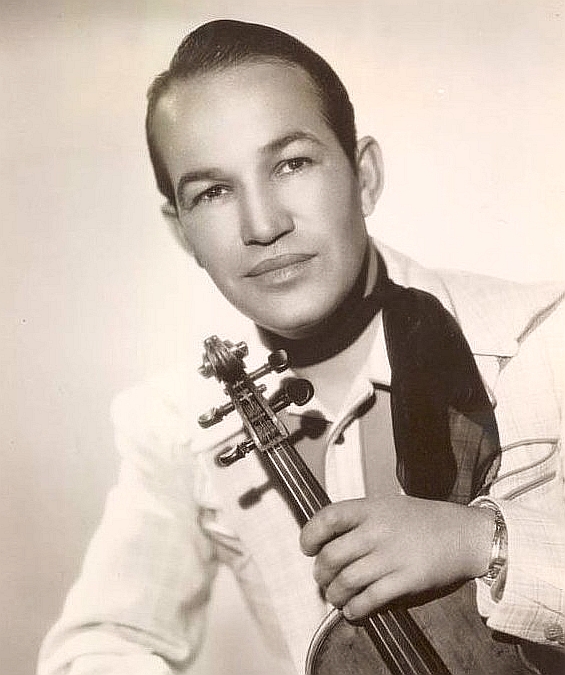
California-based fiddler-bandleader Spade Cooley was a major force in the thriving Los Angeles country music scene of the 1940s. Cooley specialized in a lushly orchestrated, melodic brand of pop country swing that made him immensely successful and — despite the fact that Texas swing kingpin Bob Wills was also based in the area — Cooley won the title “King of Western Swing.” In the mid-1940s Cooley’s appearances routinely drew huge crowds, and allowed him to score a series of chart-topping hit records and serve as host on one of the most popular television music shows in Southern California. While Cooley’s signal achievements were impressive, his career was sidetracked by a series of heart attacks and ended in tragedy, with a murder conviction, and a life sentence in state prison.
Born Donnell Clyde Cooley in Pack Saddle Creek, Oklahoma on 17 December 1910, Cooley’s father and grandfather were both fiddle players, and despite the family’s poor financial state, he was treated to classical training on fiddle and cello. After the family relocated to Oregon, Cooley debuted onstage with his father at eight years. By the time he was twenty, Cooley was living in Modesto, California and dead set on a career as a professional musician. He hopped a freight train to Los Angeles and spent the next several years drifting between the two cities, taking any gig he could find.
By 1934, Cooley’s fortunes changed when he began landing bit parts inB-movie Westerns and, after a stint as stand-in for fast-rising Western star-musician Roy Rogers, the “King of Cowboys” hired Cooley as his fiddle player. Working the road with Rogers, and also singing with Hollywood-based bandleader Foy Willing’s popular Riders of the Purple Sage, Cooley established himself as a reliable talent.
During the Second World War, Cooley began doing jobs for promoter Foreman Phillips, who maintained a circuit of huge ballrooms catering to the thousands of defense industry workers in Los Angeles. Phillips was notorious for firing rejecting any musician who tended toward bandstand improvisation and Cooley’s style fit Phillips bill perfectly. After Phillips chose the fiddler to replace Singing Cowboy star and bandleader Jimmy Wakely at the Venice Pier Ballroom in 1942, Cooley assembled one of the largest Western swing orchestras ever, featuring critical talents like vocalists Tex Williams, Deuce Spriggens, and Smokey Rogers; the innovative steel guitarist Joaquin Murphy; and Noel Boggs, a former steel man for Bob Wills’ Texas Playboys. Cooley’s band, with its multiple fiddles, guitars and accordion, created a rich, full sound, and his elaborate arrangements of old time fiddle tunes like “The Devil’s Dream” had an almost symphonic sound that was altogether unique.
In 1945, Cooley signed with Columbia subsidiary Okeh Records and his debut release, “Shame on You” rocketed to #1 on the country charts, where it stayed for over two months. The song — and its flipside “A Pair of Broken Hearts” (which made the Top Ten) — spent an impressive total of 32 weeks on the chart. That year Cooley also married Ella Mae Evans, one of his many fiddlers, and racked up another Top Ten hit, with (an ironically prophetic title), “I’ve Taken All I’m Gonna Take From You.”
Riding high in 1946, Cooley was upgraded from Okeh to the flagship Columbia label itself, and continued to churn out hits. This time it was another double-sided Top Three disc, “Detour” and “You Can’t Break My Heart,” and 1947’s Top Five “Crazy ‘Cause I Love You.” Each of these featured Tex Williams’ wry, warm vocals, but when Williams asked for a raise, the hotheaded Cooley fired him. Williams left, and so did the core of the band, who followed him to Capitol to record the monster taking blues crossover smash “Smoke! Smoke! Smoke! (That Cigarette).”
By this point, Cooley was hosting the Foreman Phillips-produced Hoffman Hayride television program, broadcast live every Saturday night from KTLA’s Sunset Boulevard Studios. The show was a runaway success—contemporary audience estimates had three quarters of television sets in the area tuning it in — and Cooley’s profile continued to rise through appearances in half a dozen cowboy flicks, as well as his own musical shorts, King of Western Swing and Spade Cooley & his Orchestra.
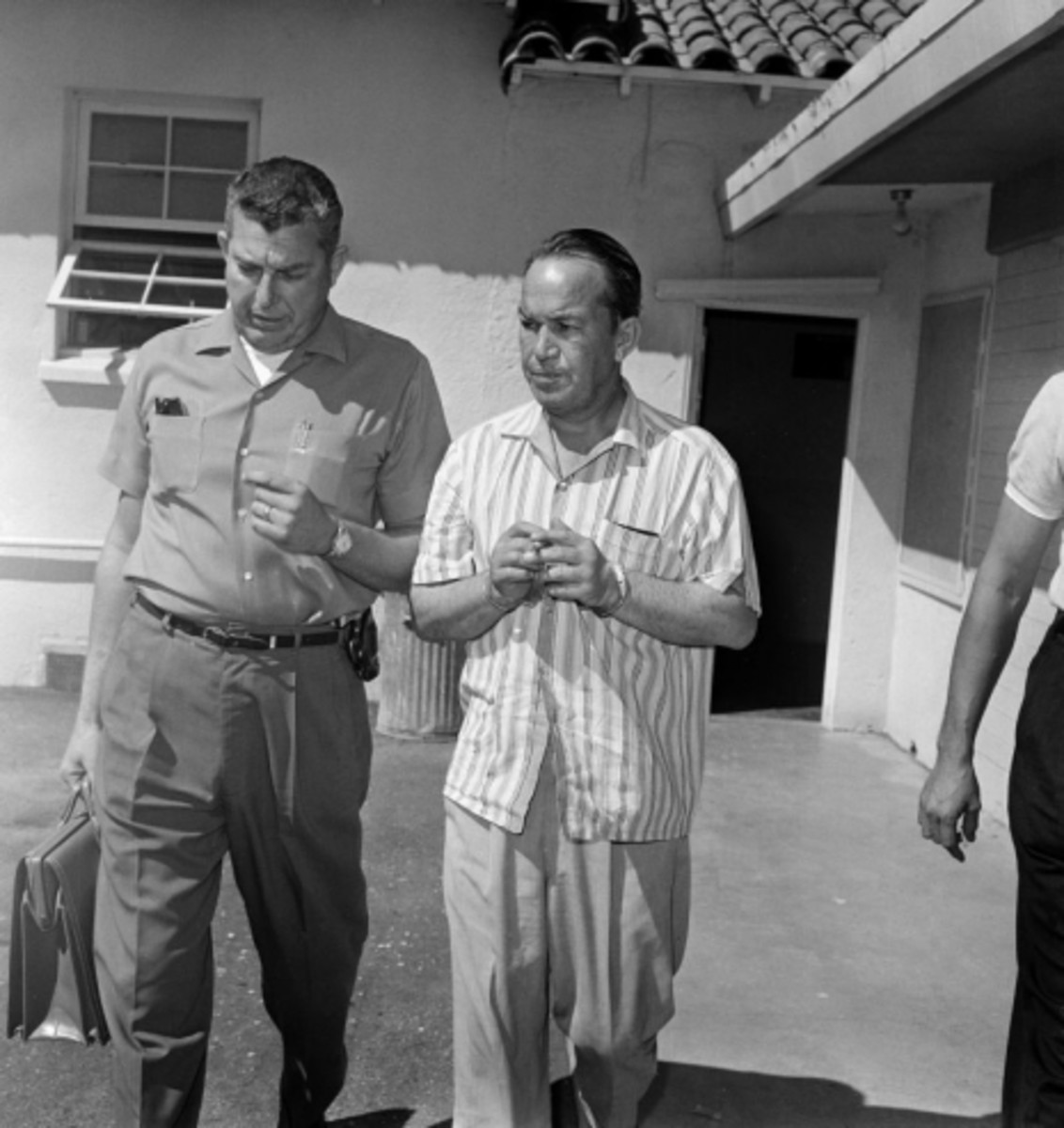
But by the mid-1950s, Cooley suffered a series of heart attacks which necessitated the curtailment of his activities. The fiddler began spending more and more time on his ranch in a remote part of Kern County where he became psychotically insecure and insanely jealous of wife Ella Mae, whom he believed had had an affair with Roy Rogers. On 3 April 1961, a drunken Cooley lost control and not only beat his wife to death but made a point of doing it in front of their 14-year-old daughter. Convicted on her testimony, he was incarcerated but was, in 1969, allowed to perform at Sheriff’s benefit concert in Oakland,. He won a standing ovation from the crowd, walked offstage, suffered a massive heart attack and dropped dead at the age of 58.
Support Eric Brightwell on Patreon

Eric Brightwell is an adventurer, essayist, rambler, explorer, cartographer, and guerrilla gardener who is always seeking paid writing, speaking, traveling, and art opportunities. He is not interested in generating advertorials, cranking out clickbait, or laboring away in a listicle mill “for exposure.”
Brightwell has written for Angels Walk LA, Amoeblog, Boom: A Journal of California, diaCRITICS, Hey Freelancer!, Hidden Los Angeles, and KCET Departures. His art has been featured by the American Institute of Architects, the Architecture & Design Museum, the Craft Contemporary, Form Follows Function, the Los Angeles County Store, Sidewalking: Coming to Terms With Los Angeles, Skid Row Housing Trust, the 1650 Gallery, and Abundant Housing LA.
Brightwell has been featured as subject and/or guest in The Los Angeles Times, VICE, Huffington Post, Los Angeles Magazine, LAist, CurbedLA, LA Times 404, Marketplace, Office Hours Live, L.A. Untangled, Spectrum News, Eastsider LA, Boing Boing, Los Angeles, I’m Yours, Notebook on Cities and Culture, the Silver Lake History Collective, KCRW‘s Which Way, LA?, All Valley Everything, Hear in LA, KPCC‘s How to LA, at Emerson College, and at the University of Southern California. He is the co-host of the podcast, Nobody Drives in LA.
Brightwell has written a haiku-inspired guidebook, Los Angeles Neighborhoods — From Academy Hill to Zamperini Field and All Points Between; and a self-guided walking tour of Silver Lake covering architecture, history, and culture, titled Silver Lake Walks. If you’re an interested literary agent or publisher, please out. You can also follow him on Bluesky, Duolingo, Facebook, Goodreads, iNaturalist, Instagram, Letterboxd, Medium, Mubi, Substack, Threads, and TikTok.


 Eric Brightwell