INTRODUCTION
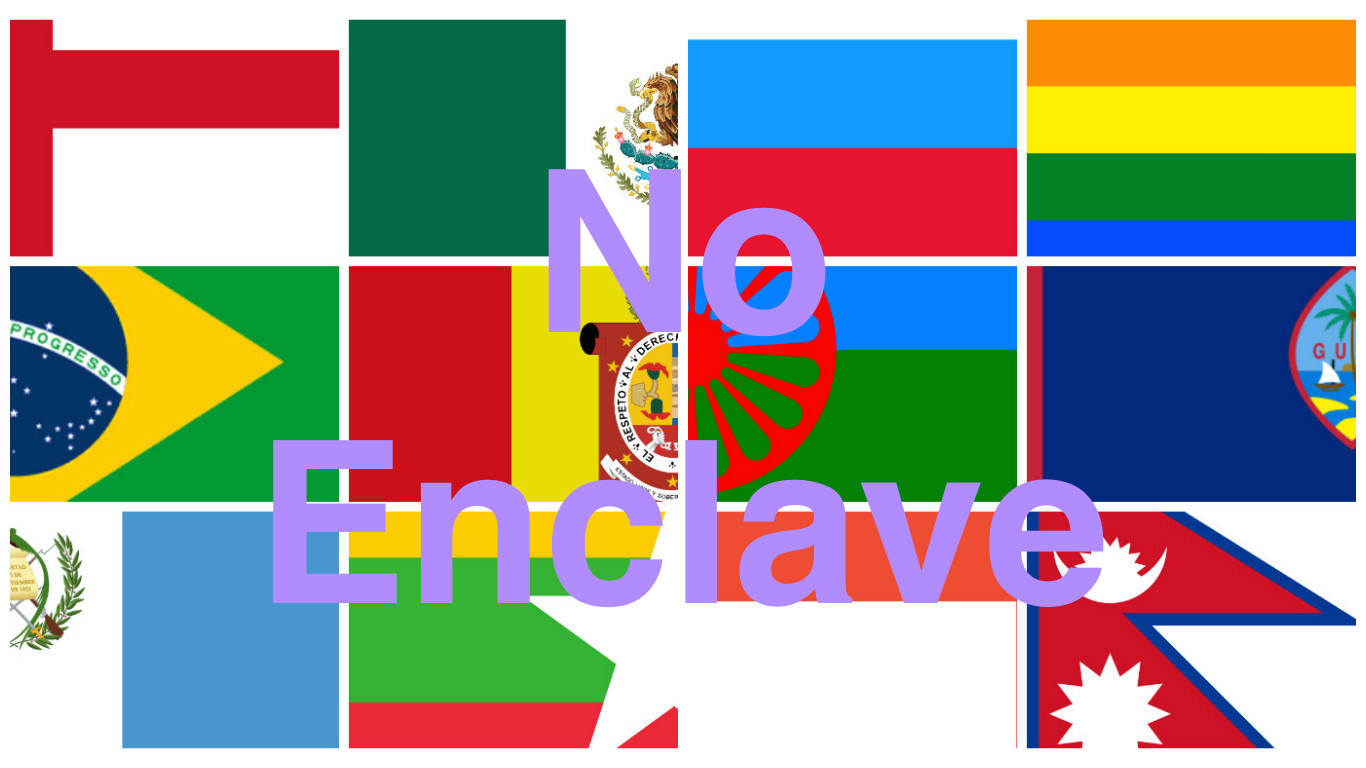
My naively ambitious plan was to write a No Enclave about Greek Los Angeles in time for Greek Independence Day. That date, 25 March, came and went. I shelved this uncompleted post with plans to finish it next year. Then, on 3 April, Chrys Chrys announced that Papa Cristo’s, a beloved Los Angeles institution, was closing its doors for good on 4 May. This followed the Echo Park location of Patra closing permanently on 23 December of last year. And so I dragged this post out and hammered away until it was something like finished. As always, corrections and additions are welcome — especially if provided without a scoldy tone.
I’m not sure when I first became aware of Greece, but it was probably around the time my older sister exhibited and. interest in Greek Mythology. Greek Mythology thus claimed, I turned my interest to Roman mythology, which my sister haughtily informed me was just watered down Greek mythology. Oh really? Who are the Greek equivalents of Janus, Pomona, Terminus, et al? I rest my case. As kids in Columbia, our exposure to Greek culture was mostly limited to library books and the field trips to the Cast Gallery at the Museum of Art and Archaeology. Our college’s most recognized icon is a row of Ionic columns — but “Greek Town,” referred not to a Greek enclave but to the cluster of fraternity and sorority houses next to the University of Missouri. While St. Louis had an historic Greek neighborhood, I knew less about it than I did the Island of Mypos. Los Angeles, of course, is a whole ‘nother story.
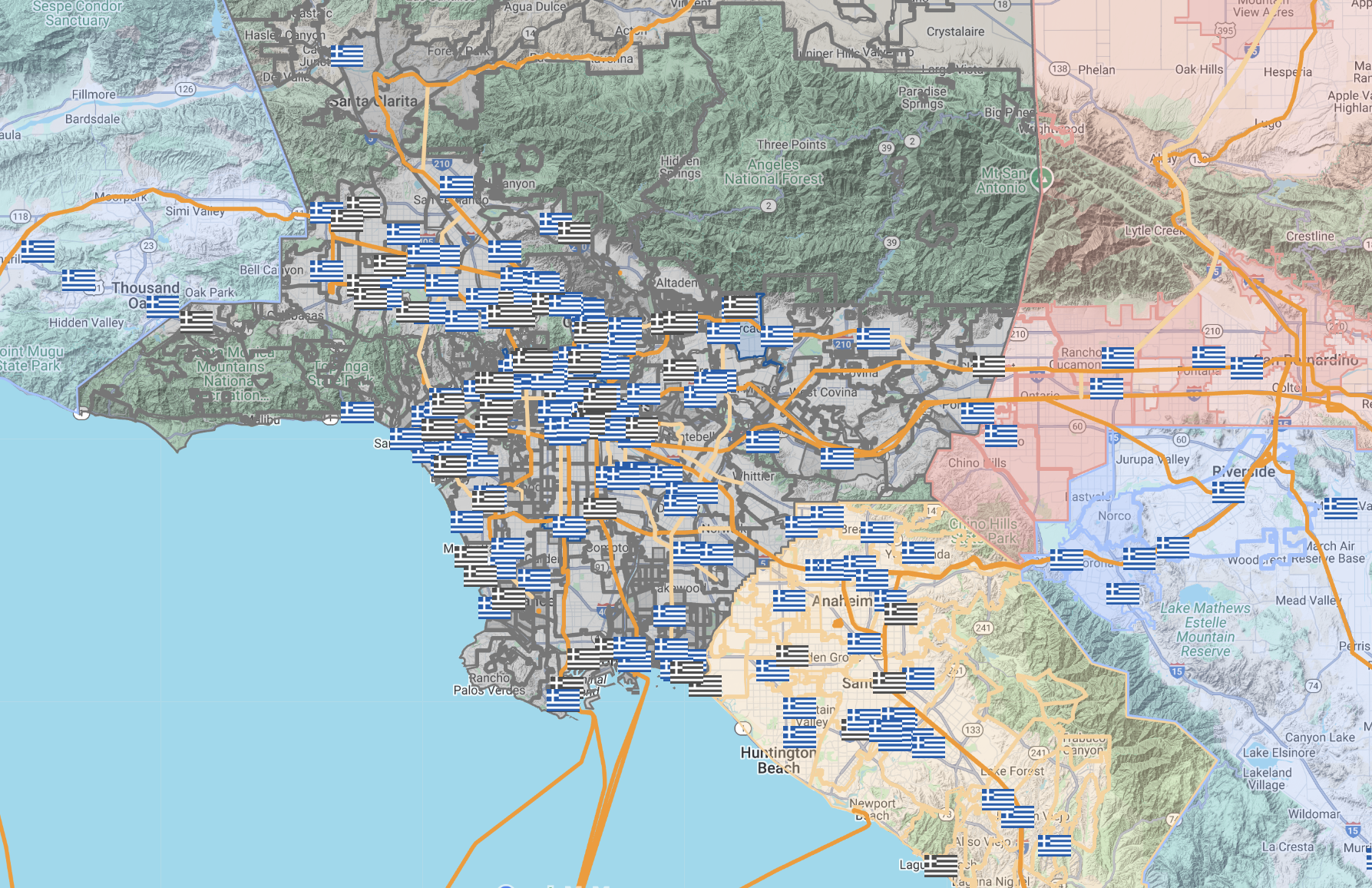
GREEK AMERICANS
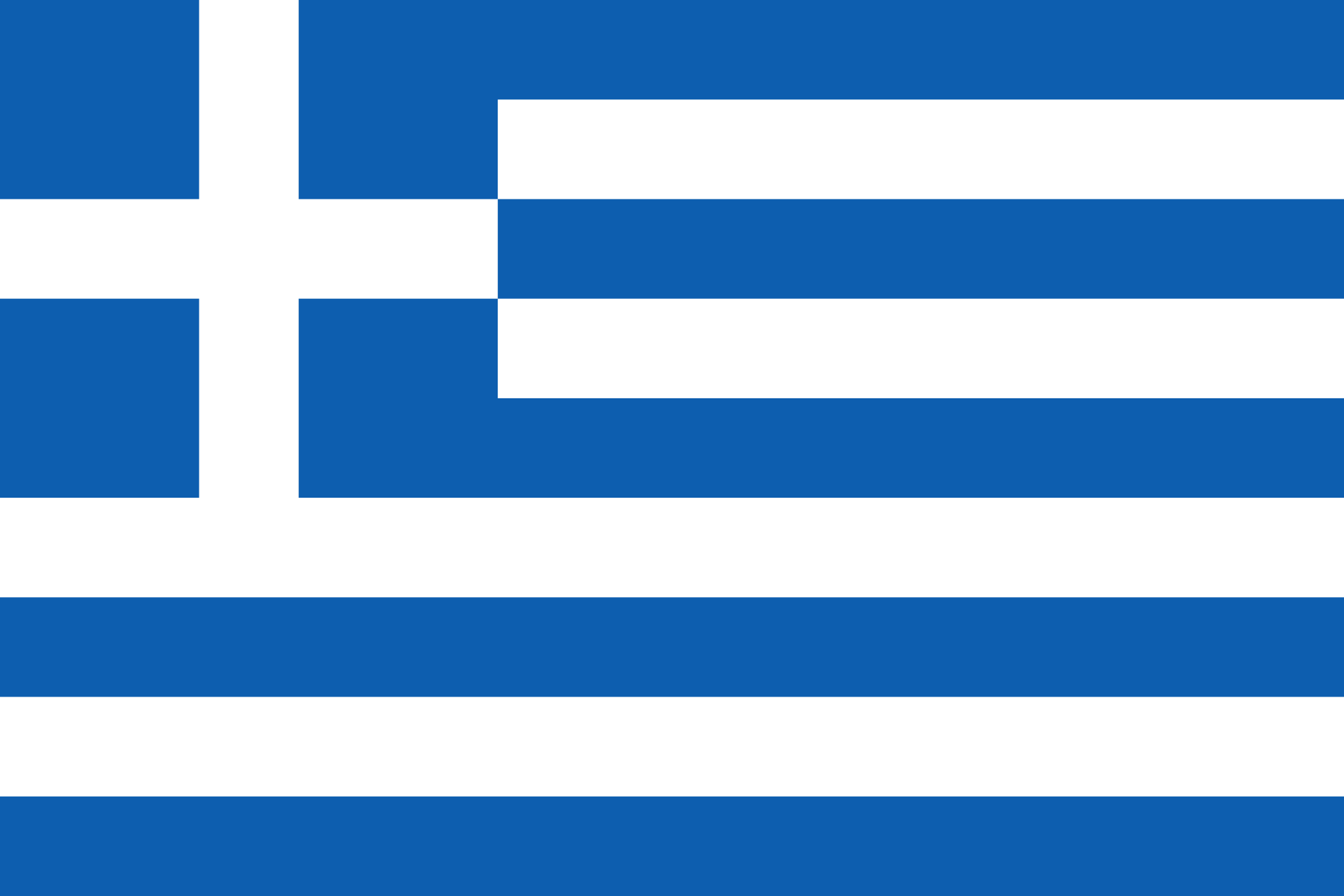
Missouri may have only been home to some 15,000 or so Greek Americans, making it on the 22nd most Greek state in the Union, but the US is home to the largest population of Greeks outside of Greece. New York is the state with the largest number, some 171,000, followed by California with roughly 135,000 (according to the 2011-2015 American Community Survey). I often compare the size of Southern California (146,350 km2) to Greece (131,990 km2) in order to provide a sense of scale. The countries Southern California is closest in size to are slightly larger Nepal and slightly smaller Tajikistan – but I doubt many Americans have more than the remotest sense at all of either of those countries whereas almost anyone with a modicum of geographical awareness is familiar with the shape and size of Greece.
The American town with the largest Greek population, percentage-wise, is Tarpon Springs, Florida, where roughly one in four residents is Greek. The Greekest towns in California, meanwhile, are Monte Sereno and Graeagle — two places even less familiar to me than either Nepal or Tajikistan. The metropoleis with the largest numbers of Greeks, in descending order, are New York City, Boston, Chicago, and Los Angeles. A 2020 American Community Survey counted 52,416 Greek Angelenos, about 5,484 of whom were born in Greece.
The first Greek known to have arrived in what’s now the US was Don Doroteo Teodoro, who arrived in the territory of the Tocobaga (present-day St. Petersburg, Florida) as part of the Narváez expedition in 1528. By the 1850s, the first significant Greek American community had coalesced in New Orleans. [I just realized that Melpomene — aka “The Melph” — is named after one of the Greek Muses] The first wave of significant Greek immigration to the US took place between 1890 and 1917, when roughly 450,000 Greeks emigrated to cities in the Northeast or to the West, primarily in the latter to work on railroads or in mines.
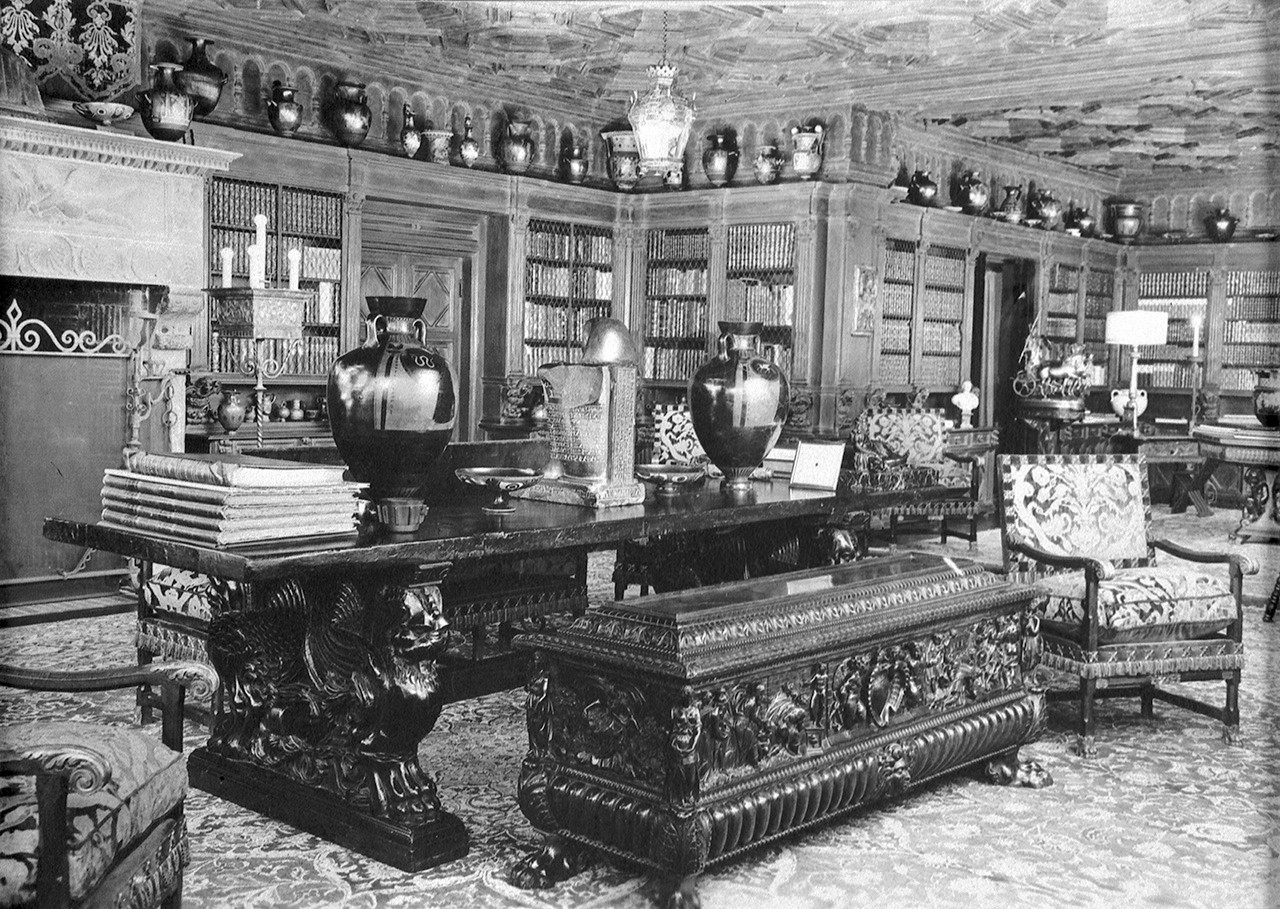
In the 1910s and ‘20s, California-based publisher/politician William Randolph Hearst used his newspaper empire to whip up a frenzy of anti-Greek hatred. Like many xenophobes, he was apparently unbound to consistency. He hated Greeks… and yet, his Mediterranean Revival-style home, in San Simeon, boasted one of the world’s largest collections of Greek vases and other art objects.
The American Hellenic Educational Progressive Association was founded in 1922 in Atlanta to counter the hostility of the revived Ku Klux Klan. The Ku Klux Klan contained inconsistent views as well. The name was derived from the Greek kyklos (κύκλος), meaning circle. In 1924, the US government passed the Johnson-Reed Act which set quotas on the number of immigrants from Eastern and Southern Europe (and banned immigration from Asia altogether). After his death, the Museum of Modern Art purchased nearly seventy from his estate.
A second wave of immigration began around 1945, fueled by the devastation of the Second World War (1939-1945) and Greek Civil War (1946-1949). The Regime of the Colonels, a right wing military junta, ruled Greece from 1967-1974, and Greek emigration peaked in the 1960s and ’70s. After Democracy was restored, immigration slowed. In 1981, Greece was admitted to the European Communities (EC). Greek emigration to the US slowed as Greek emigrants began to favor Germany — a country which (unlike the US) offers universal healthcare, free public universities, comprehensive mass transit, and a low violent crime rate.
EARLY GREEK LOS ANGELES
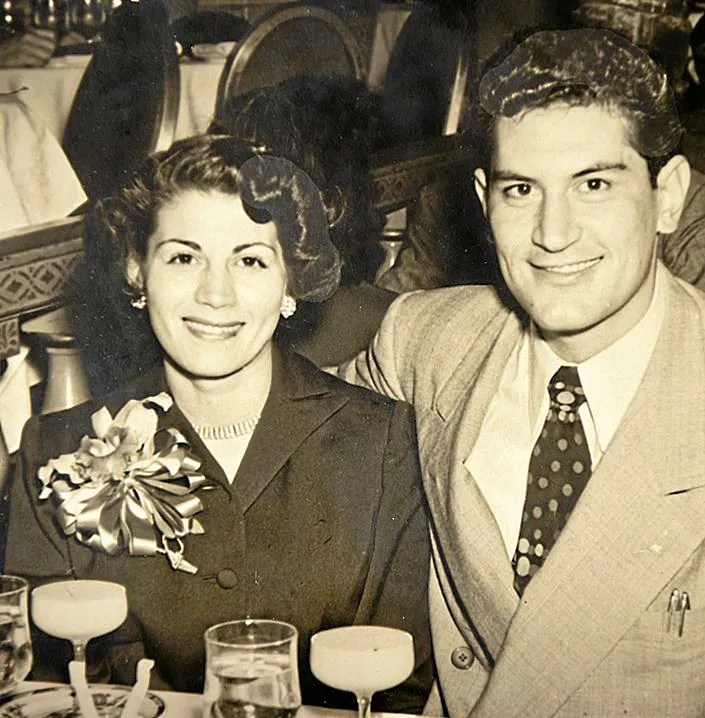
Most Greek Angelenos in the late 19th and early 20th centuries were men, many of whom worked in and around the ports. The Los Angeles Gas and Electric Company was another significant employer of Greeks, who were hired to dig ditches and lay lines across the region. Others found work in the kitchens and dining rooms of restaurants. Younger Greeks often worked Downtown as bootblacks. In Boyle Heights and the Produce District, many markets were owned by Greeks. The first known Greek-owned grocery store opened in 1896. Greeks were also active in the floral industry, which is still centered in the Flower District. Dan Stathatos, founded Broadway Florist around 1911. His son, Jerry Stathatos, who died in 2017, founded Stats Floral Supply — which, for decades, was one of the most familiar names amongst local florists.
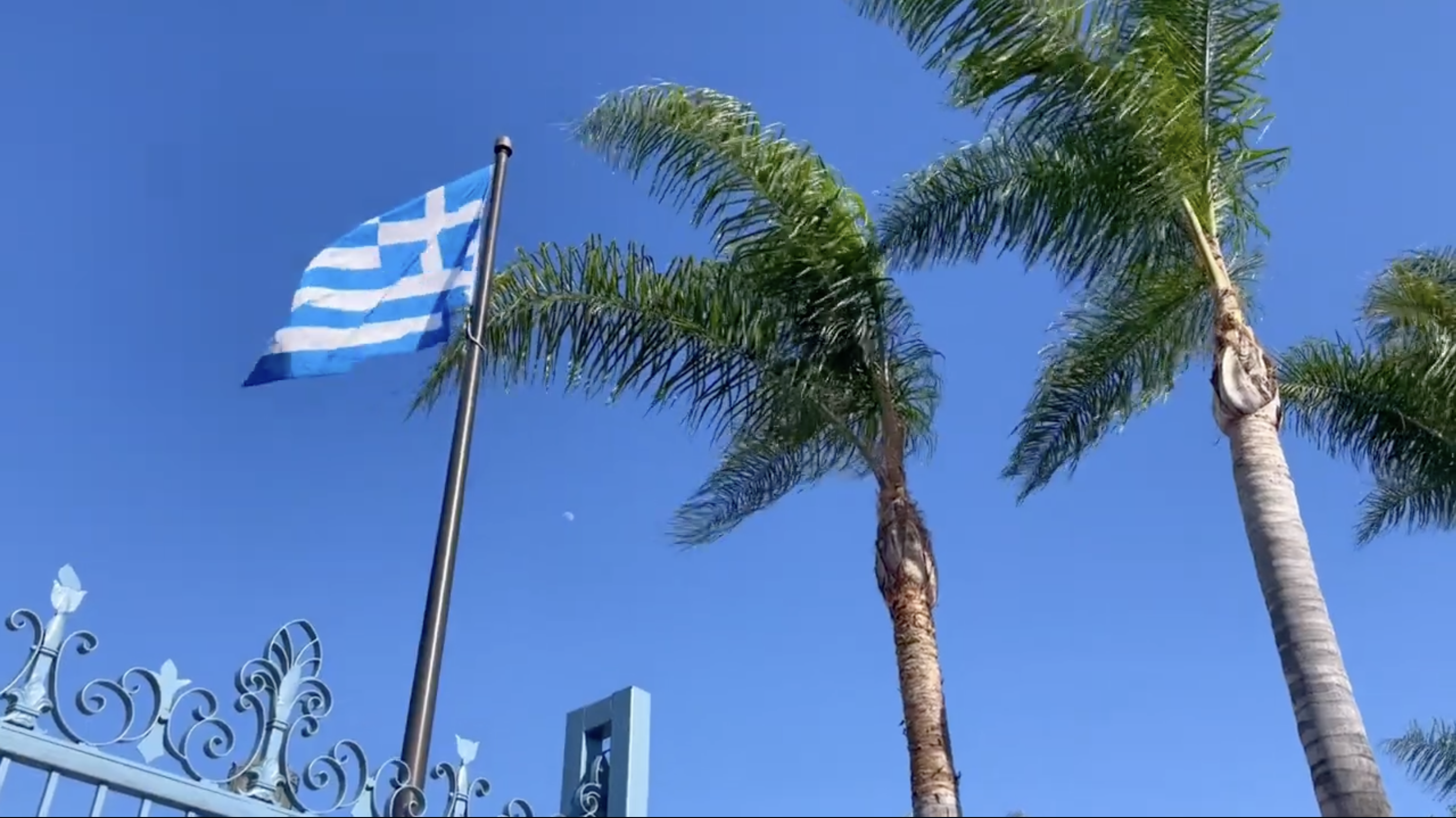
Many early Los Angeles Greeks lived in the Russian Flats section below Boyle Heights, Little Italy, or near the Garment District (now Fashion District). The first significant local wave of Greek immigration, though, took place during the First World War, when roughly 1,000 Greeks immigrated to Los Angeles. In 1919, a year after the conclusion of the war, residents of the Pico Heights neighborhood, in Midtown, formed the Electric Home Protective Association to oppose (with the backing of the Los Angeles County Anti-Asiatic Society) Japanese Angelenos from moving there. Their efforts failed, and many of Pico Heights’ wealthy whites moved west. Their void was largely filled by Greeks and working class immigrants from elsewhere. By 1930, there were 6,488 Greeks living in Los Angeles County, centered around the intersection of Normandie Avenue and Pico Boulevard. The area came to be referred to as both Normandie-Pico and Greek Town.
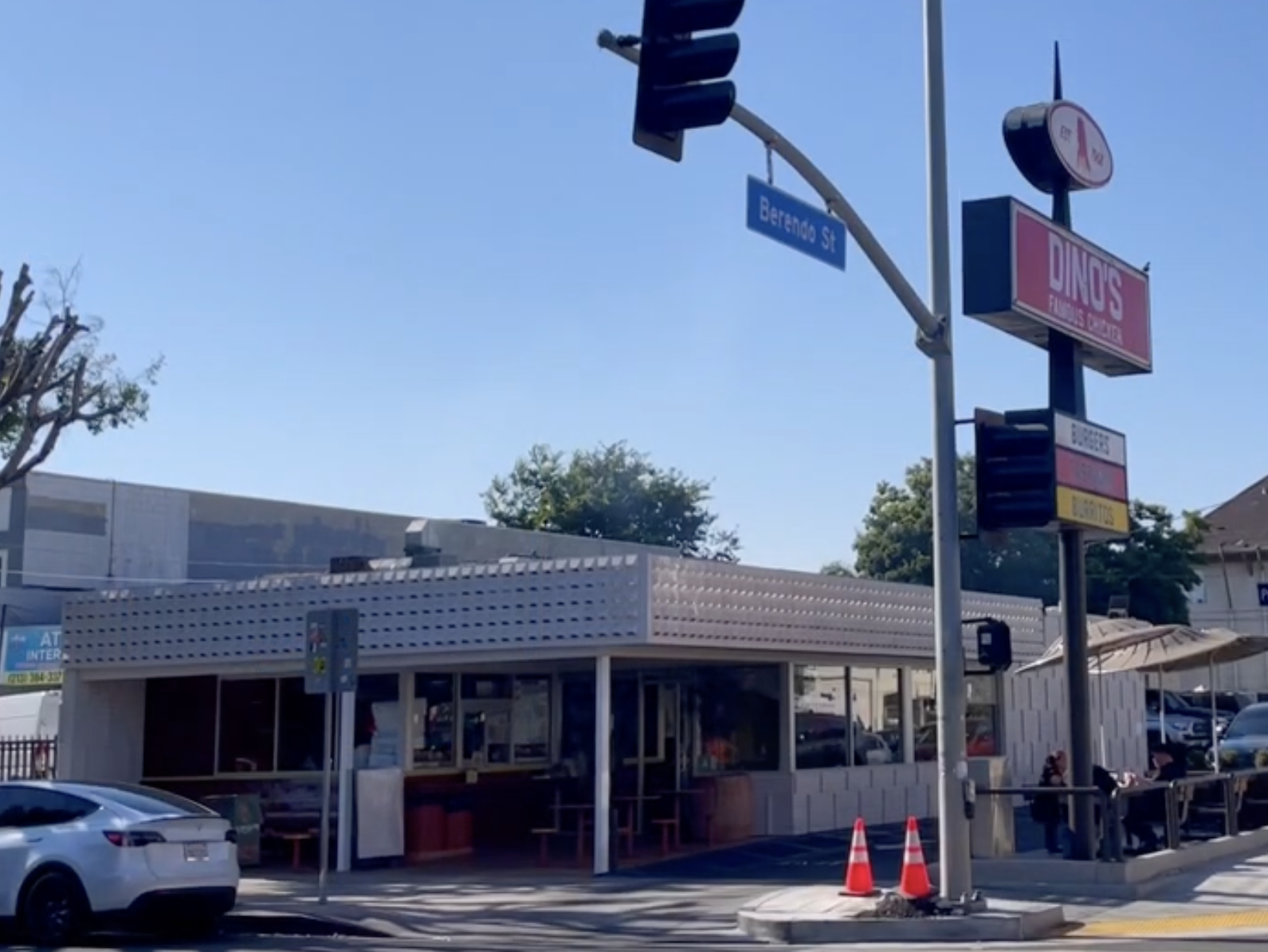
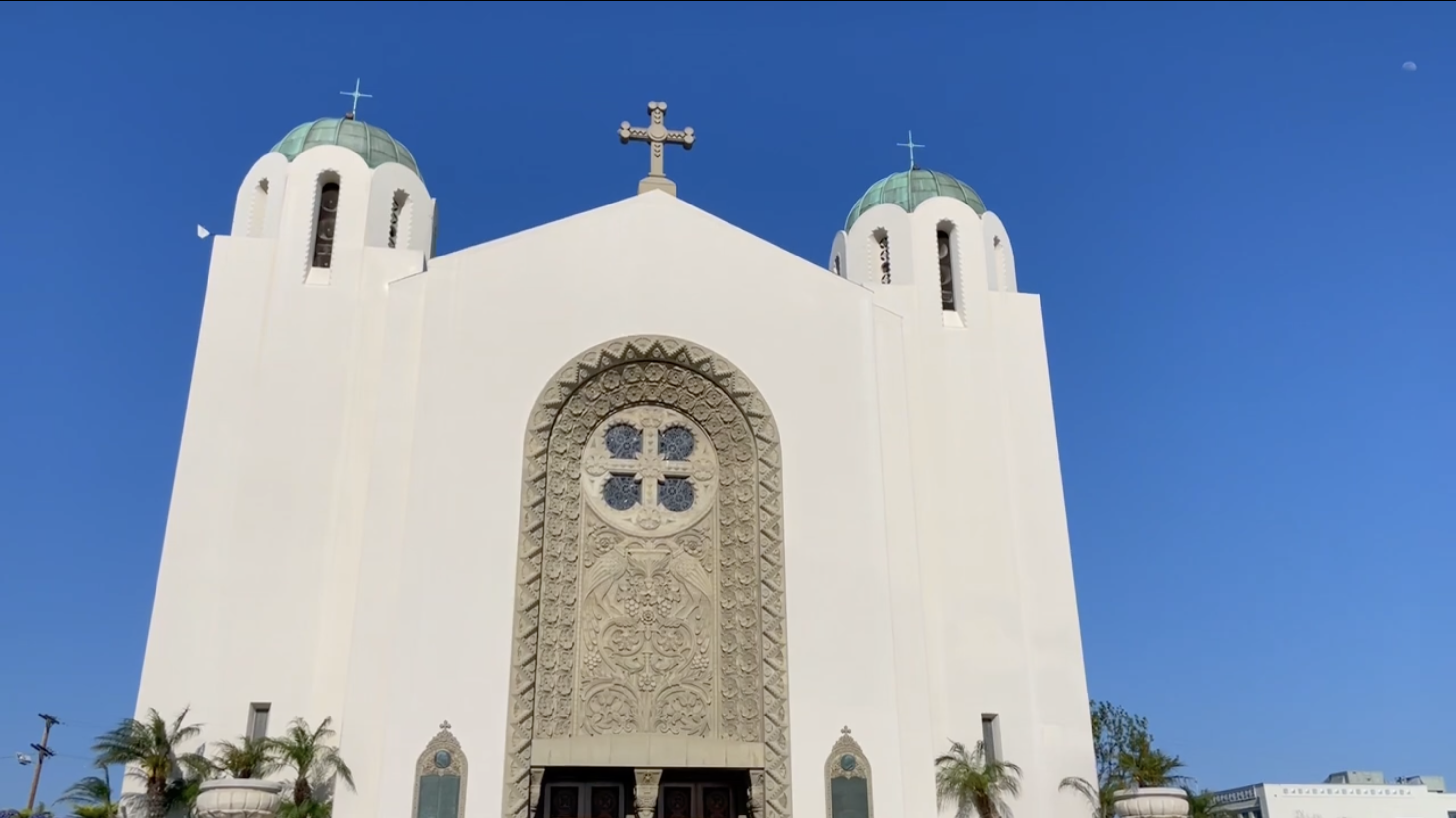
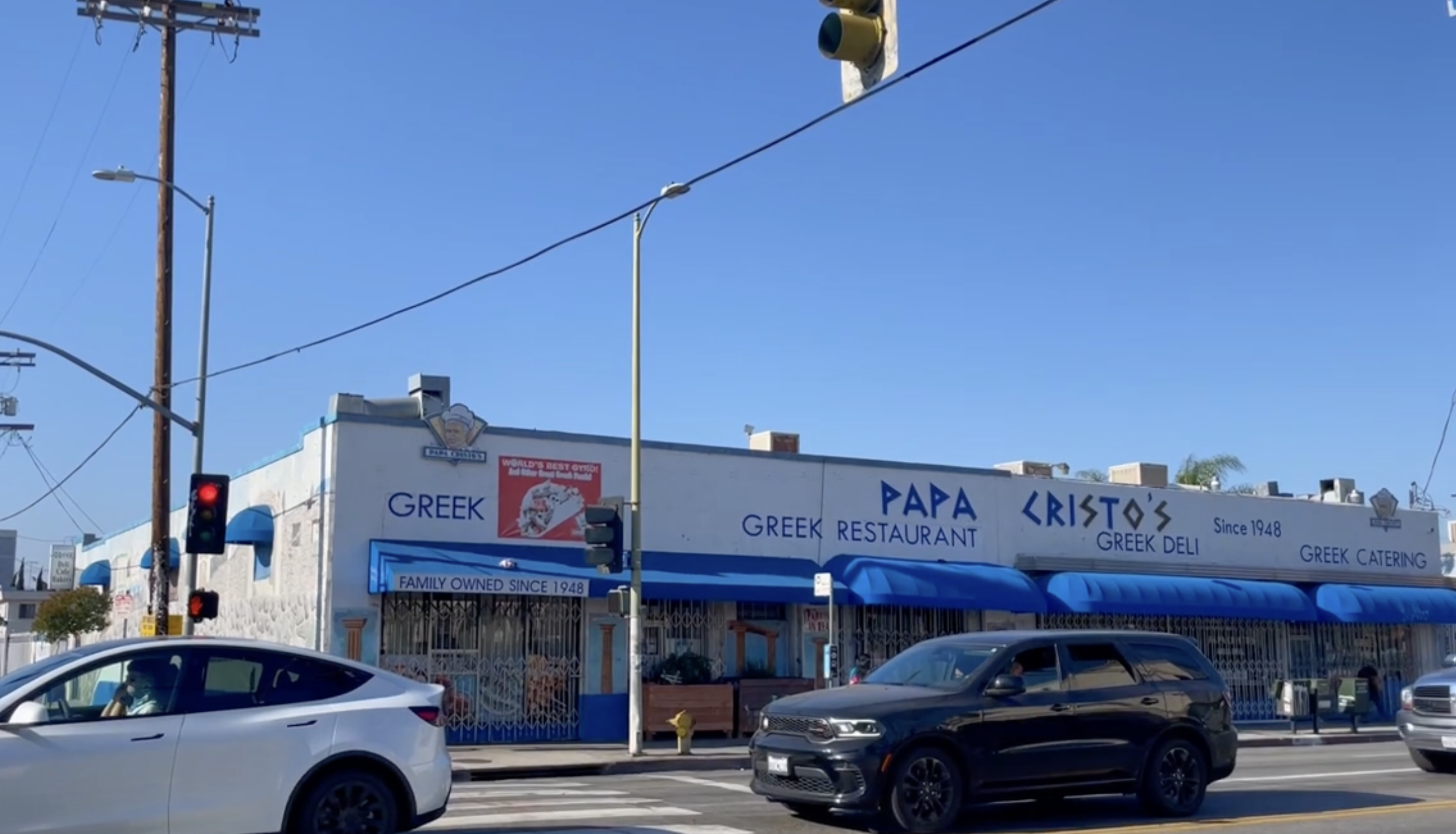
Today, there are very few Greek businesses in what used to be Greek Town. Sam Chrys opened C & K Importing in 1948. His son, Chrys opened Papa Cristo’s Taverna in 1968. Construction of St. Sophia Greek Orthodox Cathedral began in 1948 and was completed in 1952. Demetrios K. Pantazis opened Dino’s in 1968. Those, as far as I know, are all that remain.
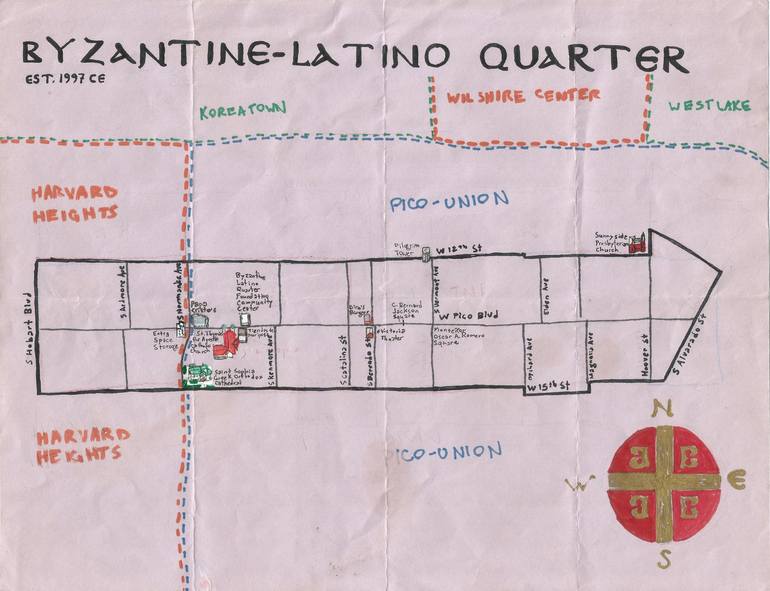
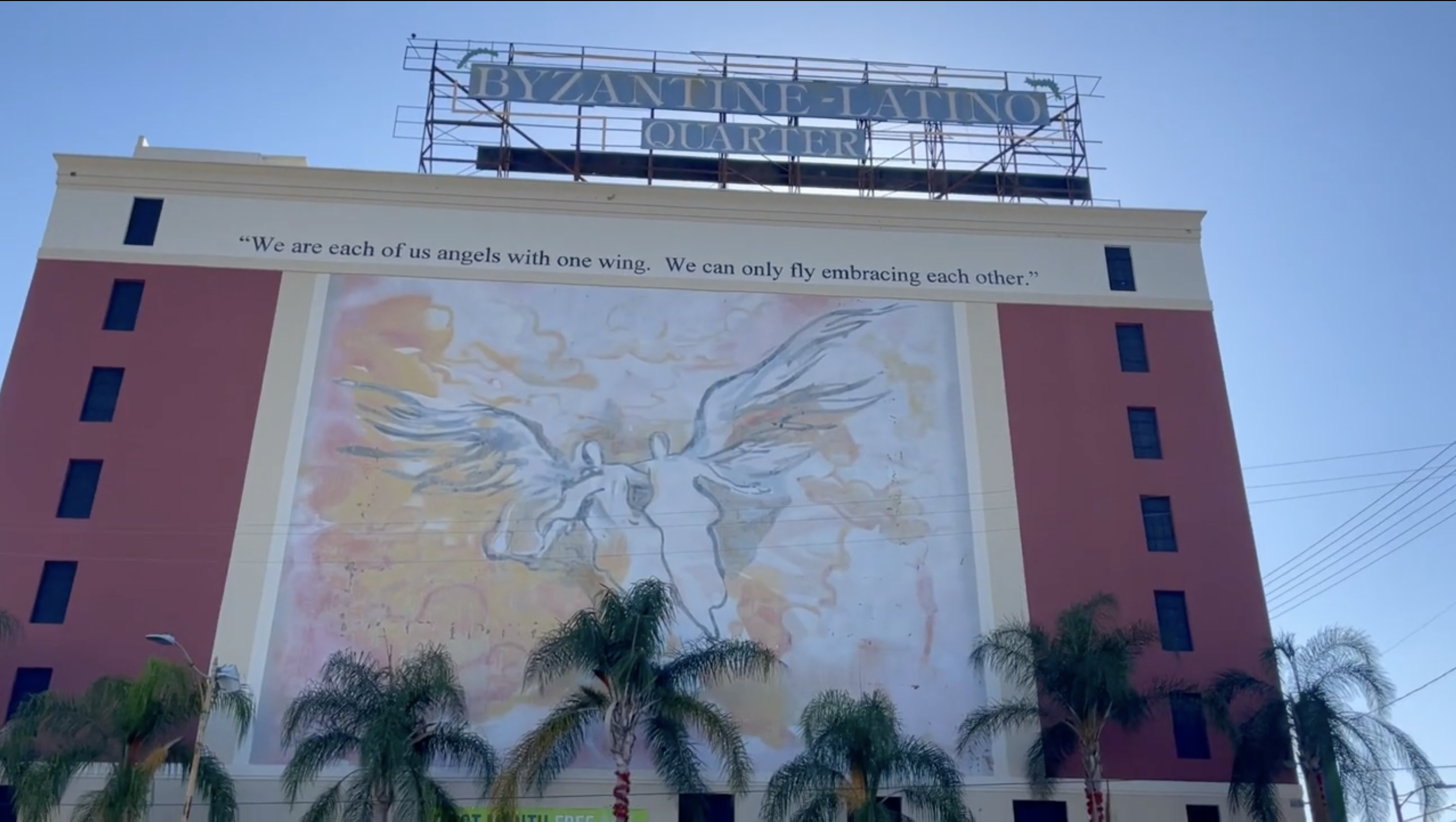
Greek businesses and residents in the area used to be far more numerous. According to researcher and former LA Greek Festival-chairman, Ted Pastras (1944-2013), there were, at one time, 65 Greek owned businesses in and around Greek Town. I, so far, have had less luck. Readily accessible information about Greek Angelenos is truly lacking. If you have the names and address of more (anywhere in the entire region), please let me know so that I can add them to the Greek Los Angeles Map. In 1997 – long after nearly all Greeks had left the area, by then mostly Central American – a Business Improvement District (BID) was formed there called the Byzantine-Latino Quarter BID.
LOS ANGELES’S NOMINAL GREEK COMMUNITIES
While most early Greek Angelenos lived in urban neighborhoods near Downtown; Ancient Greece provided several suburban community names in Los Angeles. In another irony, however, they were all (or nearly all) off limits to Greek homebuyers in the era of racist housing covenants that were finally struck down by the US Supreme Court in 1948.
The city’s first, large park, Elysian Park, was created in 1886. Its name was inspired by Elysium, the final resting place of the souls of Greek heroes. John S. Maltman subdivided the Elysian Heights Tract in late 1887/early 1888. Meanwhile, in the San Gabriel Valley, Elias J. “Lucky” Baldwin subdivided the community of Arcadia — another Greek paradise — in 1887. Back in Mideast Los Angeles, lots of the Elysian Garden Tract went on sale in 1907. By the 1910s, that community was more often known by its current name, Elysian Valley.
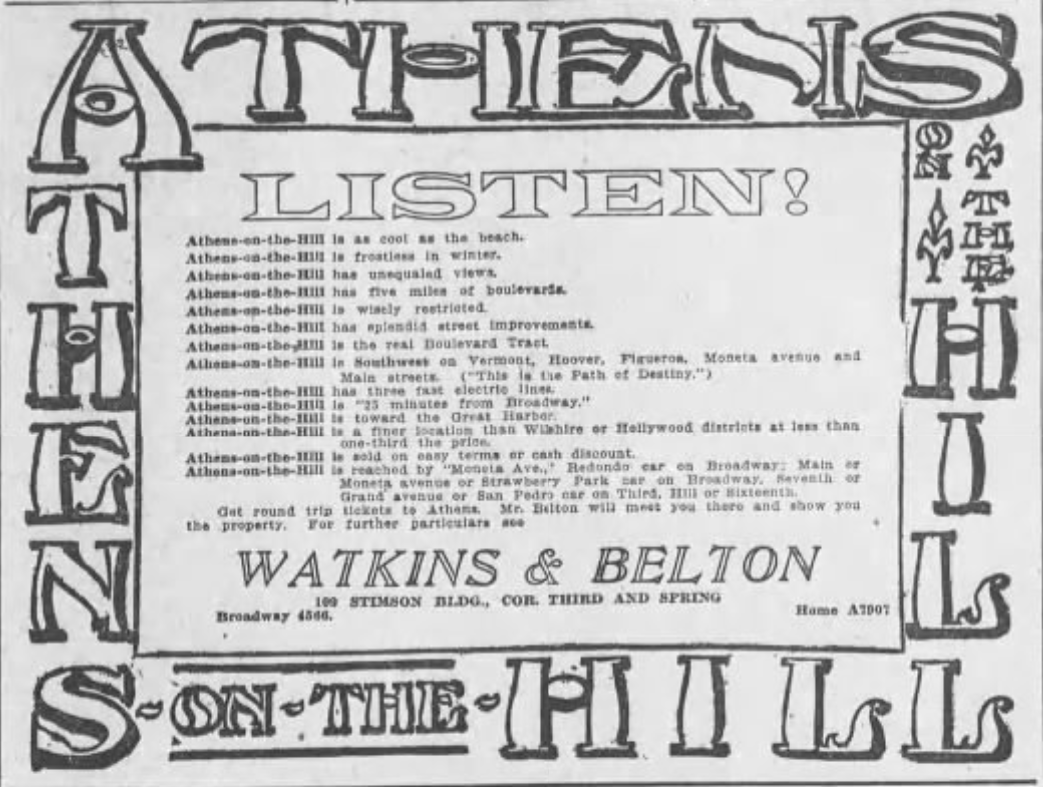
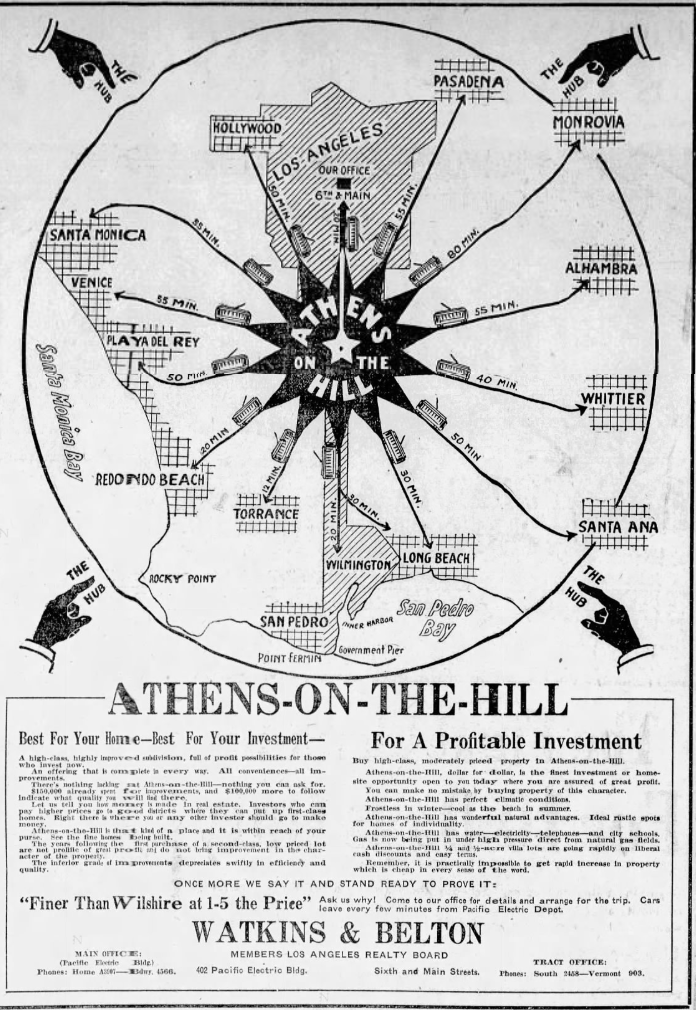
Los Angeles is home to three communities with nominal ties to Athens. I suspect, given that city’s classical associations and the era in which they were subdivided, that they may’ve been inspired by Abbot Kinney’s Venice of America and Arthur M. Parsons‘s Naples development, both developed in 1905. Strong & Dickinson‘s City of Athens Tract was subdivided in 1907. A few years later, in 1910, Watkins & Belton subdivided Athens-on-the-Hill. The community of West Athens came to be colloquially so known around 1912. East Athens was mostly built-out in the 1940s. Athens’s Athens Park was dedicated in 1943. In 1990, in an effort to increase property values that I don’t begin to understand, East Athens was renamed Rosewood. Unlike Venice and Naples, however, none of the communities named after Athens seem to have made any effort to evoke Greece in any way. West Athens, perhaps, is best known for being the filming location of the hood comedy, Friday.
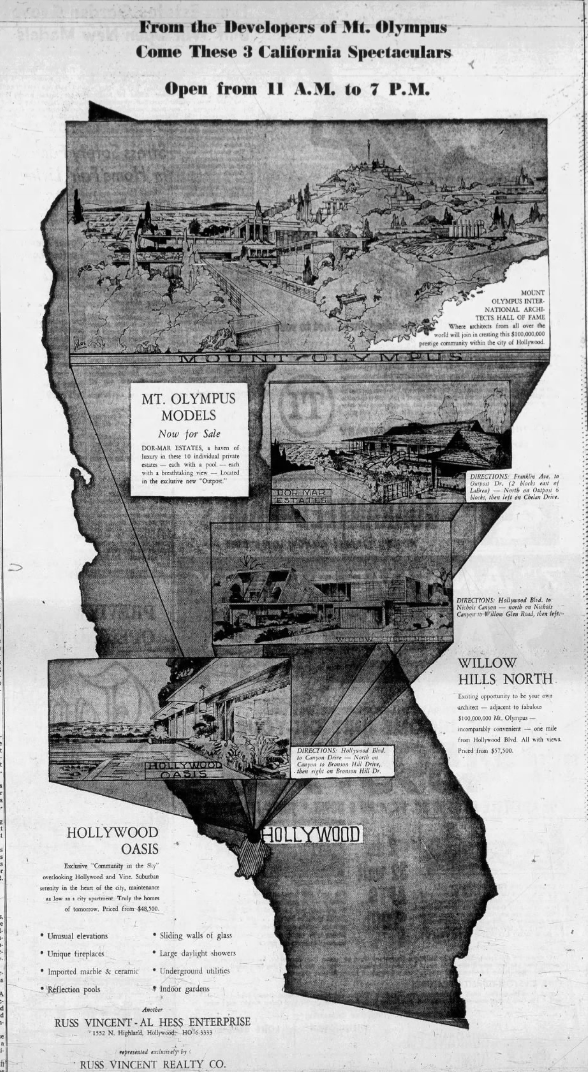
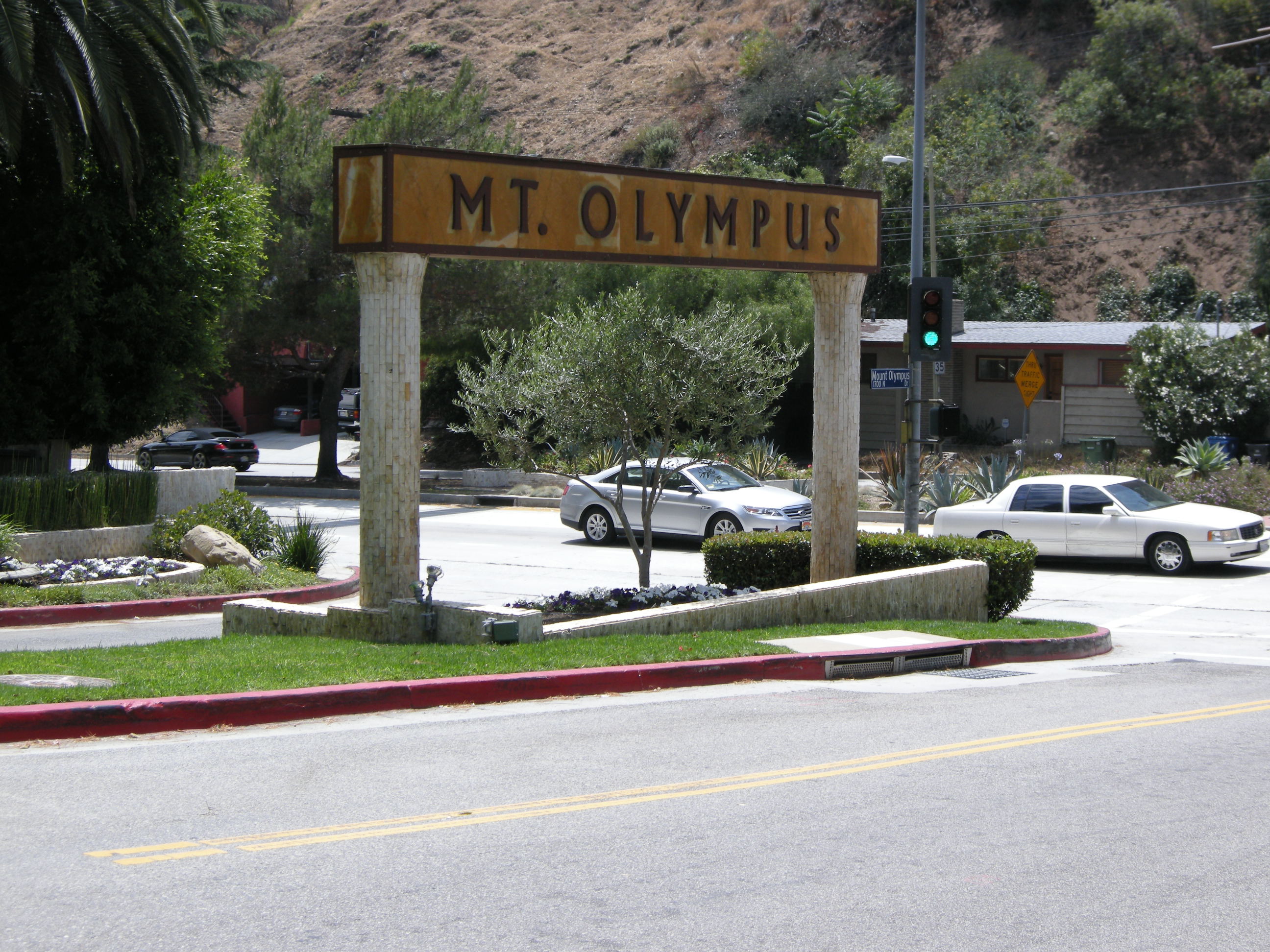
The same cannot be said of Mount Olympus. Filmmaker-turned-developer Russ Vincent and Al Hess premiered their project consisting of 700 homes located in the rugged upper Hollywood Hills, in 1963. The subdivision’s entrance sign is only half-heartedly pretentious. There is faux-Greek lettering the columns on which it is borne are not especially Greek-looking. The Greek theme seemingly begins and ends there.
GREEK CUISINE AND RESTAURANTS
The foundation of Greek Cuisine is olive oil, wheat, and wine. Other common vegetarian ingredients include cheese, herbs, lemon juice, and yogurt. Widely-consumed animals include chickens, cows, fish, pigs, goats, rabbits, and sheep. When I was a kid, our family occasionally had gyros or spanakopita but Greek food was uncommon. At college in Iowa City, it was pretty much limited to George Mihalopoulos’s gyro cart, George’s Best Gyros, a staple of that town’s Ped Mall. Whilst I was there, a Persian-Greek restaurant, Apadana, opened and turned me into a retsina fiend. After that, a bottle of resinated wine accompanied me on most of my rambles.
Driving west from Iowa to California, my first meal in the Golden State was at the Mad Greek, a staple of Baker as iconic as it’s giant thermometer (I know, technically it’s just a sign displaying the temperature). I’m almost certain that I ordered a falafel. Although falafels originated in North Africa, they long ago spread to the Levant, which Greece was sometimes historically considered to be part of. Regardless of their not being Greek, Greek-owned restaurants are generally quite versatile — seemingly valuing adaptability above authenticity.
GREEK DINERS
There is a not-undeserved association with Greek immigrants and diners. Honestly, I think my first exposure to that association was when I read James Cain‘s The Postman Always Rings Twice in college. The action of that book revolves around a drifter who finds work at a diner operated by Nick “the Greek” Papadakis and his young wife. The niche of running a diner came to be associated with Greek immigrants in much the same way that most nail salons came to be associated with Vietnamese, convenience stores with Sikhs, liquor stores with Koreans, donut shops with Cambodians, and motels with Gujaratis, &c.
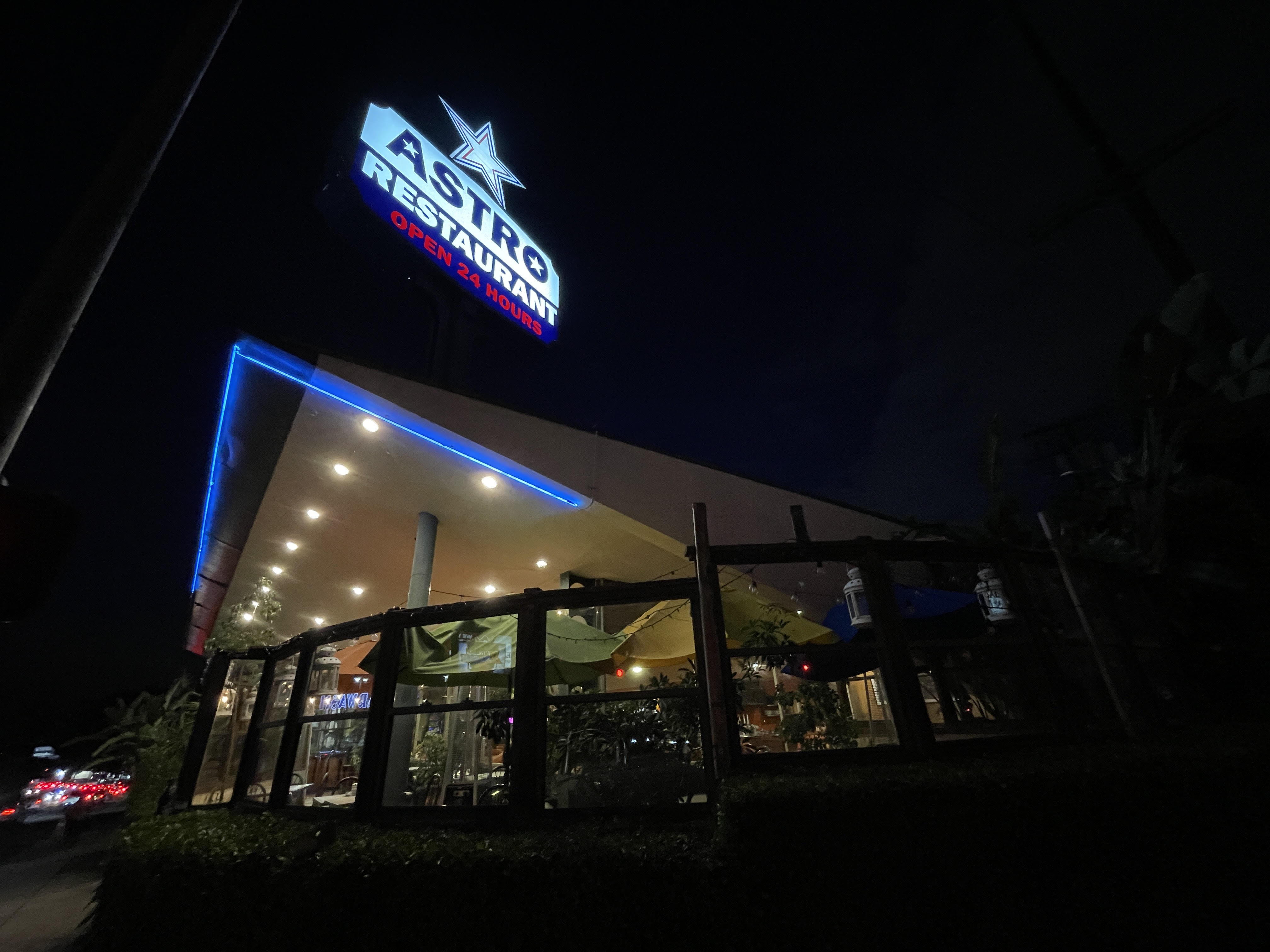
In Los Angeles, the name of the diner/carhop is sometimes the only hint of Hellenism — which is why I assume that Nick’s Diner in Pico-Robertson (1946 until 2022) and Nick’s Cafe in Dogtown (1948-the present) were likely founded by Greeks. Some diners I know were. The original Astro was founded in 1966 by Harry Siafaris. The Astro in the Hollywood Studio District was opened in 1974 by Cosmos Kapantzos. The Astro in Silver Lake was opened in 1974 by Peter Metsos.
PASTRAMI BURGERS AND BURRITOS
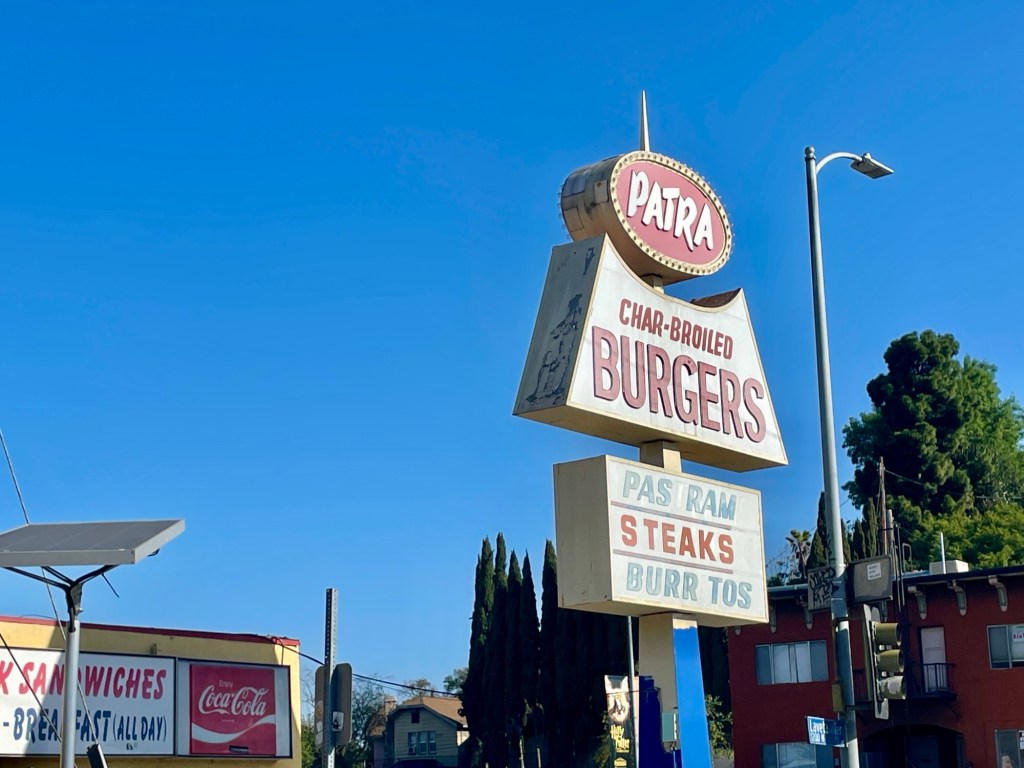
The heyday of diners and drive-ins was the 1950s and ‘60s – which was also the heyday of the burger stand; and Greek immigrants were also instrumental in establishing those in Los Angeles. Besides their Greek names, another hint of many of these stands’ Greek American origins lie in the menus that often feature pastrami burgers and burritos alongside, occasionally, a Greek item or two. The pastrami burger is a Los Angeles invention. Pastrami originated in Turkey and was brought to the historically Jewish Eastside via immigrants from Eastern Europe. In the East, pastrami is usually served on rye. In Los Angeles, it’s often sandwiched between two hamburger buns, dressed with mustard and pickles, and served with a side of fries. By the time of the Jewish exodus from the Eastside, many of the region’s Latinos had acquired a taste for pastrami while, at the same time, burritos were added to the menu where they joined cheeseburgers and other mid-20th century favorites. Thus you have places in Boyle Heights like Jim’s Burgers, founded by James Angelopoulos in 1957, and George’s Drive-In, founded by George Sideris in 1966 or ‘67. Patra was founded in 1976.
Most, if not all of these, burger stands expanded into small chains which, over time, splintered into unaffiliated restaurants owned by unrelated owners. There are several Jim’s Burgers today in the “Greater Eastside.” There are a few scattered George’s here and there. The Echo Park location of Patra closed in 2024 but there’s still one in Glassell Park. One of the most numerous burger chain with Greek origins is Troy’s, most of which seem to have opened in the 1970s. In a further innovation, the location in Monrovia was long ago taken over by a Cambodian owner and it inevitably evolved into Troy’s Donuts & Burgers.
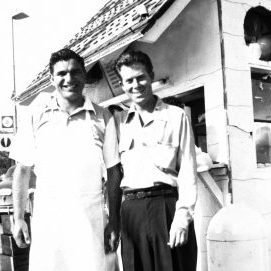
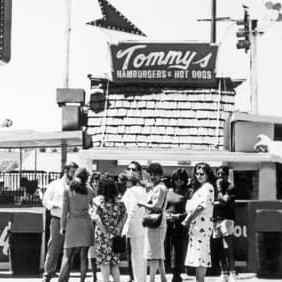
One of the most famous local hamburger chains is also one of the oldest with Greek roots: Original Tommys. Founder Thomas James “Tommy,” the son of Greek immigrants Nick and Katherine Koulax, opened the original Tommy’s in what’s now Filipinotown in 1946. As of 2023, there were 32 locations of Tommy’s – and an almost equal number of imitators. Tommy’s has never brought legal action — perhaps because Tommy’s, itself, could be reasonably accused of being an imitation of the much older Ptomaine Tommy’s chain, founded in 1913 and the birthplace of the chili burger — but not Greek.
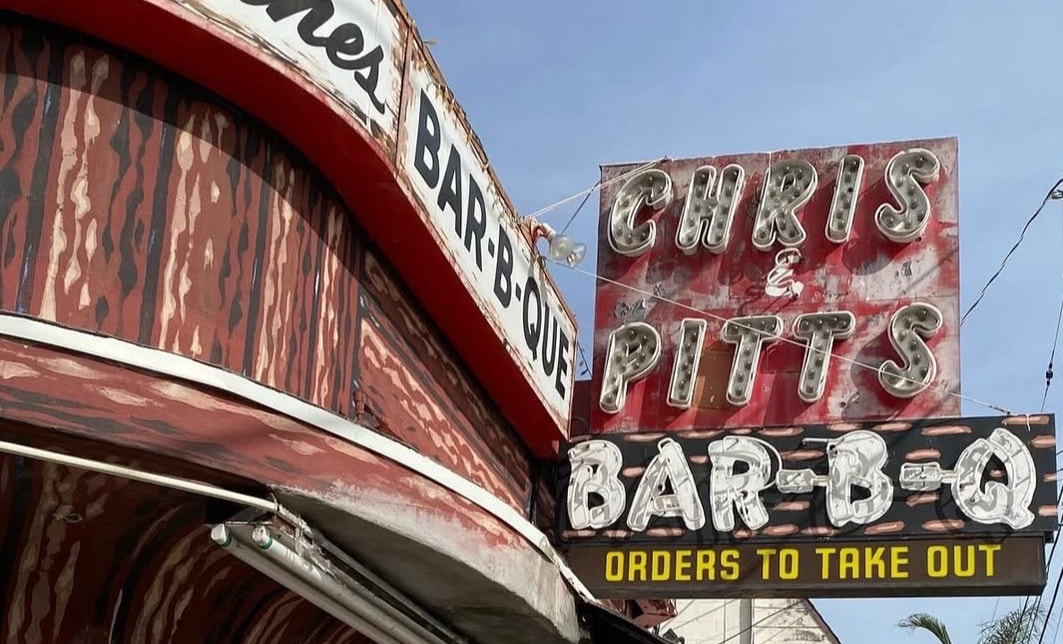
Only a few years after the Original Tommy’s was founded, another local chain was founded by a son of Greek immigrants. Chris George Pelonis born in Chicago in 1922 to George and Nicoleta Pelonis. The Pelonis family came to California around 1930. Pelonis opened his first restaurant in 1940. In 1949, Chris Pelonis borrowed $2,000 from his father to co-found Chris’ & Pitts’ Bar-B-Q with his business partner, Morris Pittman. The first location opened in Downey. For a time, their barbecue sauce was the best-selling in the nation. Pelonis bought out Pittman, who wished to retire, in 1963. At its peak, the chain boasted twelve locations. Pelonis’s wife, Andronikki, died in 1993. Chris lived to the age of 96, dying in 2018.
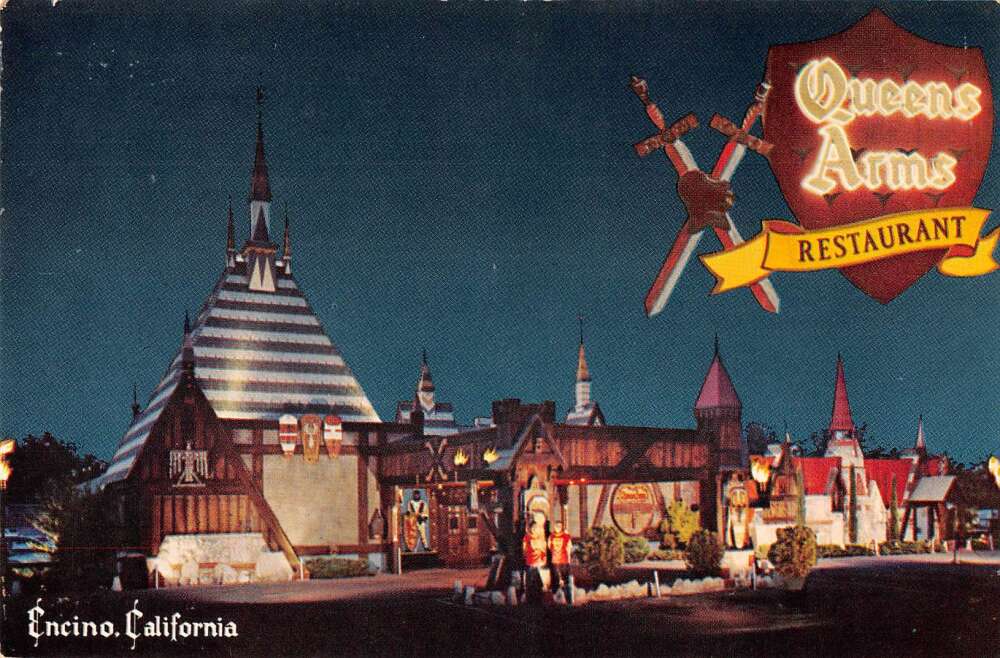
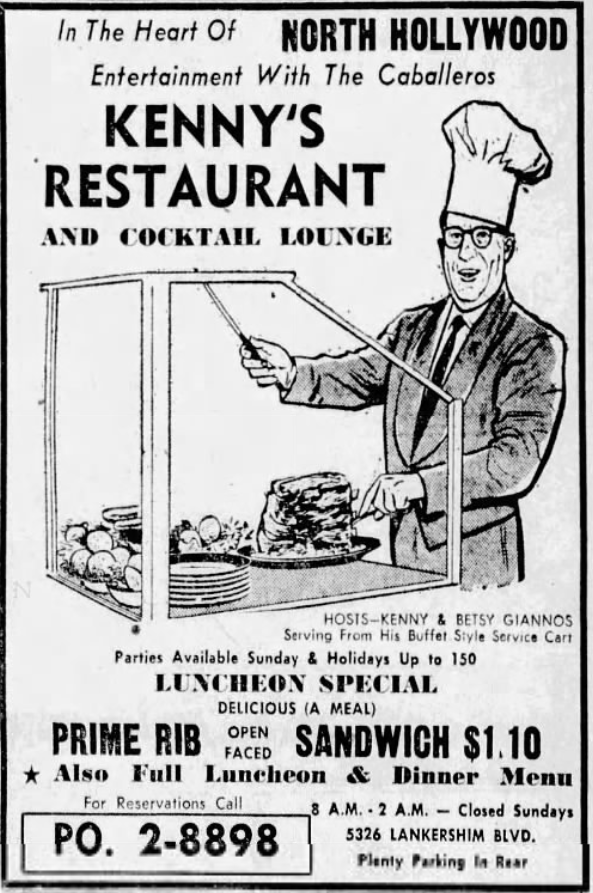
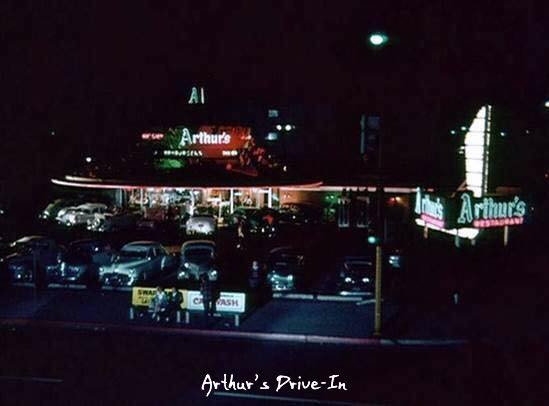
In the Valley, there were quite a few restaurants operated by Greeks — most of whom, it seems, were related to Chris Skoby, who came to Los Angeles from Kalamazoo during the Second World War to work as a flight instructor. None of their restaurants, as far as I now, actually served Greek cuisine. In 1946, Skoby’s Drive-In opened at Alameda and Victory in Burbank, which appeared on Happy Days as Arnold’s. They opened The Kings Arms in Burbank around 1954. In 1956, the Skobys and and Nick Bachakes opened The Queens Arms in in Encino (it closed in 1975). By 1956, Kenny Giannos had opened Kenny’s Restaurant & Cocktail Lounge in North Hollywood. In 1959, Skoby’s was taken over by Arthur and Gus Bachakes, who re-opened it as Arthur’s Restaurant. The Skobys opened their tenth restaurant, Skoby’s Bar & Grill, in Chatsworth around 1988. Chris Skoby died in 1998.
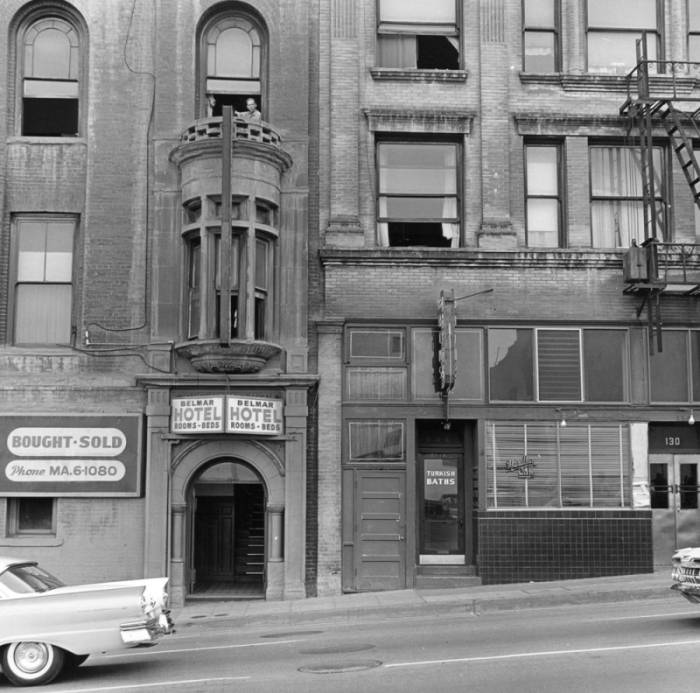
Locally, there have been Greek-owned restaurants serving Greek Cuisine, too, for well over a century. The first and longest lived in Los Angeles was Marathon Cafe, which opened in the Old Bank District in 1905. It was billed as a Grecian restaurant, perhaps, in part, because “Greek restaurant” was almost short-hand for a “greasy spoon” rather than a restaurant serving Greek cuisine. Its owner, Spiro Gioman, died in 1968. It was bought by Dean Callas around 1970 and open at least as late as 1971.
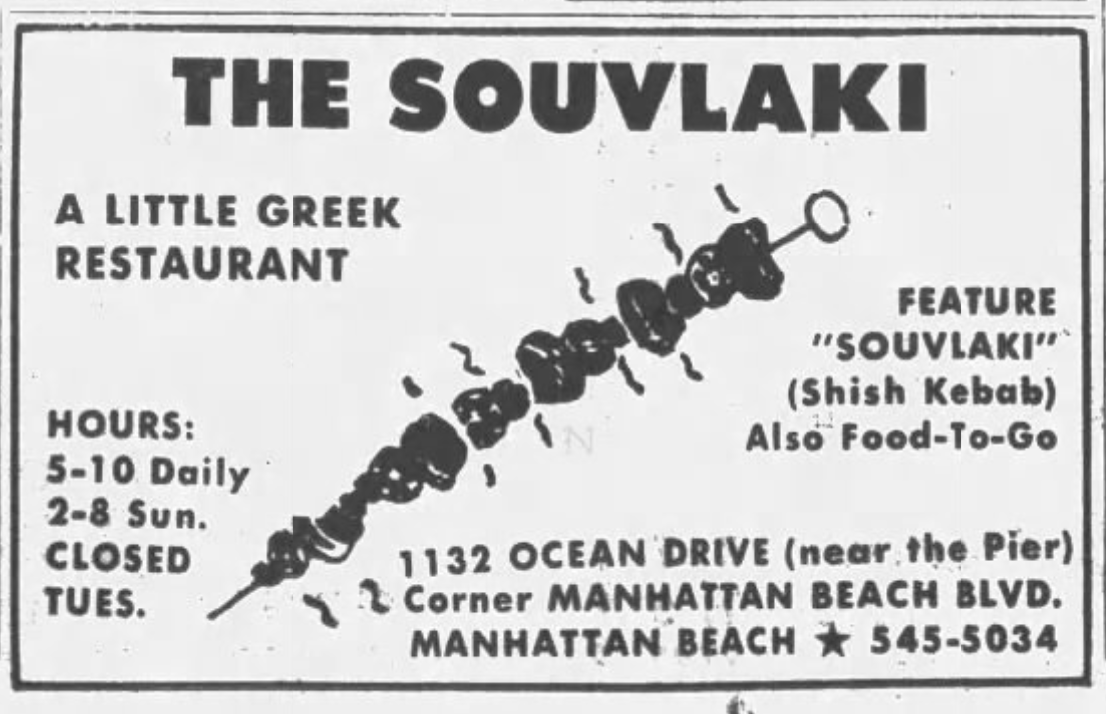
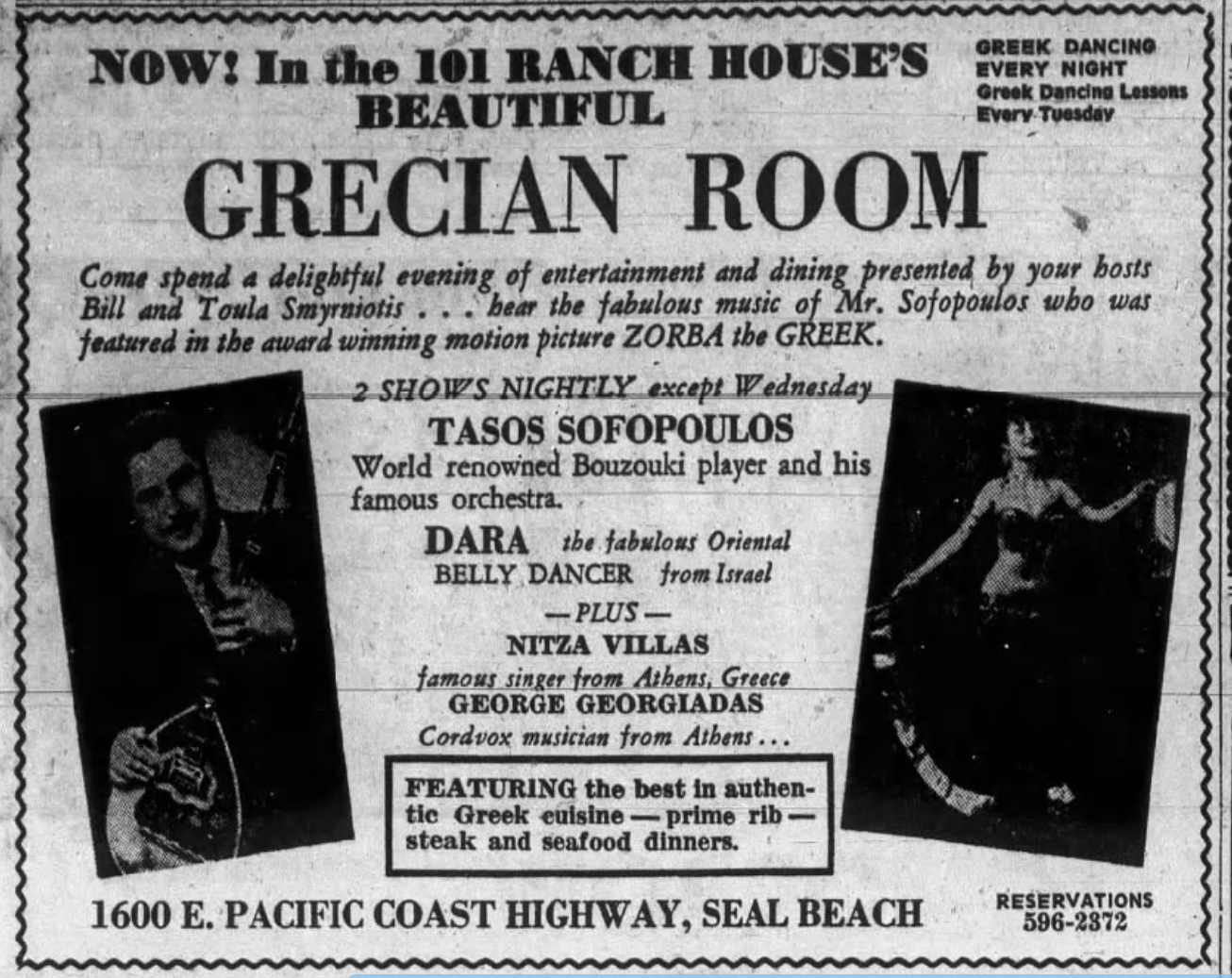
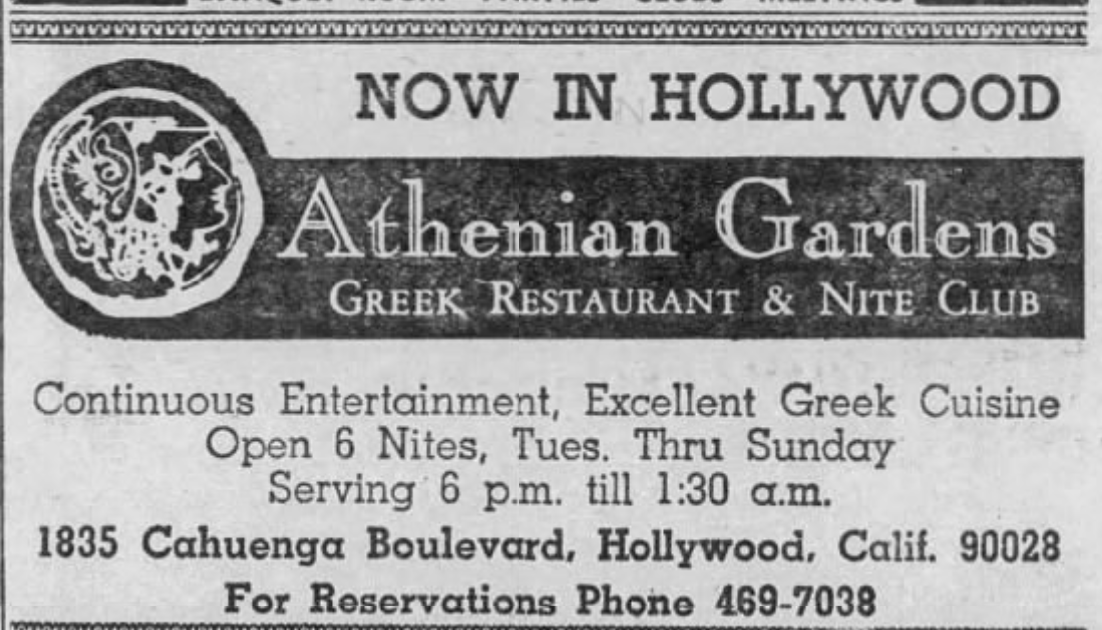
By the 1960s, Marathon was joined by several competitors serving Greek cuisine and, as often as not, entertainment in the form of music and Tsifteteli — the comeliness of dancers was often metnioned in reviews along with the quality of the food. By 1958, The Greek Village Restaurant was in operation in the Yucca Corridor and open at least as late as 1964. Also on Hollywood Boulevard, George and Helen Margaros opened The Torch around 1961. The Grecian Terrace opened down the street in 1962 and, around 1965, re-opened as Port Said, which remained in business at least until 1966. In 1965, there was a Greek restaurant called Athenia across the street from St. Sophia in Greek Town. The Grecian Room opened in Seal Beach‘s 101 Ranch House around 1967. Sophia Geronimos opened Souvlaki in Manhattan Beach around 1968. Athenian Gardens opened in the Yucca Corridor in 1969, with Chef Panagiotis Stravalexis running the kitchen. In 1983, a dance night called Acropolis, was launched there. Athenian Gardens was open at least as late as 1986. Tom Katsenes openend Galleon in Wilshire Center in 1969. It was still open as late as 1969, when Petros Pappas was hired as executive chef and, by night, it operated as Constandinas.
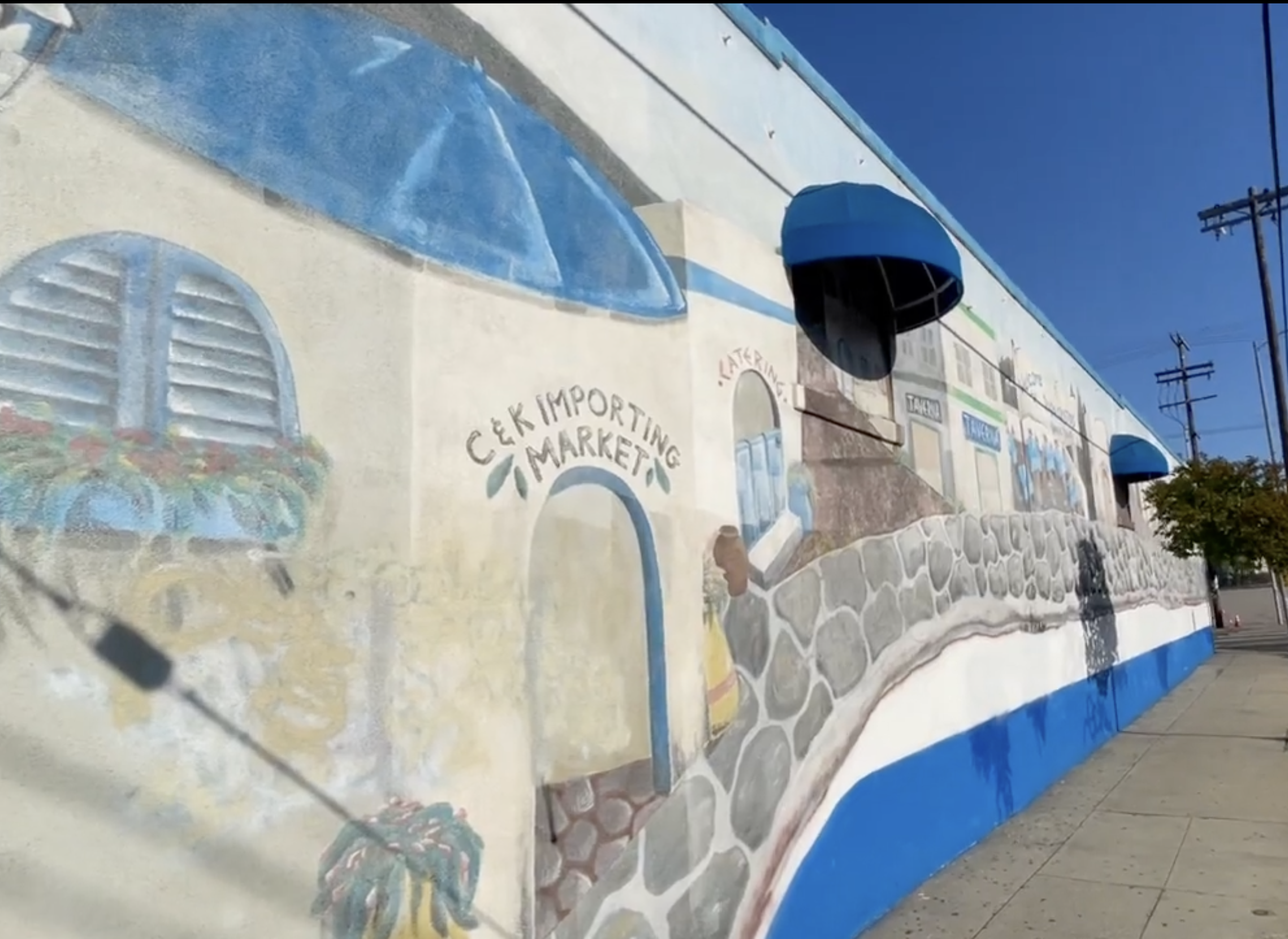
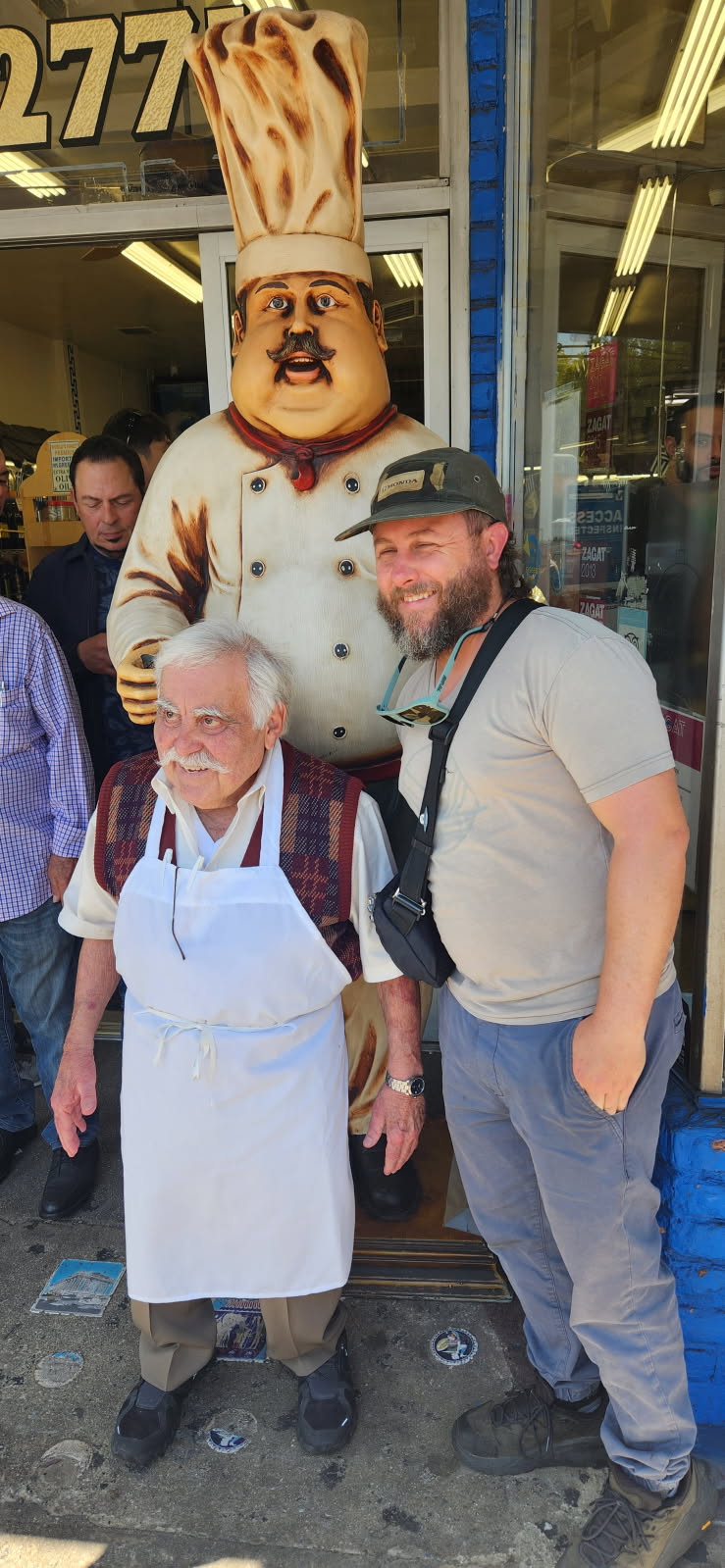
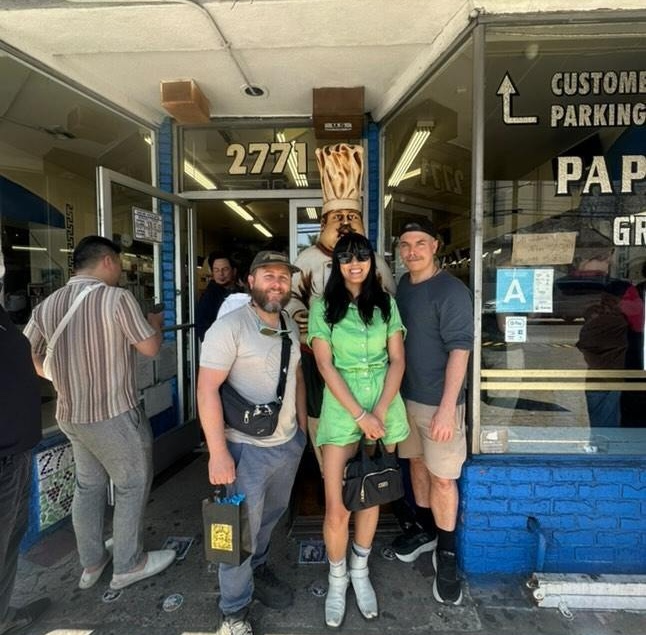
C & K (photo by Eric Brightwell); Papa Cristo and Michael (left); Michael, Jackie, and Dustin (right) (Photos courtesy of Jackie Lam)
The most famous Greek Restaurant today, and for decades now, is Papa Cristo’s. The business began with Sam Chrys, a Greek immigrant born in Turkey in 1900. In 1943, he married Annie Yordon, the Fresno-born daughter of Greek immigrants. Their son, Chrys S. Chrys, was born in 1945. In 1948, Sam Chrys founded C & K Importing. In 1962, the Chryses relocated, like many Greeks, to the South Bay — Rancho Palos Verdes in their particular case. In 1968, Chrys expanded the family business into a restaurant, Papa Cristo’s. Sam Chrys died in 1988. Around 1990, the business began catering and expanded into Papa Cristo’s Catering & Greek Taverna. Papa Cristo’s is closing permanently on 4 May, which is Star Wars Day but also, I suspect, Papa Cristo’s 80th birthday. Hopefully he enjoys a well-deserved retirement but I hope that his namesake restaurant lives on — in some fashion — in more than just our collective memories
Alcholic beverages are a cornerstone of Greek dining and culture. Wine, in particular, has religious significance, associated as it is with Dionysus and amphoras are one of the primary sources of ancient Greek art. Other popular beverages include the anisette, Ouzo, a grape-derived spirit, Tsipouro, and Rakomelo, a digestif.
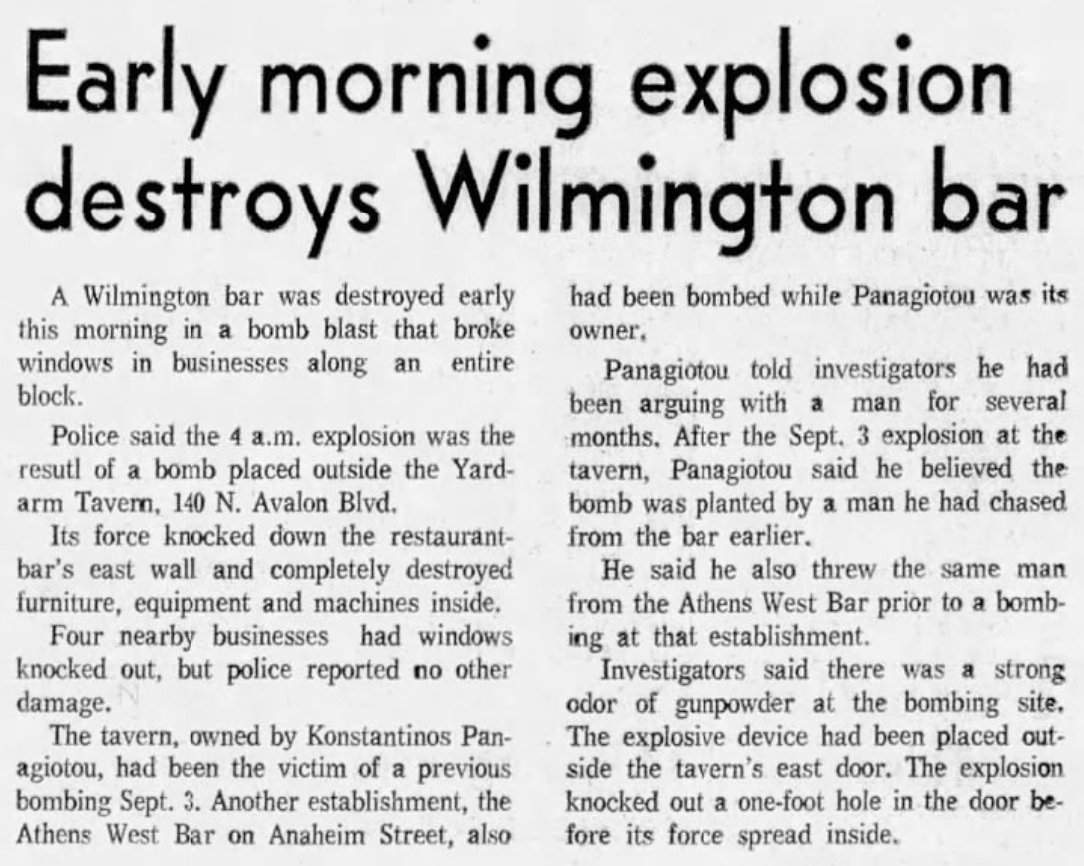
In the 1960s, there were two bars in in the Harbor District neighborhood of Wilmington owned by two brothers, Konstantinos and Panagiotis Panagiotou, that were mysteriously targeted with a bombing campaign. In June 1969, Panagiotis‘s Athens West was bombed. In September, Konstantinos‘s Yardarm Tavern was bombed with enough dynamite to blow out the windows of four neighboring businesses. It was bombed again in early October. Understandably spooked, Konstantinos announced that he was out of the bar game. The following March, a car driven by Panagiotis went into the bay. Inka Modovitch, and an unnamed woman, were fished from the water by a Long Beach Marine diver. Only Konstantinos escaped death and swam to shore but was in shock. In the 1980s, he returned to the bar game, opening The Spot, with his wife, Maria, in neighboring San Pedro. Konstantinos died at the age of 53 in 1990.
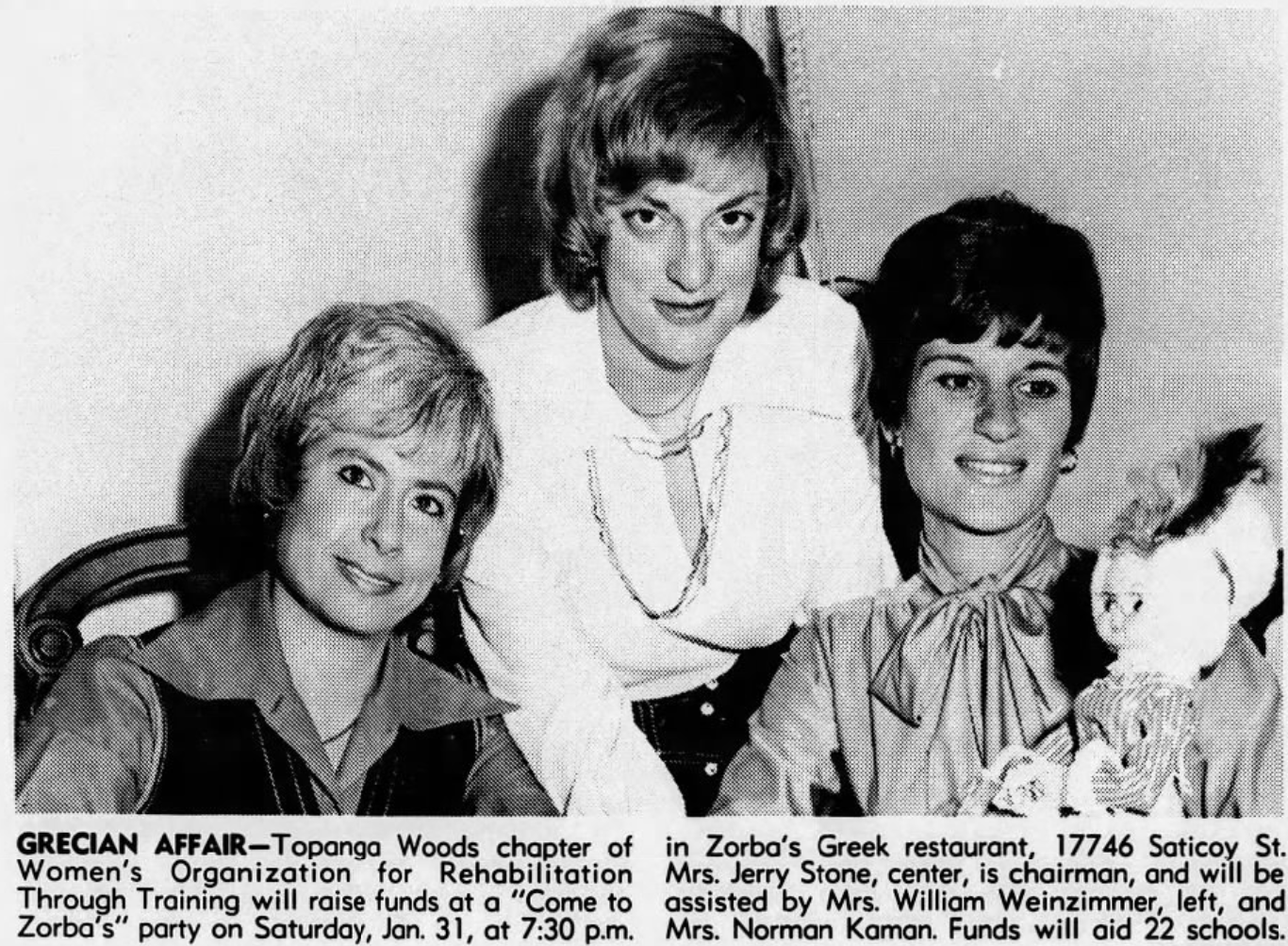
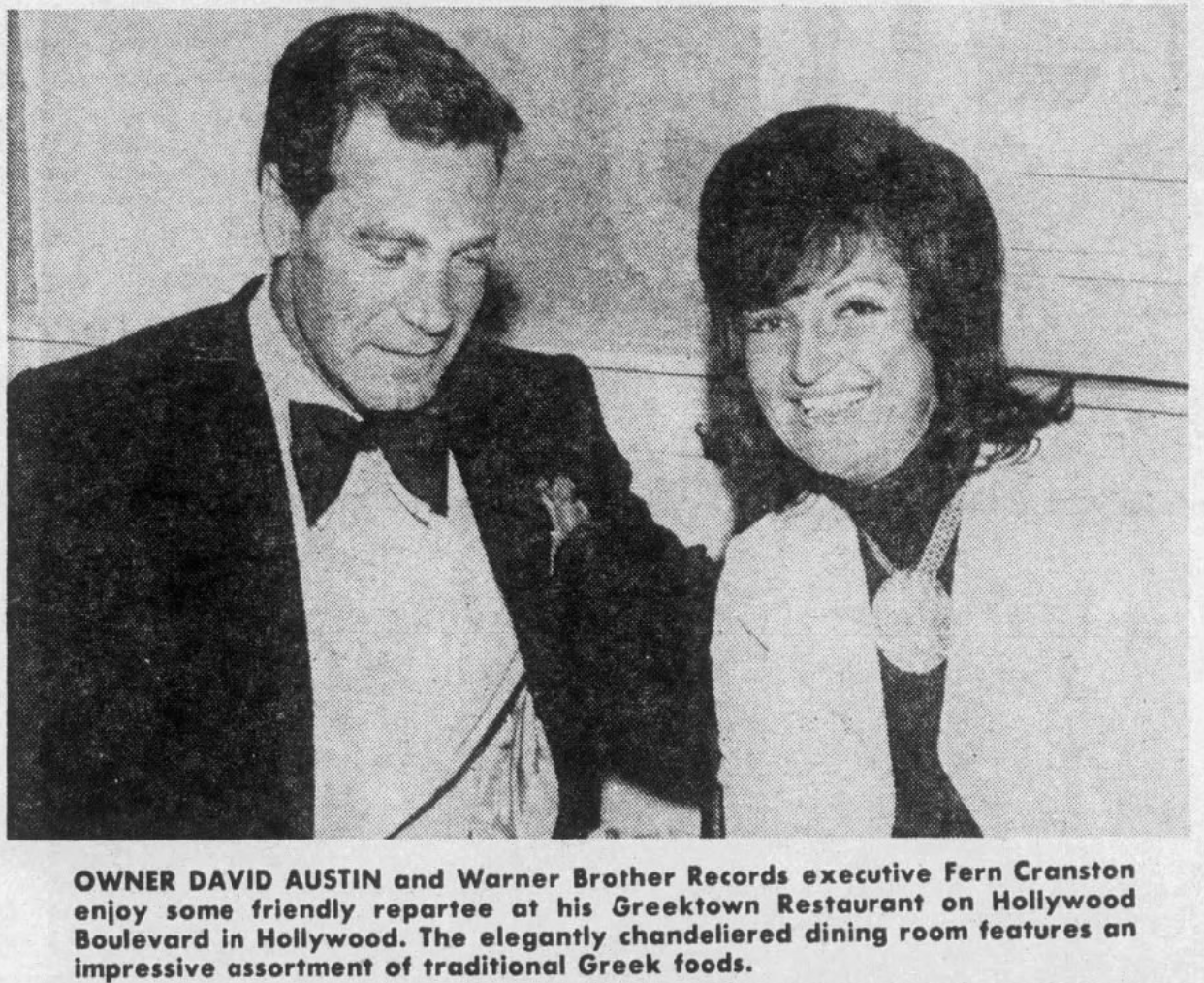
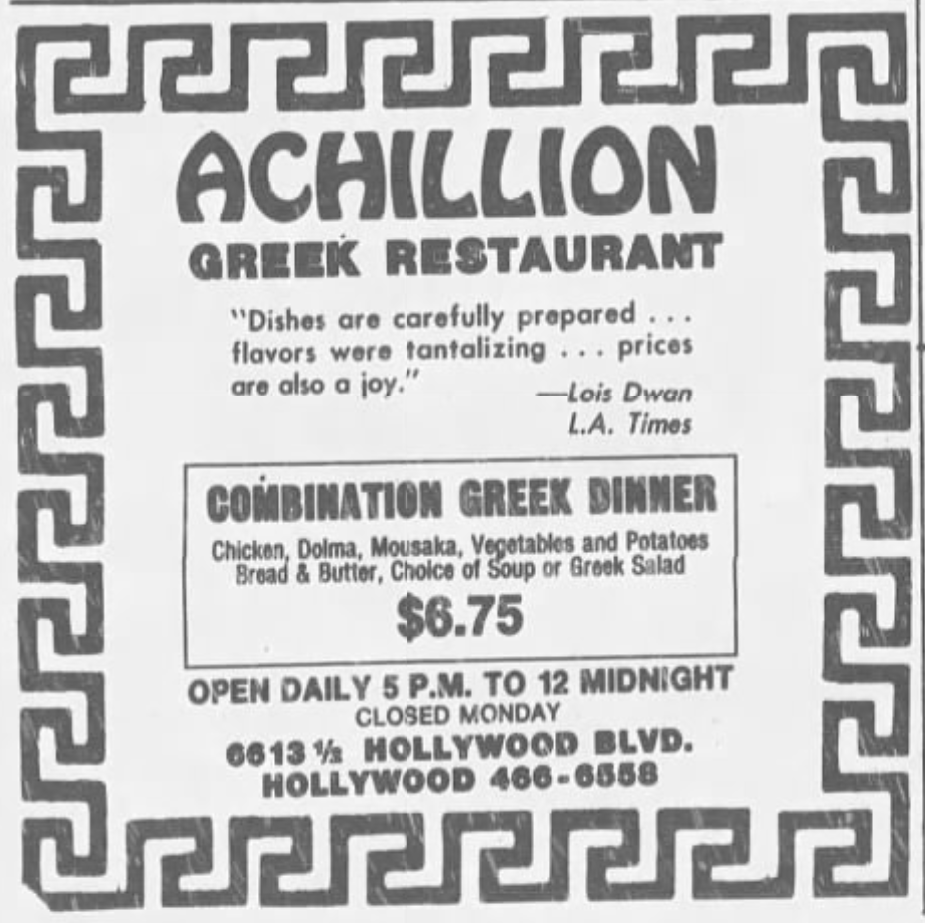
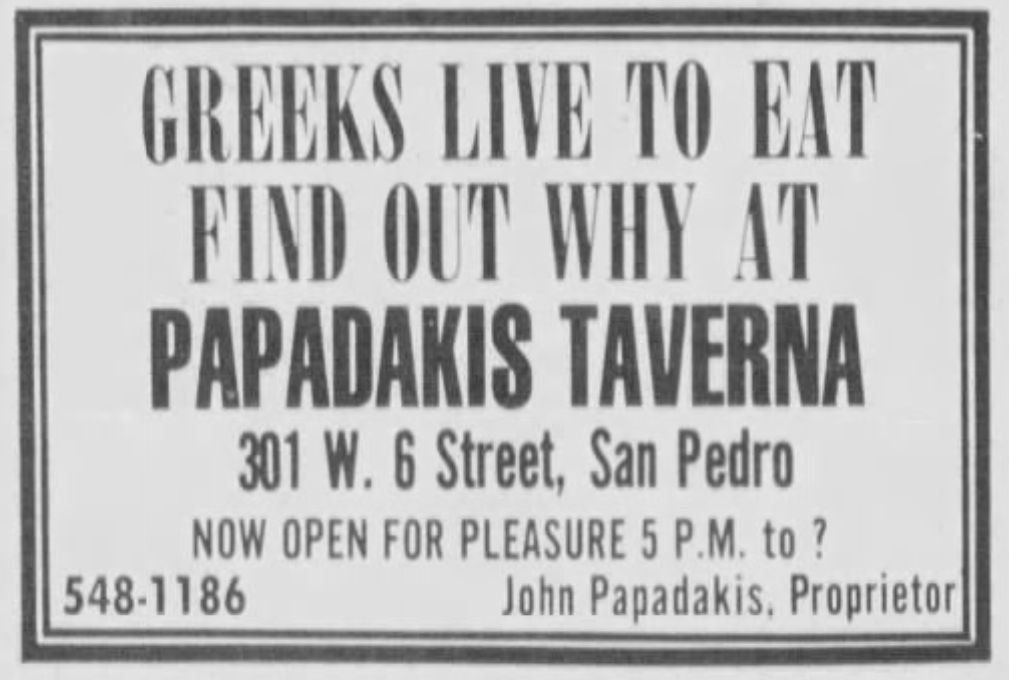
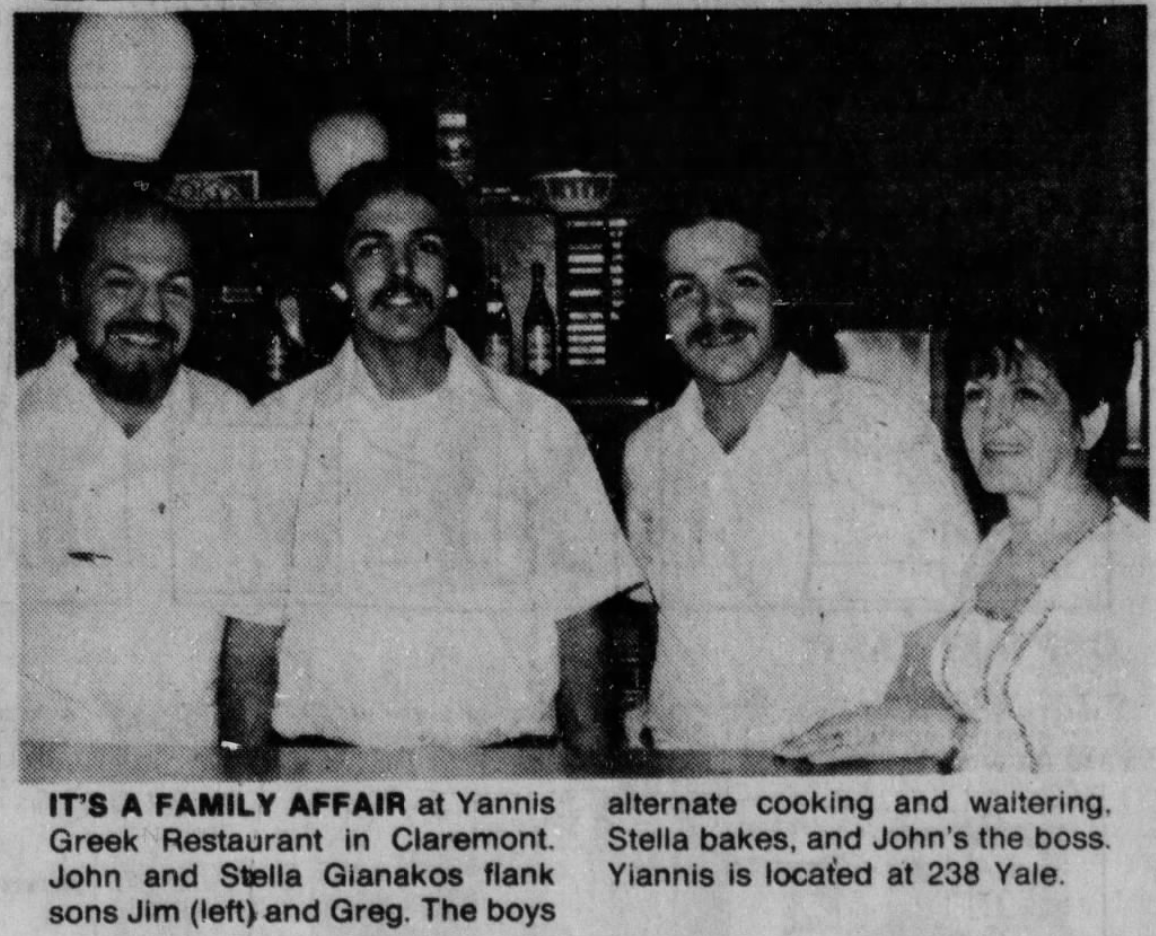
The first Greek restaurant in Orange County, Zorba’s, opened in Garden Grove in 1971 and was open at least as late as 1974.Mark Geronimos, brother of Souvlaki’s owner, opened The Cook Book in Hermosa Beach, in 1971. Its name was changed to The Corinthian in 1974. Yianni Gianakos opened Yiannis in Claremont around the same time, making it the first Greek restaurant in the Pomona Valley,. It remained open until at least 1985. Former Trojan footballer, John Papadakis, opened Papadakis Taverna in San Pedro in 1973, which was open until 2010. Restaurateur David Austin had a Greek restaurant on Santa Monica Boulevard called Greektown. In 1973, it moved to Hollywood Boulevard in Downtown. In 1977, he released an album on his own Greektown label called The Many Faces of Greektown, featuring himself, Dimitri Vamvakas, Nikos And Janette Koudas, Niko Selas, and Thomas Duckett. It had closed by 1979. The Gardens opened in Porter Ranch in 1974, and was then the only Greek restaurant in the Valley. Alexilion opened in Westwood in 1974 and was in operation as lates as 1978. Mykonos Greek Restaurant opened in Naples around 1976. Achillion opened on Hollywood Boulevard around 1978. By 1979, Erna Michaelidas had opened Skorpios in Westwood Village.
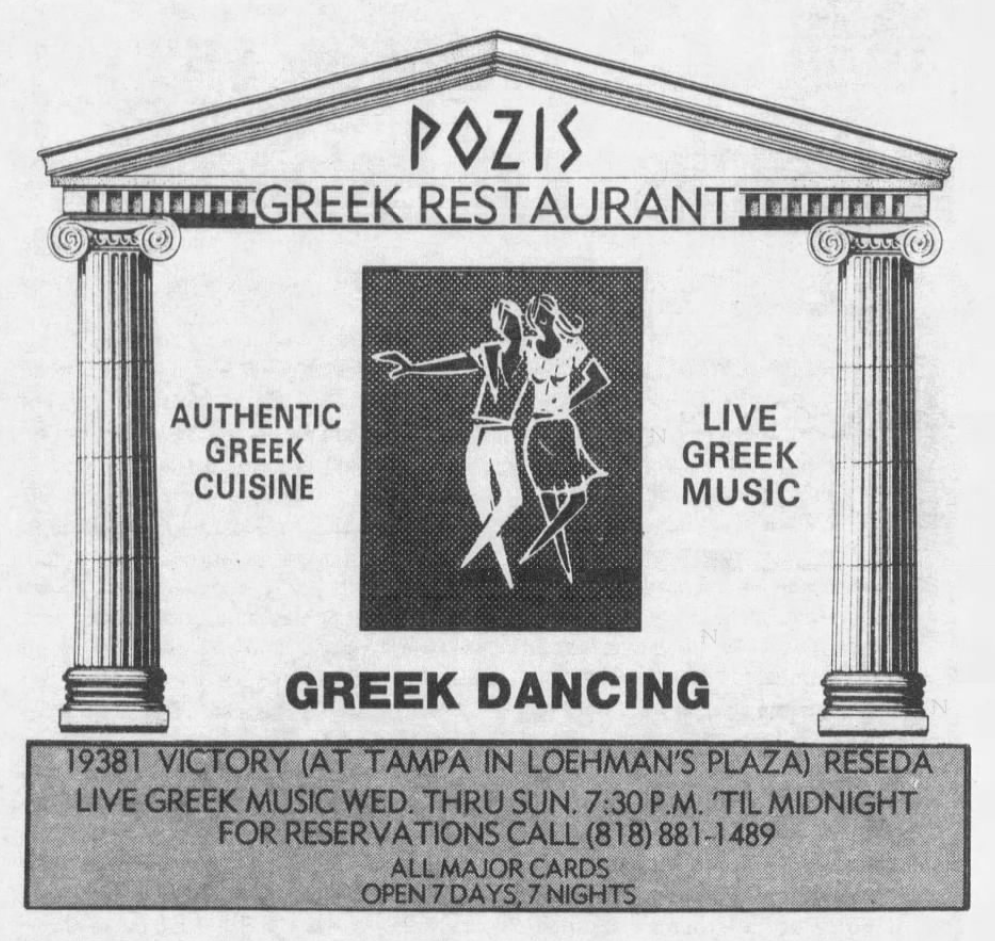
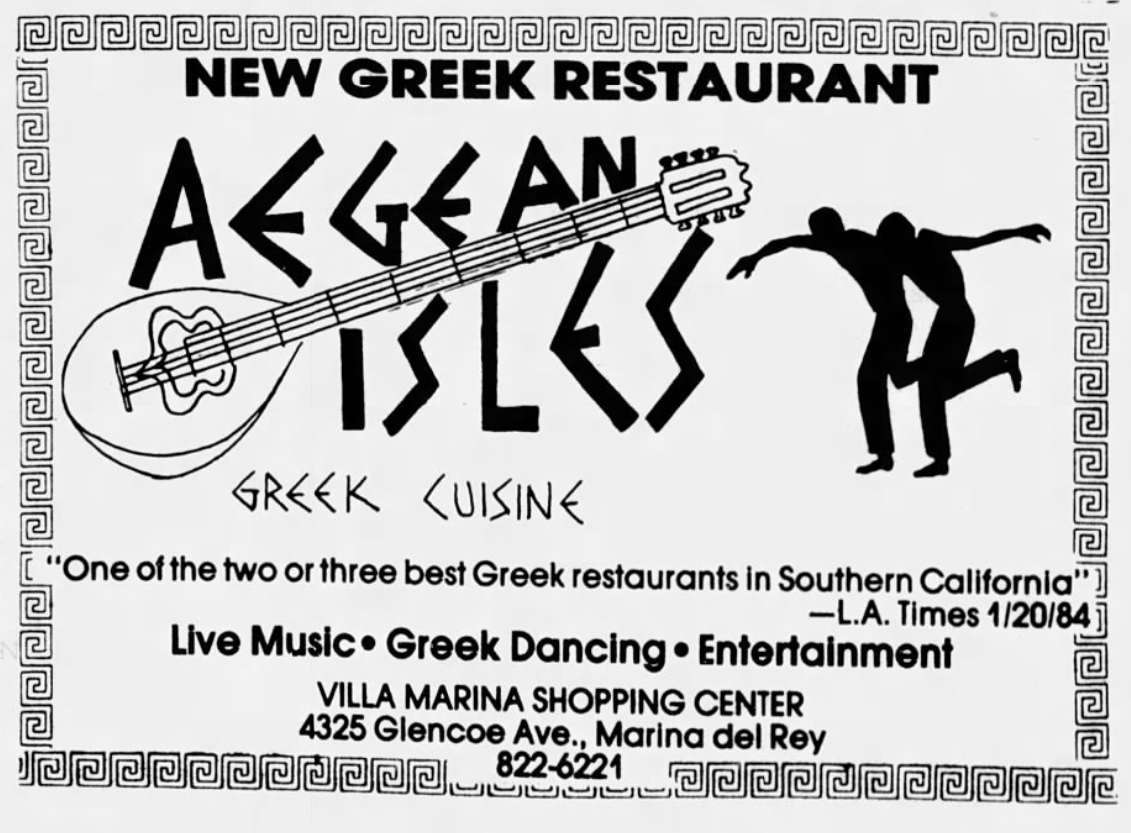
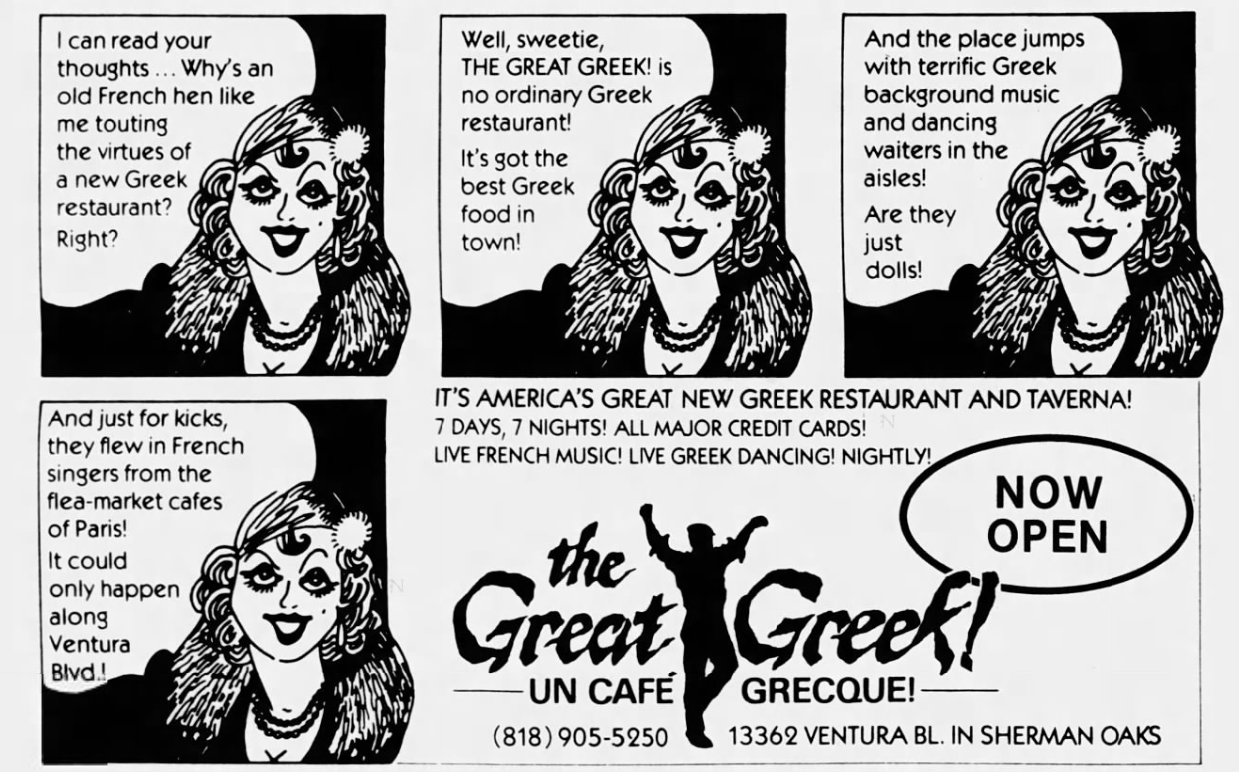
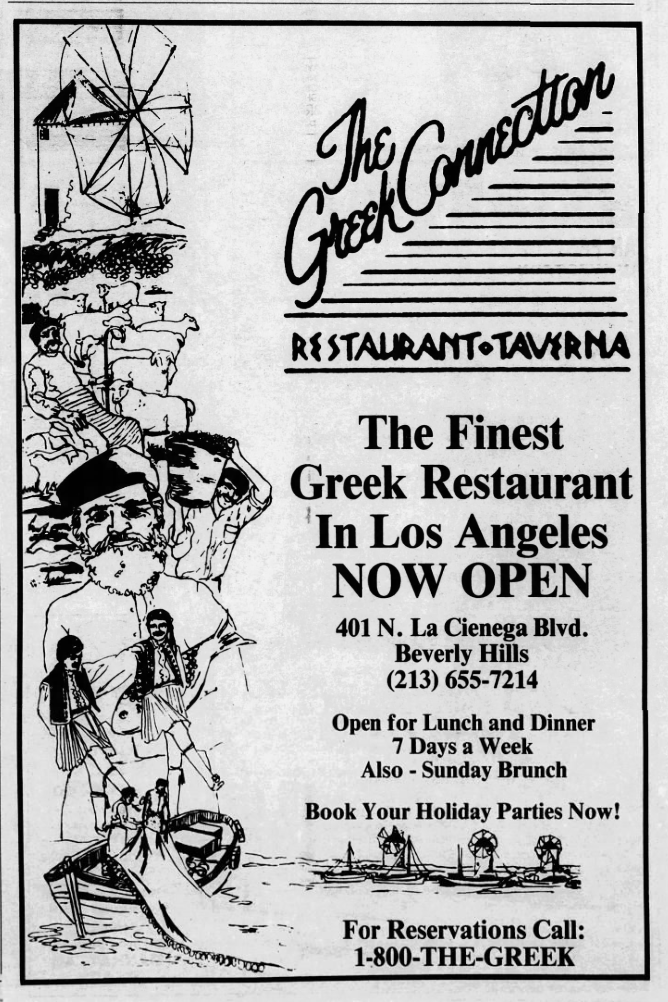
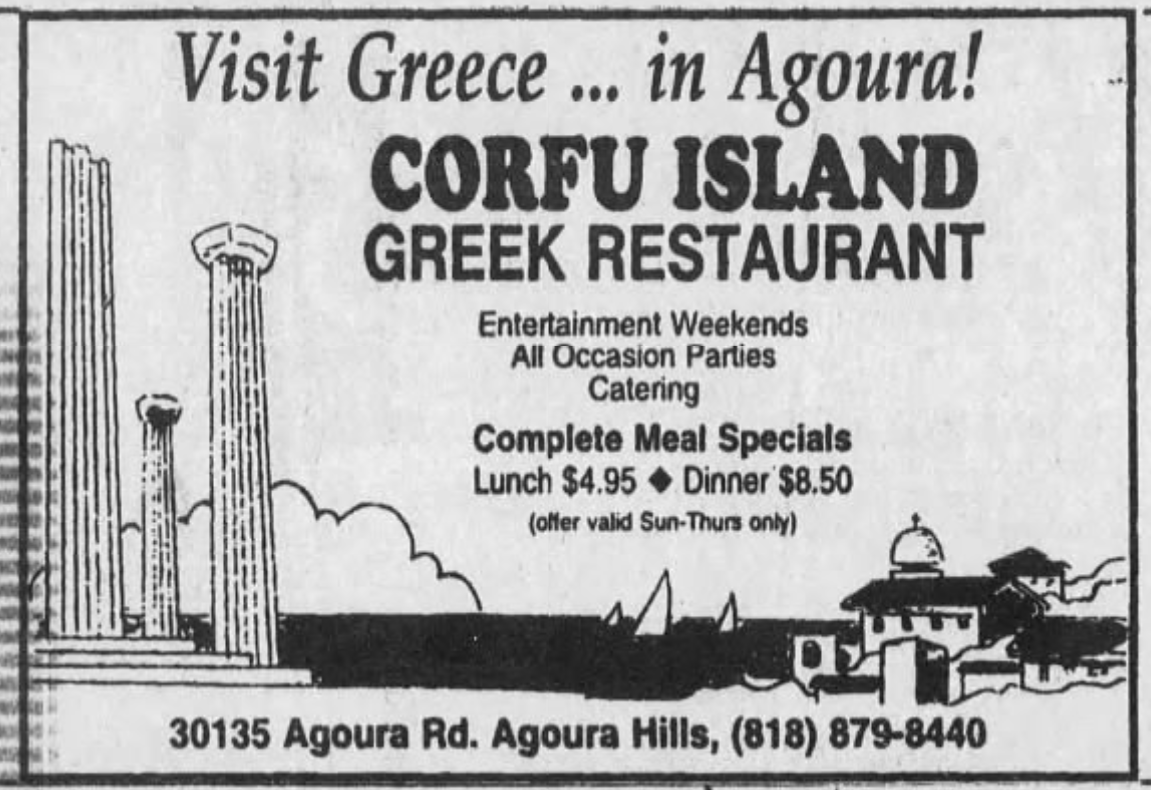
Around 1981, Orlando’s opened in West Torrance. Over in San Diego, in 1982, Haralabos Theodorpoules was arrested for burning Georgio’s Greek Village Restaurant to the ground. His half-brother, George Stravalexis, was the owner. In 1982, Cyprus-born Anna Vanero bought Chowder Call in Marina del Rey around 1981 and launched a Greek night in 1982. Around 1984, it became Aegean Isles (which remained open at least until 1987). A second Marina del Rey Greek restaurant, Dionysus, opened and closed in 1984. Around 1983, Fran O’Brien’s, in Santa Monica, became a Greek restaurant. In Santa Ana, George Smyrniotis opened The Golden Ram. Porto di Leone opened in Studio City around 1983. Sofi Lazaridis and Konstantin Konstantinides opened Sofi Greek Gourmet in West Hollywood around 1984. The Great Greek, still open in Sherman Oaks, opened in 1984. The Greek Connection opened near West Hollywood in 1984. A Taste of Athens opened in Pasadena around 1987. Pozis opened in Reseda around the same time. Mykonos was open in Silver Lake in 1987. Corfu opened in Tehrangeles around 1988.
GREEK RELIGION IN LOS ANGELES
Greek’s ancient religion – more commonly characterized as Greek Mythology – is probably the most widely familiar body of myths in the world. The majority of Greeks, today, are members of the Greek Orthodox Church, part of the larger communion of Orthodox Christianity. There is also the Church of Antioch, which gets a bit complicated for me. Today Antakya, Turkey; Anticoh was formerly a Greek city. It is divided into two branches. The Syriac Orthodox Patriarchate of Antioch and All the East, who rejected Chalcedon, and the Greek Orthodox Patriarchate of Antioch and All the East, who accepted Chalcedon.
The first Greek Orthodox services were held at a warehouse at 720 North Broadway in 1906. By 1908, they’d relocated to a building at 240 South Anderson Street in the Russian Flats section of the Eastside. That 14 June, a group of Greeks took out a state charter to formally organize the Greek Community. The board of directors was composed of Bill Tsagalakis, Fotis Tsoumas, George Alexakis, George Mantas, George Vacrinos, Gust Chicos, Gust Legakis, Gust Markopoulos, Gust Picoulas, Jim Carellas, John Heliotis, Louis Alexakis, Peter Sakellaris, Thomas Vacrinos, and Tsoumas Vacrinos. The first permanent leader of the church was Papa Gerondeos Koutouzis. The first church, O Evangelismos Tis Theotokou (aka “St. Julian”) was dedicated in 1912 and located in the Garment District until it was closed with an injunction in May 1953.
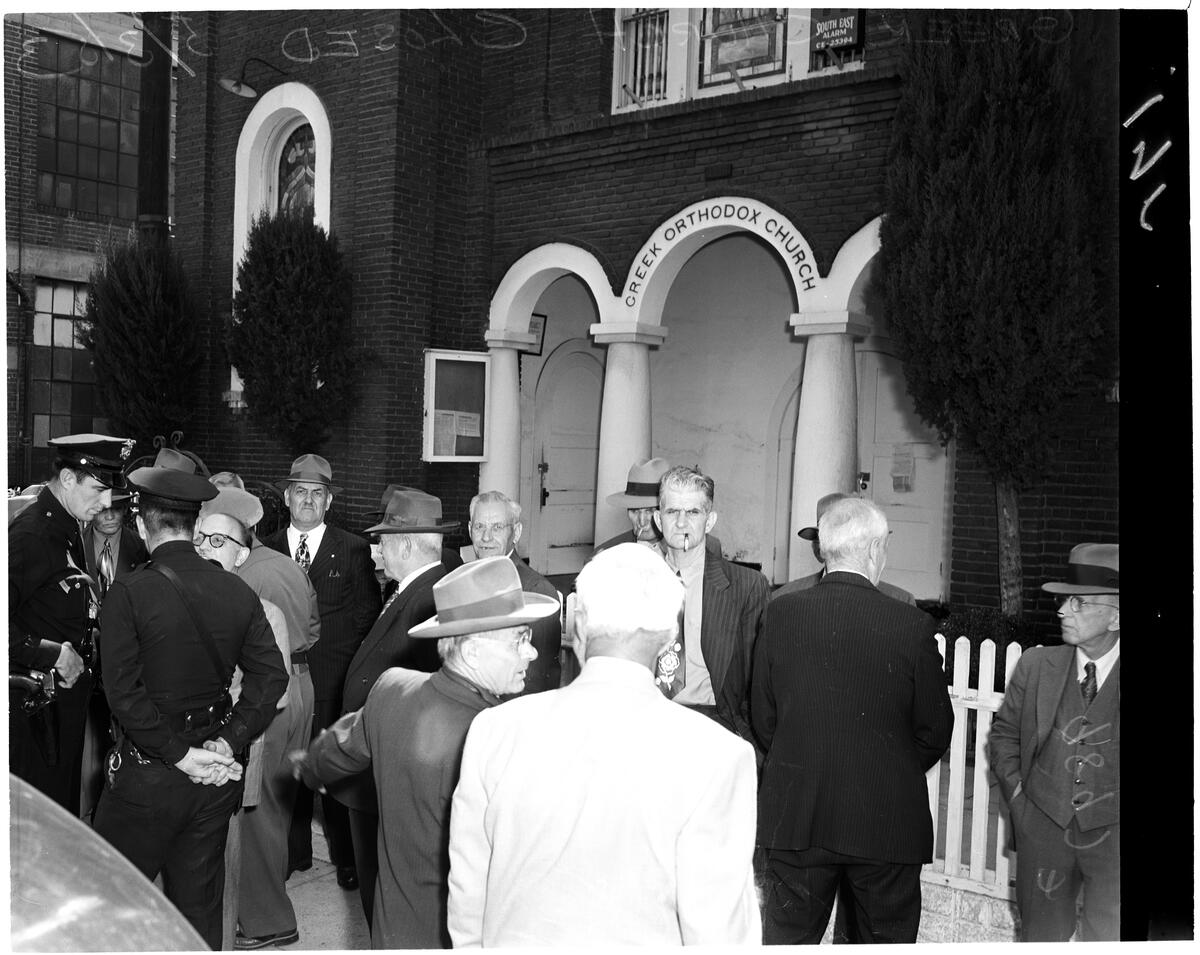
The aforementioned St. Sophia, was designed by Kalionzes, Klingerman & Walker, Constantine W. “Gus” Kalionzes was a Greek Angeleno architect. It was built by Charles P. Skouras, the one-time head of United Artists. In East Pasadena, St. Anthony Greek Orthodox Church was purchased in 1959. Ground broke on the St. Nicholas Greek Orthodox Church in Northridge in 1962. The St. Michael Antiochian Orthodox Church in Lake Balboa opened in 1968. The St. George Greek Orthodox Church in Downey was completed in 2002. I’m not prepared to research them all at this time… but perhaps in the future.
GREEK ANGELENO FILM FIGURES
When Greece has been depicted in Hollywood, it has usually been the Greece of the ancient and/or mythological past; e.g. Alexander, Clash of the Titans, Hercules, Spartacus, 300, Troy, Ulysses, and Wonder Woman. There are a exceptions — although most didn’t actually feature Greeks in starring roles. In 1931, Jewish actor, Edward G. Robinson, played Nick Venizelos in Smart Money. In 1954, “The Day the Greeks Closed” aired as an episode on NBC‘s Summer Playhouse anthology series.
There’s also Boy on a Dolphin. That film was the first Hollywood production shot in Greece. Though set in Greece, virtually no one involved with the making of the film was Greek. It was co-directed by Romanian American Jean Negulesco and Samuel G. Engel. The screenplay was written by Ivan Moffat and Dwight Taylor and adapted from a novel by South African writer, David Divine. It starred Sophia Loren as a Greek sponge diver named Phaedra. The film is commemorated by a statue of a boy on a dolphin across the street from the original Original Tommy’s, in the parking lot of the former El Tomasito — Tommy’s attempt to expand into the Mexican restaurant scene.
In 1964, Mexican actor Anthony Quinn played Alexis Zorba in Zorba the Greek; which was written, produced, edited, and directed by Greek Cypriot filmmaker Michael Cacoyannis. It seems to have inspired a brief rise in interest in Greek culture. The title was parodied in a 1965 episode of My Mother, the Car, titled “Asorba the Greek.” On The Lawrence Welk Show, Long Beach dancers Barbara Boylan and Bobby Burgess demonstrated Greek dance.
Somewhat more recent examples in My Big Fat Greek Wedding (2002) and Mamma Mia! The Movie (2008).
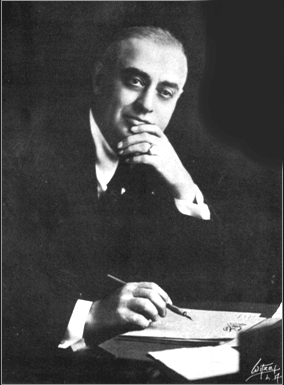
There have been at least a couple of big Greek figures behind the scenes in Hollywood. Alexander Pantages, born Periklis Alexandros Padazis, in 1867, was a vaudeville impresario who transitioned into motion pictures as a producer. In 1920, he opened the first Pantages Theatre at 7th and Hill streets. From there, he expanded his circuit of theaters across the western US and Canada. In 1929, he was arrested and charged with the rape of a seventeen-year-old dancer, Eunice Pringle. Afterward, he sold most of his cinema chain to RKO and his flagship theater to Warner Bros. After serving a few months of his fifty year sentence, he was acquitted in a retrial and died in 1936. The Pantages Theatre in Hollywood, which opened in 1930, ceased operation as a cinema (it hosted the Oscars from 1950-1959) and transitioned into a live theater known as The Pantages in 1977.
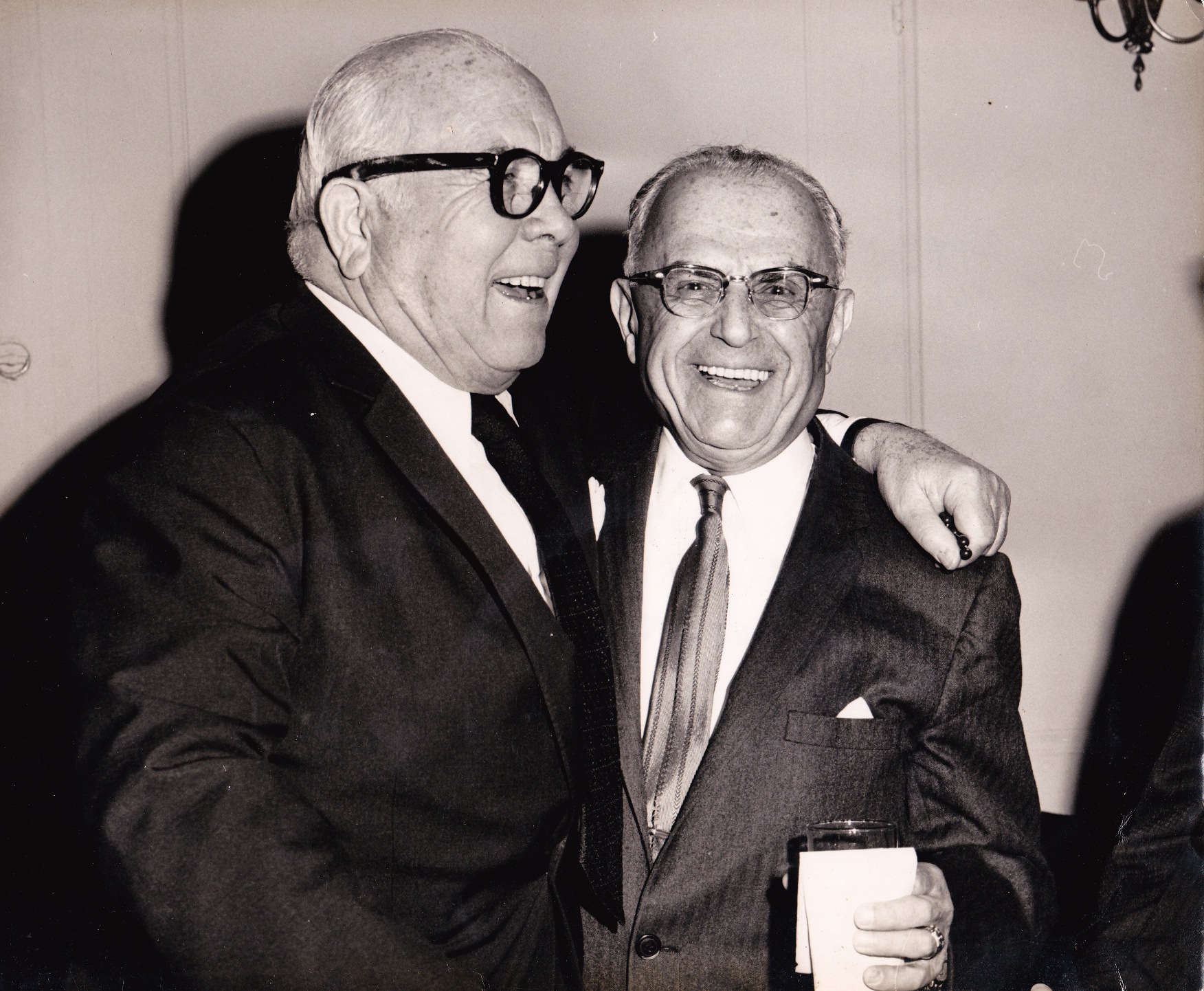
Spyros Panagiotis Skouras was born in 1893 in Skourochori. In 1910, he and his two brothers (Charles and George) emigrated to St. Louis. In 1914, they opened a nickelodeon called the Olympia. By 1924, the Skouras Brothers Company operated more than thirty local theaters around St. Louis. In 1932, they assumed control of the Fox West Coast Theater chain. Fox merged with Twentieth Century Pictures to create 20th Century Fox in 1935 and Spyros served as the company’s president from 1942 till 1962. As president, Skouras oversaw the production of Cleopatra, a popular but costly epic about the Hellenistic ruler of the Macedonian-led Ptolemaic Kingdom — starring English actress, Elizabeth Taylor. It was the highest-grossing film of 1963… but was, due to its huge budget, also a commercial failure which sparked a shareholder revolt. Darryl F. Zanuck replaced Skouras and, in part to recoup costs, the 20th Century Fox lot was sold and redeveloped as Century City. Skouras died in 1971.
While not set in Greece, there have been a few American television series that have featured Greek characters, including, sometimes, characters played by Greek Angeleno actors. From 1983 until 1987, Alex Karras played George Papadopolis on Webster, filmed at the Paramount Studios in the Hollywood Studio District. It followed his role in the 1980 made-for-television film, Jimmy B. & André, upon which the series was based. The Famous Teddy Z was an American sitcom starring Jon Cryer as Theodore “Teddy” Zakalokis that aired in the autumn of 1989. It was filmed at Sunset Gower Studios, also in the Hollywood Studio District. Full House, filmed at Warner Bros. in Burbank, co-starred John Stamos as Uncle Jesse Katsopolis.
Greek American film and television directors include some of the greats and include Alexander Payne (anglicized from Papadopoulos), Dimitri Logothetis, Elia Kazan (né Elias Kazantzoglou), George P. Cosmatos, Gregory Charles Yaitanes, John Cassavetes, Milton Katselas, Penelope Spheeris, and Tony Leondis. While perhaps neither would be included on many lists of great filmmakers, Greek Angeleno filmmakers Andy Sidaris and Nico Mastorakis were auteurs, in the true sense of the word. Sidaris was the pioneer of the “Bullets, Bombs, and Babes” sub-genre which cast Playboy Playmates and Penthouse Pets instead of actors in lead roles. Mastorakis is a prolific exploitation filmmaker whose films bear noted similarities with those of Sidaris.
Greek Angeleno actors include Abraham Benrubi, Adoni Maropis, Alex Karras, Alexa Nikolas, Alexander Scourby, Andreas Katsulas, Annita Adamou, Ariel Winter, Aristotelis “Telly” Savalas, Billy Zane, Christopher George, Dan Vadis (né Constantine Daniel Vafiadis), David Mazouz, Dimitra Arliss, Dimitri Diatchenko, Elizabeth Perkins (anglicized Pisperikos), Evan Spiliotopoulos, Gabrielle Carteris, George Chakiris, George Maharis, Georgios Demosthenes Savalas, Gloria Votsis, Haley Alexis Pullos, Hank Azaria, Jack Angel, Jennifer Aniston, Jessica Chastain, John Aniston, John Anthony Aniston (né Yannis Anastassakis), John Stamos, Katie Chonacas, Kopi Sotiropulos, Kym Karath, Leon Logothetis, Lindsay Hartley, Margia Dean, Marguerite Louise Skliris-Alvarez, Marilu Henner, Marina Sirtis, Mena Suvari, Michael Chiklis, Nick Dennis, Nick Kiriazis, Nico Minardos, Paula Cale (née Paula Korologos), Peter Lupus, Rita Wilson, Robert Karvelas, Ron Karabatsos, Stelio Savante, Tim Considine, Tracy Spiridakos (né Panagiota Spiridakos), Xenia Gratsos, Yannis Zafeiriou, and Zoe Kazan.
Of course, the comedy mask is as essential as the drama mask in theater of ancient Greece. Greek Angeleno comedians (most of them actors, too) include Andy Milonakis, Demetri Martin, and Zach Galifianakis. It will probably strike most readers as strange, but Greek Americans used to be a sort of stock character in vaudeville. Non-Greeks continued to portray Greek characters for laughs in Hollywood.
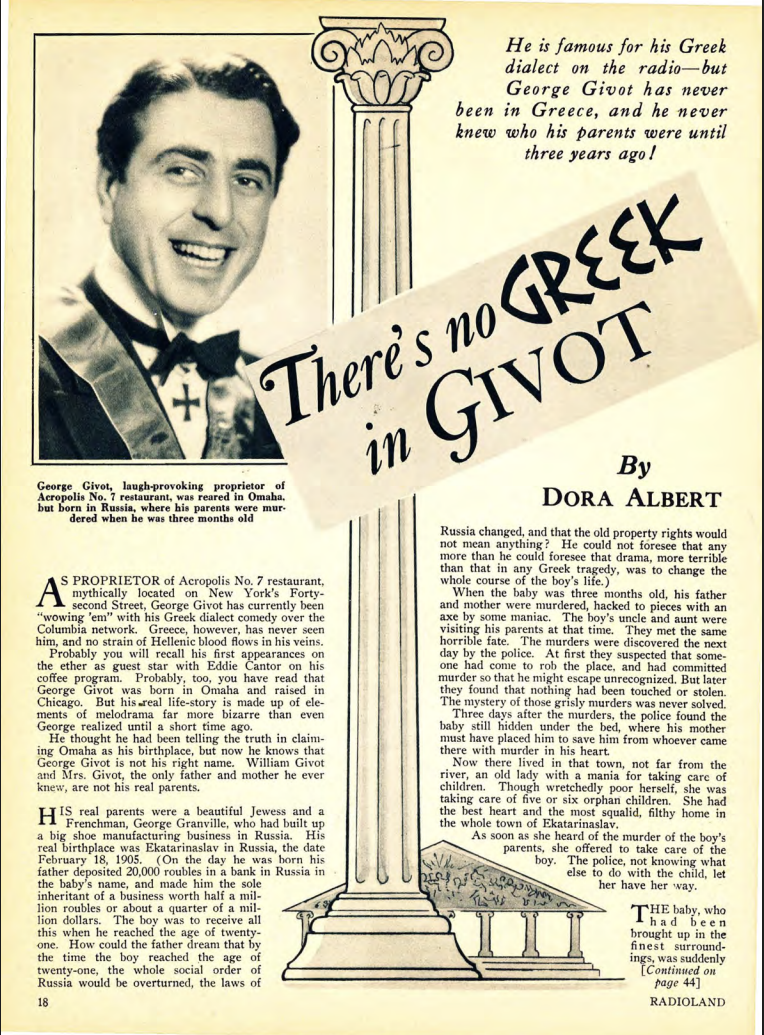
Ukrainian American vaudevillian George David Givot — the Greek Ambassador of Good Will — reportedly picked up some Greek whilst working as a soda jerk in Omaha. In Hollywood, much of his career was based on portraying Greek characters, which he did in films including Gobs of Fun (1933), The Chief (1933), Howd’ Ya Like That? (1934), Roast Beef and Movies (1934), Ed Sullivan’s Headliners (1934), and Ain’t Misbehavin‘ (1955). He lived in Tarzana before retiring to Palm Springs, where he died in 1984.
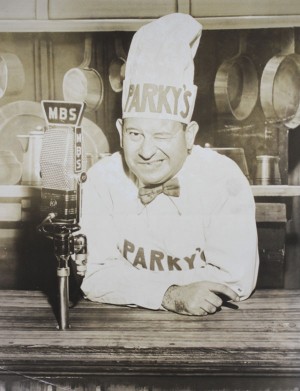
Boston-born Harry Einstein was famous for portraying Greek chef Nick Parkyakarkus, which he often did on programs starring Al Jolson or Eddie Cantor. Credited as Parkyakarkus, he appeared in Strike Me Pink (1936), New Faces of 1937 (1937), The Life of the Party (1937), She’s Got Everything (1937), Night Spot (1938), A Yank in Libya (1942), Sweethearts of the U.S.A. (1944), Movie Pests (1944), The Yanks Are Coming (1942), Earl Carroll Vanities (1945), and Out of This World (1945). He was the father of Albert Brooks and Bob “Super Dave” Einstein. He died onstage in 1958 during a roast of Lucille Ball and Desi Arnaz.
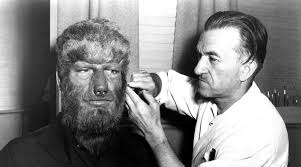
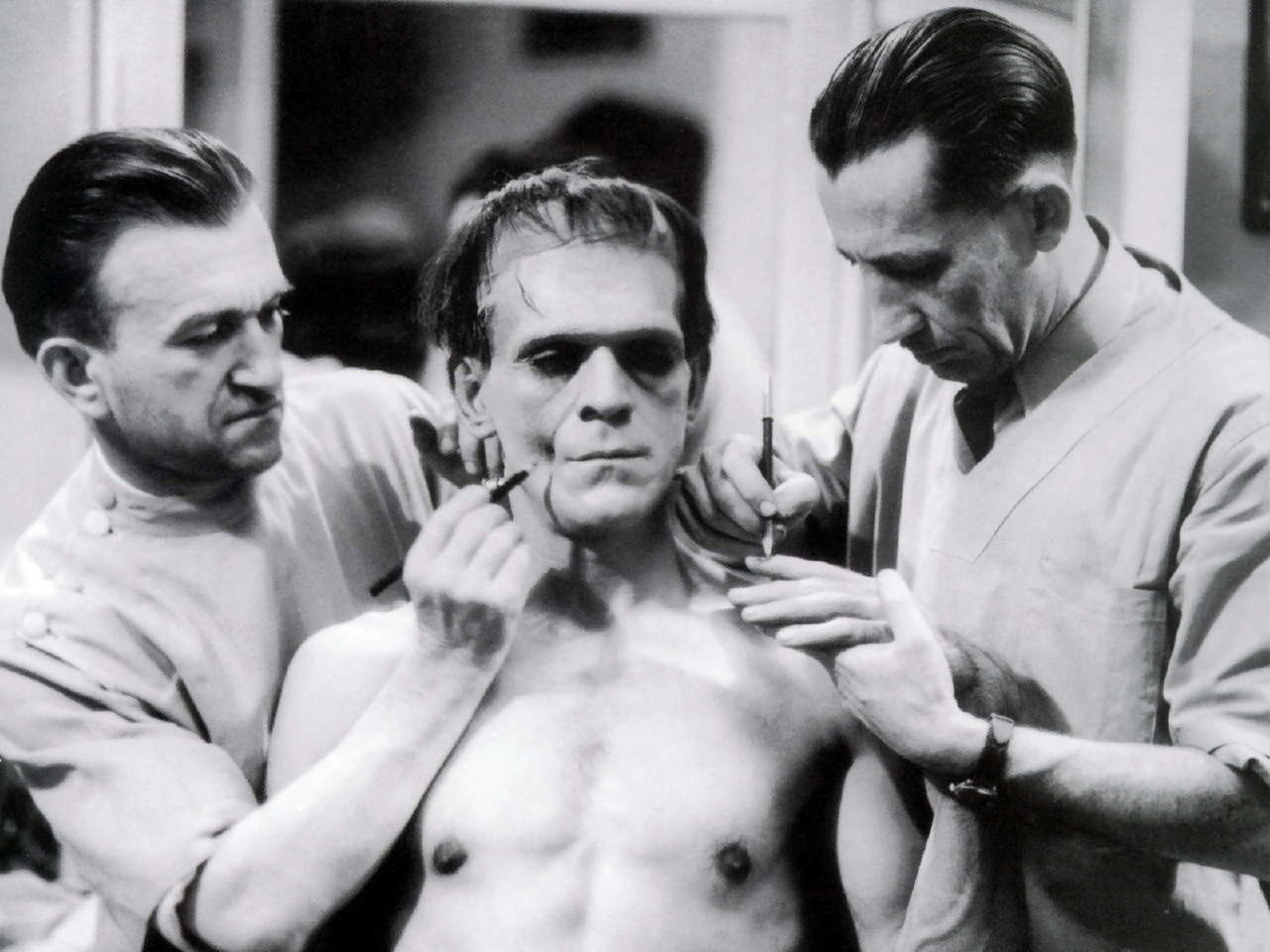
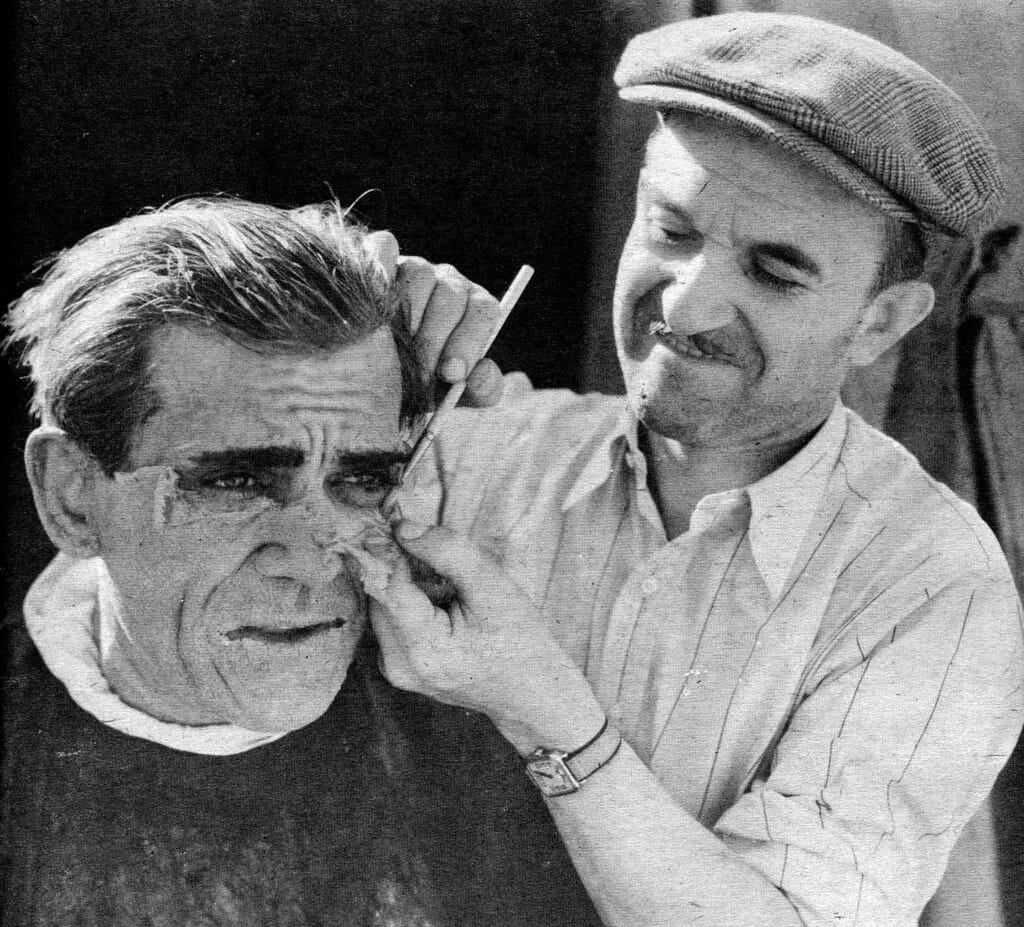
The great Jack Pierce (né (born Yiannis Pikoulas) working on some of his iconic creations
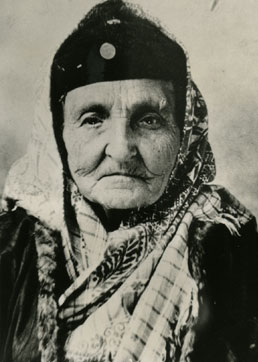
Greek Angeleno cinematographers include Chris J. Condon (né Christo Dimitri Koudounis), Mike Gioulakis, and Phedon Papamichael. Greek Angeleno production designers included Dean Tavoularis and Patrick Tatopoulos. Other Greek Angeleno film figures include screenwriter Albert Isaac “Buzz” Bezzerides, make-up artist Jack Pierce, special effects creator Petro Vlahos, and costume designer Mary Zophres.
Perhaps the first Los Angeles specific documentary about Greek Angelenos was Island of Roses: The Jews of Rhodes in Los Angeles, directed by Gregori Viens and released in 1995.
The annual Los Angeles Greek Film Festival, founded in 2007, takes place in May.
GREEK ANGELENO MUSIC
Despite its ancient roots, it seems to me like there aren’t that many Greek musicians or composers who can be said to be household names. Having worked at two record stores, I can say that Demis Roussos, Nana Mouskouri, and Maria Callas — although likely unfamiliar to the majority of listeners — all have their absolutely rabid fans. I wouldn’t self identify as rabid but I am appropriately appreciative of Vangelis’s (né Evangelos Odysseas Papathanassiou) atmospheric synthesizer scores. When I was a kid, it seems like there were always ads on television for Yanni (né Yiannis Chryssomallis), who moved to Los Angeles in the 1980s.
My college girlfriend (who, for some reason, went by “ρ” for a time) was a fan of Diamanda Galás, who I didn’t know at the time was a Greek Angelena/San Diegan. Embarrassingly, I was a bit sniffy about George Michael (né Georgios Kyriacos Panayiotou) when I was growing up but as an adult I’m mature enough to sing “Everything She Wants” at a noraebang. Michael didn’t live in Beverly Hills for long — although he was famously entrapped and arrested there in 1998 for lewd conduct — and so I claim him as an Angeleno.
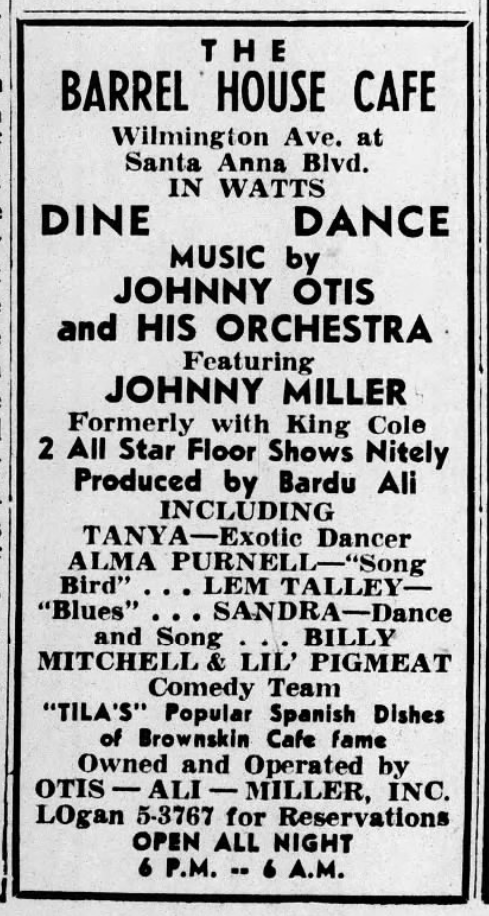
Johnny Otis (né Ioannis Alexandres Veliotes) might not be widely remembered today but his role in developing and popularizing rhythm & blues and rock & roll can scarcely be overstated. In 1947, he co-opened the storied Barrel House in Watts.
Other prominent Greek Angeleno musicians include Alex Varkatzas (of Atreyu), The Andrews Sisters (anglicized “Andreas”), Art Alexakis (of Everclear), Athan Hilaki, Athan Maroulis, Basil Poledouris, Eden xo (née Eden Malakouti), Fran Jeffries (née Frances Ann Makris), George Arvanitidis, Jim Sclavunos, Jimmie Spheeris, John Cacavas, Marco Beltrami, Shuggie Otis, Ted Nichols (né Theodore Nicholas Sflotsos), Teddy ‘Zig Zag’ Andreadis, Tommy Clufetos, Tommy Lee (of Mötley Crüe) and Wayne Stanley Kramer (né Kambes) (of MC5).
GREEK ANGELENO ART
Ancient Greek art is best known for its depictions of nude men — rendered in naturalistic but idealized fashion. It flourished from 750 until 300 BCE – a time so long ago that more durable art forms such as pottery and sculpture are what we know it by today. The last 2,300 hundred years have introduced all sorts of new expressions and few, if any, modern Greek artists preoccupy themselves entirely with naked men. Modern Greek Angeleno artists of note include animator Aliki Theofilopoulos, photographer Chris Hondros, multi-disciplinary Ithaka Darin Pappas, ceramicist Peter Voulkos (born Panagiotis Harry Voulkos), and cartoonist Stephan Thomas Pastis.
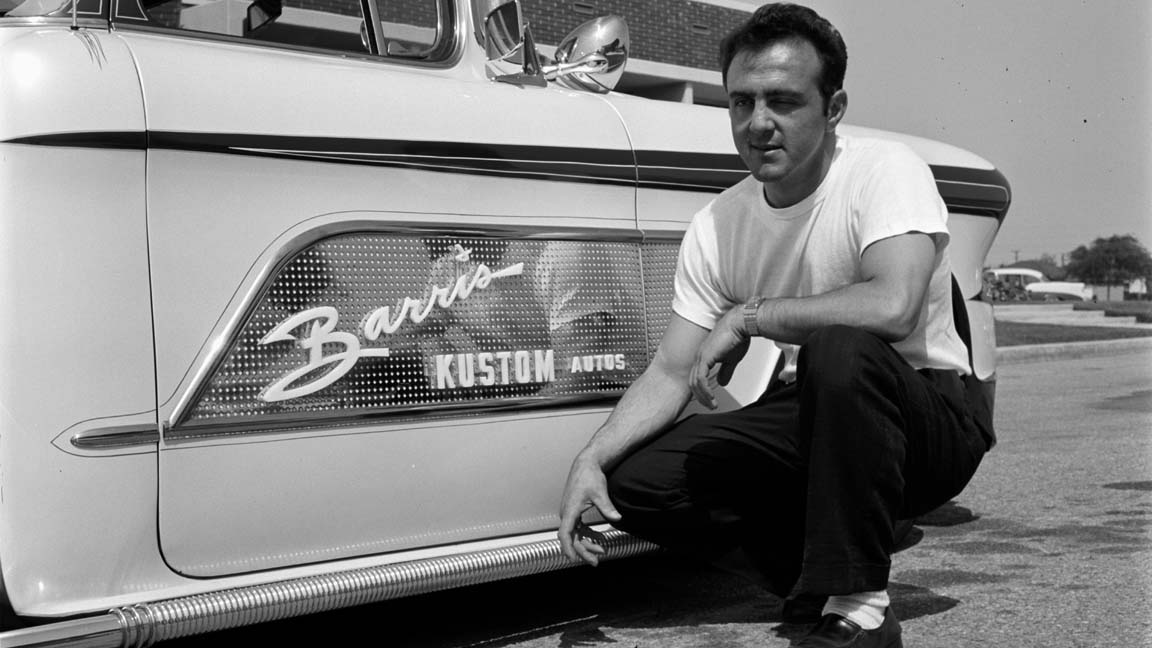
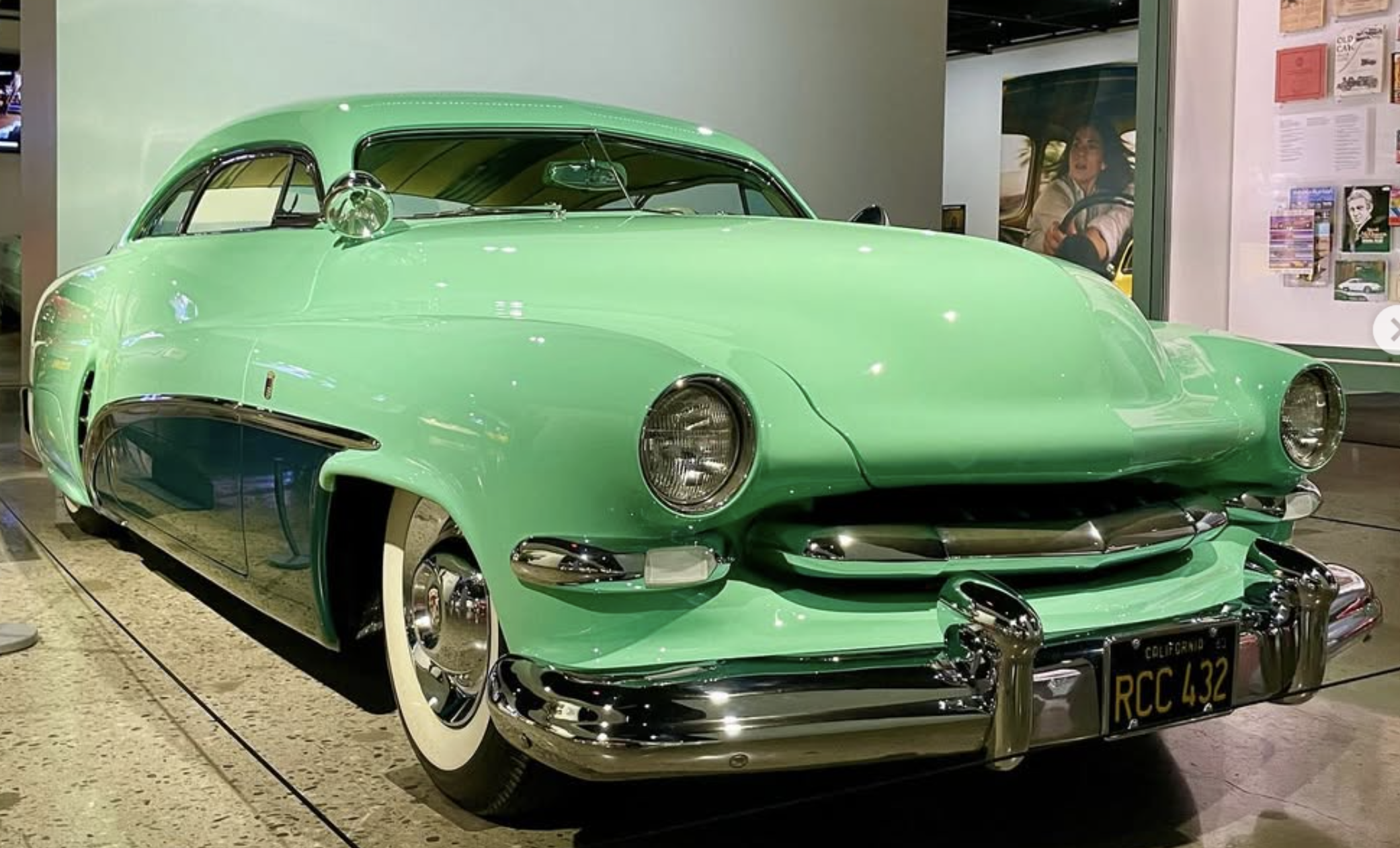
Although not traditionally characterized as an art – and even though I co-host an anti-car podcast titled Nobody Drives in LA, I can’t not mention the great George Barris. Barris was a famous designer and customizer of automobiles. In an era when most automobiles could already be said to have been works of art, his designs nevertheless managed to stood out. He founded the Kustoms Car Club when he was in high school in Citrus Heights, and shortly before he moved to Los Angeles to be part of its car culture. In 1953, he and his brother, Sam, designed the Hirohata Merc for Bob Hirohata. In 1957, Barris, Mike “Blackie” Gejeian, and Richard Peters built the Ala Kart. In 1962, Barris built the Clampett Jalopy for The Beverly Hillbillies. In 1963, he was the subject of Tom Wolfe’s essay, “There Goes (Varoom! Varoom!) That Kandy-Kolored (Thphhhhhh!) Tangerine-Flake Streamline Baby (Rahghhh!) Around the Bend (Brummmmmmmmmmmmmmm)…” In 1964, he created DRAG-U-LA and the Munster Koach for The Munsters. In 1966, he created the Batmobile for Batman. Other Barris creations and modifications include the 1966 Mercury Station Wagon in The Silencers (1966), the Plymouth Barracuda for Fireball 500 (1966), the Dodge Charger in Thunder Alley (1967), the Lincoln Continental Mark III in The Car (1977), and the eponymous Supervan (1977) – one of the six foundational films in the vansploitation canon.
GREEK AMERICAN DANCE
Greek dance can be traced back, at least, to the 2nd millennium BCE, where several forms arose around entertainment and religious rituals. There are or have been several Greek Angeleno dance groups, including Hellenic Dancers and Southern California Greek Dancers. Corky Ballas is a retired competitive ballroom dancer whose paternal grandparents, Karolos Ballas and Maria Lymnaos, were Greek. He’s the father of dancer Mark Ballas.
Athan Karras was born in Thessaloniki in 1927 and emigrated to the US around the age of twelve. In 1961, he appeared in the independent Greek-American drama, Dark Odyssey, as both an actor and choreographer. He went on to act in twelve more film and television productions. In 1964, he founded the Intersection Folk Dance Center and taught Greek culture and dance at Loyola Marymount University for more than two decades.
Hermes Pan was born Hermes Joseph Panagiotopoulos) on 10 December 1909 in Memphis, Tennessee. His family moved to New York City when he was fourteen. In 1930, he moved to California, where he met Fred Astaire on the set of Flying Down to Rio (1933), and with whom he collaborated as a choreographer. Their long partnership continued until Astaire’s last musical film, Finian’s Rainbow (1968). His most significant romantic relationship was another dancer, Gino Malerba. Pan died in 1990.
GREEK ANGELENO ARCHITECTURE
Traditional Greek architecture is characterized by its balance and symmetry – and often recognized for its use of columns with Corinthian, Doric, and Ionic capitals. It is the primary influence on Neoclassical architecture, which — along with related Greek Revival architecture — arose in the mid-18th century in England, France, Germany, and Italy – and which was further refined in the US’s Federal-style architecture.
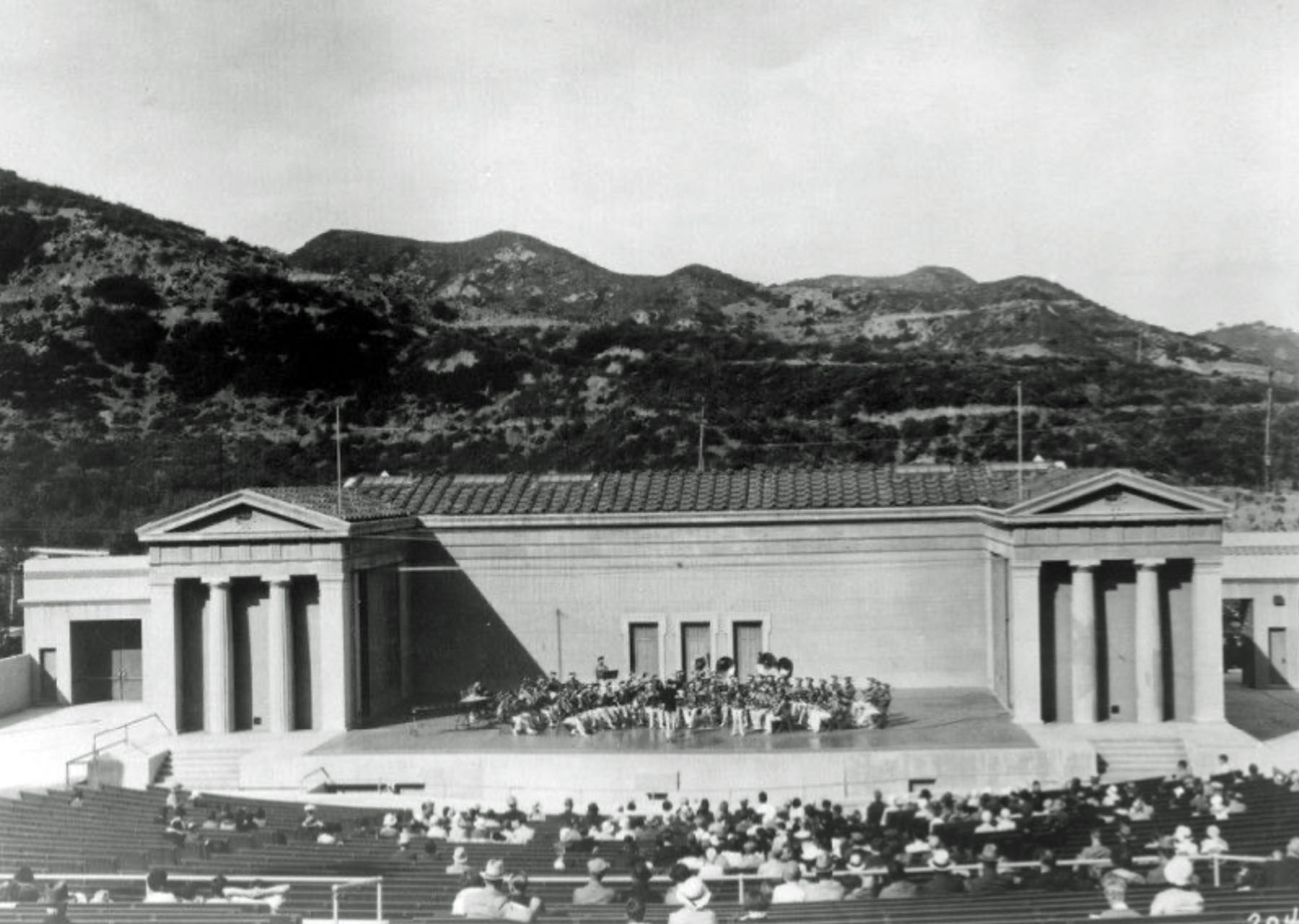
There are too many buildings in Los Angeles in the Greek Revival, Neoclassical, or Federal-styles to name all of. However, a few notable examples include the John Rowland Mansion (1855); the Continental Building (1904); the Farmers and Merchants Bank of Los Angeles, the Nickel-Leong Mansion, and Santa Monica Bay Woman’s Club (all 1905); Clune’s Broadway Theatre/the Cameo Theatre (1910); the Second Church of Christ, Scientist (1910); Quinn’s Rialto Theatre (1917); the Bank of Italy Building (1922); the Fireboat House 1/Fire Station No. 111 (1927); the Los Angeles Board of Trade Building (1929); and the Arzner-Morgan Residence and Greek Theatre (both 1930).
None of the aforementioned buildings were actually designed by Greek Americans. There are Greek Angeleno architects, though, including Stefanos Polyzoides of Moule & Polyzoides and the aforementioned Constantine W. “Gus” Kalionzes. My favorite is Raphael Soriano.

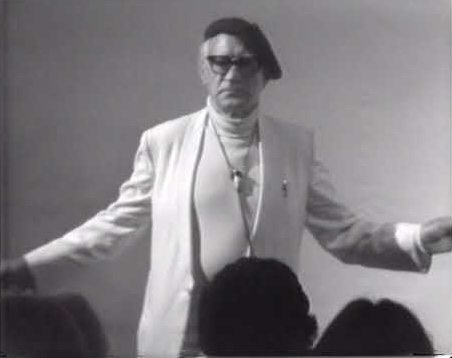
Soriano was a Mid-Century Modernist born in Rhodes on 1 August 1904. He emigrated to the US in 1924 and enrolled at the University of Southern California‘s School of Architecture in 1929. In 1931, he began interning with Richard Neutra, alongside Gregory Ain and Harwell Hamilton Harris. In 1934, he interned with Rudolph Schindler, before returning to Neutra. His first commission came in 1936, Silver Lake’s magnificent Lipetz House. He designed the Colby Apartments in 1951 for the Case Study House program. He moved from Los Angeles in 1953 but returned, shortly before his death in 1988, to Los Angeles County to serve as a Special Sessions Instructor at the College of Environmental Design at Cal Poly Pomona, where a collection of his papers now resides.
GREEK ANGELENO FASHION
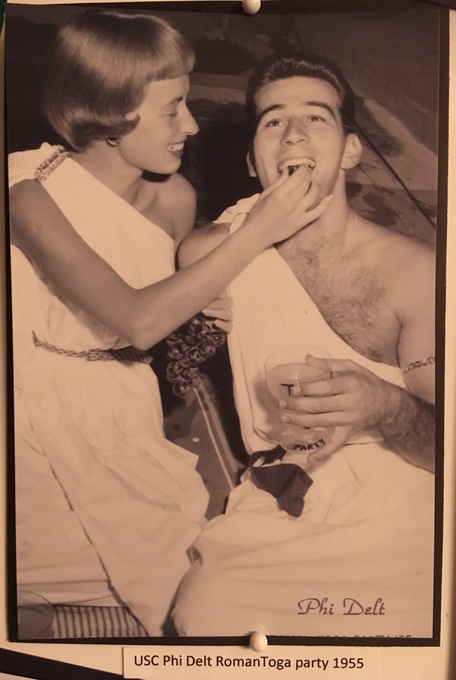
Ancient Greek was famous for its simplicity and functionality. Greek dress was also famous for often being diaphanous – a word with Greek etymology – coming from diaphanēs, and essentially meaning “see through.” Oscar Wilde, himself no prude, famously remarked that “Greek dress was in its essence inartistic. Nothing should reveal the body but the body.” In the 1950s, toga parties gave randy-but-repressed college students an excuse to drape themselves in nothing but pillowcases and bedsheets. One of the first documented college toga parties took place in 1953, at Pomona College in Claremont.
I rarely fine myself disagreeing with Wilde but I find the elegant simplicity of Ancient greek dress utterly artistic, and so, too, did those who embraced Neoclassical fashion, beginning in the 1780s. Who doesn’t love an Empire silhouette? Two hundred years later, as a kid, I used fabric crayons, an iron, and a bed sheet to make my own toga which I wore on my adventures in my mid-Missouri Arcadia.
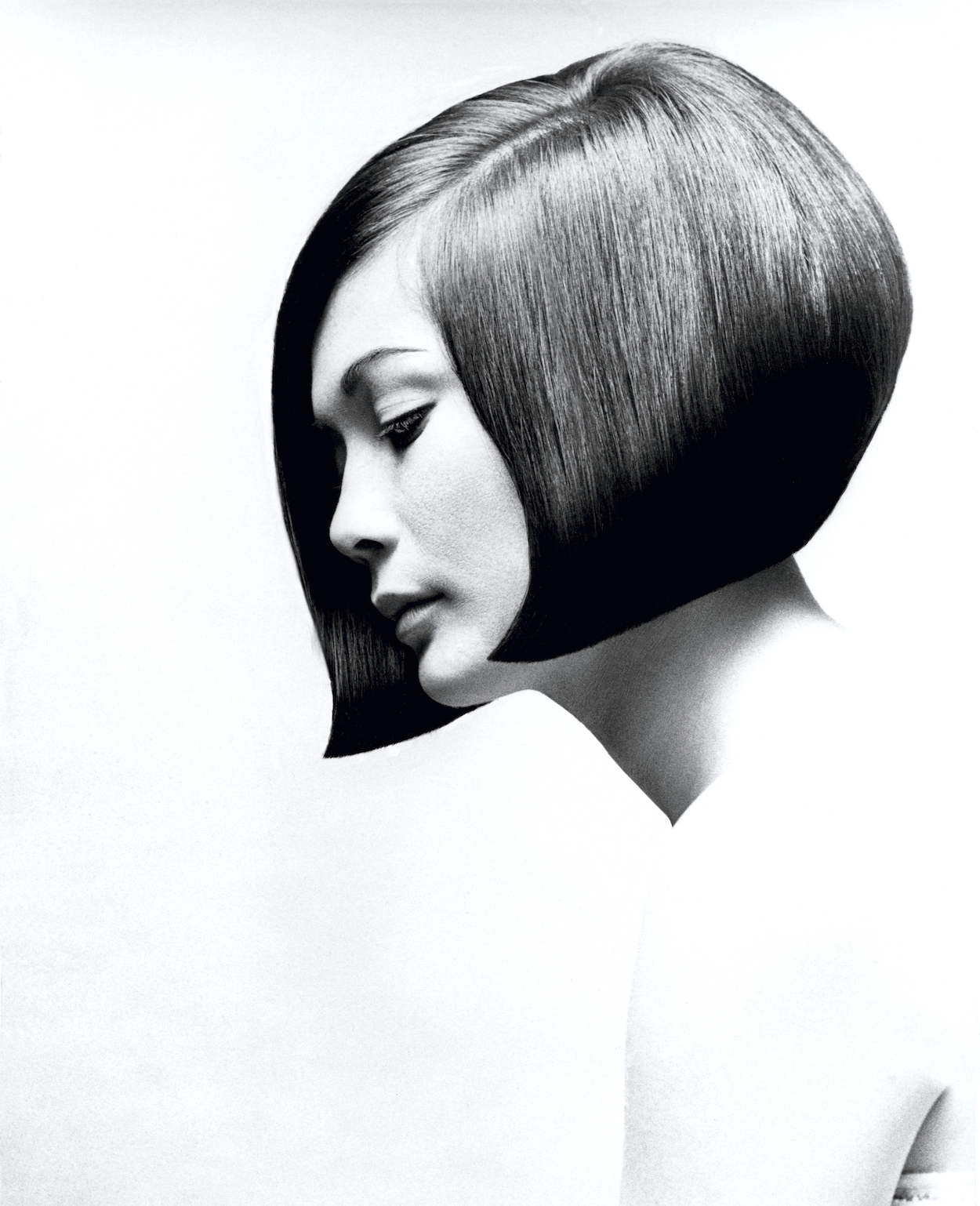
Greek Angeleno fashion designers and hairstylists of note include Dimitris Giannetos, James Galanos, Michael Costello, Nick Verreos, and Sophia Amoruso. Greek Angeleno models include Corinna Tsopei, Ella Halikas, Jessica St. George, Patricia Kara, and Sofia Richie.
Most people will recognize the name of Vidal Sassoon, whose father, Jack Sassoon, was from Thessaloniki. Vidal Sassoon opened his first boutique in London in 1954 but some of his iconic looks, like the Nancy Kwan bob, were popularized by Hollywood. Sassoon moved to Los Angeles in the early 1970s and died of leukemia at his Neutra-designed home in Bel Air in 2012.
GREEK AMERICAN ATHLETICS AND ATHLETES
Of all ancient societies, surely Ancient Greece is most associated with sports. In some ways, sports history truly began with the formalization of the Olympic Games in 776 BCE. The modern Olympic Games were revived in 1896, two years after Pierre de Coubertin founded the International Olympic Committee. In 2028, Los Angeles will, for worse or better, host the Olympics. Having hosted them before in 1932 and 1984 (when Los Angeles and Athens became sister cities), it will join London and Paris as cities that have thrice hosted the costly event.
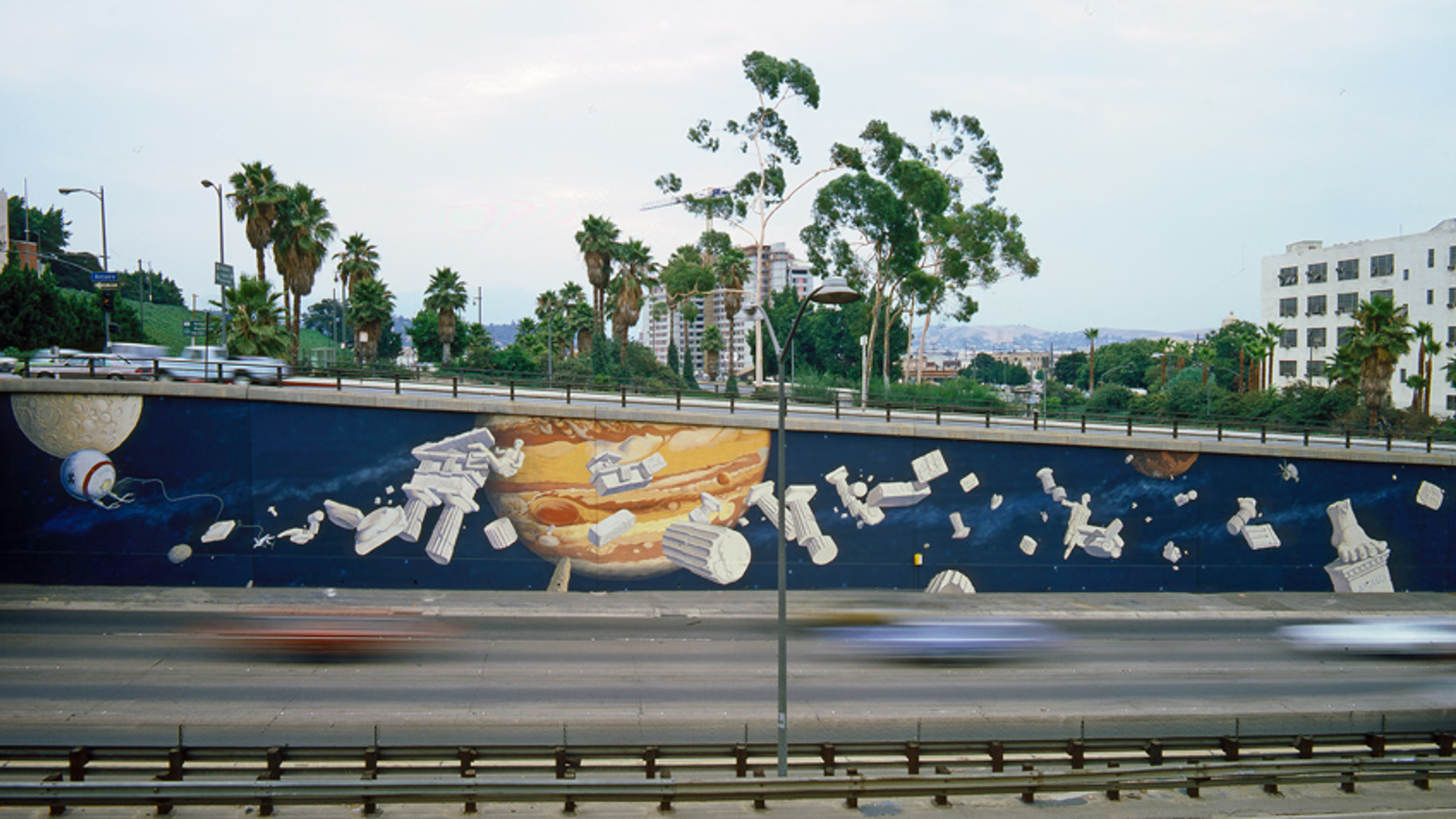
In 1932, 10th Street was renamed Olympic Boulevard. In 1984, many murals were painted for the games. One, on the 101, was painted by John Wehrle and seemed to obliquely reference Greece. It was titled, “Galileo, Jupiter, Apollo.” Galileo was the name of a probe built at the Jet Propulsion Laboratory — although the probe in the mural looked like Discovery‘s EVA pod from 2001: A Space Odyssey — the title of which contains a reference to Homer‘s epic poem. In the mural, there’s rubble from an apparently destroyed statue or temple of Apollo. The mural has, for years, been covered by CalTrans‘s gray paint but there is an effort to uncover and restore it.
Today, the most popular sport in Greece is soccer – also, of course, the most popular sport in the world. At least one prominent Greek Angeleno soccer player has achieved fame (and a legion of haters), Alexi Lalas (né Panayotis Alexander Lalas), who played with the Los Angeles Galaxy from 2001–2003. Before Lalas, Peter N. Skouras played for the Los Angeles Heat in 1990.
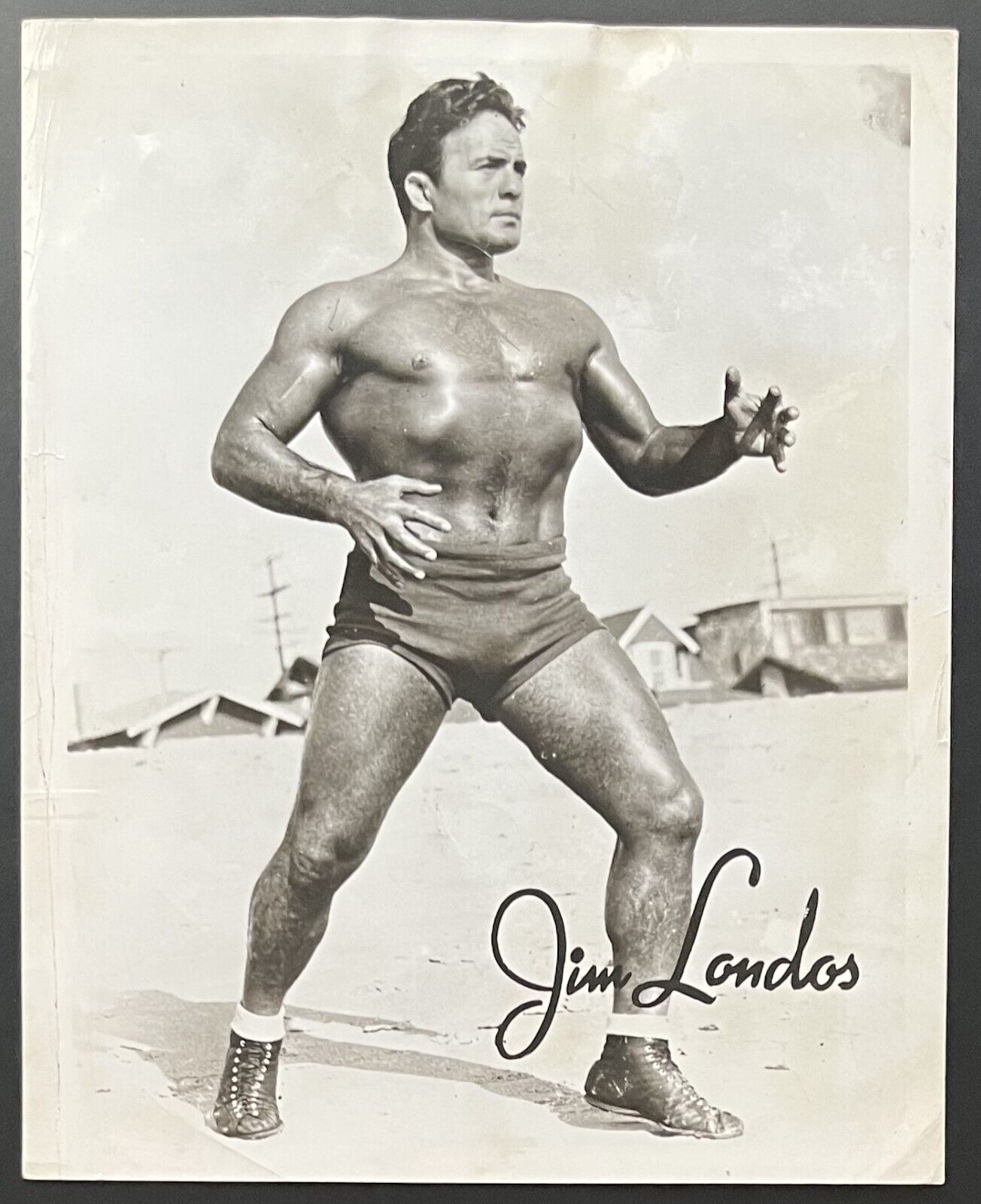
One of the earliest famous Greek Angeleno athletes was professional wrestler Jim Londos (né Christopher Theophelus in Argos c. 1894). He ran away from home at thirteen and emigrated to the US, where he worked in a grocery store, as an electrician, and as an acrobat before coming to wrestling, where he was first known as “Chris Theophelus, the Wrestling Plasterer.” He later was known as the “Golden Greek.” In Los Angeles, he owned a restaurant and also bought Tom Mix‘s Rolls Royce. By the 1950s, he was growing avocados, lemons, and oranges near San Diego. He also owned a ranch near Phoenix. He died on 20 August 1975.
In Metro Los Angeles, the most popular sport played by Greek Angeleno athletes has been baseball. Greek Angeleno baseball players include Al Campanis, Alex Anthopoulos, Billy Loes, Cody Bellinger, and Eric Karros, (all Los Angeles Dodgers); Clay Bellinger (Anaheim Angels); and Peter Bourjos (Los Angeles Angels).
Other Greek Angeleno athletes include surfer Caroline Marks, ice skater Dimitris Zogaris, diver Greg Louganis, basketball Kurt Rambis (né Kyriakos Rambidis), tennis player Pete Sampras, snowboarder Tara Dakides, and hockey player Trevor Zegras. And Bob Costas, one of the most widely recognized sportscasters, lives in Newport Beach.
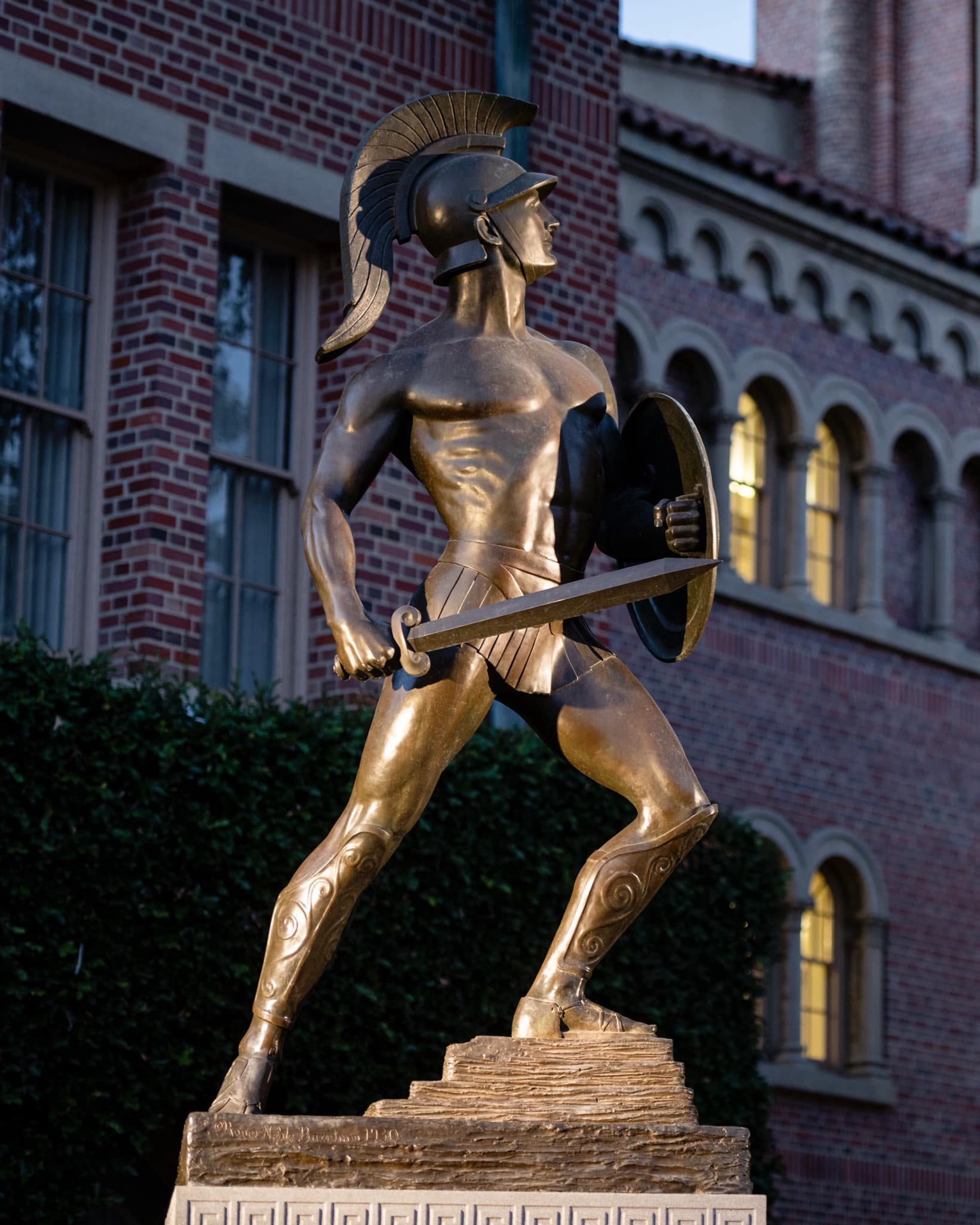
There are Los Angeles mascots derived from Greek culture, too. The best known, undoubtedly, are the USC Trojans. Having attended a high school with a Trojan mascot, it always struck me as a bit odd — the Trojans being best remembered for having been defeated by the Achaeans in the Trojan War after foolishly accepting a giant horse full of soldiers from their enemies. Personally, I prefer their pre-Trojan name, the Fighting Methodists.
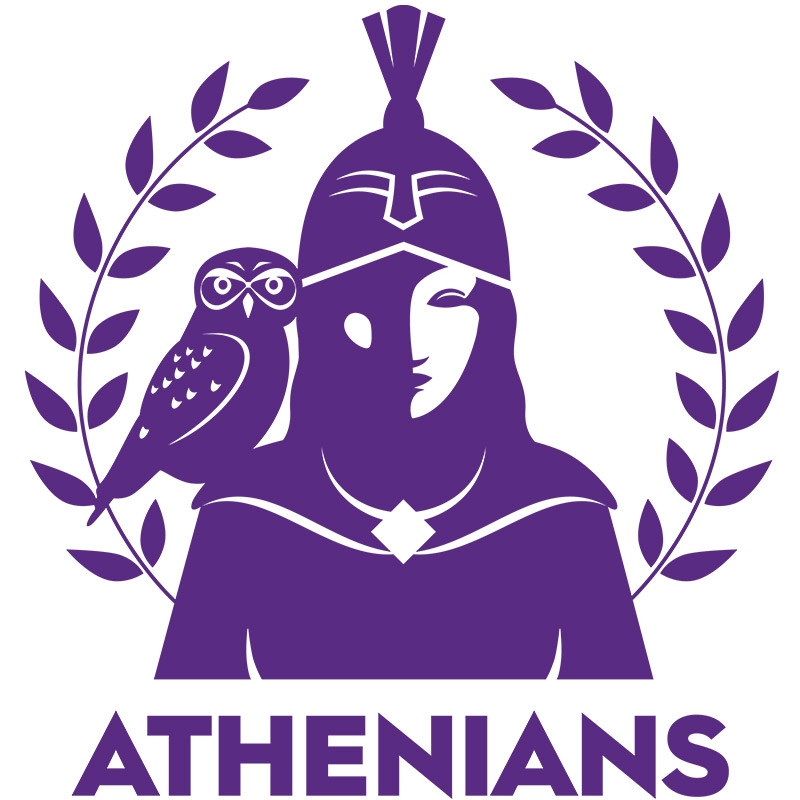
Near USC is Mount St. Mary’s University, whose teams are the Athenians. Bright-eyed Athena became the schools mascot in 1990.
OTHER PROMINENT GREEK ANGELENOS
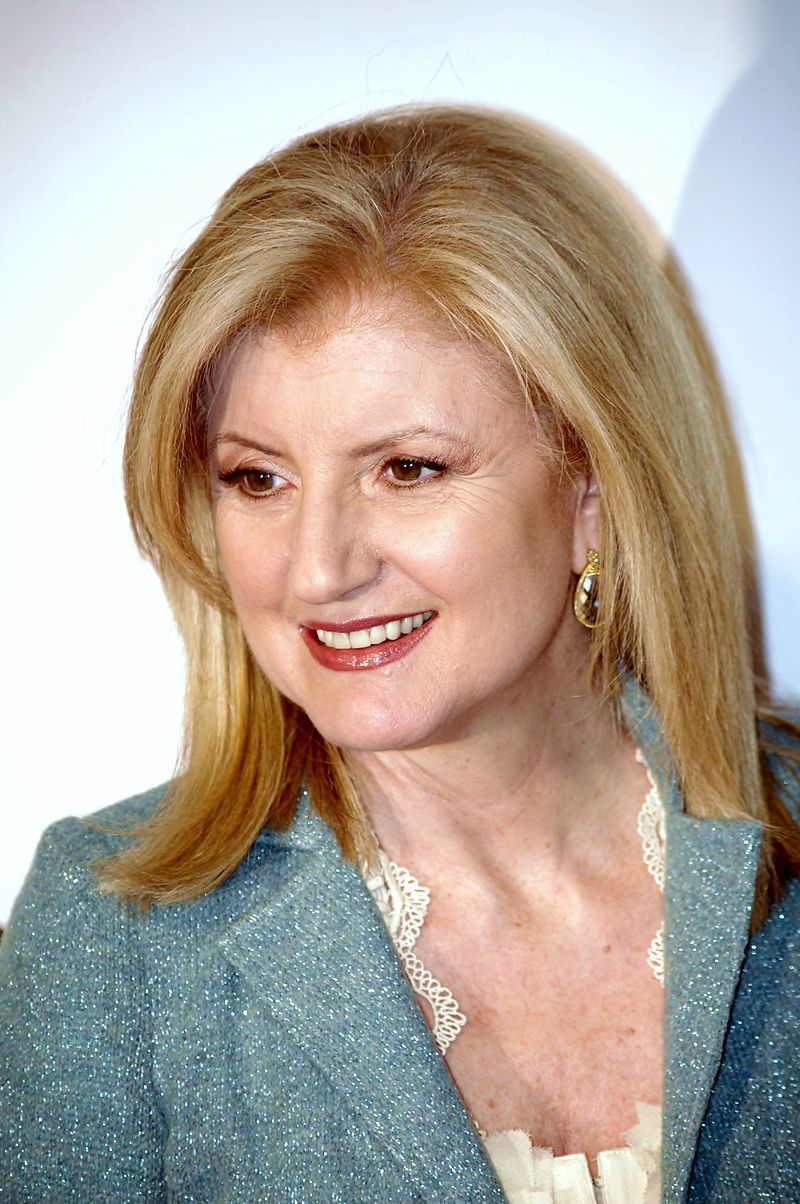
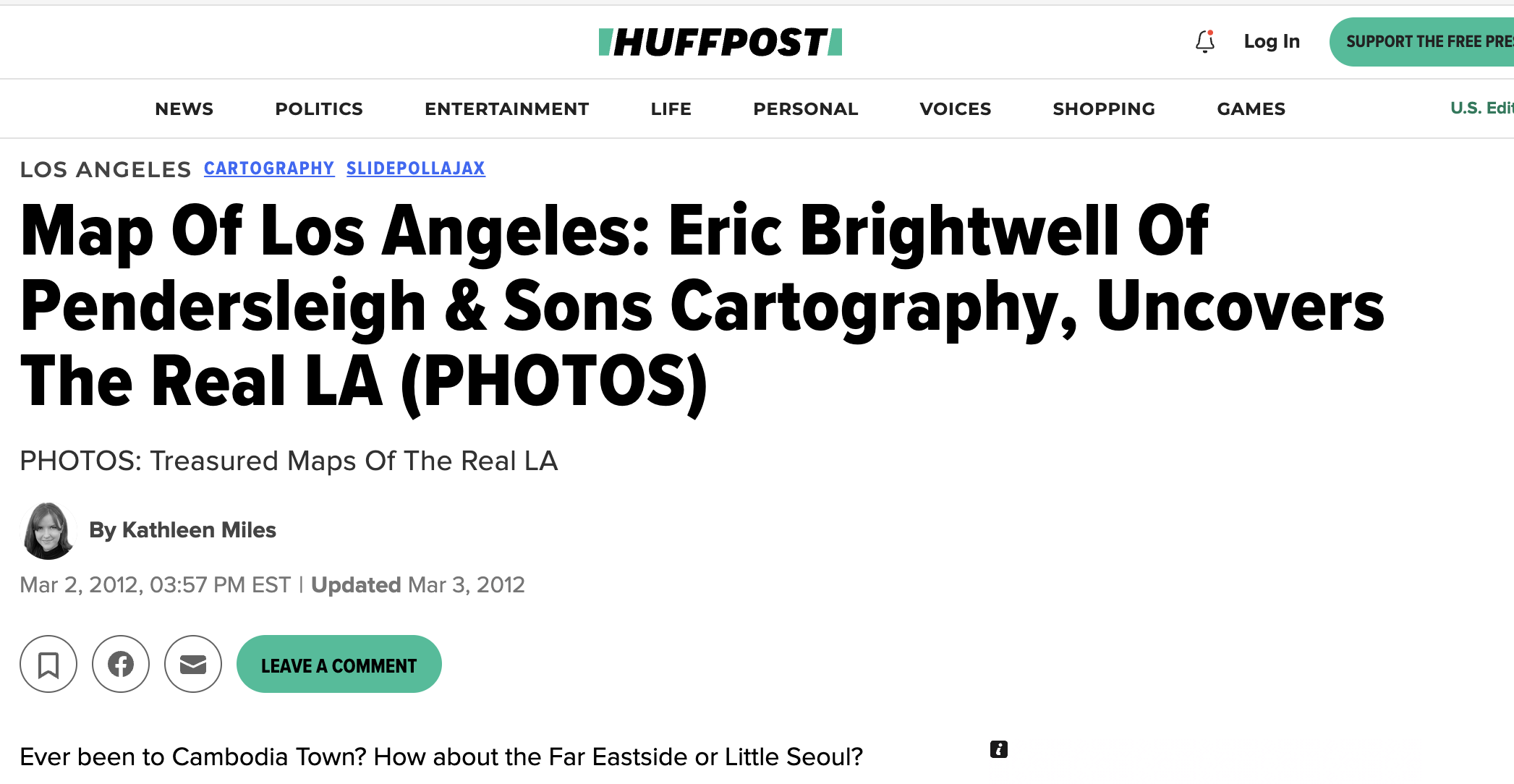
Ariana Huffington (Photo: David Shankbone) and a front page article on the Huffington Post
Other Greek Angelenos include Huffington Post-founder, Ariana Huffington (née Ariadnē-Anna Stasinopoúlou), radio DJ Chris Douridas, academic Chrysostomos Loizos “Max” Nikias, theoretical physicist Cosmas K. Zachos, journalist Dean Brelis, Dean Metropoulos (owner of Pabst and the Playboy Mansion), computer scientist Demetri Terzopoulos, news anchor Ernie Anastos, Evan and Gregg Spiridellis (founders of JibJab), George Argyros (real estate investor/former ambassador to Spain), mathematician James Dugundji, physician-scientist James S. Economou, John Paul DeJoria (co-founder of Paul Mitchell and owner of Patrón), computer scientist Marius Vassiliou, former presidential candidate, Michael Dukakis, author Panio Gianopoulos, engineer Peter H. Diamandis, former vice president Spiro Agnew, and mathematician Tom M. Apostol.
GREEK PUBLIC SQUARES
Public squares known as “plateia” are prominent and cherished features of Greek cities and towns. Some of the most famous are Athens‘s Syntagma Square and Monastiraki Square, and Thessaloniki‘s Aristotelous Square. Los Angeles has several true public squares. The oldest is Plaza de Los Ángeles, founded in 1818. A century later, Pershing Square was designated. Morin Memorial Square followed in 1968. Three public squares in 150 years. Since 1980, however, Los Angeles has created hundreds of public squares. They’ve managed that feat by doing away with anything the makes a square a square and just slapping beige signs over busy intersections. A couple of these squares in name only superficially honor Greek Los Angeles.
In 2008, the city designated the intersection of San Julian Street and an unnamed alley, Annunciation of the Virgin Mary Greek Orthodox Church Square, commemorating the former location of the long ago-demolished O Evangelismos Tis Theotokou. There are zero indications that this is a public square with no pedestrian amenities whatsoever aside for the pre-existing sidewalk.
In October 2012, the intersection of West 6th Street and South Centre Street was designated Papadakis Square, in remembrance of Papadakis Taverna. Pedestrian “amenities” at this nominal public square include curb cuts, crosswalks, and a single waste bin.
HOLIDAYS AND OBSERVANCES
Most of the biggest religious holidays and observances in Greek culture are the same as those of mainstream American Christians, although since most Greeks are Orthodox Christians, they mostly fall on different dates than those in Western Christianity. New Year’s Day and Epiphany are on 1 and 6 January, respectively, but Orthodox Easter is a moveable feast and takes place on a different date than Western Easter. Greeks observe Christmas on 7 January. Lent ends with Clean Monday. Independence Day is celebrated on 25 March. Ohi Day is celebrated on 28 October.
There are a perhaps surprising number of Greek Festivals, all seemingly tied to their own church and each taking place at a different time, making it possible, at least theoretically, to experience them all firsthand. The oldest, having launched in 1958, is the Pasadena Greek Festival, taking place at St. Anthony’s in September since 1958. The South Bay Greek Festival has taken place in July at St. Katherine in Redondo Beach since 1964. St. John the Baptist has organized the OC Greek Fest since 1966, which takes place in May. In the San Fernando Valley, St. Nicholas has organized the Valley Greek Festival on Memorial Day weekend since 1975. The largest Greek festival in Los Angeles is the LA Greek Fest, which has taken place in early October at St. Sophia since 1990. Blessed Virgin Mary in Stoney Brook started the Long Beach Greek Festival in 1991, which takes place in September.
GREEK ORGANIZATIONS & SOCIETIES
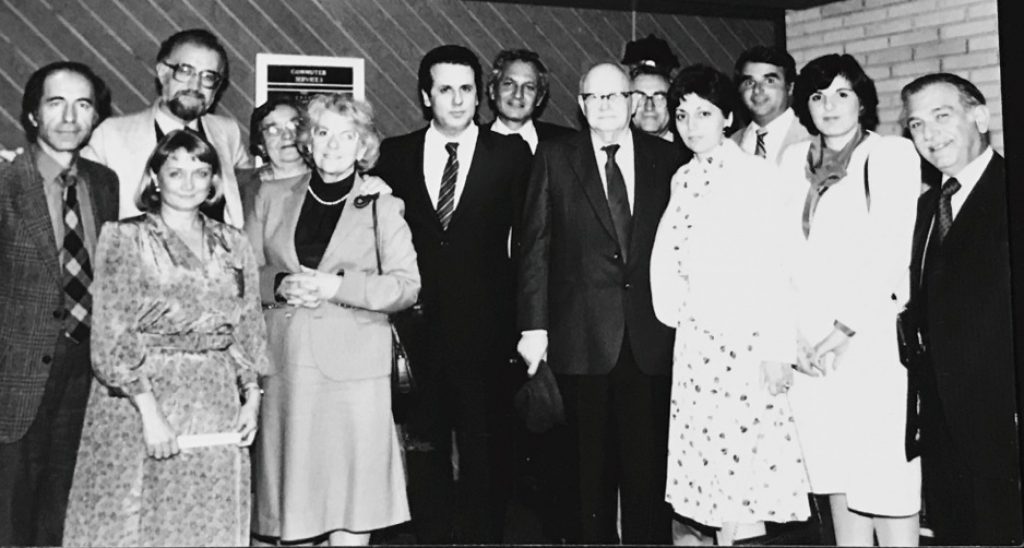
There are several Greek community organizations in Metro Los Angeles. The Hellenic University Club of Southern California was founded in 1961 by Theodore Saloutos and Speros Vryonis Jr. The Consulate General of Greece in Los Angeles was established in 1964. The American Hellenic Council of California was founded in 1974. The Greek Heritage Society of Southern California was founded in 1985. The Basil P. Caloyeras Modern Greek Studies Center was founded at Loyola Marymount in 1980. The Stavros Niarchos Foundation Center for the Study of Hellenic Culture was established at UCLA in 2017.
FURTHER READING
As I wrote, earlier, there’s a shocking dearth of information — at least online — about Greek Los Angeles History. Two of the only sources I relied upon for this piece and thus, worth crediting, are Teresa Watanabe‘s “A return to Greek Town” (published in 2008 by The Los Angeles Times) and “The History of the Greek Community of Los Angeles,” published on the St. Sophia website.
Support Eric Brightwell on Patreon

Eric Brightwell is an adventurer, essayist, rambler, explorer, cartographer, and guerrilla gardener who is always seeking paid writing, speaking, traveling, and art opportunities. He is not interested in generating advertorials, cranking out clickbait, or laboring away in a listicle mill “for exposure.”
Brightwell has written for Angels Walk LA, Amoeblog, Boom: A Journal of California, diaCRITICS, Hey Freelancer!, Hidden Los Angeles, and KCET Departures. His art has been featured by the American Institute of Architects, the Architecture & Design Museum, the Craft Contemporary, Form Follows Function, the Los Angeles County Store, Sidewalking: Coming to Terms With Los Angeles, Skid Row Housing Trust, the 1650 Gallery, and Abundant Housing LA.
Brightwell has been featured as subject and/or guest in The Los Angeles Times, VICE, Huffington Post, Los Angeles Magazine, LAist, CurbedLA, LA Times 404, Marketplace, In a Minute With Evan Lovett, Office Hours Live, L.A. Untangled, Spectrum News, Eastsider LA, Boing Boing, Los Angeles, I’m Yours, Notebook on Cities and Culture, the Silver Lake History Collective, KCRW‘s Which Way, LA?, All Valley Everything, Hear in LA, KPCC‘s How to LA, at Emerson College, and at the University of Southern California. He is the co-host of the podcast, Nobody Drives in LA.
Brightwell has written a haiku-inspired guidebook, Los Angeles Neighborhoods — From Academy Hill to Zamperini Field and All Points Between, that he hopes to have published. If you’re a literary agent or publisher, please contact him.
You can follow him on:
Bluesky, Duolingo, Facebook, Goodreads, iNaturalist, Instagram, Letterboxd, Medium, Mubi, Threads, and TikTok.


 Eric Brightwell
loved this blog post!
LikeLiked by 1 person