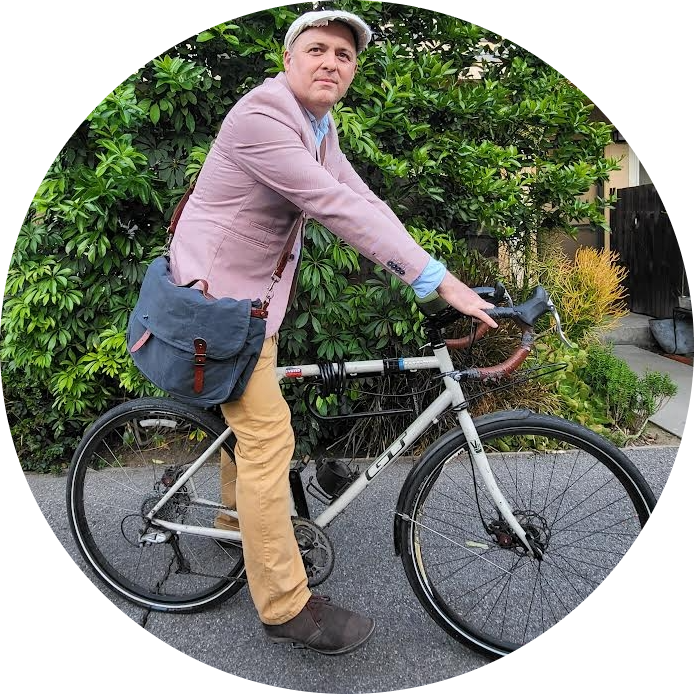
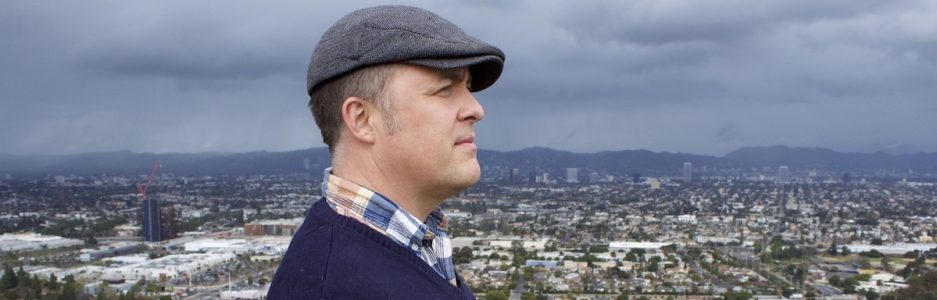

I was recently contacted by Nicholas Guiang, an audio journalist and producer at the American Public Media radio program, Marketplace. He’d seen me on Rebecca Castillo‘s piece for LA Times 404 and wanted to accompany me on an urban ramble for a radio segment.
You know Marketplace, it’s the show hosted by Kai Ryssdal… the one that interpolates, depending on the state of market, the songs “Stormy Weather,” “We’re in the Money,” “It Don’t Mean a Thing” (which always reminded me of the 1979 Apple IIe business simulation game, Lemonade Stand. Despite my own economic precariousness — I was a regular listener of the program in my college days, when I was delivering flowers for Every Bloomin’ Thing and listened to a lot of public radio in the delivery van. Why would I, a mere hundredaire, be a good subject for a program about economics? I don’t know… but even my lack of business acumen told me that I should do nothing to dissuade Giaung from his quest.
I suggested a stroll near his place — which happens to be that sort of no man’s land on the northern edge of the Wilshire Center sub-region. A few years ago there were even fake neighborhood signs in the area, probably installed by a real estate developer, designating Catalina Heights and Historic Edgemont Square. Most consider it to be the northern frontier of Koreatown, the southern frontier of East Hollywood sub-region, or an expanding frontier of Little Bangladesh — but it’s not exactly any of those — although the borders of ethnic enclaves, it seems to me, are more fluid than those of other neighborhoods. And as Little Bangladesh and Koreatown grow, fewer and fewer Angelenos seem to identify anywhere as Wilshire Center.
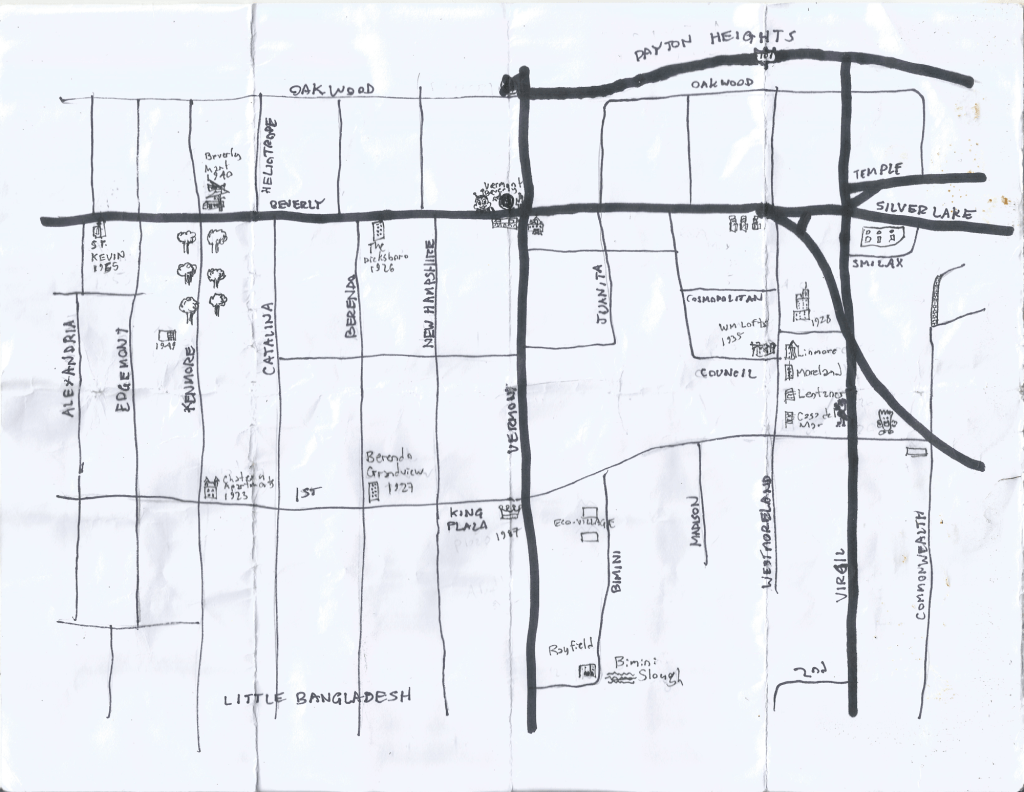
I’ve seen a fair amount of women in sarees accompanying children at Frank Del Olmo Elementary School but the vast majority of students there are Latino. The largest “racial” group is Asian. Of course, neither of these designations more than hints at the diversity in the neighborhood. Bengalis, Filipinos, and Koreans are all, despite, perhaps, deeper cultural differences than “racial” affinities, clustered together under the umbrella of Asian. There are, similarly, 33 counties in Latin America and, just based on the businesses that I observed, include substantial numbers of Oaxacans, Salvadorans, Guatemalans, and at least a few Peruvians.
I met Nicholas at Vermont/Beverly Station. I’m of the belief that train stations should have more memorable names that reference nearby attractions. Some do, like Heritage Square Station. Many are confusingly named after streets that share names with communities but aren’t in them… like Laurel Canyon Station (in Valley Village), Long Beach Bl Station (in Lynwood), Anaheim St Station (in Long Beach), or Lakewood Bl Station (in Downey). Were I in charge, things would be different. Hollywood/Western Station would be named Thai Town/ไทยทาวน์ Station. Hollywood/Highland Station would be Eighth Circle of Hell Station and there would be a sign on the station platform alerting riders to “abandon all hope, ye who exit.” And so I suggested to Nicholas that we meet at Jollibee Station and of course he knew what I was talking about and was waiting for me there when I disembarked from Metro‘s 754 Line.

The first time I really engaged with this station was around 2010 or ‘11, when I participated in a guerrilla gardening project with LA Guerrilla Gardeners. I think it was around that station, on the train, that a woman named Soodtida approached and introduced herself and her friend, Adrienne and, all of these years later, we’re still very good friends. That sort of thing doesn’t happen in cars. When we ascended from the platform at Jollibee Station, we didn’t do any planting because that particular station is planted with barrel cacti, agave, and other uncharacteristically hearty, drought-tolerant plants. We just picked up litter and then hopped on the next train. It looked to me like there were fewer succulents now. And now I remember the last time I was at the station. I’d eaten some mushrooms at Shatto 39 Lanes and decided — not in a bad way — that I no longer wanted to be there. I walked to the station and there were people smoking something that didn’t agree with me. I decided that I didn’t want to be there, either, and walked home listening to music.
One of the reasons I wanted to return here for an urban ramble here was because it’s a neighborhood many an Angeleno has driven though and, yet, probably thought little of… beyond asking themselves how they can get to their destination without passing through the infamously hellish intersection of Beverly, Silver Lake, Temple, and Virgil. And, while there’s some more recent housing rising south of the station, on Vermont Avenue, it still seems curiously underdeveloped for an ostensibly transit oriented area.

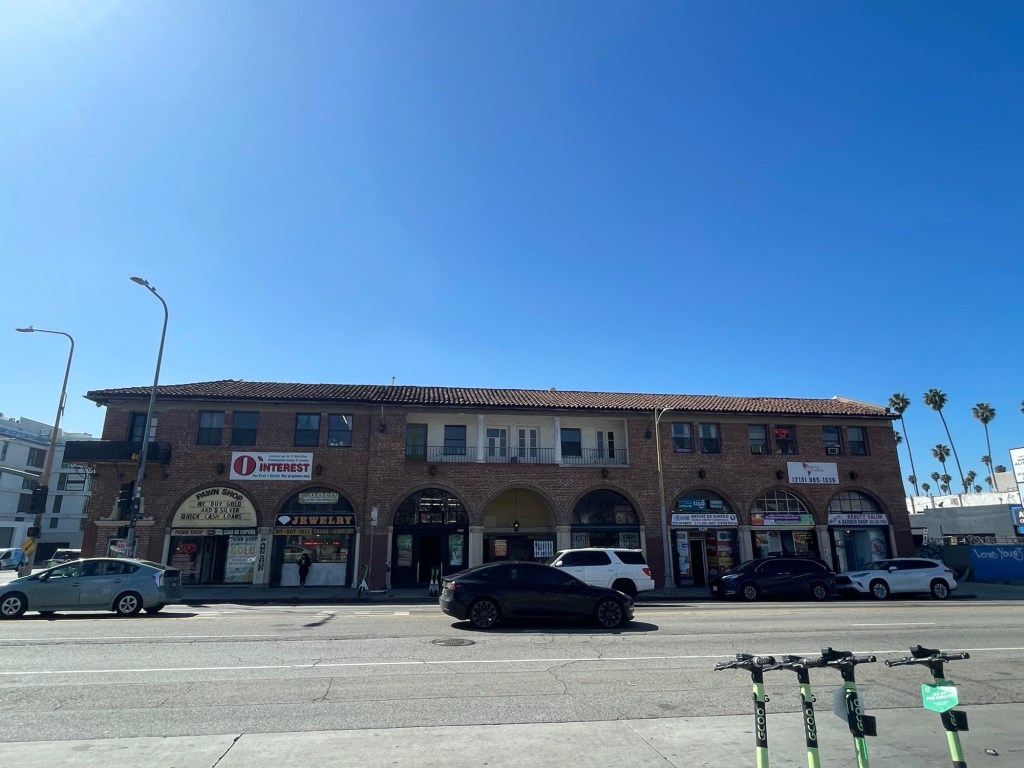
On the northeast corner is a Rocket Convenience Store that I don’t think I’ve ever even considered entering. I certainly had no idea that it was called Rocket before today. On the southeast corner is a bank, the Palladian architecture of which would likely please the current regime. On the corner behind the station is the burned out husk of a 1920s hotel known, in its final incarnation, as “고려호텔.” It’s slated for demolition. And, on the southwest corner, is a commercial building that you can tell, if you can block out the busy, text-cluttered windows and ugly vinyl signs, is an attractive construction from 1925. If a building in this part of town appears to be “old,” it’s usually from the 1920s.
We crossed Beverly and headed west. After passing an alley, I reminisced about the television repair place that used to be there. Ages ago – maybe twenty years – and back when I still owned a car – I lugged my Sony Trinitron there to be repaired. It’s a long time… and yet, not that long… but when is the last time anyone bothered to get any appliance repaired?

West of there is the Dicksboro, built in 1926 by Harris Dickerman. It’s six stories tall, has 73 units, and about seven parking spots. I suppose back then Angelenos were less car-brained and were generally willing to ride mass transit provided by the Los Angeles Railway and Pacific Electric Railway – both of which historically served this stretch of Beverly. Today it’s served by Metro’s B Line and 14 Line which, despite what haters would have you believe, are part of a mass transit network superior to Henry Huntington‘s celebrated system.
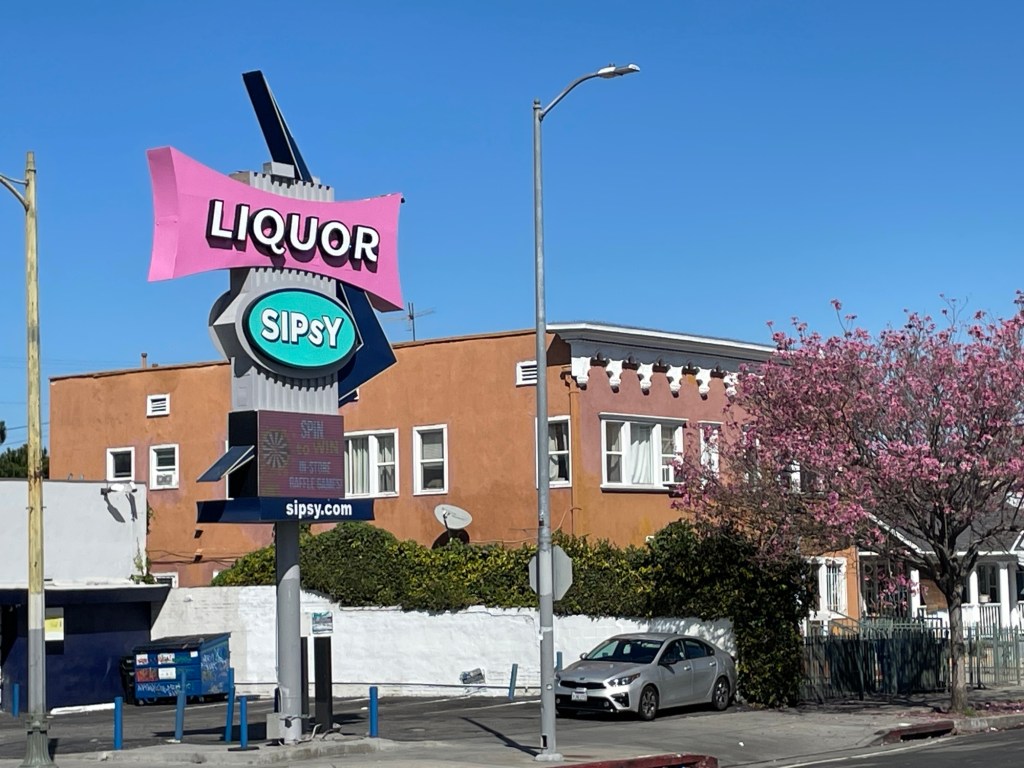
Further west, our conversation was drowned out by the din of a car wash. Honestly, I’d never thought about how much noise pollution is created keeping the exteriors of automobiles shiny. I pointed across the road to a liquor store, Sipsy. It’s in a building that was constructed in 1940 and has a dramatic Googie sign that, until recently, advertised “LIQUOR DELI” for the Beverly Mart in glorious neon. Sipsy, iconoclastically replaced the neon with a lame plastic sign in 2023. Across the street, there used to be an Art Deco building that was home to Sinaloa Market and the oddly named dive bar, One Eye Jack. Both were demolished to make way for more housing, which is harder to hate than the unaesthetic removal of beautiful, historic neon signage.

We continued west past several Salvadoran businesses. Most of this area of Los Angeles was developed with generically named subdivisions like Tract 485, Tract 673, and Tract 3247. This area, however, was subdivided as the Vista del Monte Tract in 1907. At the corner of Beverly Boulevard and Alexandria Avenue, we stopped in front of K-Town Mini-Outlet… surely the most outermost business with “Koreatown” (or “K-Town”) in the name.
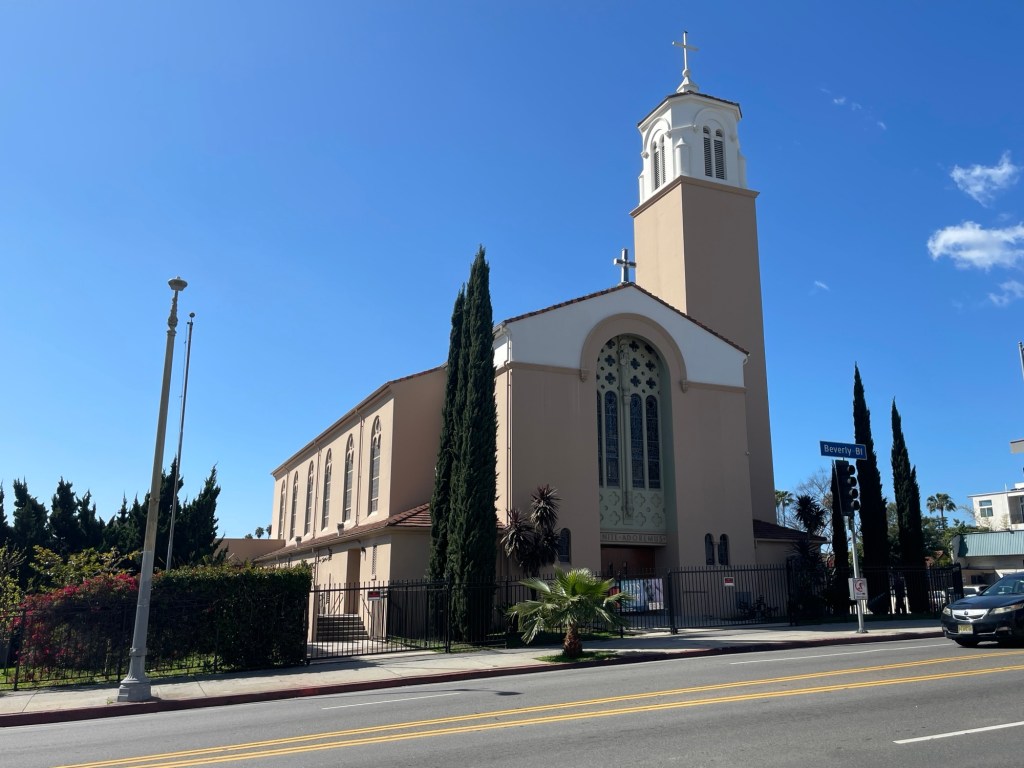
Across the street is Tomboloco, a Peruvian restaurant. I wanted to stop to admire St. Kevin. Apparently, if the Catholic Church’s version of history is to be swallowed, Kevin of Glendalough died in 618 CE. To my ears, though, Kevin sounds anachronistically modern, like a St. Brittany, Braden, Jameson, or Taylor. I do love a mid-20th century church, though, and this one was built pretty close to the middle of the last one, in 1955.

We crossed the street and I took a picture of the map of Guatemala on the exterior of Chapines Market.

We turned south down Kenmore where, away from the cars and on a street lined with native sycamores (or are they London plane trees?) because it’s so much more pleasant. The multi-tenant brick homes there were mostly built between 1923 and ‘26 and I’ve had several friends who’ve lived on this block.
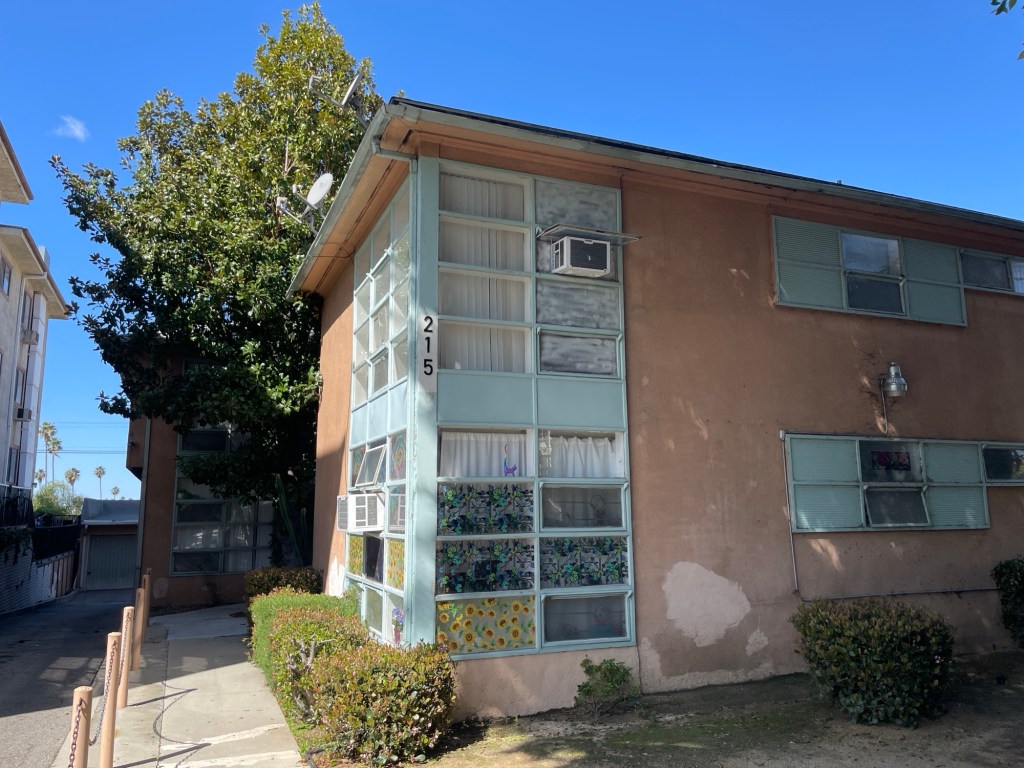
There is a notable exception, at 215 North Kenmore, a Modernist apartment built in 1949 that looks a bit like a suburban school or medical office building. That I’m a fan should go without saying.

At the corner of Kenmore and 1st Street we came across the Normand Revival-style Chateau Apartments, built in 1923. I spotted a whimsical (and phony) well in the courtyard, which was filled with dirt and weeds. The “wooden” logs were made of concrete. The stair rails look like they, too, at some distant point in the past, were possessed of more charm… or at least some sort of long-gone decoration like urns or busts. A bit of post-walk research shows that Georgia-born actor Walter Hiers lived here in 1924. He died in 1933, at the age of 39, from pneumonia.
Heading east down 1st we stopped in front of another 1920s mid-rise, the six-story Berendo Grandview Apartments, built in 1927 with 50 units and approximately two parking spots. Next door are the Marigold Apartments, built in 1924 with 29 units and no apparent car storage. There’s no indication that these names are still used nor have been used for a long time – which always strikes me as odd because a bit of placemaking goes a long way.

At the corner of Vermont and 1st are two strip malls. Loyal readers will know that I love a strip mall with a pretentious name and it’s hard to imagine a more pretentious name than King Plaza. Built in 1987, it is unlikely that in its 38 years of existence, anyone has ever referred to it by name. No one, even in the height of mall culture, was taken in by this wonderfully half-assed attempt at place making enough to tell someone else that they were hanging out at King Plaza. Across the street is another strip mall, a Spanish Colonial Strip Mall, built in 1986. Sadly, it has no name. If it’s not too late, I’d like to submit “Queeng Plaza,” based on my non-binary monarchic destination that I’m still trying to make happen.
We turned south down Vermont. On our left we passed the only Kentucky Fried Chicken I’ve ever visited in Los Angeles. Despite having the appearance of a battle scarred bunker – and seeing a rat run into a pipe underneath its floor – I went there in 2022 to get KFC Beyond Fried Chicken — an apparently immensly popular menu item that was, for whatever reason, limited to the menu for only a month. It’s got to be one of the last KFCs with a giant bucket sign.
Across the street, at 125 S. Vermont, is a building that is home to International Reformed University & Seminary. The sign used to have Hangul (개혁 신학) on it, which, for whatever reason, was removed when the current sign was installed. With its boxy shape and Corinthian columns, it looks like it was originally a bank. A quick search up on the internet shows that it was built in 1926 and that it was apparently home to the G. Cavaglieri Mortgage Company and the Vermont Building Association. A couple of doors down is Aladin Sweets & Market Inc, a sign that Little Bangladesh refuses to be confined to its official location along 3rd Street.

We turned east on 2nd Street, where I stopped to admire (the exterior, anyway) of another 1920s apartment building with a name, the Rayfield, built in 1922.
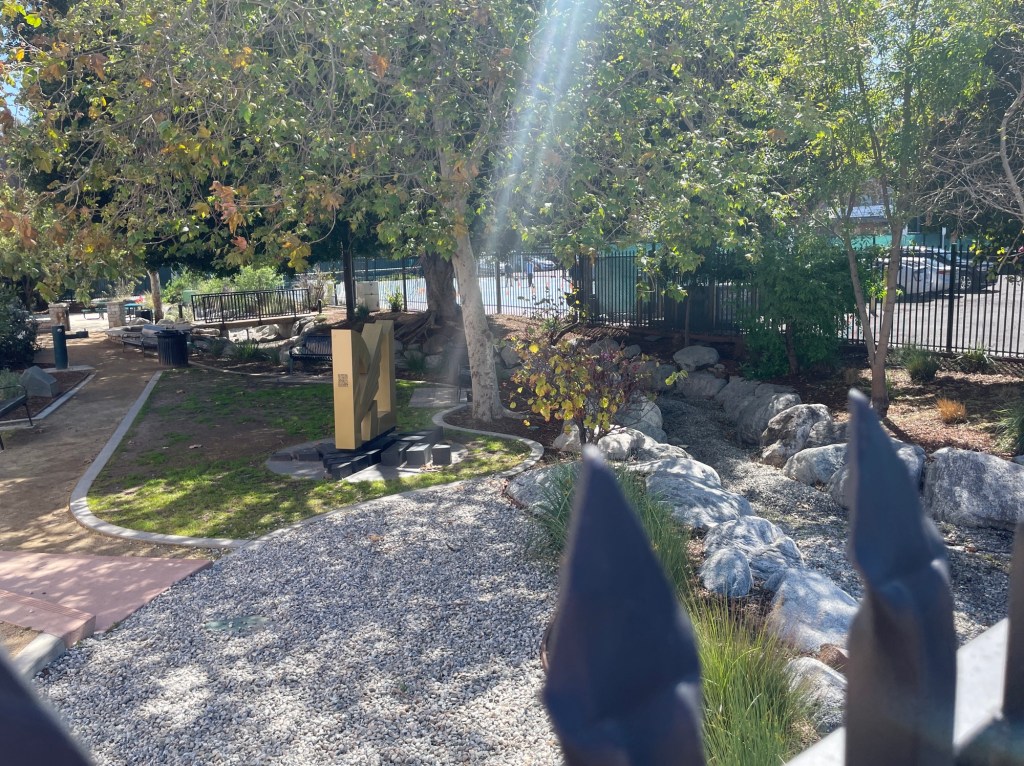
Behind us was the Bimini Slough Ecology Park, a fenced off bioswale. It was designed by landscape architect and wastewater engineer Nishith Dhandha, to filter runoff that recharges the Arroyo de la Sacatela. That arroyo is a channelized spring that flows from beneath Franklin Hills/Los Feliz’s Shakespeare Bridge, beneath the Sunset Overpass over wide, winding Myra Avenue, to its confluence with Ballona Creek in Country Club Park, from which it flows to the Santa Monica Bay. There used to be a hot spring resort here, the Bimini Baths (1902-1951), which took advantage of the water here. That I know anything about Los Angeles’s channelized streams that are begging to be daylit is entirely due to reading L.A. Creek Freak, a project started by Jessica Hall and Joe Linton and later bolstered by the contributions of Jane Tsong and Joshua Link.

On a Metro subway car preview, recently, I ran into Linton and he told me that he lives in the Los Angeles Eco-Village, which is just a few doors down from the slough. The Eco-Village is a large co-op founded in 1993 with about 500 residents that I first became aware of when I was in the Echo Park Time Bank (now part of the Arroyo S.E.C.O. Network of Time Banks, which, in an uncharacteristic effort to be succinct, I described to Nicholas as a “hippie mafia.” Members vouch for you and you do favors for one another, capiche? I seem to remember we had a potluck there.
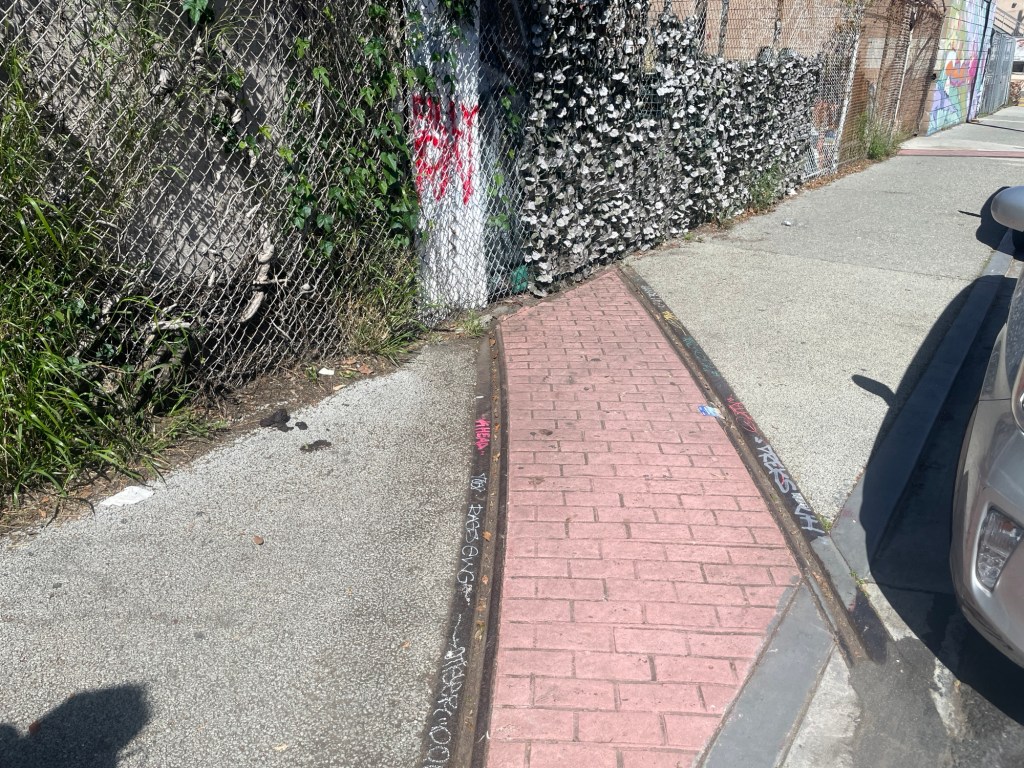
We headed back toward 1st Street, we noticed a couple of old train track remnants that, I proposed, may’ve been used by LARy’s H Line. Across the street, at Virgil Street Middle School, large painted letters told us “CROSS WALK [sic] SAFETY” and a giant arrow pointed east. Meanwhile, a city sign states “USE CROSSWALK” and includes an arrow pointing west. Since there were no cars, we ignored the conflicting messages and safely crossed Bimini Place.
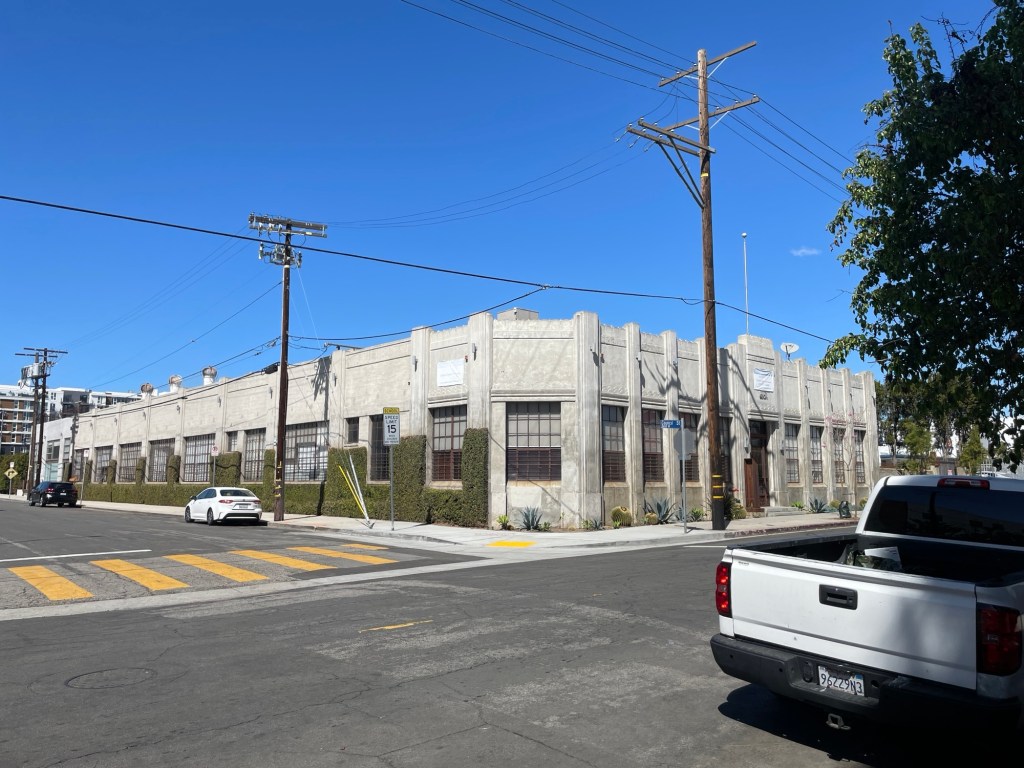
We headed north on Westmoreland, which I held up as an example of a charming little pocket of Los Angeles surrounded by hostile streets. On the northwest corner of Westmoreland and Council are the WM Lofts, an example of adaptive reuse. The Art Deco building, built in 1935, was formerly home to the American Linen Company. Now they are homes.
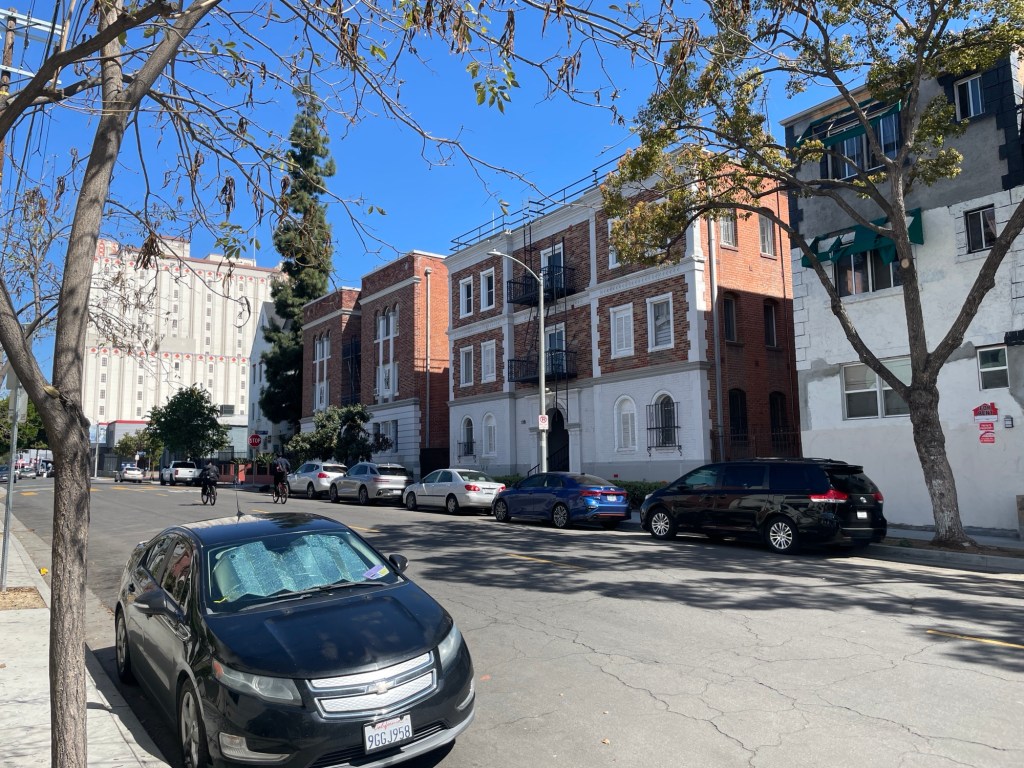
Across the street are four attractive apartment homes. Their names were originally Casa del Mar (1926), the Lentnzer (1926), the Moreland Apartments (1927), and the Linmore Apartments (1926). Only the Linmore has a sign, giving its construction date correctly but assigning it a more generic and ahistorical name, Chateau Westmoreland, first applied around 2019.
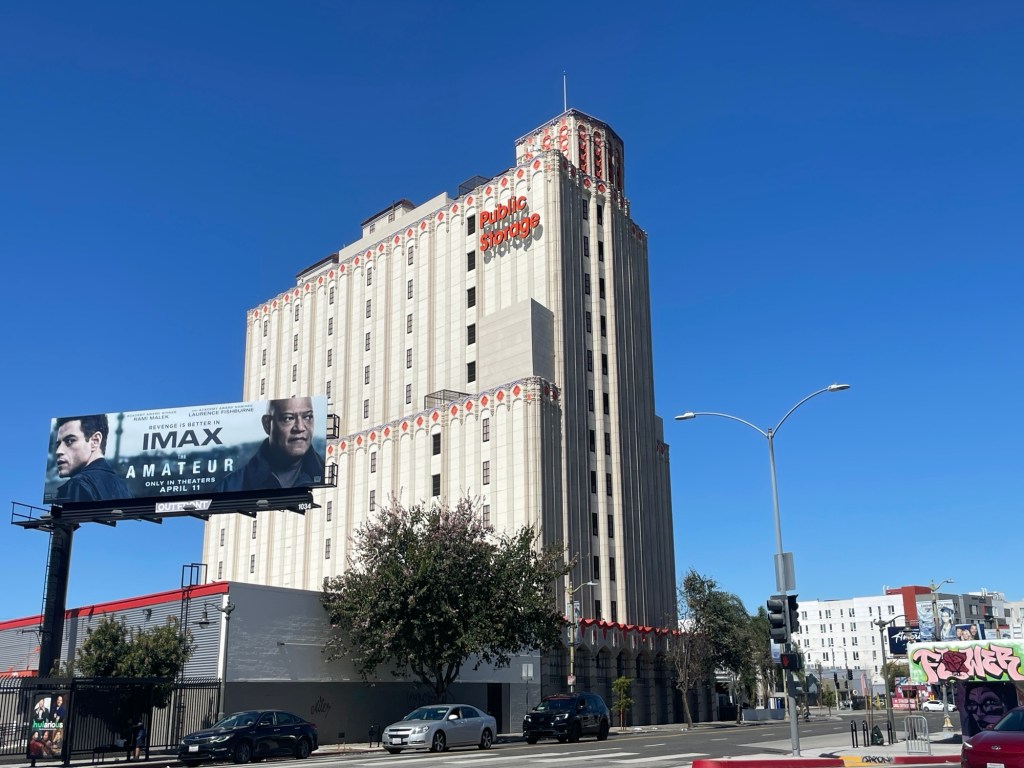
Looming above them all is a thirteen-story, wedding cake-style public storage building. It was built in 1928 by the Comosart Realty and Building Corporation and owned by the American Storage Building Company. A friend told me, just two nights ago, that she’d rented a space in the building and that the building’s owner had told her that it had been owned by none other than Al Capone. In reality, Scarface spent very little time in Los Angeles, He came for the first time as a tourist in December 1927 during which time he stayed at the Biltmore for no more than two days. He was charged with income tax evasion in 1931 and after that, imprisoned. It was as a prisoner that Capone returned to Los Angeles, when he was transferred from Alcatraz to Federal Correctional Institution, Terminal Island in 1939, so that experts could stud his syphilitic paresis-addled mental state.
In reality, E.W. “Curley” Bordwell opened the first club atop the storage facility, the Roof Garden Nightclub in September 1928. By December, it was known as Thirteenth Heaven and run by Bud Murray. By 1931, it was home to the Los Angeles Press Club, which was busted during Prohibition for operating as a speakeasy. Later in 1931, it was taken over by a former LAPD officer, Marco Sheffield, and named the 41 Club. It, too, was busted for violating Prohibition. Prohibition was repealed in 1933 and the space went quiet. I’d love to peak inside.

We turned right on Virgil, crossing it near L.A. Fresh Poultry; which you’ll know it as the store topped with a large fiberglass rooster (and a much smaller duck). We then crossed Beverly, across from the Sunset Foot Clinic, which was famous for its rotating Happy Foot/Sad Foot sign from 1986 until 2019, when it left Silver Lake. The new space has designs based on those created by Russell Jamison, the then-young son of the clinic’s founding podiatrist, Gary Jamison.
When we reached Commonwealth, across from a somewhat garishly-painted Tudor Revival commercial building from 1927, we turned left, heading north until a protective and puffed up Pomeranian attempted to prevent our progress with a succession of low growls. After receiving permission to pass, we continued to a brick street. I think it was Alissa Walker who, a few years ago, asked me if I knew anything about why this street abruptly turns from a concrete one into a brick one. I do not. Brick streets are not common in Los Angeles, though.In a city with 8,845 public streets, I know of only four that are brick.
There’s L. Ron Hubbard Way, in Little Armenia — a stretch of Berendo renamed in 1996 after the science-fiction writer and which, only afterward, became a brick street. There’s also Powers Place in Alvarado Terrace, often said to be the shortest street in Los Angeles (although there are shorter pedestrian streets). There’s charming St. Vincent’s Court, in the Jewelry District. Commonwealth, according to L.A. Street Names, was platted in 1887 on land owned by George and Clara Shatto.
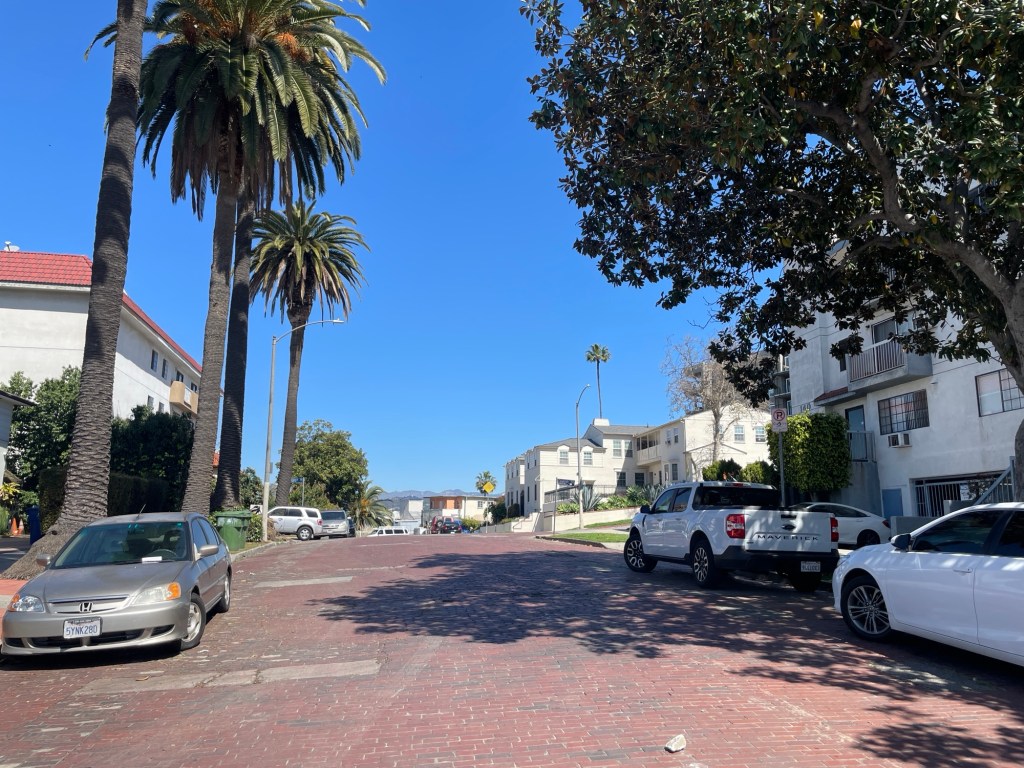
We turned around. The Pomeranian, now with a back-up Pomeranian, was calmer. We turned north on Beverly, past another deafeningly loud car wash. There had, until not too long ago, been yet another rooftop fiberglass animal here – a horse above El Potrillo Cafe. That restaurant was closed and demolished, though, to create storage space for four empty cars.

We passed the Community Space Food Bank on the left, which took over the old Silver Lake Community Fridge and which I’d just seen received donations from the Guatemalteca Bakery nearby. On the right is Smilax, a short street used, almost exclusively, by unhoused Angelenos and motorists wishing, understandably, to avoid the intersection from hell. It’s always appealed to me, though, for its weird liminal character that reminds me of something from the imagination of Giorgio de Chirico. The doors on this short street are all placed above ground level. The wall of the building curves. It plays tricks on your perspective. You play tricks back!
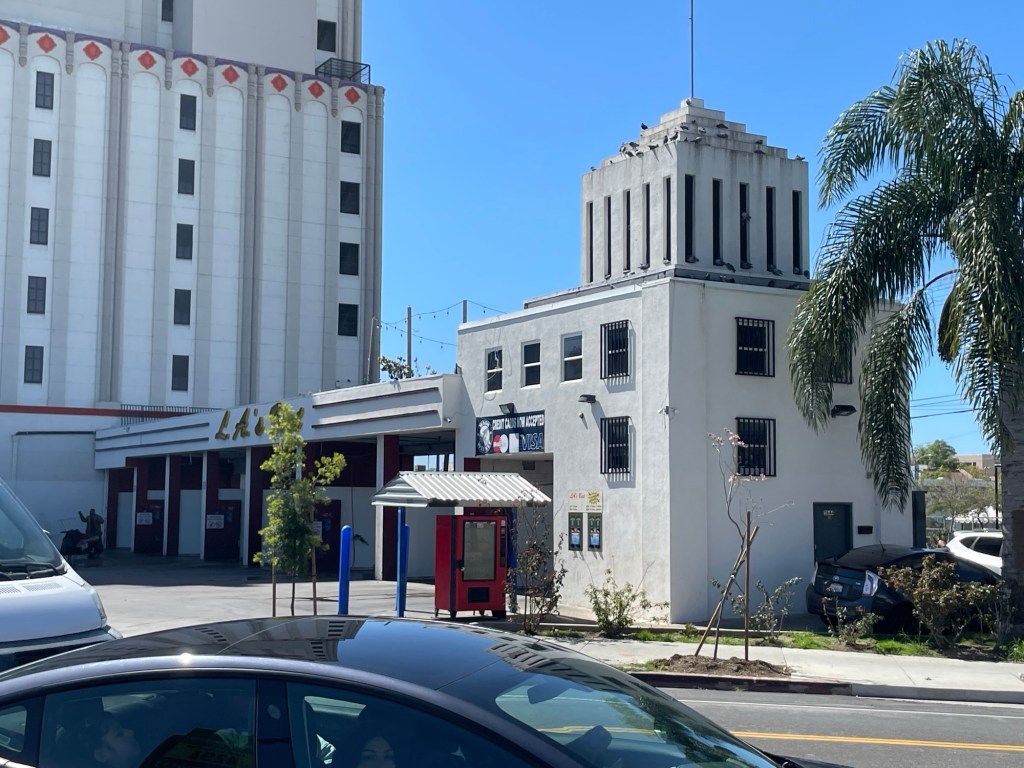
We hit a beg button and crossed Virgil. We hit another beg button and crossed a slip lane. We hit another beg button and crossed Beverly. We hit yet another beg button and crossed Westmoreland – but not before stopping to appreciate yet another car wash, this one tucked between the storage tower and a ziggurat-like building. Being a self wash, it’s appreciably quieter than its automated competition. I thought that this nightmarishly designed, hostile, and dysfunctional tangle of streets had something to do with the unbuilt Beverly Hills Freeway but, it seems, it may just owe its existence to Los Angeles’s incurable and terminal aversion to roundabouts. I asked Nicholas how long he thought it had taken to cross the intersection. He estimated fifteen minutes.
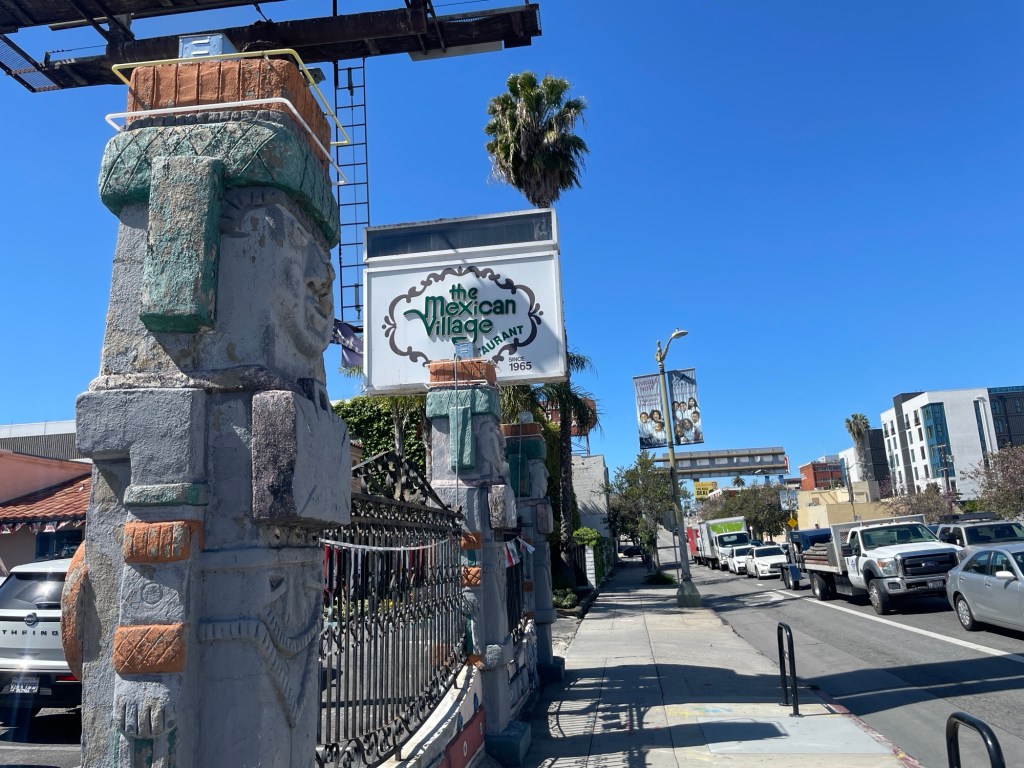
At the corner of Beverly and Westmoreland, I stopped to take a picture of the columns in front of Mexican Village Restaurant, which has been in business since 1965, and a smaller drive-up restaurant, currently abandoned, that was built in 1954. The columns seem to be based on the famed Toltec statues at Tula.
Further along we passed the Ambassador Dog & Cat Hospital, founded in 1927, and topped with an appealingly ostentation sign. Next door, in utter contrast, is a completely nondescript building. One night, ages ago, an ex and I were in this neighborhood, for reasons I can’t remember. She spied a line of young men lined up at the door and she insisted we get in line to investigate. When we got to the ticket booth, the man behind the glass said “hell no!” and shooed us away without explanation. When I looked up the address, I found that we had been turned away from Slammer, a gay sex club. I knew nothing of such places but soon learned that there were other such gentlemen’s clubs in the area, like the now-closed Faultline. And so, when I saw a line of young men lined up outside a nondescript building in the Seafood District, I wasn’t surprised to learn that it was home to Midtowne Spa — which, despite its name, was nowhere near Midtown and seemingly closer, in spirit, to Slammer than the Bimini Baths.
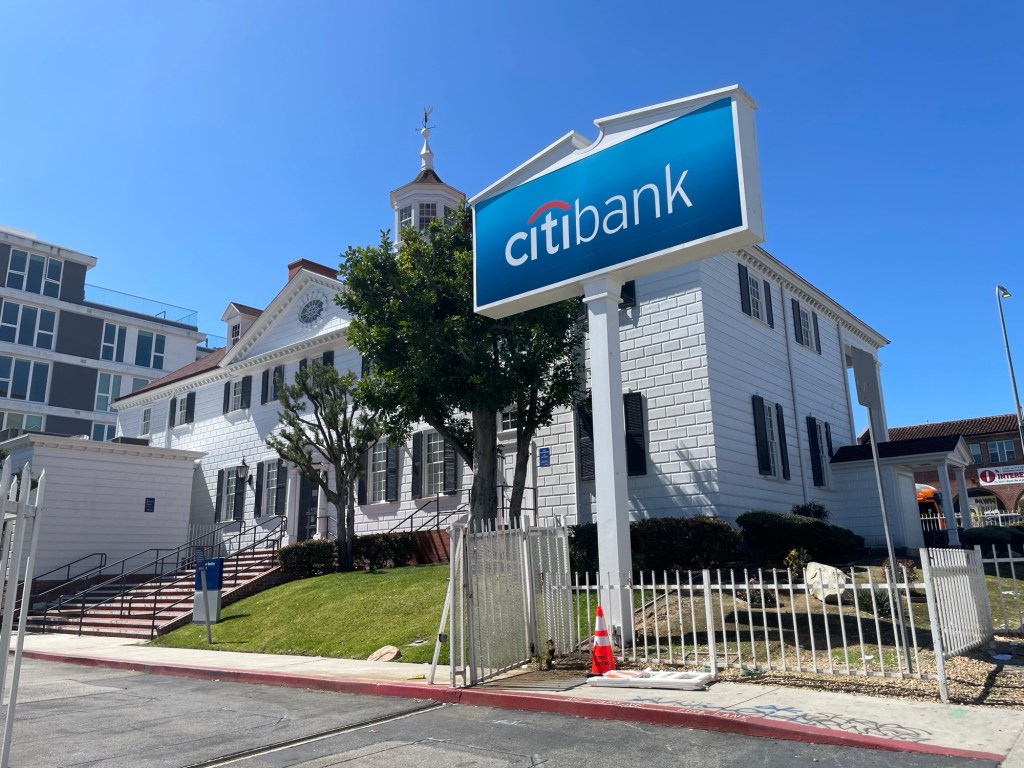
Our last stop was the Citibank catercorner from Jollibee Station. I always wondered whether or not, given its appearance, it had once been a funeral home – and also why funeral homes in Los Angeles so often look like Southern plantations. I think it was Victoria Bernal who texted to let me know that several historians were trying to get to the bottom of this building’s history. In the end, Tom Carroll (of LA Times 404) informed us that it was built in 1979 for a California Federal Bank and was designed to look like George Washington’s home, Mount Vernon. I’m just barely old enough to remember the era after the US Bicentennial, which occurred in 1976. There were fireworks and ceremonial coins. Even Los Angeles, which had in 1776 been part of Nueva España, not the British colonies, apparently got in on the action. There were parades, pageants, and fireworks and Paul Anka hosted a television special, Happy Birthday, America. Maybe the plans for the bank were drawn up in 1776. Who knows? It provided me with food for thought… or at least a mental snack, as I waited for my bus to take me home.
Support Eric Brightwell on Patreon

Eric Brightwell is an adventurer, essayist, rambler, explorer, cartographer, and guerrilla gardener who is always seeking paid writing, speaking, traveling, and art opportunities. He is not interested in generating advertorials, cranking out clickbait, or laboring away in a listicle mill “for exposure.”
Brightwell has written for Angels Walk LA, Amoeblog, Boom: A Journal of California, diaCRITICS, Hey Freelancer!, Hidden Los Angeles, and KCET Departures. His art has been featured by the American Institute of Architects, the Architecture & Design Museum, the Craft Contemporary, Form Follows Function, the Los Angeles County Store, Sidewalking: Coming to Terms With Los Angeles, Skid Row Housing Trust, the 1650 Gallery, and Abundant Housing LA.
Brightwell has been featured as subject and/or guest in The Los Angeles Times, VICE, Huffington Post, Los Angeles Magazine, LAist, CurbedLA, LA Times 404, Marketplace, In a Minute With Evan Lovett, Office Hours Live, L.A. Untangled, Spectrum News, Eastsider LA, Boing Boing, Los Angeles, I’m Yours, Notebook on Cities and Culture, the Silver Lake History Collective, KCRW‘s Which Way, LA?, All Valley Everything, Hear in LA, KPCC‘s How to LA, at Emerson College, and at the University of Southern California. He is the co-host of the podcast, Nobody Drives in LA.
Brightwell has written a haiku-inspired guidebook, Los Angeles Neighborhoods — From Academy Hill to Zamperini Field and All Points Between, that he hopes to have published. If you’re a literary agent or publisher, please contact him.
You can follow him on Bluesky, Duolingo, Facebook, Goodreads, iNaturalist, Instagram, Letterboxd, Medium, Mubi, Threads, and TikTok.


 Eric Brightwell
Thanks for another deep dive into a neighborhood that most Angelenos (including me) know little about. I learned a lot.
LikeLiked by 1 person
My pleasure. When the segment airs on “Marketplace,” I’ll add it to this post.
LikeLike