The following article was written for the Silver Lake Neighborhood Council‘s “Ask Silver Lake” series — ‘Ask Silver Lake’ is dedicated to exploring the history and insights of our community. If you have questions or ideas you’d like us to consider, please drop a comment or send them to outreach@silverlakenc.org.’
For the sake of full disclosure, this month’s “Ask Silver Lake” resulted not from a question from readers — but out of my own curiosity. I live near Edendale, knew that it was a former firehouse, and had heard a few stories about it over the years — both true and untrue. Because the building turned 100 years old this month, I thought it would be a nice time to explore its history…

Los Angeles and Southern California have been shaped by fire since the end of the last ice age. The first humans in the region, the ancestors of the Chumash, arrived at least 13,000 years ago and used fire to manage and alter the landscape for many millennia. Intentional burns were banned by the Spanish and the ban was upheld by the Mexican and American governments that succeeded them. Accidental fires, however, remain a fact of life and for those, we have fire departments. The first was the all-volunteer Engine Company No. 1, organized in Los Angeles in 1871 by George M. Fall, a Counter Clerk. The professional Los Angeles Fire Department was organized on 1 February 1886.
Los Angeles grew rapidly in the 1910s, overtaking San Francisco during that decade to become the most populous California city in the state. Los Angeles’s population more than doubled in the 1920s, surpassing one million. As the city grew, so too did the fire department – which also modernized. Horse drawn fire-carts were phased out on 19 July 1921. Under Chief Engineer Ralph J. Scott, the Los Angeles Fire Department opened thirteen new bungalow style fire departments in the early ’20s. The bungalow style was designed to ensure that fire stations fit, aesthetically, into their suburban residential surroundings. The Los Angeles Evening Express declared, of the new bungalow style stations, “the day of the ugly common brick box stuck into an otherwise handsome row of homes is past.”
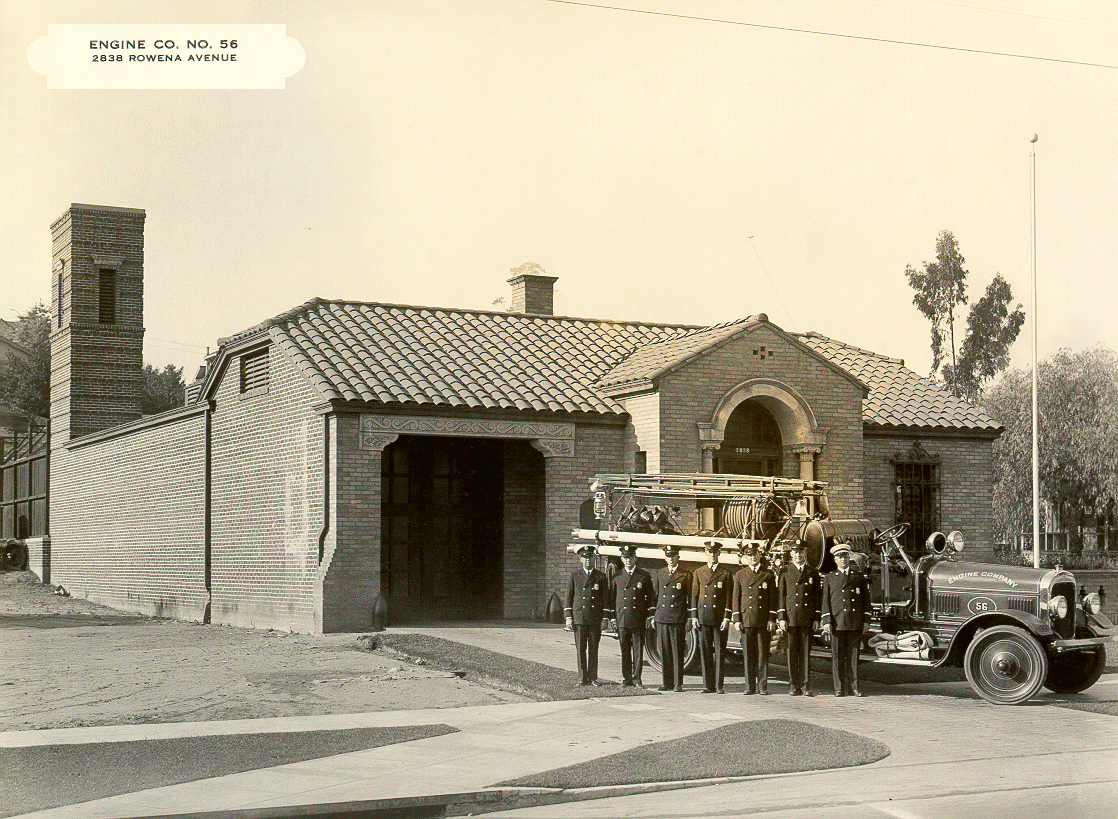
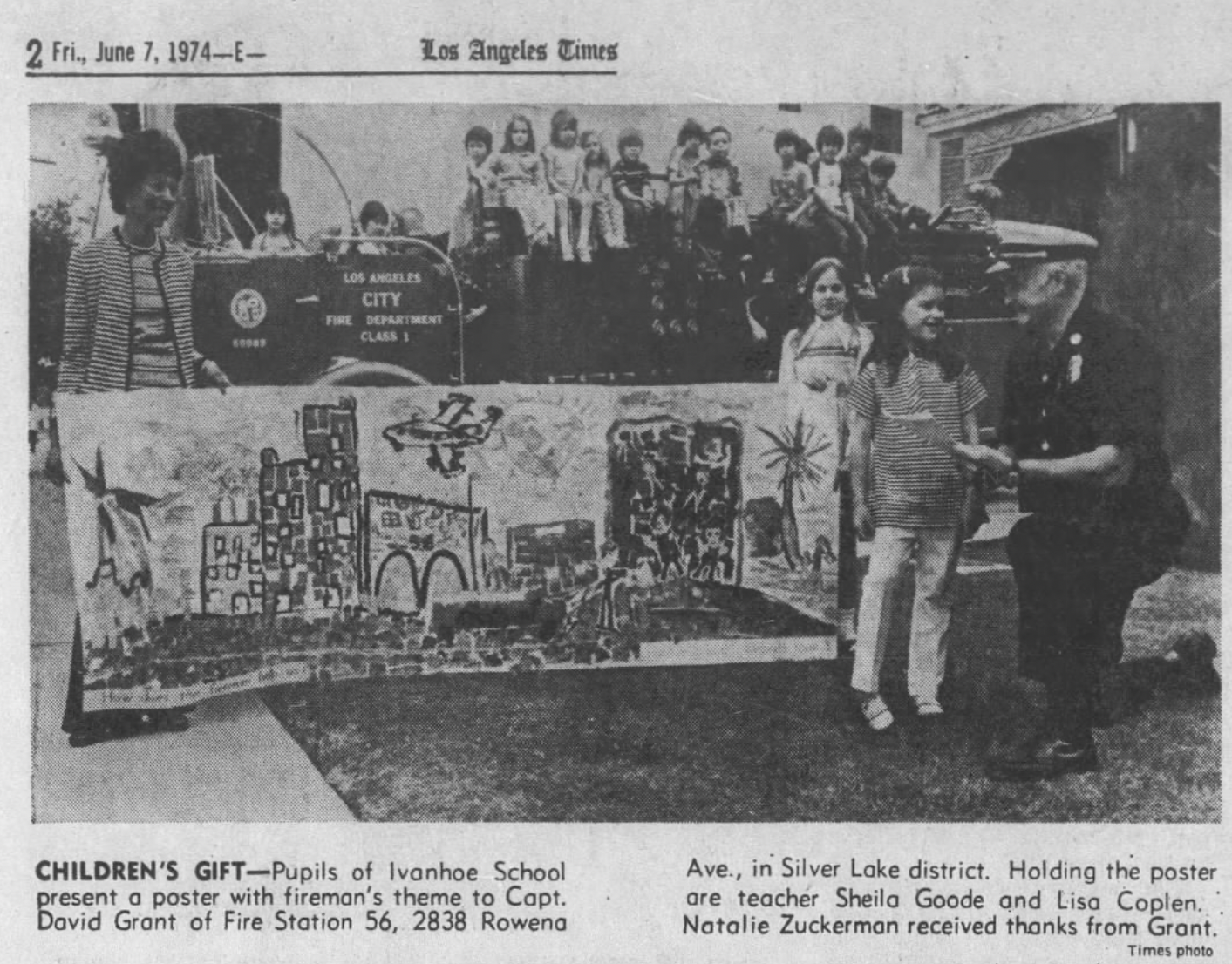
In the area of Silver Lake then still commonly referred to as the Ivanhoe Hills, the then-new Engine Company No. 56 moved into its new fire house on 11 August 1924. The brick building was constructed at a cost of $23,500 ($431,761 adjusted for inflation). Its Mediterranean-inspired architecture matched that of many of the homes in the neighborhood constructed during that era. The Spanish Colonial Revival-style bungalow court across the street matched its style when it was constructed in 1928. In addition to the main building, the firehouse included a kitchen/oil room and a handball court.


Apparatus Maintenance (left) and Hand Ball (right) (Source: Adolph Ziegler Collection, circa 1950)

In 1933, The Los Angeles Times profiled Los Angeles firefighters in an article titled “Men Who Laugh at Death.” In it, author Mary June Burton described Station No. 56 firefighter Alexander J. MacDonald as “a very Scotch fireman–steady, close-mouthed, unbending, but still ready to risk his life when the need comes.’ Like all LAFD firehouses before 1955, it was racially segregated – in Silver Lake, that meant whites only. Most of Silver Lake itself was racially restricted until the 1940s.
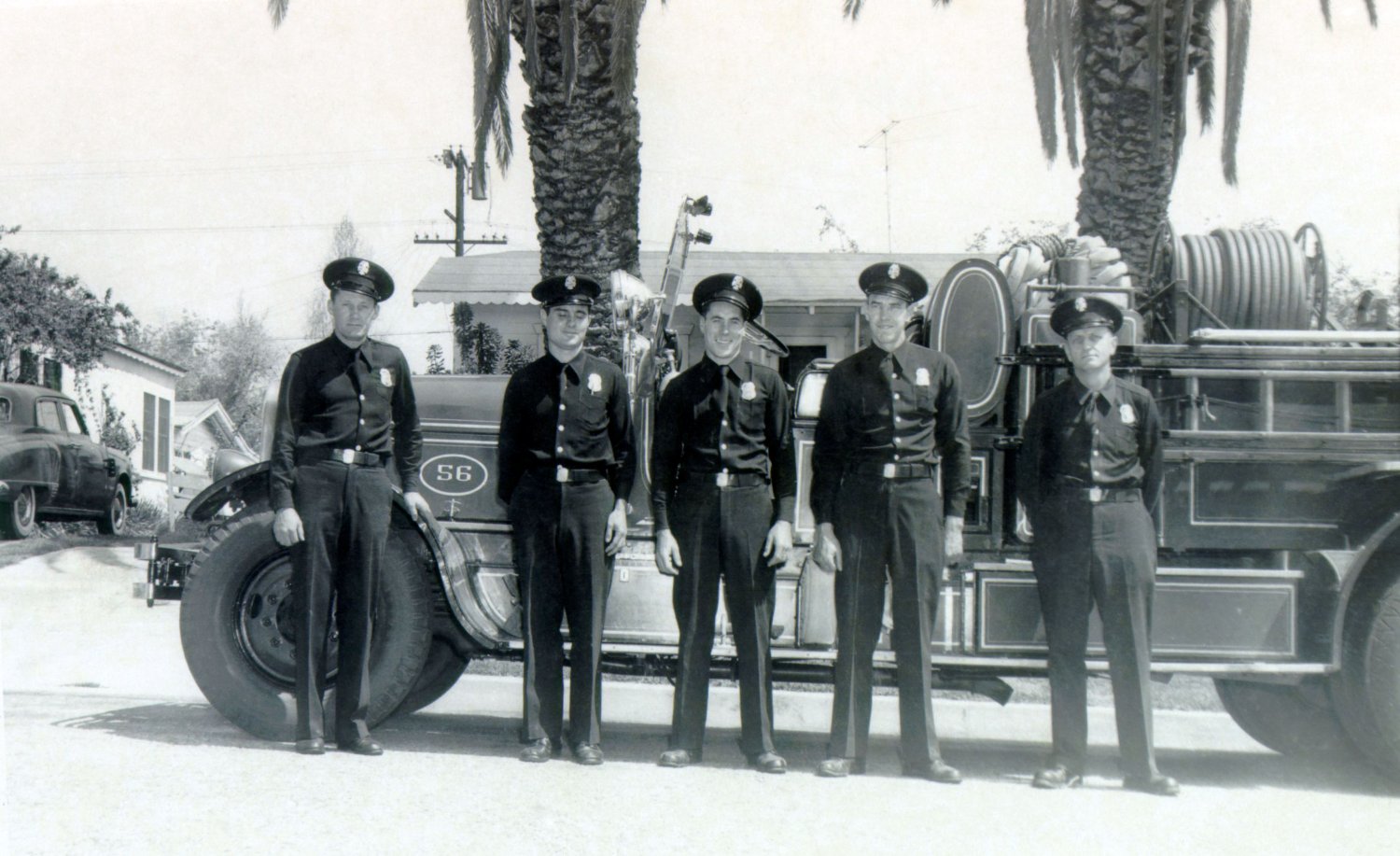
Because of earthquakes, some of the station’s ornamental features were removed in 1960 and the efforts were made to stabilize the building. Nevertheless, the station and sixteen others (as well as fourteen branch libraries) were listed as earthquake hazards in 1982. In 1984, The Los Angeles Times reported that these “antique firehouses” were “facing the ax.” The Los Angeles Cultural Heritage Board singled out Station 56 as an “excellent example of the bungalow-type stations built in 1923-1924.” On 12 January 1988, the station was designated Los Angeles Historic-Cultural Monument No. 337.
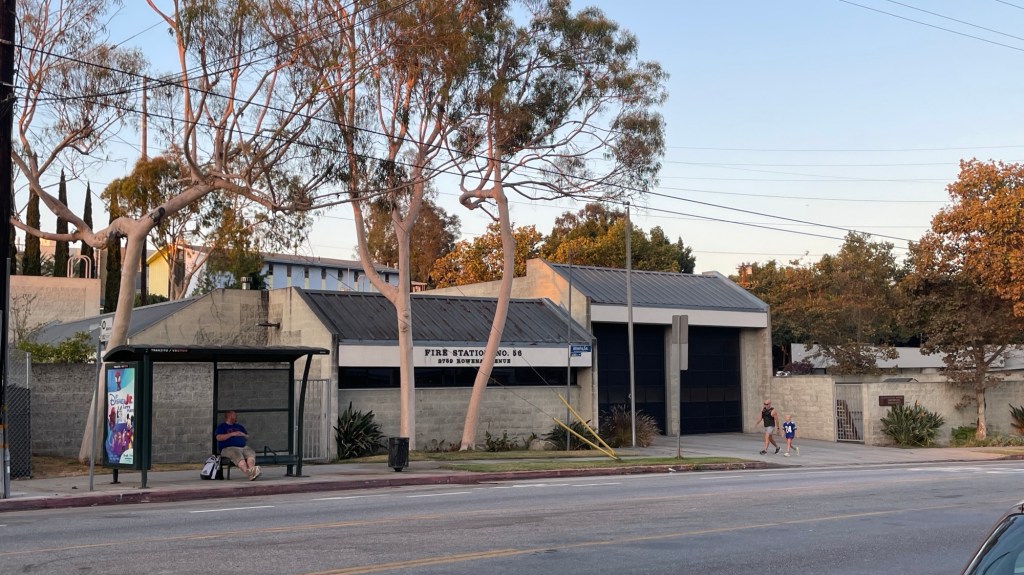
The new Station 56 opened 160 meters east of the original on the other side of Rowena Avenue on 8 February 1989. It was designed by Howard Robinson & Associates and built by contractors, Shirley Brothers Construction. The station, more “Smog Check Revival” than “Spanish Colonial Revival,” lacks the former’s architectural charms but, more importantly, was designed to withstand earthquakes. And, on second thought, maybe this gray bunker was designed, like it’s predecessor, to blend in with its surroundings which do, after all, include four automotive shops.
The old building, meanwhile, was sold at an auction in 1990. Its Historic-Cultural Monument status protected it from demolition or significant alterations. At the same time, however, the aging building needed new plumbing, new electrical fixtures, new windows, earthquake retrofitting, and asbestos removal. The first buyer backed out and the sale was canceled in 1991. It was auctioned again on 9 September 1994 but sat abandoned for years after.

Around 2000, Melanie Tusquellas and Patti Peck began undertaking costly renovations for the restaurant they planned to open there. A conditional use permit for alcohol and live entertainment was issued in 2001. In mid-October 2002, the Edendale Grill & Mixville Bar opened in the old firehouse. “Edendale” was the name of a 1902 tract that straddled the border of what later came to be known as Echo Park and Silver Lake. “Mixville,” meanwhile, was the name of early cowboy star Tom Mix’s, old movie ranch, located where the Whole Foods is now.

A few years later, Eddie Ebell, a waiter at Blair’s, began bartending at the Mixville Bar. In July 2010, he took over the business and shortened its name to just Edendale. The pub threw a “100 Year Centennial Party” on 27 July. History Happy Hour, a group I’m part of, decided to gather there on 13 August. I’m tempted to shout out everyone who was there except I’m deathly afraid of inadvertently leaving anyone out. If you were there, cheers.,.. and to Station 56 and the Edendale — here’s to another 100!

Support Eric Brightwell on Patreon

Eric Brightwell is an adventurer, essayist, rambler, explorer, cartographer, and guerrilla gardener who is always seeking paid writing, speaking, traveling, and art opportunities. He is not interested in generating advertorials, cranking out clickbait, or laboring away in a listicle mill “for exposure.”
Brightwell has written for Angels Walk LA, Amoeblog, Boom: A Journal of California, diaCRITICS, Hey Freelancer!, Hidden Los Angeles, and KCET Departures. His art has been featured by the American Institute of Architects, the Architecture & Design Museum, the Craft Contemporary, Form Follows Function, the Los Angeles County Store, Sidewalking: Coming to Terms With Los Angeles, Skid Row Housing Trust, the 1650 Gallery, and Abundant Housing LA.
Brightwell has been featured as subject and/or guest in The Los Angeles Times, VICE, Huffington Post, Los Angeles Magazine, LAist, CurbedLA, Office Hours Live, L.A. Untangled, Spectrum News, Eastsider LA, Boing Boing, Los Angeles, I’m Yours, Notebook on Cities and Culture, the Silver Lake History Collective, KCRW‘s Which Way, LA?, All Valley Everything, Hear in LA, KPCC‘s How to LA, at Emerson College, and at the University of Southern California.
Brightwell has written a haiku-inspired guidebook, Los Angeles Neighborhoods — From Academy Hill to Zamperini Field and All Points Between, that he is trying to get published. If you’re a literary agent or publisher, please contact him.
You can follow him on Ameba, Duolingo, Facebook, Goodreads, iNaturalist, Instagram, Letterboxd, Mastodon, Medium, Mubi, the StoryGraph, Threads, TikTok, and Twitter.


 Eric Brightwell
Hi Mr. Brightwell, I am a history teacher in LA County currently piloting an ethnic studies course and I love your articles on ethnic enclaves. I was wondering if I could ask you about a few of the sources you’ve used that are unable to be located online. Please feel free to drop me an email if you’re available: jwelch@hartdistrict.org
LikeLike