Schatten (dir. Arthur Robison, 1923) begins with a five minute introduction to the film’s players, who are trotted out like the foils in a police lineup onto an actual stage where they’re identified with intertitles. After this lengthy prologue, the film abandons the use of titles altogether and embraces the purely visual ideal of silent films (predating Friedrich Wilhelm Murnauu’s efforts which are usually credited as the first to do the same.)
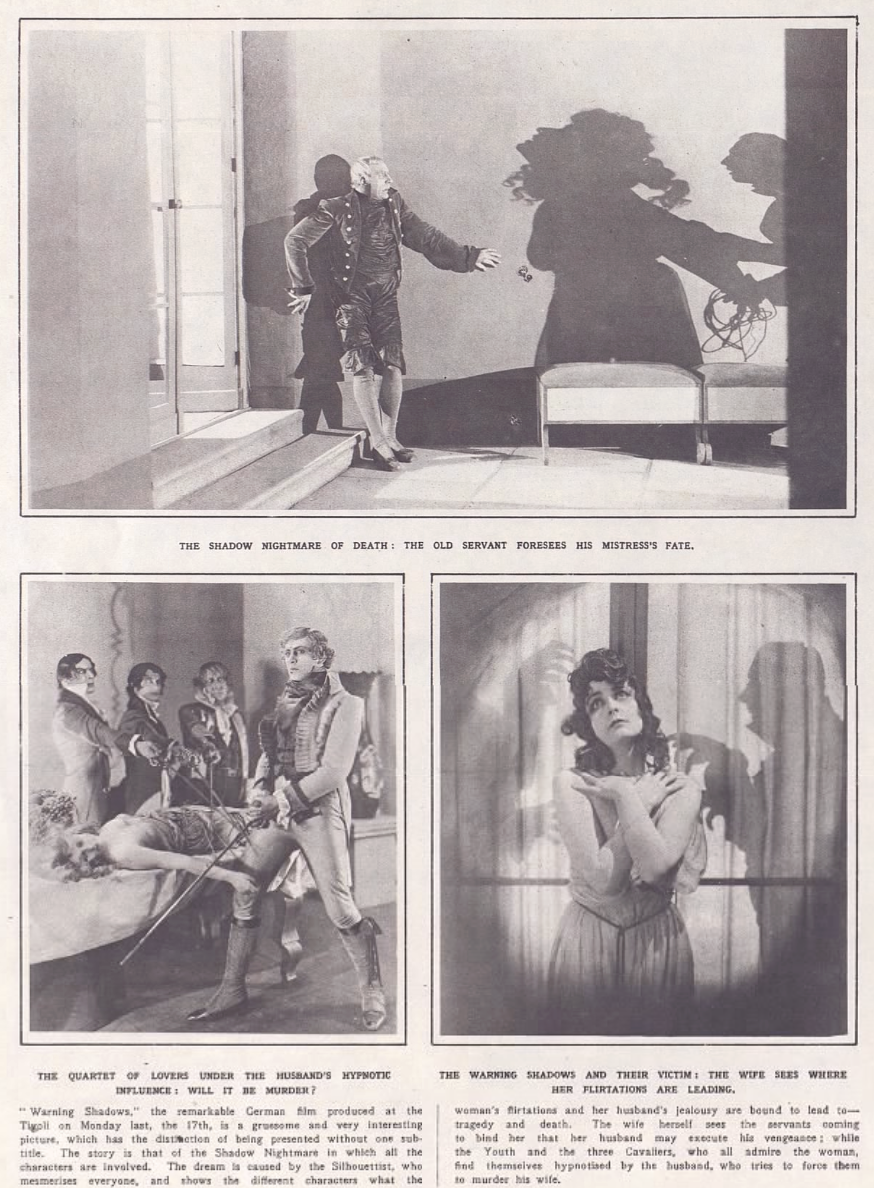
In the 19th century, a slightly touched travelling illusionist performs shadow puppetry for the assembled guests at a wealthy baron’s dinner party. The host’s wife is pursued quite unashamedly by four otherworldly effeminate guests who openly and continuously wink and purse their lips. This effrontery quite rankles the woman’s husband (who looks like Orson Welles crossed with Kelsey Grammer). In one scene, the fops appear to grope the baron’s wife in a public mé·nage à quatre, but it turns out to be shadowplay. If this seems like bad behavior, it’s because it is. And the moral of the puppeteer’s story is brutal. Already confused and disoriented by phantasmagoric shadows, reflections and misleading silhouettes, the puppeteer’s curiously timely tale pushes the partygoers over the edge and the viewer is pulled along with them.
The film has an appropriately hallucinatory, slightly nauseating quality which is quite fitting given the substance of the story and largely owes to the skill of cameraman Fritz Arno Wagner (sometime cinematographer for Fritz Lang and Murnau). The sometimes fantastic sets by Albin Grau (another Murnau collaborator) are also of note. Together with the garish purple and gold tints, the shifting shadows, the unclear distinction between characters’ imaginations and actual events all serve to blur and cloud the viewer’s mind like a drank-fuelled fever dream. The expressionistic acting can seem unintentionally awkward and unsophisticated to modern audiences who wrongly assume that naturalism was the aim. In actuality, the stylized performances merely serve to compliment the purposeful and appropriate artifice of the proceedings in this, one of the finest examples of German Expressionism.
Support Eric Brightwell on Patreon

Eric Brightwell is an adventurer, essayist, rambler, explorer, cartographer, and guerrilla gardener who is always open to paid writing, speaking, traveling, and art opportunities. He is not interested in generating advertorials, cranking out clickbait, or laboring away in a listicle mill “for exposure.”
Brightwell has written for Angels Walk LA, Amoeblog, Boom: A Journal of California, diaCRITICS, Hey Freelancer!, Hidden Los Angeles, and KCET Departures. His art has been featured by the American Institute of Architects, the Architecture & Design Museum, the Craft Contemporary, Form Follows Function, the Los Angeles County Store, Sidewalking: Coming to Terms With Los Angeles, Skid Row Housing Trust, the 1650 Gallery, and Abundant Housing LA.
Brightwell has been featured as subject and/or guest in The Los Angeles Times, VICE, Huffington Post, Los Angeles Magazine, LAist, CurbedLA, LA Times 404, Marketplace, Office Hours Live, L.A. Untangled, Spectrum News, Eastsider LA, Boing Boing, Los Angeles, I’m Yours, Notebook on Cities and Culture, the Silver Lake History Collective, KCRW‘s Which Way, LA?, All Valley Everything, Hear in LA, KPCC‘s How to LA, at Emerson College, and at the University of Southern California. He is the co-host of the podcast, Nobody Drives in LA.
Brightwell has written a haiku-inspired guidebook, Los Angeles Neighborhoods — From Academy Hill to Zamperini Field and All Points Between; and a self-guided walking tour of Silver Lake covering architecture, history, and culture, titled Silver Lake Walks. If you’re an interested literary agent or publisher, please out. You may also follow on Bluesky, Duolingo, Facebook, Goodreads, iNaturalist, Instagram, Letterboxd, Medium, Mubi, Substack, Threads, and TikTok.


 Eric Brightwell